


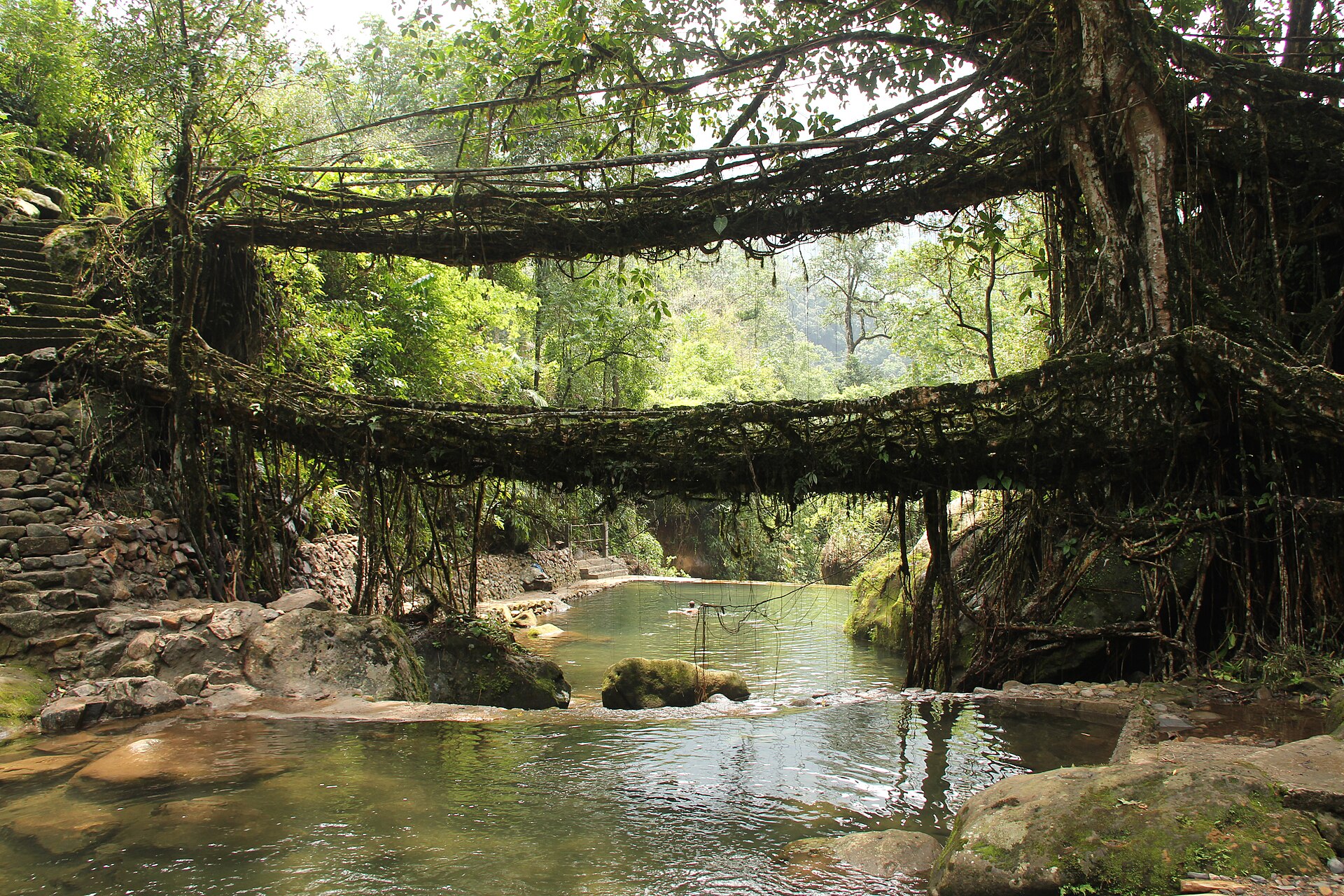
The living root bridge trek to Nongriat is the one experience almost every Meghalaya traveler puts on the list, and it is also the one that catches the most people unprepared. On paper it is a short walk to a bridge. In reality it is roughly 3,500 stone steps down from Tyrna and every one of them back up, in heavy humidity, with a registered guide now compulsory in East Khasi Hills.
Let me be upfront, my friend. I have not done this trek myself yet, so this guide is based on research: Meghalaya Tourism’s own pages, the UNESCO tentative-list entry, district orders reported in the news, and recent trip reports cross-checked against each other. Where sources disagree on a number, I tell you so instead of picking one. In case you want the full 5-day circuit with Shillong, Sohra and Dawki, read my Meghalaya travel guide for 2026 first. This post zooms in on the root bridges alone.
Quick Answer: How Do You Do the Living Root Bridge Trek in 2026?
Quick answer: Drive 30 to 45 minutes from Sohra (Cherrapunji) to Tyrna, hire a registered guide (mandatory in East Khasi Hills since July 2025), and descend about 3,500 steps over roughly 3 km to the double decker bridge at Nongriat. Rainbow Falls is about one hour further. Go October to March, and stay overnight in Nongriat if your knees are not trek-fit.
Root Bridge Trek at a Glance (Last Verified October 2026)
| Trailhead | Tyrna village, 30 to 45 minutes by taxi from Sohra (Meghalaya Tourism) |
| Steps and distance | About 3,500 stone steps, roughly 3 km one way to the double decker bridge |
| Rainbow Falls | About 1 more hour beyond the double decker bridge |
| Difficulty | Moderate to hard. Not technical, but the return climb is relentless |
| Altitude | The bridge sits at around 1,293 ft, so AMS is not a concern |
| Guide | Registered guide mandatory for treks in East Khasi Hills (reported July 2025) |
| Fees | Around Rs 20 per person at the double decker plus a camera fee (reported, verify locally) |
| Best months | October to March for dry steps. June to September is monsoon |
| Network and cash | Weak signal in the valley, carry cash for guide, fees and homestay |
What Is a Living Root Bridge, and Why Is Nongriat So Famous?
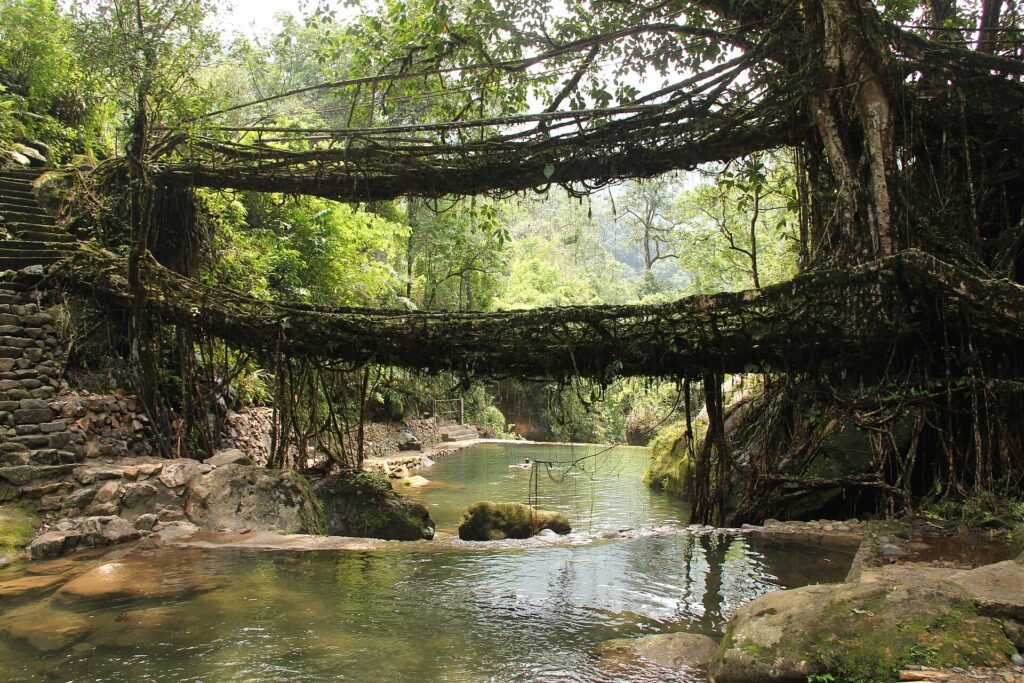
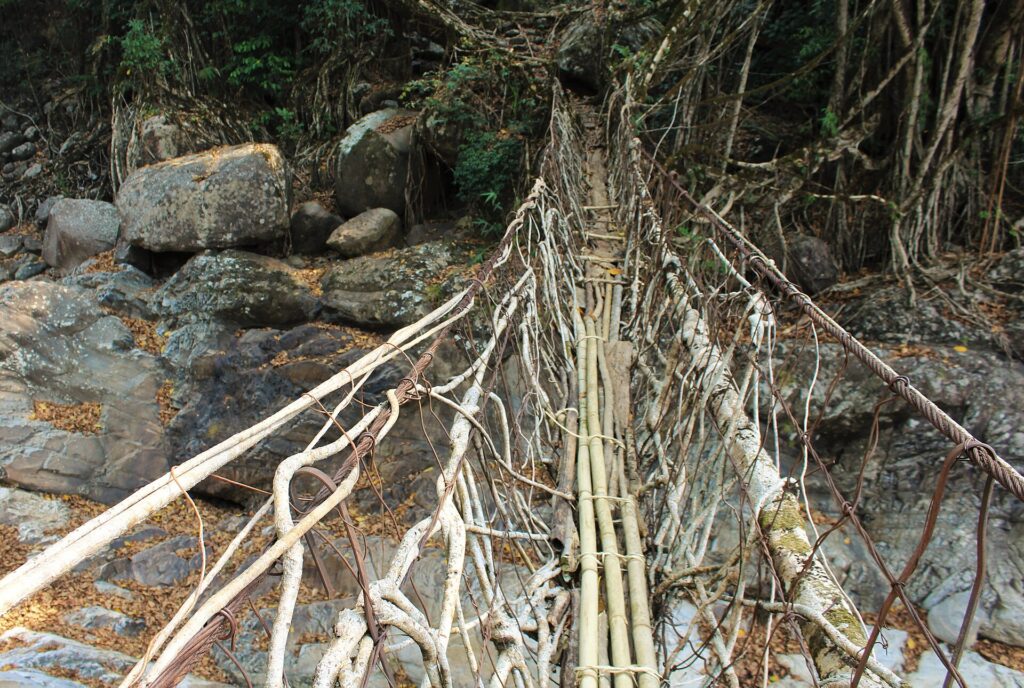
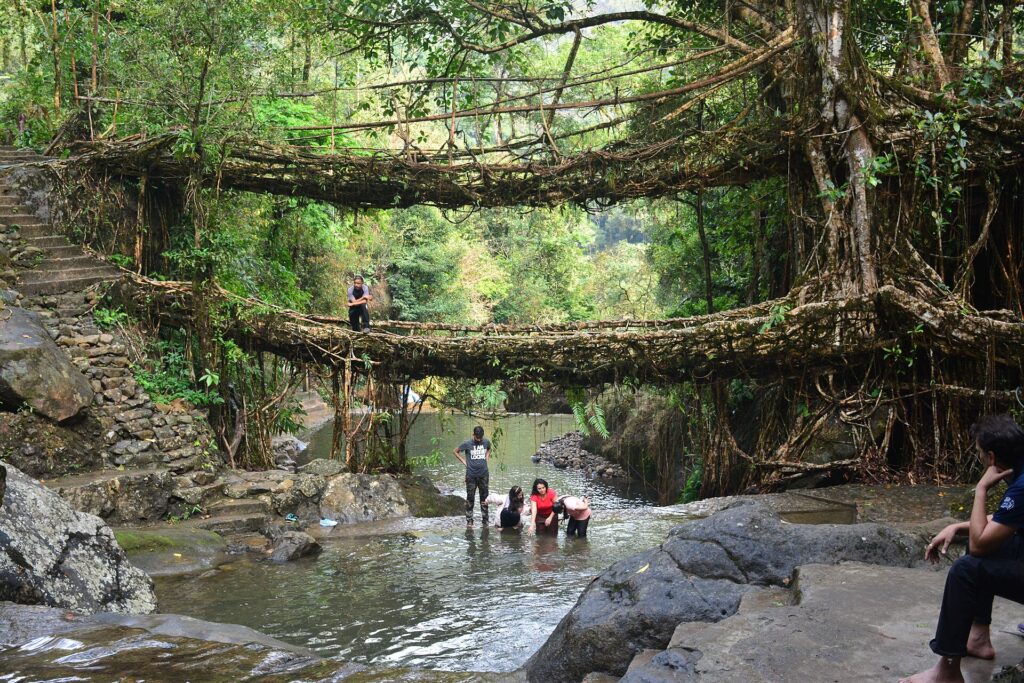
Quick answer: A living root bridge is a footbridge grown, not built. Khasi and Jaintia villagers guide the aerial roots of the rubber fig (Ficus elastica) across a stream until they knit into a walkable span. Nongriat is famous because its bridge has two tiers, one stacked above the other.
According to the UNESCO World Heritage tentative list entry, “Jingkieng Jri: Living Root Bridge Cultural Landscapes” was added in March 2022. The entry describes around 100 known root bridges in 72 villages across East Khasi Hills and West Jaintia Hills, each taking roughly 10 to 15 years of patient training before it becomes usable. Keep in mind that a tentative listing is not World Heritage status yet. It is the first step of a nomination.
The Nongriat double decker is the one on every postcard. A July 2026 Smithsonian Magazine feature on the bridges put its age at approximately 200 years, sitting in a forested valley at about 1,293 ft above sea level. That low altitude matters for planning. This is not a Himalayan trek where thin air is the enemy. Here the enemy is gravity, humidity and wet stone. Hence, your fitness prep should focus on legs and knees, not lungs.
Villages keep repairing and extending these bridges, sometimes adding steel cables where roots are still young. Meghalaya Tourism also lists sites beyond Nongriat, including Mawlynnong, Kudengrim, Nongbareh, Padu and Rangthylliang to Mawkyrnot, which tells you the double decker is the famous one, not the only one.
Which Living Root Bridge Should You Visit? A Quick Chooser
Quick answer: Fit and keen on a full day out? Do Nongriat and Rainbow Falls. Short on time, travelling with elders or bad knees? Riwai near Mawlynnong is a short walk. Want the longest known bridge and fewer crowds? Look at the Rangthylliang to Mawkyrnot trail near Pynursla.
Most guides send everyone to Nongriat by default, which is a mistake for many families and older parents. Let us look at the realistic options side by side.
| Bridge / trail | Effort | Access | Best for | Keep in mind |
|---|---|---|---|---|
| Nongriat double decker (Umshiang) | Hard on knees | About 3,500 steps, roughly 3 km from Tyrna | Fit travelers, first-timers who want the iconic one | Busiest site. Guide mandatory |
| Rainbow Falls | Harder | About 1 hour beyond the double decker | Overnight stayers | Very hard to add on a day trip |
| Mawsaw root bridge | Moderate add-on | Reported about 30 minutes from the double decker | Those staying in Nongriat | Timing from trip reports, not official |
| Ritymmen (Nongthymmai) | On the way down | Short detour on the Tyrna trail | Everyone doing Nongriat | Its length is quoted differently by different sources |
| Riwai (near Mawlynnong) | Easy | Short walk, reported 300 to 450 m with steps | Families, elders, short trips | Crowded at midday. Small entry fee |
| Rangthylliang to Mawkyrnot | Moderate full day | Starts near Pynursla, about 50 km from Shillong | Repeat visitors, culture-focused travelers | Longest known root bridge. Book through operators |
My recommendation is simple. If you can comfortably climb 20 to 25 floors of stairs at home without stopping for long, Nongriat is doable. If not, I suggest Riwai on your Mawlynnong day and keep the full trek for a future trip once you have trained for it. There is no shame in that call 🙂
How Many Steps Is the Tyrna to Nongriat Trek, Stage by Stage?
Quick answer: Meghalaya Tourism describes a roughly 3 km descent of about 3,500 stone steps from near Tyrna to the double decker bridge. The steepest stair section comes first, then the trail levels out across steel suspension bridges before Nongriat village. The climb back is the real test.
Step counts online range wildly, and even Meghalaya Tourism’s pages have shown both 3,000 and 3,500 at different times. Around 3,500 is the figure on the current official Nongriat page, so I use it throughout. Here is how the trail breaks down.
- Tyrna parking to the bottom of the main staircase. This is the steep, concrete and stone stairway that people photograph. Route accounts put the first stretch at roughly 45 minutes of continuous descent. Your knees take the load here, so go slowly.
- Nongthymmai village and Ritymmen. One route guide puts Tyrna to Nongthymmai at about 1.5 km. Ritymmen, a long single root bridge, sits here as a short detour. Worth five minutes.
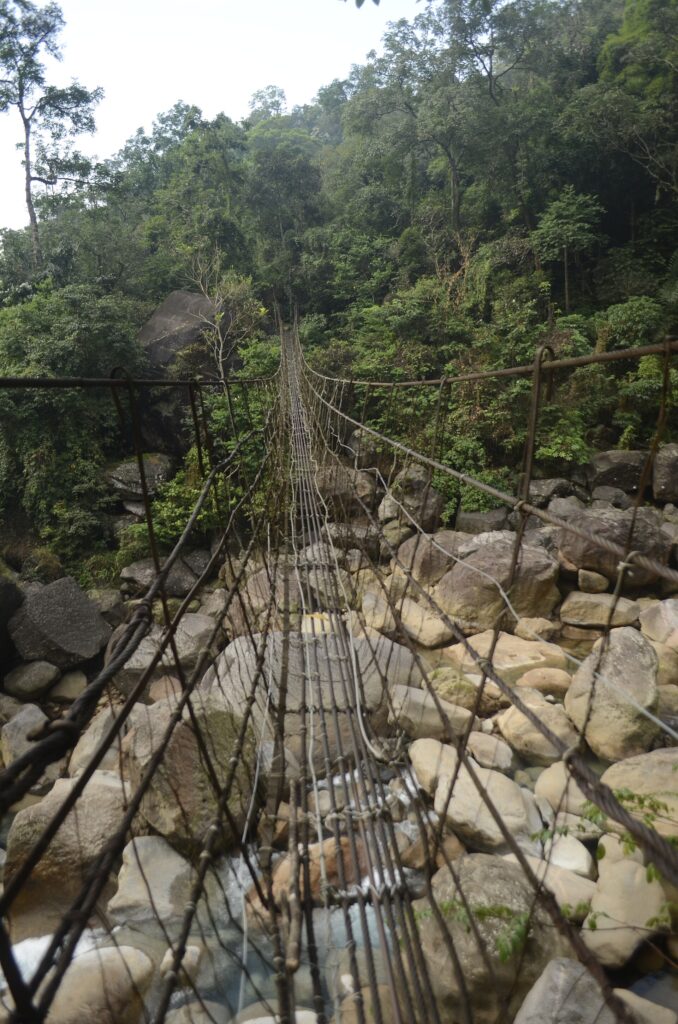
- The steel suspension bridges. About 1 km further, the trail crosses narrow wire-and-steel bridges over boulder-strewn streams. They sway. One person at a time is the sensible rule, whatever the crowd behind you does.
- Nongriat village and the double decker. A short final climb brings you to the ticket point and the bridge itself, with natural pools below it.
- Optional: Rainbow Falls. Meghalaya Tourism says to continue for about another hour. Realistically this is for people sleeping in Nongriat.
Now, the honest part. Every account I read agrees the return climb takes noticeably longer than the descent, and it is where most groups lose their schedule. Pace yourself on the descent and keep something in the tank.


Do You Need a Guide for the Nongriat Trek in 2026?
Quick answer: Yes. East Khasi Hills, which covers Sohra, Tyrna and Nongriat, made registered guides mandatory for treks and outdoor activities in mid-2025. Fees are set locally. Trip reports from 2025 and 2026 mention roughly Rs 700 to Rs 1,500 depending on how far you go, but verify at Tyrna.
As reported by Asia News Network on July 2, 2025, East Khasi Hills Deputy Commissioner Rosetta M Kurbah, who chairs the District Tourism Promotion Society, said tourists “must now avail the services of registered guides for treks and outdoor activities.” The stated reasons were accidents, tourists getting lost in remote terrain, and crime. The order followed the widely reported May 2025 case of a honeymooning couple from Indore in the Sohra area, who had stayed near the double decker bridge before going missing.

I could not find an official, published guide rate card. One reviewer reported paying about Rs 1,000 for a guide to the double decker and Rs 1,500 including Rainbow Falls, while other accounts mention around Rs 700 for the basic route. Hence, treat Rs 700 to Rs 1,500 per group as a planning range only, confirm the rate before you start, and ask whether it covers Rainbow Falls and an overnight stay.
Honestly, I would hire one even without the rule. A local guide knows which pools are safe, can call ahead to a homestay, and is your link to the village in a valley with patchy signal.
Day Trip or Overnight in Nongriat: Which Is Better?
Quick answer: Overnight, if you have the extra day. Sleeping in Nongriat splits the brutal climb into a fresh morning effort, lets you see the bridge without the midday crowd, and makes Rainbow Falls realistic. A day trip works for fit travelers who start from Tyrna by 8 AM.
Plan A: The day trip. Leave your Sohra hotel early, meet your guide at Tyrna and be on the steps by 8 AM. Spend an hour or so at the bridge and the pools, then start climbing back well before afternoon. Skip Rainbow Falls unless your group is genuinely fast. This is the plan for groups with only two nights in Sohra, which is what my 5-day Meghalaya itinerary assumes.
Plan B: The overnight. Descend at a relaxed pace in the late morning, check into a Nongriat homestay, and spend the afternoon at the double decker once the day-trippers start leaving. Next morning, walk to Rainbow Falls (and Mawsaw on the way, if your guide agrees), return to Nongriat for lunch, then climb out. In case someone in your group is unsure about the steps, this is the safer plan.
Keep in mind that Nongriat homestays are basic, with simple rooms and home-cooked meals. I could not find current, verifiable room rates (the prices floating around online are years old), so ask your guide or call ahead and confirm the rate including dinner. Under the 2025 rules, accommodation providers must register guests on the state tourism app, so carry ID.
Is Rainbow Falls Worth the Extra Hour Beyond Nongriat?
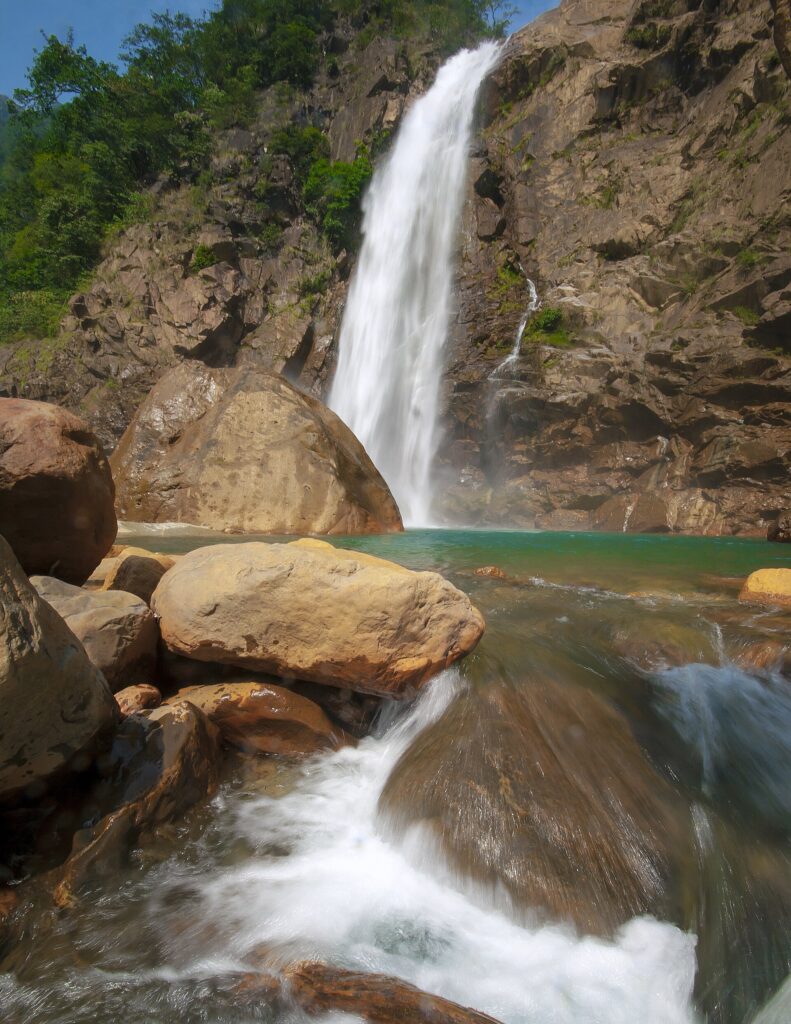
Quick answer: Yes, if you are staying overnight in Nongriat. Rainbow Falls drops into a turquoise pool about an hour beyond the double decker, per Meghalaya Tourism. On a day trip it adds roughly two hours of walking plus extra climbing, which pushes most groups into a late, risky return.
The trail from Nongriat to Rainbow Falls is more rugged than the main staircase, with rocks, roots and a few uneven sections rather than neat steps. The name is usually explained by the rainbows that form in its spray on sunny mornings, which is one more reason to go early in the day from a Nongriat base. Travellers have reported that access down to the pool can be restricted after heavy rain, so do not assume you can swim there in the wetter months.
Also, the guide fee usually goes up if Rainbow Falls is included, so agree on that at Tyrna, not halfway down the valley.
Which Root Bridges Can You See Without the 3,500 Steps?
Quick answer: Riwai, a few minutes from Mawlynnong, is the easiest root bridge to reach, with a short walk and some steps from the road. For something bigger, the Rangthylliang to Mawkyrnot trail near Pynursla has the longest known root bridge, over 50 metres, on a guided day walk.
Riwai Single Decker Root Bridge (Near Mawlynnong)
Riwai sits on the road to Mawlynnong, which Meghalaya Tourism places about 72 km from Shillong. Reviewers describe a walk of roughly 300 to 450 metres from the parking area down a stepped, railed path, which is a completely different scale of effort from Nongriat. Reported entry fees range from about Rs 30 to Rs 50 per person, sometimes with a small camera charge, cash only. Since it sits on the Sohra to Dawki day of most itineraries, it slots in without extra driving.
The trade-off is crowds, since most tour groups stop here. Go early or late in the day if you can.
Rangthylliang to Mawkyrnot Trail (Near Pynursla)
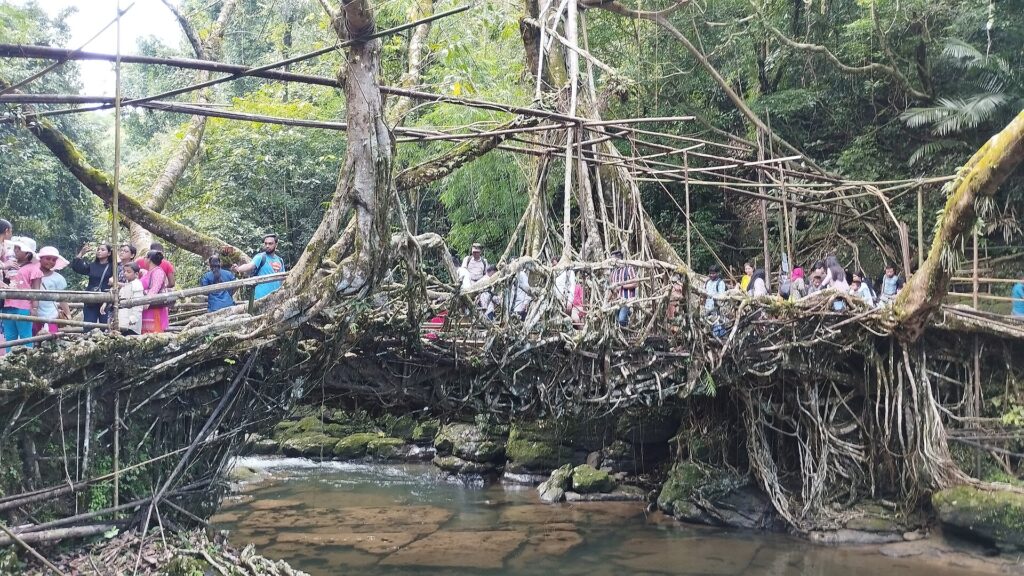
This is the option I find most interesting for repeat visitors. Meghalaya Tourism lists a guided day experience that starts in Rangthylliang and ends in Mawkyrnot, following forest and plantation trails with a root-bridge architect from the village as your guide. The route passes seven root bridges, and the Rangthylliang bridge is generally cited (including on Wikipedia) as the longest known living root bridge, at over 50 metres.
The starting point is Pynursla, about 50 km from Shillong. The tourism listing quoted a tariff of around Rs 1,500 per person including lunch and basic first aid, but I could not confirm it is current, so check while booking. One listing mentions around 1,500 steps on this route, so it is easier than Nongriat but not a stroll. The listing recommends the dry season, October to March.
When Is the Best Time for the Living Root Bridge Trek?
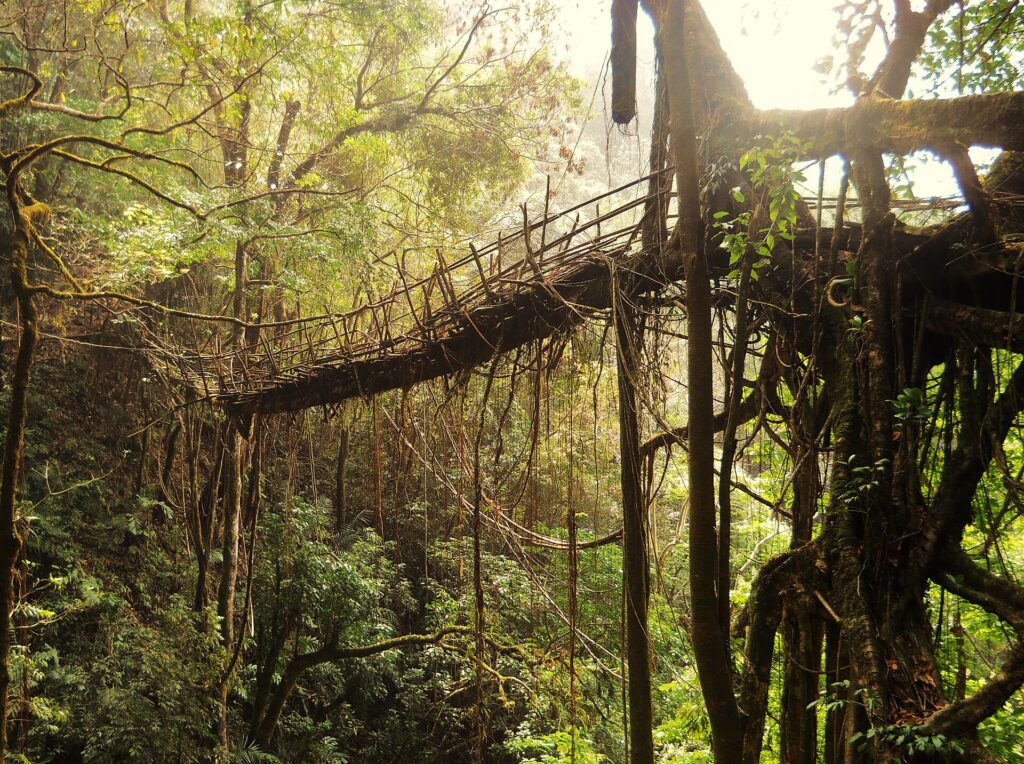
Quick answer: October to March. The steps dry out after the monsoon, the pools are calmer and the humidity drops. October and November still have full streams and greenery. June to September brings very heavy rain around Sohra, slippery steps and swollen streams, so trek only with a guide and extra caution.

| Months | Steps and trail | Streams and pools | My verdict |
|---|---|---|---|
| October to November | Drying out, still damp in shade | Full and lively, pools clearing | Best overall window |
| December to February | Driest, best grip | Lower water, calmest pools | Best for comfort and safety |
| March to May | Good early, pre-monsoon showers later | Low to rising | Good, go early in the day |
| June to September | Slippery and muddy | Swollen, swimming risky | Only for experienced trekkers with a guide |
The monsoon has its fans for the dramatic falls. However, wet stone steps are a different trek altogether, and streams near the bridges turn dangerous after a heavy spell. If monsoon travel is your thing, my monsoon travel guide for Uttarakhand covers the general mindset, and the same rules apply here: start early, turn back early.
How Do You Reach Tyrna from Shillong or Guwahati?
Quick answer: Fly or take a train to Guwahati, travel about 100 km to Shillong, then 54 km on to Sohra. Tyrna is 30 to 45 minutes from Sohra by taxi. Base yourself in Sohra rather than Shillong, because starting the trek from Shillong adds two hours each way.
Since June 2025, renting private vehicles to tourists for self-drive has been banned in Meghalaya, so plan on a Meghalaya-registered cab or shared transport rather than a self-drive rental. I covered the transport choices, including shared sumos and what changed with Guwahati taxis, in detail in the main Meghalaya guide, so I will not repeat it here. For the trek day itself, the simplest arrangement is a taxi that drops you at Tyrna and picks you up at an agreed time, or the next day if you are staying in Nongriat.
In case you are combining Meghalaya with Sikkim on one North East trip, my Sikkim budget route planner and the Gangtok weekend guide will help you stitch the two together via Guwahati and Siliguri.
How Much Does the Root Bridge Trek Cost in 2026?
Quick answer: For two people on a day trip from Sohra, expect roughly Rs 4,240 to Rs 6,090 in total (about Rs 2,120 to Rs 3,045 each), covering the guide, entry fees and a day’s cab hire. Food, an overnight homestay and Rainbow Falls cost extra. Every figure here is reported, not officially published.
| Item (2 people, day trip) | Low (Rs) | High (Rs) | Source quality |
|---|---|---|---|
| Registered guide (per group) | 700 | 1,500 | Trip reports 2025-26, no official rate card |
| Double decker entry (Rs 20 x 2) | 40 | 40 | Reported by multiple travelers |
| Camera fee (one camera) | 0 | 50 | Reported, applies only if charged |
| Small cab for the day from Sohra | 3,500 | 4,500 | Older quotes, verify locally |
| Total for two | 4,240 | 6,090 | |
| Per person | 2,120 | 3,045 |
A full-day cab is more than Tyrna alone needs, so combine it with Sohra sightseeing or negotiate a drop-and-pickup rate. For an overnight stay, add the Nongriat homestay, meals and a second pickup, all of which you should confirm directly. I am not quoting homestay prices because the ones I found were too old to trust. Carry enough cash for everything, and do not count on an ATM or card payments down in the valley.
What Safety Tips Matter Most on the Nongriat Steps?
Quick answer: Start from Tyrna by 8 AM, hire the mandatory guide, wear shoes with real grip, carry water and cash, and never attempt the climb out after dark. Treat the suspension bridges and pools with respect, and tell your homestay or hotel your plan before you head down.
- Footwear decides your day. Wet, mossy steps punish worn soles. Proper trekking shoes beat sneakers here. My list of trekking shoes under Rs 5,000 has budget options that grip well.
- Knees, not lungs. AMS is not a concern at this altitude, but the descent strains knees and the climb strains everything else. A trekking pole helps a lot on the way down.
- Water and salt. Humidity drains you faster than you expect. Carry at least 1.5 to 2 litres per person and something salty.
- Respect the pools. The water below the double decker looks gentle, but streams rise quickly after rain upstream. Swim only where your guide says it is safe.
- One at a time on suspension bridges. They are narrow and they sway. Do not crowd them for photos.
- Share your plan. Signal is weak in the valley. Tell your hotel which homestay you are booked at and when you expect to be back.
- Do not litter. Carry your wrappers back up.
Women travelling solo or in pairs will find practical advice in my solo female travel safety guide, and the guide mandate is a genuine plus here. For what to pack in a day bag, use my trekking packing checklist.
Related Reading for Your Meghalaya and North East Trip
- Meghalaya Complete Travel Guide 2026: Shillong, Cherrapunji and Dawki
- Sikkim permits explained: RAP, PAP and ILP
- Honeymoon trip planning for couples in the hills
- Trekking basics for beginners
- How to pack a backpack for trekking
Frequently Asked Questions About the Living Root Bridge Trek
How many steps are there to the double decker root bridge?
Meghalaya Tourism describes about 3,500 stone steps over roughly 3 km from Tyrna to the double decker bridge at Nongriat. You climb all of them back on the return.
Do I need a guide for the Nongriat trek in 2026?
Yes. East Khasi Hills made registered guides mandatory for treks and outdoor activities in mid-2025. Trip reports mention roughly Rs 700 to Rs 1,500 per group depending on the route, so confirm the rate at Tyrna.
Can I do the living root bridge trek in one day?
Yes, if you are reasonably fit and start from Tyrna by 8 AM. Adding Rainbow Falls on the same day is hard for most groups, so stay overnight in Nongriat if you want both.
What is the entry fee for the double decker root bridge?
Travelers report about Rs 20 per person at the ticket point near the bridge, plus a small camera fee. There is no official published rate card, so carry small change.
Which is the longest living root bridge in Meghalaya?
The Rangthylliang root bridge near Pynursla is generally cited as the longest known, at over 50 metres. It sits on a guided Rangthylliang to Mawkyrnot day trail.
Which root bridge is easiest for elderly travelers or kids?
Riwai, near Mawlynnong. Reviewers describe a short walk of roughly 300 to 450 metres with some steps and railings, compared with about 3,500 steps at Nongriat.
Is the root bridge trek safe during the monsoon?
It is possible but riskier. From June to September the steps are slippery and streams swell quickly. Go only with a guide, start early, and avoid swimming in the pools.
Are the living root bridges a UNESCO World Heritage Site?
Not yet. “Jingkieng Jri: Living Root Bridge Cultural Landscapes” was added to UNESCO’s tentative list in March 2022, covering about 100 bridges in 72 villages. Full inscription requires a separate nomination.
Final Thoughts: Is the Nongriat Root Bridge Trek Worth It?
Based on everything I researched, yes, as long as you go in with the right expectations. The double decker bridge is genuinely one of a kind, and the effort of the steps is part of why it still feels like a village rather than a theme park. My suggestion: base yourself in Sohra, trek between October and March, hire the guide happily rather than grudgingly, and sleep a night in Nongriat if your schedule allows. If the steps are not for you this time, Riwai or the Rangthylliang trail will still show you what makes these bridges special.

Since this guide is research-based, your first-hand updates matter a lot. What did your guide charge, how long did the climb back take, and what did you pay for your Nongriat homestay? Share it in the comments and I will fold verified details back in for fellow travelers. You can also find travel partners for a North East trip through the DwD Community, and feel free to share this guide with friends planning Meghalaya 🙂 …
If you have any questions, feel free to ask in the comments section below 🙂
