


Sikkim is the only Himalayan state I know where two travelers standing in the same queue can need two completely different permits, and where one of them may not be allowed to continue at all. I have driven the Old Silk Route and stayed in Lachen and Lachung, and the biggest planning mistake I see is assuming that “Sikkim permit” means one thing. It does not. Three names are in circulation, RAP, PAP and ILP, and mixing them up is how people lose a day of their trip.
This guide pulls all of it into one place, from the Government of Sikkim’s own Tourism and Civil Aviation Department listings, so you know which permit applies to you, where it is issued, how long it lasts, and which places you cannot enter at all. It covers both Indian and foreign travelers, because almost every Sikkim permit article online answers only one half of that question.
Quick Answer
Indian citizens need no permit to enter Sikkim, but they do need a Protected Area Permit (PAP) for Nathu La, Tsomgo Lake, Zuluk and all of North Sikkim beyond the Toong checkpost. Foreign nationals need a Restricted Area Permit (RAP), also called an Inner Line Permit, just to enter the state, valid 30 days and extendable by another 30, plus a separate PAP for those same restricted areas. For comparison, Indians need no Inner Line Permit for Meghalaya as of October 2026, as the Meghalaya travel guide explains. Arunachal Pradesh is the Northeast state where Indians still need an ILP, covered in the Tawang travel guide.
Sikkim Permits at a Glance
| Permit to enter Sikkim | Foreign nationals only (RAP / ILP). Indians exempt. |
| RAP validity | 30 days, extendable by a further 30 days |
| Permit for restricted areas | PAP, required for Indians and foreigners |
| Tsomgo Lake PAP | Issued for one day only |
| North Sikkim PAP | Minimum 3 days, maximum 5 days |
| Closed to foreigners | Gurudongmar Lake, Nathu La |
| Permit cost | Government fee is nominal or nil. Agency service charges are the real cost. |
| Best planning window | Apply through a registered operator at least 1 day ahead, more in Oct-Nov |
| Last verified | September 2026, against sikkim.gov.in and esikkimtourism.in |
Which Sikkim Permit Do You Actually Need in 2026?
Quick answer: Start with your passport. If you hold an Indian passport, you need nothing to enter Sikkim and only a PAP for restricted areas. If you hold any foreign passport, including an OCI card, you need a RAP to enter the state and a PAP on top of it for restricted areas.
Think of it as two layers. The first is entry into Sikkim itself. The second is entry into specific sensitive pockets near the international border with Tibet. Indians clear layer one automatically. Nobody clears layer two automatically.
| You are | To enter Sikkim | For Tsomgo, Nathu La, Zuluk, North Sikkim | Gurudongmar and Nathu La |
|---|---|---|---|
| Indian citizen | No permit | PAP required | Allowed with PAP |
| Foreign national | RAP / ILP required | PAP required, agent-arranged | Not allowed |
| OCI card holder | RAP / ILP required | PAP required, agent-arranged | Not allowed |
| Bhutanese national | Exempt from RAP | PAP required | Check locally |
That last row surprises people. Per the Sikkim Tourism and Civil Aviation Department, Bhutanese nationals are specifically exempted from the RAP. If you are combining Sikkim with a run across the eastern border, our guide to Bhutan permits for Indians covers that side, and the two systems work nothing like each other.
What Is the Restricted Area Permit, and Why Do People Also Call It an ILP?
Quick answer: They are the same document. Sikkim’s foreigner entry permit was originally issued as an Inner Line Permit and is now formally a Restricted Area Permit. Both names remain in everyday use by agents, hotels and even some government pages, which is the single biggest source of confusion online.
For a foreign national this is the document that lets you cross into Sikkim at all, not just into the pretty bits. The state government lists the permissible stay for foreign tourists as 30 days initially, extendable by another 30. You will need photocopies of your passport and Indian visa plus two passport-size photographs.
What most articles get wrong is the list of places that can issue it. Per the state government, a RAP can come from Indian missions abroad, the Sikkim Tourism Offices in New Delhi and Kolkata, District Magistrate offices in Darjeeling, Siliguri and Rangpo, Foreigners Registration Offices, District Collectors, the Superintendent of Police, and online through the eFRRO portal. The eFRRO route is the one I would push anyone toward in 2026.
One caveat worth stating plainly. Multiple travel-industry sources report that nationals of Pakistan, China and Myanmar, and foreign nationals of Pakistani or Chinese origin, need prior clearance from the Ministry of Home Affairs before a RAP is issued. I could not confirm this on an official page, so treat it as a reason to start months in advance rather than as a quoted rule.
Has Sikkim Stopped Issuing Permits on Arrival for Foreigners?
Quick answer: Possibly, and you should plan as though it has. Several travel-industry sources report that from January 2026 Sikkim ended on-the-spot physical RAP issuance at Rangpo and Melli for foreign nationals, moving everything to online clearance. I could not confirm this on a government page, so apply online in advance regardless.
I would rather be straight with you than pretend this is settled. Through 2026, a number of operator and industry sources have reported that under a Ministry of Home Affairs directive, Sikkim discontinued issuing physical paper permits to foreign nationals at the land checkposts and airports, and that digital clearance through the centralised eFRRO platform is now required before reaching the border.
At the same time, the official Sikkim Tourism portal still carries a page headed “Restricted Area Permit (RAP) for Foreigners (on arrival),” and I could not read its full current text, so I will not quote it either way. What I can confirm from the Government of Sikkim’s own department listing is that eFRRO is an official issuing channel.
So here is the practical instruction, and it holds whichever way the rule has landed. Apply online through eFRRO before you travel, carry printed copies plus your passport and visa, and have your Gangtok operator confirm the position a week before arrival. That costs you nothing if on-arrival issuance still exists, and saves your trip if it does not. Keep in mind that turning up at Rangpo hoping to sort it out at the counter is the version of this plan with no fallback.
What Is the Protected Area Permit and Which Areas Need One?
Quick answer: The PAP is required for both Indian and foreign nationals to enter border or protected areas inside Sikkim. The Government of Sikkim defines these by police checkpost and axis, not by tourist attraction, which is why the list looks unfamiliar even to people who have been.


This is the permit that actually affects Indian travelers, and the one people underestimate. I am reproducing the state government’s own framing below, because the checkpost names are what you will see on your paperwork.
- 3rd Mile police check post, JN Axis, Gangtok District, covering Tsomgo, Baba Mandir and Nathu La
- Lingtam, Pakyong District, covering Zuluk, Kupup and the RN Axis, which is the Old Silk Route
- The entirety of Dzongu
- Phidang, Sankalang and Toong police check posts and everything beyond, covering the Lachen and Gurudongmar axis and the Lachung and Yumesamdong axis
- The KNP axis in Geyzing and Soreng Districts, covering Dzongri, Goechala, Chewabhanjyang, Singalila, Hilley and Barsey
Validity is fixed per area, which catches people out when they build an itinerary backwards from their flight.
| Area | PAP validity |
|---|---|
| Tsomgo Lake | One day only |
| Lachen, Lachung, Yumthang, Yumesamdong, Thangu | Minimum 3 days, maximum 5 days |
| Dzongu | Maximum 5 days |
| Two-wheeler pass | Maximum 7 days |
Read that North Sikkim row again. A minimum of three days is written into the permit itself. You cannot legally do Gurudongmar as a rushed overnight dash, and that is a rule, not a recommendation from a tour operator trying to sell you an extra night.
PAPs are issued by the Permit Cell at HQ Gangtok, the District Tourism Offices at Rongli, Mangan, Namchi, Soreng and Pelling, the Adventure Cell for trekking routes, and online through registered travel agencies.
How Do You Get the Tsomgo Lake and Nathu La Permit?
Quick answer: Through a registered Gangtok operator, usually applied for the afternoon before your trip. The permit is issued for a single day, foreign nationals can go as far as Tsomgo Lake but not Nathu La, and the real expense is the vehicle and mandatory local driver rather than the permit fee itself.
This is the classic Gangtok day trip and the most commonly applied-for permit in the state. Your operator submits the application with your ID and photographs, usually the afternoon before travel, and the permit is issued for that specific date. Because Tsomgo permits are valid for one day only, there is no flexible Nathu La permit you can hold back until the weather clears.
Per the official district breakdown, Tsomgo and Baba Mandir permits are issued by the police check post for domestic tourists, while Nathu La permits come from the Tourism Department and the police check post, for domestic tourists only. Foreign tourists are allowed up to Tsomgo Lake, with that permit issued by the Tourism and Civil Aviation Department and the police check post.
On cost, I will give you what the market quotes rather than invent a government figure. Operators in 2026 commonly quote around Rs 200 per person for the Nathu La permit component, with the full Tsomgo, Baba Mandir and Nathu La day trip landing near Rs 6,500 to Rs 8,000 per vehicle once the vehicle permit and compulsory local driver are included. Those are operator-quoted numbers, not an official tariff, so confirm before you pay. Our Gangtok and Nathu La travel guide covers how that day runs, and the Gangtok weekend trip guide covers fitting it into a short break.
How Do Permits Work for Zuluk and the Old Silk Route?
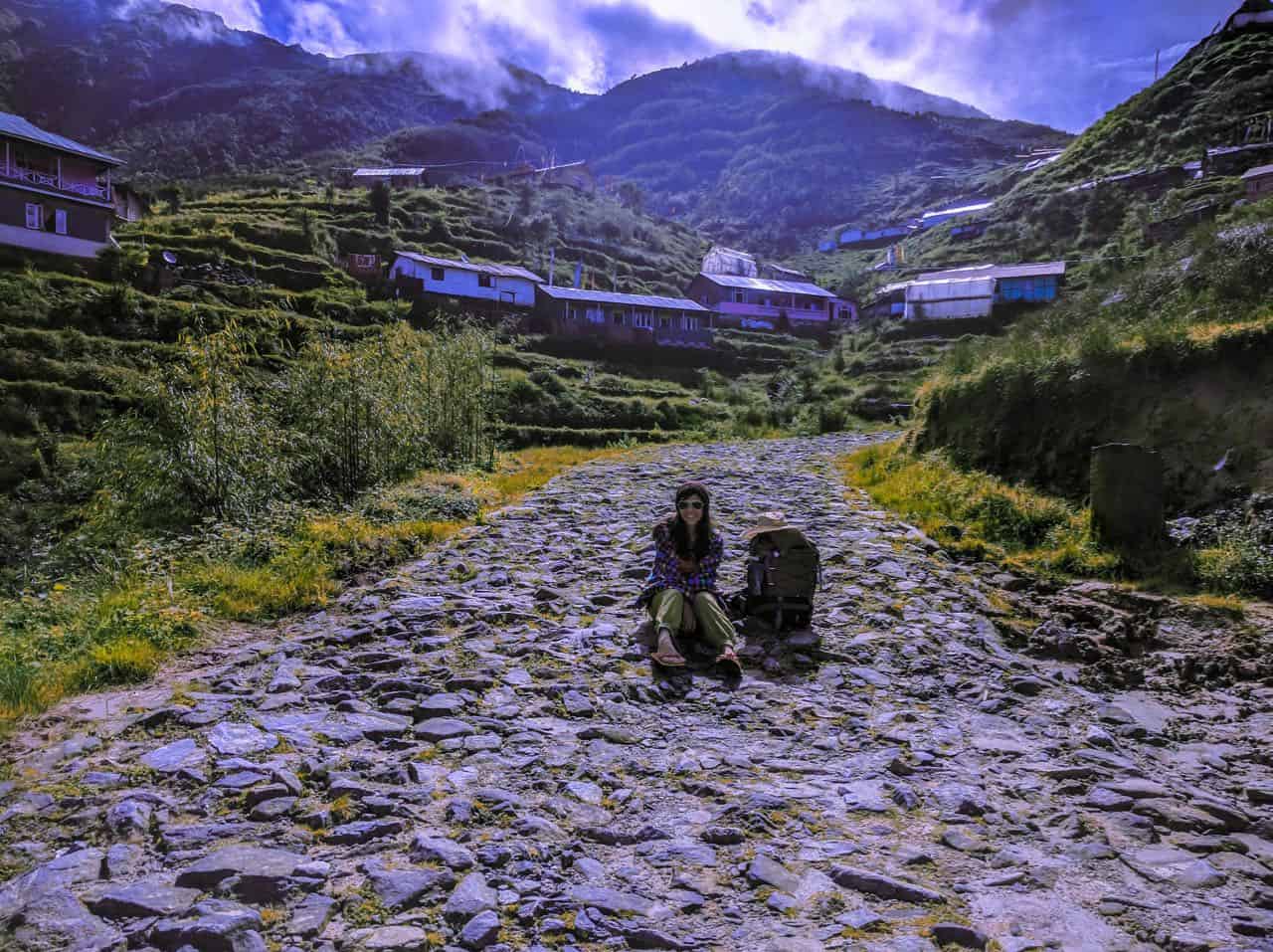
Quick answer: The Old Silk Route sits behind the Lingtam check post in Pakyong District and needs a PAP covering the Zuluk to Kupup stretch. Permits are normally arranged from Rongli by your homestay or operator, so book your stay first and let them handle the paperwork.
The Silk Route confuses people because it does not start from Gangtok. This axis is processed at the District Tourism Office in Rongli, where your vehicle stops on the way up. In practice your Zuluk or Nathang homestay collects your documents in advance and has the permit ready when you arrive, which is why booking the stay before worrying about permits is the right order here.
Keep in mind this route runs very close to the border and the checkposts take it seriously. Carry the original of whichever ID you submitted, not just a photocopy. Our Old Silk Route guide and the Zuluk travel guide cover the road, viewpoints and stays.
How Do North Sikkim Permits Work for Lachen, Lachung and Gurudongmar?
Quick answer: North Sikkim beyond the Toong check post needs a PAP issued for a minimum of three days and a maximum of five. It is arranged through a registered Gangtok operator or from Mangan, the permit itself is free, and Gurudongmar Lake is open to Indian nationals only.
North Sikkim is where the permit system has the most direct effect on your itinerary. The three-day minimum written into the permit is why every standard North Sikkim package is sold as three days and two nights. It is not a packaging trick.
The permit carries no government fee. What you pay is the operator’s service charge, and they charge it because they carry responsibility for you once you are past the checkpost. You will need two passport-size photographs and a government photo ID. Voter ID, Driving Licence and Passport are safest, and while Aadhaar is generally accepted, carry a second ID too, because I have seen operators ask for one of the other three.
There is also a route most people miss. With your own vehicle and an early start from Siliguri, you can drive straight to Mangan or Singhik via Singtam and Dikchu, bypassing Gangtok entirely, and get permits issued at Mangan the next morning. Our North Sikkim travel guide has the route breakdown, the Gurudongmar Lake and Chopta Valley guide covers the lake, and the Yumthang Valley guide handles the Lachung side.
Where Are Foreign Nationals Not Allowed to Go in Sikkim?
Quick answer: Gurudongmar Lake and Nathu La are closed to foreign nationals because of their proximity to the international border. Foreigners can travel up to Tsomgo Lake in the east and up to Chopta Valley in the north, and must apply for North Sikkim permits through a registered travel agent.
This is the section almost nobody writes, and it saves a foreign traveler from building a whole trip around a lake they will be turned back from. Both exclusions are about the border, not bureaucracy.
The alternatives are genuinely worth the trip rather than consolation prizes. In the north, Chopta Valley is open to foreign nationals and is, in my view, the more beautiful of the two on a clear day. In the east, Tsomgo Lake is open. Yumthang and Lachung stay accessible through agent-arranged permits, and the official guidance is that foreigners should apply through their travel agents rather than directly.
Trekkers should also know the Green Lake permit is a different animal. The Tourism Department issues it only after clearance from the Ministry of Home Affairs in New Delhi, so it is a months-ahead exercise, not a Gangtok-morning one.
Which Parts of Sikkim Need No Permit at All?
Quick answer: For Indian citizens, most of Sikkim needs nothing. Gangtok town, Pelling, Ravangla, Namchi, Yuksom, Lava, Aritar and the whole of South and West Sikkim outside the KNP trekking axis are permit-free. Foreign nationals still need their RAP for all of it.
It is easy to read a permit guide and conclude Sikkim is a locked-down state. It is not. The protected areas are specific pockets near the border, and most of what people travel to Sikkim for sits outside them. For an Indian traveler who wants a Himalayan trip with zero paperwork, West and South Sikkim deliver exactly that.
Our Pelling travel guide and the Lava and Aritar guide both cover permit-free territory. The exception in the west is trekking: Dzongri, Goechala, Singalila, Hilley and Barsey sit on the KNP axis and need Adventure Cell permits. Our Sandakphu trek guide covers the Singalila ridge.
What Documents and Money Should You Keep Ready?
Quick answer: Carry two passport-size photographs per person and at least two government photo IDs in original, plus photocopies. Foreign nationals additionally need passport and visa copies. Government permit fees are nominal or nil, so budget for operator service charges and vehicle costs instead.
Here is the checklist I would pack for any Sikkim trip involving a restricted area.
- Four passport-size photographs per person. Two is the stated requirement, but doing both the Nathu La day trip and North Sikkim means applying twice.
- Two government photo IDs in original. Voter ID, Driving Licence or Passport are safest. Carry Aadhaar as well, not instead.
- Photocopies of everything. Checkposts keep copies, and Gangtok photocopy shops have 8 AM queues for exactly this reason.
- Foreign nationals: passport and Indian visa photocopies plus your eFRRO approval, printed.
- Vehicle papers if self-driving, since two-wheeler and vehicle passes are issued separately.
| Permit | Government fee | What you actually pay |
|---|---|---|
| RAP / ILP for foreigners | Nominal, officially described as cheap | Agent facilitation charge if not self-applied online |
| North Sikkim PAP | Free | Operator service charge, bundled into the package |
| Nathu La permit | Around Rs 200 per person, operator-quoted | Roughly Rs 6,500 to Rs 8,000 per vehicle for the full day trip |
| Dzongu special permit | Free | Homestay’s document and travel costs to Mangan |
I have deliberately not quoted precise rupee figures where the government does not publish one. The pattern across every Sikkim permit is the same: the permit is cheap or free, and the service around it costs the money. Anyone quoting a large “permit fee” as a government charge is worth a second question. Verify current rates locally before you pay.
What Are the Most Common Sikkim Permit Mistakes?
Quick answer: The four that cost people their trip are arriving without a pre-arranged RAP as a foreigner, planning a one-night Gurudongmar dash, carrying only Aadhaar, and booking flights that leave no buffer day in Gangtok for permit processing.
Assuming a single night in North Sikkim is possible. The permit minimum is three days. Every year people book one night in Lachen and then find the itinerary cannot be permitted.
Treating Aadhaar as universal. It is generally accepted, but not the safest choice at a border checkpost. Carry a Voter ID, Driving Licence or Passport too.
Landing in Gangtok with no buffer. Applications go in the morning and are issued the same afternoon, or go in the afternoon before travel. That is fine until it is a long October weekend and the queue is deep. Give yourself a full day in Gangtok.
Foreign travelers planning around Gurudongmar. This genuinely ruins trips. With a foreign passport, build your North Sikkim plan around Chopta Valley, Lachung and Yumthang from the start.
Assuming Sikkim works like Ladakh or Spiti. It does not. Indian travelers in Ladakh no longer need an Inner Line Permit and pay an environmental fee instead, per our Ladakh permit guide, while foreigners there face a separate Protected Area Permit system. Himachal differs again, per our Inner Line Permit guide for Kinnaur and Spiti. Do not carry assumptions across state lines.
Related Reading from the DwD Archive
- North Sikkim Travel Guide for the full Lachen, Lachung and Yumthang circuit
- Dzongu Travel Guide for the Lepcha reserve and its separate permit
- Old Silk Route in East Sikkim for the Zuluk and Nathang run
- Gurudongmar Lake and Chopta Valley Guide for current access status
- Sillery Gaon and Icchey Gaon for permit-free Kanchenjunga views
Frequently Asked Questions
Do Indians need a permit to enter Sikkim?
No. Indian citizens need no permit to enter Sikkim or to travel through Gangtok, Pelling, Ravangla, Namchi and most of the state. A Protected Area Permit is only needed for restricted areas such as Nathu La, Tsomgo Lake, Zuluk and North Sikkim beyond the Toong check post.
Is the Sikkim ILP the same as the RAP?
Yes, for practical purposes. Sikkim’s entry permit for foreign nationals was historically called the Inner Line Permit and is now formally the Restricted Area Permit. Both names are still used interchangeably by agents, hotels and some government material, which is the main reason the topic is confusing online.
How long is the Sikkim RAP valid for?
The Government of Sikkim states that the permissible duration of stay for foreign tourists is 30 days initially, with an extension of a further 30 days available. Protected Area Permits for specific areas have their own separate and much shorter validity, such as one day for Tsomgo Lake.
Can foreigners visit Gurudongmar Lake or Nathu La?
No. Both Gurudongmar Lake and Nathu La are closed to foreign nationals because they sit very close to the international border. Foreign travelers can go up to Chopta Valley in North Sikkim and up to Tsomgo Lake in East Sikkim, and can visit Lachung and Yumthang with agent-arranged permits.
Do OCI card holders need a permit for Sikkim?
Yes. OCI card holders are treated as foreign nationals for this purpose and must obtain a Restricted Area Permit to enter Sikkim, along with a Protected Area Permit for restricted areas. The same area restrictions apply, so Gurudongmar and Nathu La remain off limits.
How much does a Sikkim permit cost?
Government permit fees are nominal or nil. The North Sikkim PAP and the Dzongu permit are free, and operators charge a service fee instead. For Nathu La, operators commonly quote around Rs 200 per person for the permit, with the full day trip costing roughly Rs 6,500 to Rs 8,000 per vehicle. Verify current rates locally. For total trip costs beyond permits, see my Sikkim budget and route planner.
Can I apply for a Sikkim permit online?
Foreign nationals can apply for the Restricted Area Permit online through the eFRRO portal, which the Government of Sikkim lists as an official issuing channel. Protected Area Permits are applied for online through registered travel agencies rather than directly by the traveler.
Do I need a permit for Pelling, Ravangla or Namchi?
Indian citizens need no permit for Pelling, Ravangla, Namchi, Yuksom or anywhere else in South and West Sikkim outside the Kanchenjunga National Park trekking axis. Treks such as Dzongri, Goechala, Singalila, Hilley and Barsey do need permits from the Adventure Cell.
Final Thoughts on Planning Around Sikkim’s Permits
If you take one thing from this guide, make it this: Sikkim’s permit system is not difficult, it is just badly explained. Two layers, entry and restricted areas. Indians clear the first one automatically. Nobody clears the second one automatically. Once you hold that model in your head, every confusing article you read afterwards sorts itself out.

My own recommendation, having driven these roads, is to give Gangtok one full working day at the start of your trip and let a registered local operator handle the paperwork. It costs a little more than doing it yourself and removes the one failure mode that actually ends trips. If you hold a foreign passport, do not plan to sort your RAP at the border in 2026. Apply through eFRRO before you fly, carry printouts, and confirm with your operator a week out.
Permit rules in border states change quietly and often, so treat everything here as verified in September 2026 against the Government of Sikkim’s listings, and confirm before you travel. If you have been to Sikkim recently and the rules on the ground differed from what you read here, please tell us in the comments. That is how these guides stay accurate, and the DwD community has caught changes long before they reached any official page.
If you have any questions, feel free to ask in the comments section below 🙂
