


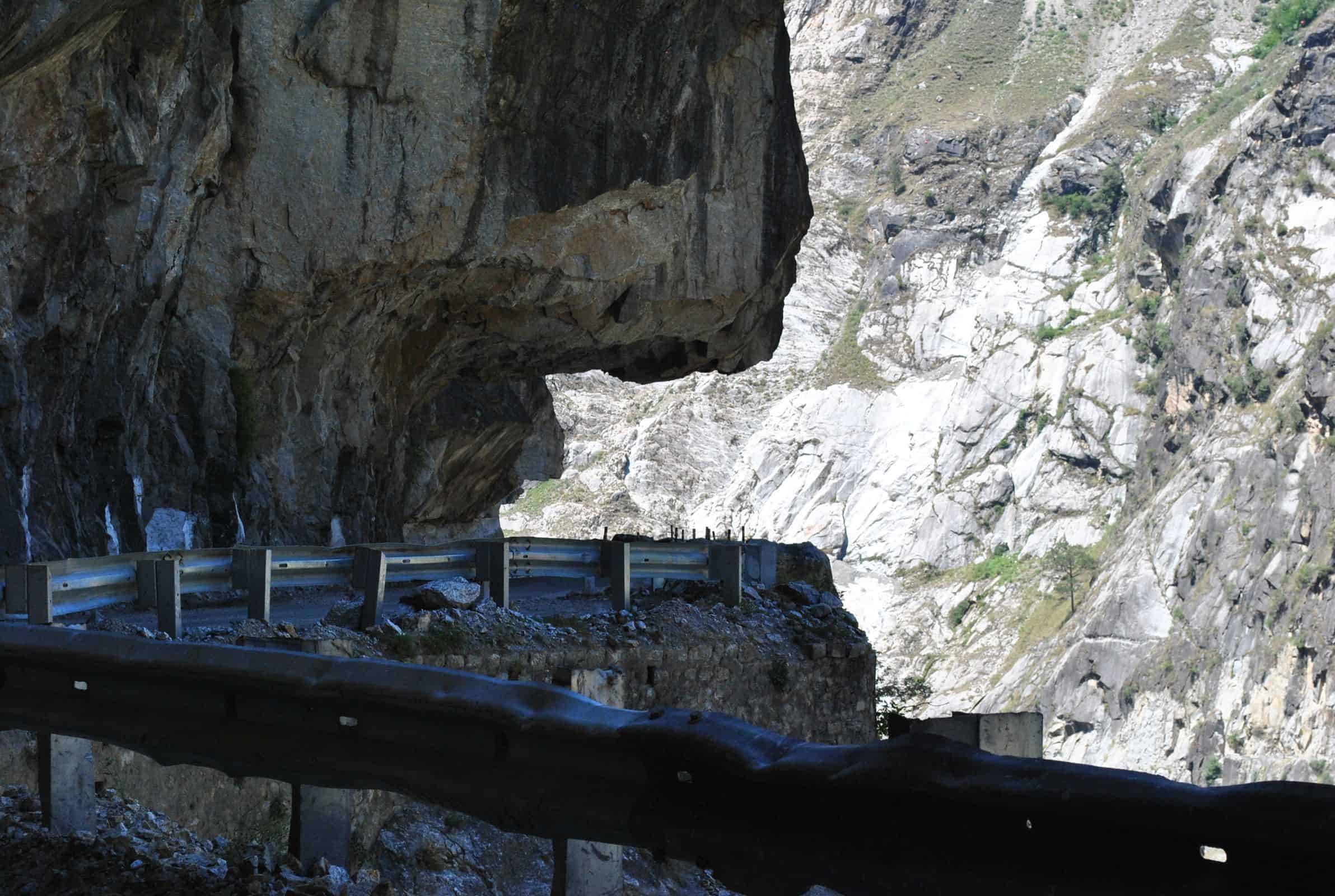
If you are planning your first or second Himachal trip and cannot decide between Kinnaur and Spiti, I have good news. You do not need to choose. The Kinnaur to Spiti circuit is one of the finest road trips in all of India, combining two completely different landscapes in a single journey. Apple orchards and terraced fields on the Kinnaur side, and stark desert mountains with ancient monasteries on the Spiti side. The shift happens almost kilometre by kilometre as you move inland, and the contrast is what makes this circuit so memorable.
I get asked regularly about this route on the blog and through the DwD community. So here is a proper guide for 2026, with two itinerary options, real distances, current road condition notes, permit rules, and budget numbers that I have verified as best I can for this season.
Quick Answer: Kinnaur to Spiti Circuit in 2026
The Kinnaur-Spiti circuit runs from Shimla to Manali via NH-5 and the Kaza-Manali road, about 750-800 km on the 10-day plan. Indians need no ILP, only checkpost registration. Budget Rs 12,200-28,400 per person for 10 days (self-drive, group of 4). Best time is June to October, with September the sweet spot.
Practical Info: Kinnaur-Spiti Circuit at a Glance
| Total Distance (circuit) | ~750-800 km on the 10-day plan, close to 1,000 km on the 14-day plan (Shimla to Manali via Spiti, sum of the day-wise distances below) |
| Minimum Duration | 10 days (from Shimla/Delhi) |
| Comfortable Duration | 14 days (includes side trips and buffer) |
| Best Time | June to October (peak: July-September) |
| Permits (Indians) | No ILP. Registration at Jangi and Sumdo checkposts. Carry photo ID. SADA vehicle fee at Sumdo (cash). |
| Permits (Foreign nationals) | PAP required for Nako, Tabo, Kaza, Pin Valley, Kibber. Apply at DM offices. |
| Starting Point | Shimla or Chandigarh |
| Exit Point | Manali (via Kunzum Pass and Atal Tunnel) |
| Budget (10 days, self-drive) | Rs 12,200-28,400 per person (budget to mid-range tier, group of 4 sharing) |
| Vehicle Recommendation | SUV preferred. Sedan possible on Kinnaur route; challenging on Kaza-Manali section. |
| Last Updated | October 2026 |
Why Do This Circuit Instead of Just Kinnaur or Just Spiti?
Many travelers make the mistake of treating Kinnaur and Spiti as separate trips. They spend a week in Kinnaur, come back to Shimla, then plan a separate Spiti trip later. This makes logical sense on a map but misses the point of the region entirely. The two valleys share the Spiti River as their spine. The Kinnaur-Spiti border near Sumdo is where the topography shifts so dramatically that your photos from hour one and hour two look like different countries.
Doing the circuit also avoids doubling back on any road. The Kinnaur side (NH-5 via Shimla) opens around April, while the Manali-Kaza route stays closed until late May or early June, so entering from Shimla and exiting via Manali follows each route’s natural opening order.
Hence, I almost always recommend this circuit format over out-and-back options for anyone with 10 days or more. You cover more ground, get variety, and spend zero time on repeated roads.
Route Overview: Shimla to Manali via Kinnaur and Spiti
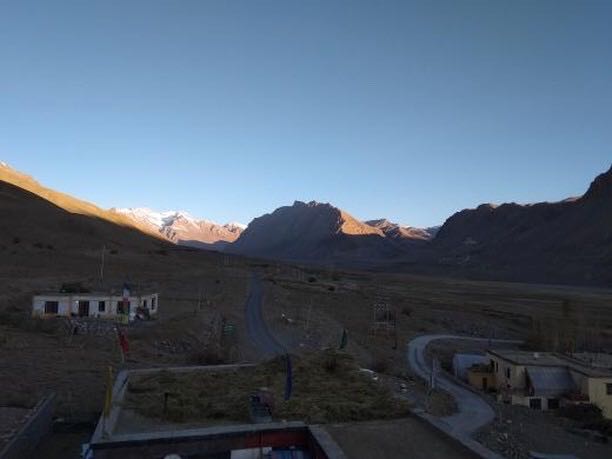
The circuit follows a U-shaped path through the mountains. Starting from Shimla (2,200 m / 7,218 Ft), you drive east on NH-5 along the Sutlej River through Narkanda, Rampur, and Jeori. From Jeori, the road branches: you can take the detour up to Sarahan and Bhimakali Temple, then rejoin the main highway at Karcham. From Karcham, the road splits again. The left fork goes up the Baspa River to Sangla Valley and Chitkul. The right fork continues along the Sutlej toward Rekong Peo and Kalpa. Rekong Peo is also the gateway for the multi-day Kinnaur Kailash Parikrama trek, which begins from nearby Thangi village, if you have extra days built into your circuit.
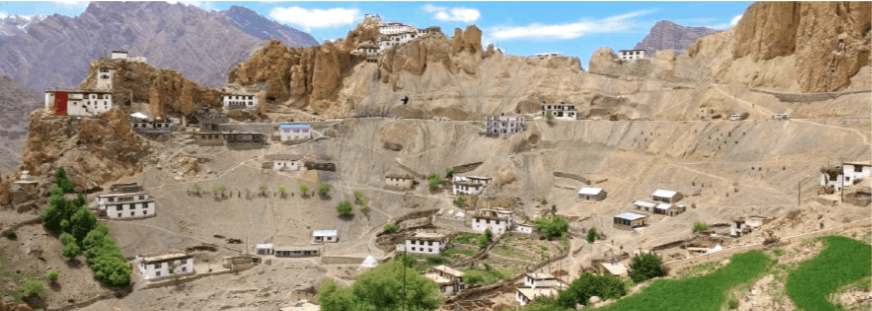
After Kalpa, you cross into the upper Kinnaur belt, passing through Nako (3,625 m / 11,893 Ft) and the treacherous Malling Nala section before entering Spiti at Sumdo. From there, Tabo, Dhankar, and Kaza are sequential stops along the Spiti River. Out of Kaza, you take the high road via Kunzum Pass (4,551 m / 14,931 Ft), Batal and Gramphu, then drop down to Manali through the Atal Tunnel.
Key distances to know before planning:
| Segment | Distance | Typical Driving Time |
| Shimla to Narkanda | ~65 km | 2-2.5 hrs |
| Narkanda to Rampur | ~65 km | 2 hrs |
| Rampur to Karcham | ~65 km | 2 hrs |
| Karcham to Sangla (via Chitkul) | ~35 km to Sangla, 28 km more to Chitkul | 2-3 hrs total |
| Sangla/Chitkul back to Rekong Peo (via Karcham) | ~80 km | 3 hrs |
| Rekong Peo to Kalpa | ~14 km | 45 min |
| Kalpa to Nako | ~115 km | 4-5 hrs |
| Nako to Tabo | ~70 km | 3-4 hrs (Malling Nala area) |
| Tabo to Kaza | ~47 km | 1.5-2 hrs |
| Kaza to Chandratal | ~75 km | 3-4 hrs |
| Chandratal to Manali (via Atal Tunnel) | ~115 km | 4-5 hrs |
For the complete picture of current road conditions on this stretch, you can check the NH-5 Road Status 2026 guide which is updated regularly through the season.
The 10-Day Kinnaur-Spiti Circuit Itinerary (Day by Day)
This is the minimum itinerary I would recommend for someone starting from Delhi. You will not be bored on any day, but you will not have much buffer for delays either. Keep in mind that one day of bad weather or road blockage can shift everything by a day. Add at least one rest day if you are altitude-sensitive.
| Day | Route | Distance | Overnight | Key Stops |
|---|---|---|---|---|
| Day 1 | Delhi to Shimla | ~350 km | Shimla (2,200 m) | Chandigarh, Kalka, Shimla Mall Road |
| Day 2 | Shimla to Sangla | ~230 km | Sangla (2,680 m) | Narkanda, Rampur, Karcham junction |
| Day 3 | Sangla to Chitkul and Kalpa | ~120 km | Kalpa (2,960 m) | Chitkul (3,450 m), Rekong Peo market |
| Day 4 | Kalpa to Nako | ~115 km | Nako (3,625 m) | Pooh, Khab Sangam, Nako Lake |
| Day 5 | Nako to Kaza | ~120 km | Kaza (3,800 m) | Malling Nala, Tabo Monastery, Dhankar |
| Day 6 | Kaza local sightseeing | ~60-80 km | Kaza (3,800 m) | Key Monastery, Kibber, Langza, Komic |
| Day 7 | Kaza to Chandratal | ~75 km | Chandratal (4,300 m) | Losar, Kunzum Pass (4,551 m) |
| Day 8 | Chandratal to Manali | ~115 km | Manali (2,050 m) | Batal, Gramphu, Atal Tunnel |
| Day 9 | Manali rest / exploration | Local | Manali | Old Manali, Vashisht, Mall Road |
| Day 10 | Manali to Delhi (or Chandigarh) | ~540 km | Delhi/Chandigarh | Kullu, Mandi, Bilaspur, Chandigarh |
Notes for the 10-day plan:
Day 3 involves visiting Chitkul (India’s last village on the Tibet border) and driving back to Kalpa in the same day. The distance is manageable, roughly 120 km total (Sangla to Chitkul is 28 km, then about 80 km back to Rekong Peo, plus the 14 km climb to Kalpa), but the road to Chitkul from Karcham has some rough patches. Start early at 7 AM from Sangla. You can check my Chitkul travel guide for what to see while there.
Day 5 is the longest leg in terms of driving difficulty, not distance. The Malling Nala area between Nako and Tabo is the most landslide-prone section of the entire circuit. If you leave Nako before 8 AM, you typically clear the worst sections before afternoon heat loosens the scree. Dhankar Monastery is about 8 km off the main road, so it is an optional detour. If you are short on time, visit Tabo (oldest monastery in the circuit, 1,000+ years old) and skip Dhankar for the 14-day version.
Day 6 is a full acclimatization and sightseeing day in Kaza. Key Monastery (4,166 m / 13,668 Ft) is the most famous stop. Kibber Village (4,270 m / 14,009 Ft) is worth the drive for the views. Langza, Hikkim, and Komic are the high-altitude villages in the region. You can cover all three in a loop of about 60-70 km from Kaza. Read my Tabo, Dhankar, and Pin Valley sightseeing guide for the monastery details.
Day 7 includes crossing Kunzum Pass (4,551 m). The pass typically opens for vehicles in late May or early June. Always confirm the current status at the Kaza Police Station the evening before. Chandratal Lake (about 4,300 m / 14,100 Ft) sits roughly 14-18 km off the Batal stretch of the Kaza-Manali road. Camps are around 3-5 km from the lake because lakeshore camping is banned. Entry is reported at Rs 150 per Indian visitor, plus the free e-Aagman e-pass (see permits below). For a detailed look at Chandratal, see the Chandratal Lake complete guide.
The 14-Day Kinnaur-Spiti Circuit Itinerary (Extended Version)
If you have 14 days, this is the version I recommend. You get time to actually breathe at each stop, spend an evening in Sangla without rushing, and include Pin Valley and Sarahan as proper detours. You will also feel the altitude change more gently, which matters at Kaza and Kunzum.
| Day | Route | Distance | Overnight | Key Stops |
|---|---|---|---|---|
| Day 1 | Delhi to Narkanda | ~415 km | Narkanda (2,708 m) | Chandigarh, Shimla bypass, Kufri |
| Day 2 | Narkanda to Sarahan | ~115 km | Sarahan (2,165 m) | Rampur Bushahr, Bhimakali Temple, Jeori |
| Day 3 | Sarahan to Sangla | ~110 km | Sangla (2,680 m) | Karcham, Baspa River, Rakcham village |
| Day 4 | Sangla to Chitkul and back | ~60 km round trip | Sangla (2,680 m) | Chitkul (3,450 m), Mathi Market checkpoint |
| Day 5 | Sangla to Kalpa | ~95 km | Kalpa (2,960 m) | Karcham, Rekong Peo market, Kinner Kailash views |
| Day 6 | Kalpa to Nako | ~115 km | Nako (3,625 m) | Pooh, Khab Sangam (Spiti meets Sutlej), Nako Lake |
| Day 7 | Nako to Tabo | ~70 km | Tabo (3,280 m) | Malling Nala (take it slow), Sumdo, Tabo Monastery |
| Day 8 | Tabo to Kaza via Dhankar | ~60 km | Kaza (3,800 m) | Dhankar Monastery (8 km detour), Dhankar Lake |
| Day 9 | Kaza local (Key, Kibber) | ~60 km | Kaza (3,800 m) | Key Monastery, Kibber Village (4,270 m), Gete village |
| Day 10 | Kaza to Pin Valley and back | ~100 km round trip | Kaza (3,800 m) | Attargoo, Mudh Village (Pin Valley), Mud homestays |
| Day 11 | Kaza local (Langza, Hikkim, Komic) | ~70 km | Kaza or Langza (4,400 m) | Fossil site at Langza, world’s highest post office (Hikkim), Komic monastery |
| Day 12 | Kaza to Chandratal | ~75 km | Chandratal camp (4,300 m) | Losar village, Kunzum Pass (4,551 m), Batal |
| Day 13 | Chandratal to Manali | ~115 km | Manali (2,050 m) | Gramphu, Koksar, Atal Tunnel |
| Day 14 | Manali to Delhi/Chandigarh | ~540 km | Home | Kullu, Mandi, Bilaspur |
The 14-day version gives you Day 4 as a dedicated Chitkul day from Sangla base. Chitkul is only 28 km from Sangla but the narrow road means you want the full day without rushing back to somewhere else. You also get Pin Valley on Day 10, which is one of the most underrated detours on this circuit. The road from Kaza to Mudh Village covers about 50 km one way. Mudh Village sits at about 3,800 m and the drive through the Pin River canyon is unlike anything else on the circuit. For the complete Pin Valley plan, the Mud Village Pin Valley guide is the most detailed resource we have.
Which Direction Should You Do the Circuit?
The strong recommendation is Shimla first, Manali exit. Here is why this matters.


If you go Shimla first, you are aligned with the seasonal opening (Kinnaur around April, Manali-Kaza late May or early June). You also acclimatize gradually. Shimla at 2,200 m, Sangla at 2,680 m, Kalpa at 2,960 m, Nako at 3,625 m, then Kaza at 3,800 m. That is roughly 200-300 m of gain per day. Compare this to the Manali-first route where you jump from 2,050 m at Manali to 4,551 m at Kunzum Pass in one day.
The Manali-first approach can work for experienced travelers who know their altitude tolerance. But for most people, and especially for first-timers to high altitude, the Shimla-first direction is safer and more practical. Also, the Shimla-Kaza route has better road quality for most of its length, making it a more comfortable entry before you hit the rougher Kaza-Manali stretch on the way out.
I covered this in detail in my earlier post on Spiti Valley from Shimla via Kinnaur, and the guidance still holds for 2026.

Best Time to Do the Kinnaur-Spiti Circuit
The circuit is accessible from early June to mid-October. Here is what each window actually means for your travel experience.
June (early to mid): The Kunzum Pass and Manali-Kaza road typically open in the last week of May or first week of June. The route is fresh, the landscape still has patches of snow especially near Kunzum, and tourist volumes are low. Road conditions are generally good on the Kinnaur stretch. Watch for Malling Nala delays. June is a good window for people who want to avoid crowds completely.
July-August: This is peak season and for good reason. The Spiti Valley has clear blue skies (unlike most of Himachal which gets monsoon). The Kinnaur stretch does receive some monsoon rain and landslide risk increases, especially around Nigulsari and the Pooh-Kaurik section. Traffic is highest in August. Road conditions vary day to day. Plan buffer days in August.
September: My personal recommendation for this circuit. The skies are clear across both Kinnaur and Spiti, the crowds thin out noticeably after August 20, accommodation rates drop slightly, and the landscape in Kinnaur is spectacular with apples ripening on the terraced fields. The Kunzum Pass is reliable in September and Chandratal is at its best. Night temperatures drop to 4-8°C in Kaza and 0-4°C at Chandratal campsite. If the harvest itself is part of the appeal, check my Kinnaur apple season guide for exactly which weeks the orchards peak before you lock in your dates.
October (first half): Still possible but you need to watch the Kunzum Pass closure dates. The pass typically closes for the season in late October. The first two weeks of October are fine in most years, but keep in mind that The Tribune reported a four-day snow blockade of the Kunzum route around 11 October 2025, so even early October is no guarantee. Beyond mid-October, confirm the pass status in Kaza the evening before.
For month-by-month Spiti Valley conditions, the Best Time to Visit Spiti Valley guide covers every month in detail.
Permits and Rules for the Kinnaur-Spiti Circuit in 2026
This is a question I get constantly. In case you are worried about paperwork, here is the straightforward answer for 2026.
For Indian citizens: No Inner Line Permit (ILP) is required for Kinnaur or Spiti. You will stop at two main checkposts where you register your vehicle and show ID. The first is at Jangi (about 20 km before Rekong Peo) and the second is at Sumdo (the Kinnaur-Spiti border). Carry your Aadhaar card or driving licence. The process takes 5-10 minutes at each point.
For foreign nationals: A Protected Area Permit (PAP) is required to enter the restricted zones of upper Kinnaur (beyond Jangi) and most of Spiti (Tabo, Dhankar, Kaza, Kibber, Pin Valley). Apply at the District Magistrate office in Shimla before you leave, or at Rekong Peo. The process takes a few hours. Fees are modest (Rs 250 at Rekong Peo, Rs 400 at the Shimla Sugam Centre, as of mid-2026). Groups of 2 or more can apply together.
Fees at the barriers: As per a February 2026 order reported for the SADA barrier at Sumdo, vehicle fees are Rs 100 (two-wheeler), Rs 200 (car), Rs 300 (SUV/MUV) and Rs 400 (bus/truck), in cash, and the collection point moves to Losar once the Manali-Kaza road opens. The Chaura toll barrier near Rekong Peo was narrowed in July 2025 to HP-registered commercial vehicles, so a private tourist car should not be liable, though enforcement can lag. Since you exit via the Atal Tunnel and Chandratal, register for the free e-Aagman e-pass on the HP government portal 24-48 hours ahead, as there is no usable network at the barrier. Verify rules on the Kinnaur district website.
For the complete permit guide covering both valleys, see the Inner Line Permits for Kinnaur and Spiti Valley guide. It has been updated for 2026 rules.
Road Conditions on the Circuit in 2026
Based on what travelers and our DwD community members have reported through mid-2026, here is the road condition summary for each section. I could not find a dated report for late October 2026, so treat this as the in-season picture and check locally before you leave.
Shimla to Rampur (NH-5): Good paved road. Some repair work near Jhakri dam area. No issues for any vehicle type. Allow extra time in peak season for truck traffic.
Rampur to Karcham: Mostly good. Some rough patches between Jeori and Karcham. Completely manageable in a sedan.
Karcham to Chitkul (Baspa Valley): Narrow mountain road. Good in June before heavy monsoon. Tight sections near Rakcham. SUV preferred but not mandatory. Some sections have single-lane traffic with passing zones.
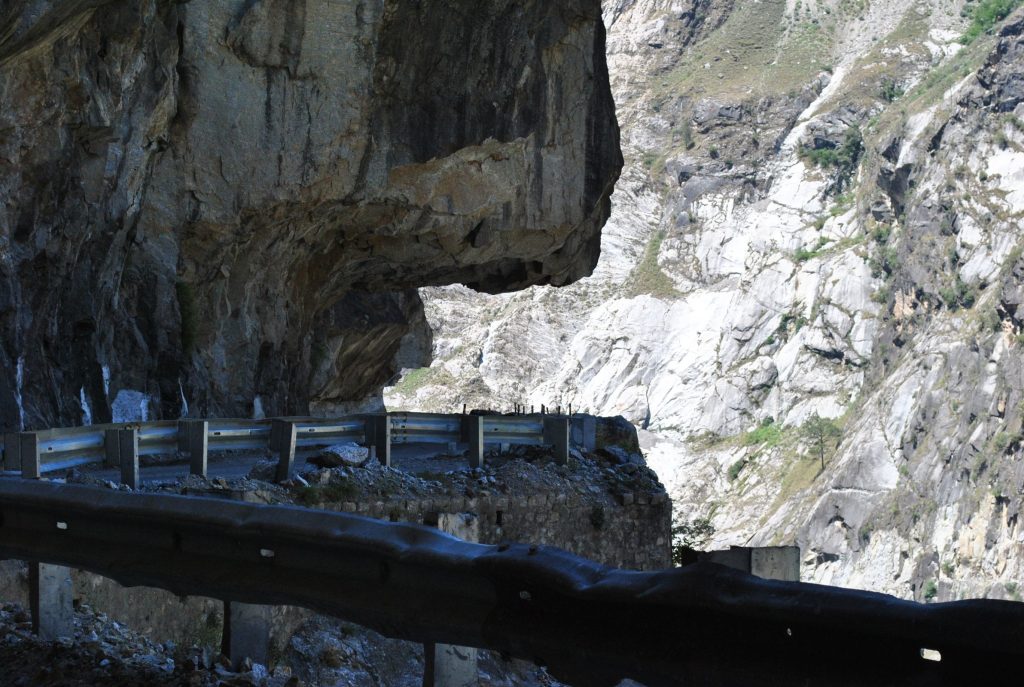
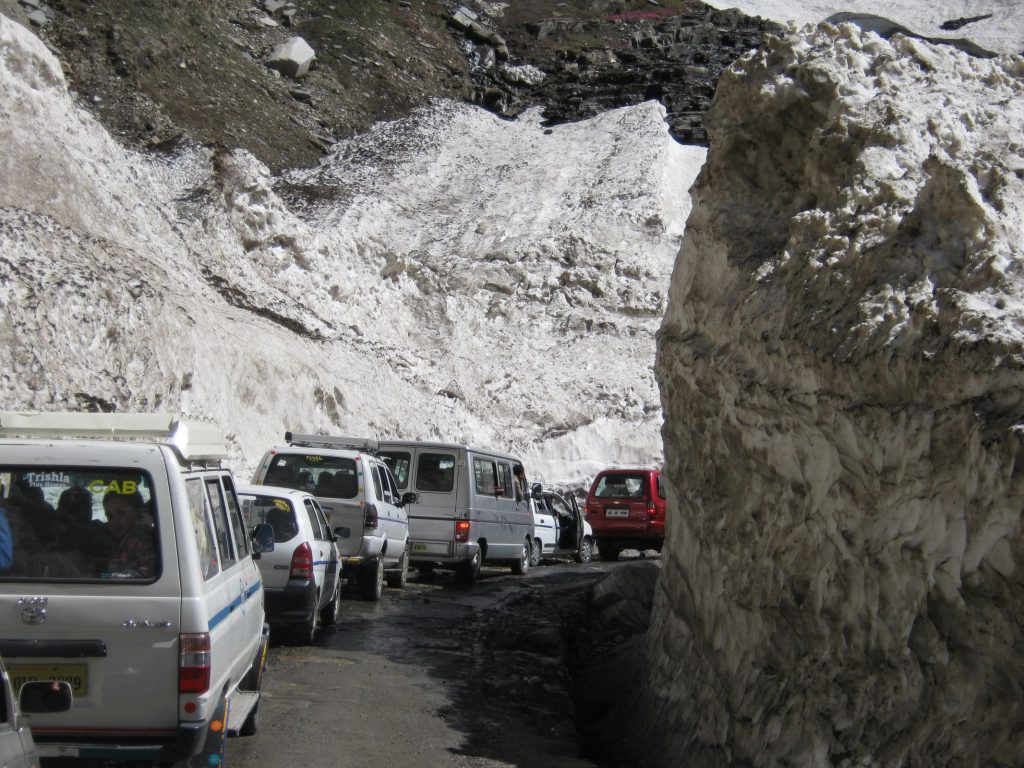
Rekong Peo to Nako: Mixed. The section from Pooh onward has historically had landslide damage from the 2025 monsoon. Repair work is ongoing on a few stretches near Chango. Check conditions at the Rekong Peo checkpost before proceeding. Always advisable to clear this section before noon. NH-5 in Kinnaur saw a debris-flow closure around 4 July 2026 and landslides at Chaura (31 July) and Nigulsari (6 August), all cleared within a day.
Nako to Tabo (Malling Nala section): This is the most demanding stretch on the entire circuit. The Malling Nala and the Sumdo approach are prone to rockfall and short closures. As of mid-2026, the road was passable but conditions change with rain. Give yourself a 1-2 hour buffer when planning this day.
Tabo to Kaza: Smooth paved road in excellent condition. No concerns.
Kaza to Manali (via Kunzum Pass): This is the most challenging section of the circuit. The road from Kaza to Batal is rough and rocky. Kunzum Pass itself (4,551 m) is a gravel road and gets very slippery in rain. One-way traffic may be enforced on some days. Post-Batal toward Gramphu is better but still rough. The Atal Tunnel north portal and the tunnel itself are smooth. An SUV with high ground clearance is recommended for this stretch. Sedans have done it but it is not comfortable.
For live updates through the season, keep checking the NH-5 Road Status 2026 post. You can also check the Spiti – Manali – Kaza road status post for the Manali exit side, and Delhi to Kinnaur and Spiti road conditions for the approach.
Budget Breakdown for the Kinnaur-Spiti Circuit 2026
Budget varies significantly based on your group size, vehicle, and accommodation choices. I have split this into three tiers. The self-drive calculations assume a group of 4 sharing a vehicle. If you are 2 people, double the per-person vehicle costs.
| Cost Category | Budget Tier (Rs/person, 10 days) | Mid-Range Tier (Rs/person, 10 days) | Comfortable Tier (Rs/person, 10 days) |
|---|---|---|---|
| Fuel (SUV, ~1,700 km Delhi to Delhi) | Rs 3,500-4,500 (group of 4 sharing) | Rs 3,500-4,500 (group of 4 sharing) | Rs 3,500-4,500 (group of 4 sharing) |
| Accommodation (8 nights, Chandratal camp priced separately) | Rs 500-800/night (basic homestay) | Rs 1,000-1,500/night (better homestay) | Rs 2,000-3,500/night (hotel/resort) |
| Food (3 meals/day, 10 days) | Rs 200-300/day | Rs 400-600/day | Rs 700-1,000/day |
| Fuel at destination (local sightseeing) | Rs 800-1,200 (shared) | Rs 800-1,200 (shared) | Rs 1,500-3,000 (private taxi for some legs) |
| Entry fees, permits (Chandratal entry Rs 150 plus Sumdo SADA SUV fee Rs 300 split four ways) | Rs 225 (no ILP for Indians) | Rs 225 (no ILP for Indians) | Rs 225-500 |
| Chandratal camp (1 night, per person) | Rs 1,200-1,500/tent | Rs 1,500-2,500/tent | Rs 2,500-4,000/tent |
| Miscellaneous (tips, snacks) | Rs 500-1,000 | Rs 1,000-2,000 | Rs 2,000-4,000 |
| Estimated 10-day total per person | Rs 12,200-17,800 | Rs 19,000-28,400 | Rs 32,700-54,000 |
Totals: Each total is the sum of the rows above, rounded to the nearest hundred. Vehicle rental, driver hire and highway tolls are not included.
Fuel planning: Fill up your tank at Rampur before entering Kinnaur. According to the IndianOil station locator, Kinnaur has outlets at Jeori, Sangla (Kamroo), Rekong Peo and Pooh, and Pooh is the last listed pump on NH-5 before the long Nako, Tabo and Kaza stretch (about 117 km from Nako to Kaza). Kaza also has a pump (petrol was reported at about Rs 103 per litre in August 2026), so top up there before Chandratal. Do not skip the Rekong Peo or Pooh fill-up even if your tank is 60% full. There is no fuel between Kaza and Manali.
For a detailed cost comparison including 7-day and 14-day Spiti costs, the Spiti Valley Budget Guide 2026 has exact current-year numbers. The Kinnaur accommodation rates for 2026 have drifted up compared to two years ago. Expect Rs 800-1,200 per night for budget homestay rooms in Sangla and Kalpa and Rs 1,200-1,800 in Kaza (these are room rates, so the per-person figure is roughly half if two of you share).
For a list of verified drivers serving both valleys, the List of Taxi Drivers for Spiti and Kinnaur is the most practical resource if you are travelling without your own vehicle.
Essential Planning: Connectivity, Safety, and What to Carry
Mobile network: BSNL is the most reliable across the entire Kinnaur-Spiti stretch. Jio and Airtel work in Shimla, Narkanda, Rampur, and Rekong Peo town. After Rekong Peo, expect BSNL only. In Kaza, Jio and BSNL both work. Between Tabo and Kaza there are frequent dead zones. Download offline maps before you leave Rampur. Carry the DwD community WhatsApp group number for real-time road updates.
Altitude and AMS: The serious altitude begins at Nako (3,625 m). Kaza at 3,800 m is your base for the most demanding part of the trip. Keep in mind that AMS can affect anyone regardless of fitness level. Common symptoms include headache, nausea, and loss of appetite. Carry Diamox if recommended by your doctor. Do not drive through AMS symptoms. The Chandratal campsite at about 4,300 m and Kunzum Pass at 4,551 m are the highest points. Rest properly in Kaza before heading higher.
ATMs: Last reliable ATM before the circuit interior is Rekong Peo. Kaza has an ATM but it is not always stocked. Carry sufficient cash from Shimla or Rampur. Rs 15,000-20,000 in cash is a safe amount for a 10-day circuit beyond what you pre-pay online.
Vehicle check: Before departure, have a mechanic check your brakes, tyre pressure, spare tyre, and engine coolant. The Kaza-Manali road is notoriously hard on vehicles. Carry a puncture repair kit, a basic tool set, and a tow rope. The nearest mechanic from anywhere in Spiti is Kaza.
Weather monitoring: Mountain weather changes quickly. Afternoon thunderstorms are common July-August. The Malling Nala area can close for hours without warning after rain. Always complete the difficult sections by noon if possible. The India Meteorological Department (IMD) HP forecast is useful but not always granular for the inner valleys. Local check at Rekong Peo and Kaza police posts is the most reliable real-time source.
Key Stops You Should Not Rush Through
Chitkul: India’s last village before the Indo-Tibet border sits at 3,450 m and has a character unlike any other stop on this circuit. The wooden houses with slate roofs, the little temple above the village, and the view down the Baspa River valley are things you will remember. The 10-day itinerary gives you a half-day here; the 14-day version gives you a full day from Sangla base. Read the Chitkul travel guide before you go.
Nako Village: At 3,625 m in upper Kinnaur, Nako is the acclimatization checkpoint of this circuit. The 11th-century Nako Monastery (Lotsava Jhakang, built by Lotsawa Rinchen Zangpo in 1025 AD) is one of the oldest in the entire Himalayan belt. The Nako Lake is right next to the village and freezes solid in winter. An overnight stay here allows your body to adjust before the harder Malling Nala section. More on this in the Nako Village guide.
Tabo Monastery: Founded in 996 AD, Tabo is one of the oldest continuously occupied monasteries in the world. The cave temples behind the main complex are genuinely old and were used for meditation by monks for centuries. Do not skip Tabo even on the 10-day plan. The monastery village is quiet, the monastery caretakers are welcoming, and it takes 2-3 hours to properly explore.
Key Monastery: The most photographed structure in Spiti, Key Monastery (Ki Gompa) sits at 4,166 m on a hilltop above the Spiti River. Best viewed in morning light. The monks welcome visitors and there is a simple guest house within the monastery complex for overnight stays. Kibber Village just beyond sits at about 4,270 m and is often billed as one of the highest villages connected by road, though that title is disputed. It has remarkable clarity of sky on clear days.
Frequently Asked Questions
Is a sedan car enough for the Kinnaur-Spiti circuit?
A sedan can handle the Shimla-Kinnaur-Nako-Kaza section without major issues. The Kaza-Chandratal-Manali section via Kunzum Pass is a different story. The road is rocky, has loose gravel at high altitude, and has some water crossings near Batal. An SUV with higher ground clearance is strongly recommended for the complete circuit. If you are doing only the Kinnaur side and returning to Shimla, a sedan is fine. For the full Manali exit, upgrade to a Bolero, Innova Crysta, Scorpio, or similar.
Can I do the Kinnaur-Spiti circuit by public transport (bus)?
Yes, but it requires flexibility on timings. HRTC buses run from Shimla to Rekong Peo (roughly Rs 400-600, 8-9 hours normally, up to 10-12 hours after landslides). From Rekong Peo, HRTC buses go to Kaza via Nako and Tabo for roughly Rs 400-700 (8-10 hours), but the frequency is low, sometimes once daily in season. From Kaza to Manali, a daily bus via Kunzum Pass was running in July 2026 at about Rs 500-589, and this service is seasonal. Between Kaza and Chandratal, you typically need to arrange a shared cab or jeep (Rs 1,000-2,000 per person). Fares move with the season, so verify at the depot. Budget Rs 8,000-14,000 per person for a 10-day bus circuit. The 14-day version makes more sense by bus as it gives you time for connections.
When does the Kunzum Pass open and close in 2026?
In most years, Kunzum Pass opens in the last week of May or first week of June. Closure is typically late October or early November depending on snowfall, and a four-day snow blockade hit the route around 11 October 2025. Always verify with the Kaza Police checkpost before attempting the pass, especially at the start or end of the season. The BRO team that maintains this section posts updates on the official BRO social channels and at the Kaza police station. Do not rely on third-party apps for pass status.
Do I need to acclimatize before the circuit?
If you are following the Shimla-first direction with the itineraries above, the gradual altitude gain does most of the acclimatization work for you. However, I suggest spending at least one rest night in Nako (3,625 m) without any strenuous activity before moving to Kaza (3,800 m). If you have a history of AMS or have had difficulty at altitude before, add an extra rest night in Kalpa before proceeding to Nako. Never take the Manali-first route for this circuit if you are altitude-sensitive.
Is Chandratal campsite safe for tent camping in June?
Yes, camps at Chandratal operate from mid-June onward once the Kunzum Pass opens. The camps are around 3-5 km from the actual lake (lakeshore camping has been banned for ecological reasons). Night temperatures in June at about 4,300 m drop to around 0 to -5°C so bring a sleeping bag rated for -10°C or rent a heavy-duty one from camp operators. Pre-booking is advisable in August. In June and September, walk-in camping is generally available. Rates run roughly Rs 1,200-4,000 per person per night depending on the tier, and organized camps usually include dinner and breakfast (confirm when booking).
For more on planning the Chandratal section specifically, the Chandratal Lake travel guide has everything you need.
Final Thoughts on the Kinnaur-Spiti Circuit
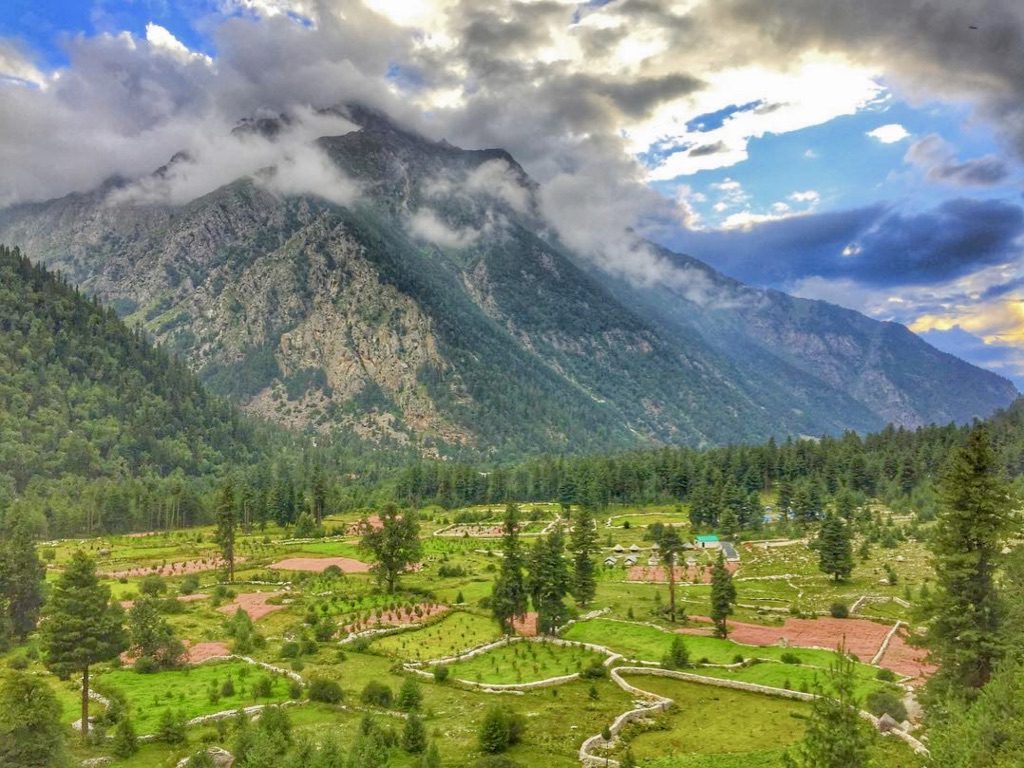
Of all the road trips I have planned and tracked through this blog over the years, the Kinnaur-Spiti circuit is the one that gets the most repeat travelers. People do it once and want to go back. The reason is simple. It gives you two completely different Himalayan experiences in a single trip. The green, apple-scented valleys of Kinnaur and the stark, Buddhist monastery-studded desert of Spiti are not just different landscapes. They feel like different worlds.
If you have 10 days, do the 10-day plan and do not rush Chitkul or Tabo. If you have 14 days, add Pin Valley and take it slow in Langza. If time is really short, do Kinnaur only for 7 days and plan the full circuit next time. But once you see the Spiti River from the Nako cliffs, you will understand why one valley is never enough 🙂 …
If you have done this circuit recently and have fresh road condition intel, share it too. That kind of real-time community update is what makes planning these trips actually possible.
If you have any questions, feel free to ask in the comments section below 🙂
Related reading: Sarahan and Bhimakali Temple guide, Hindustan Tibet Road attractions, Langza, Komic and Hikkim day trip from Kaza and Key Monastery and Kibber sightseeing. Want company on the road? Join the DwD travel community to find travel partners.
