


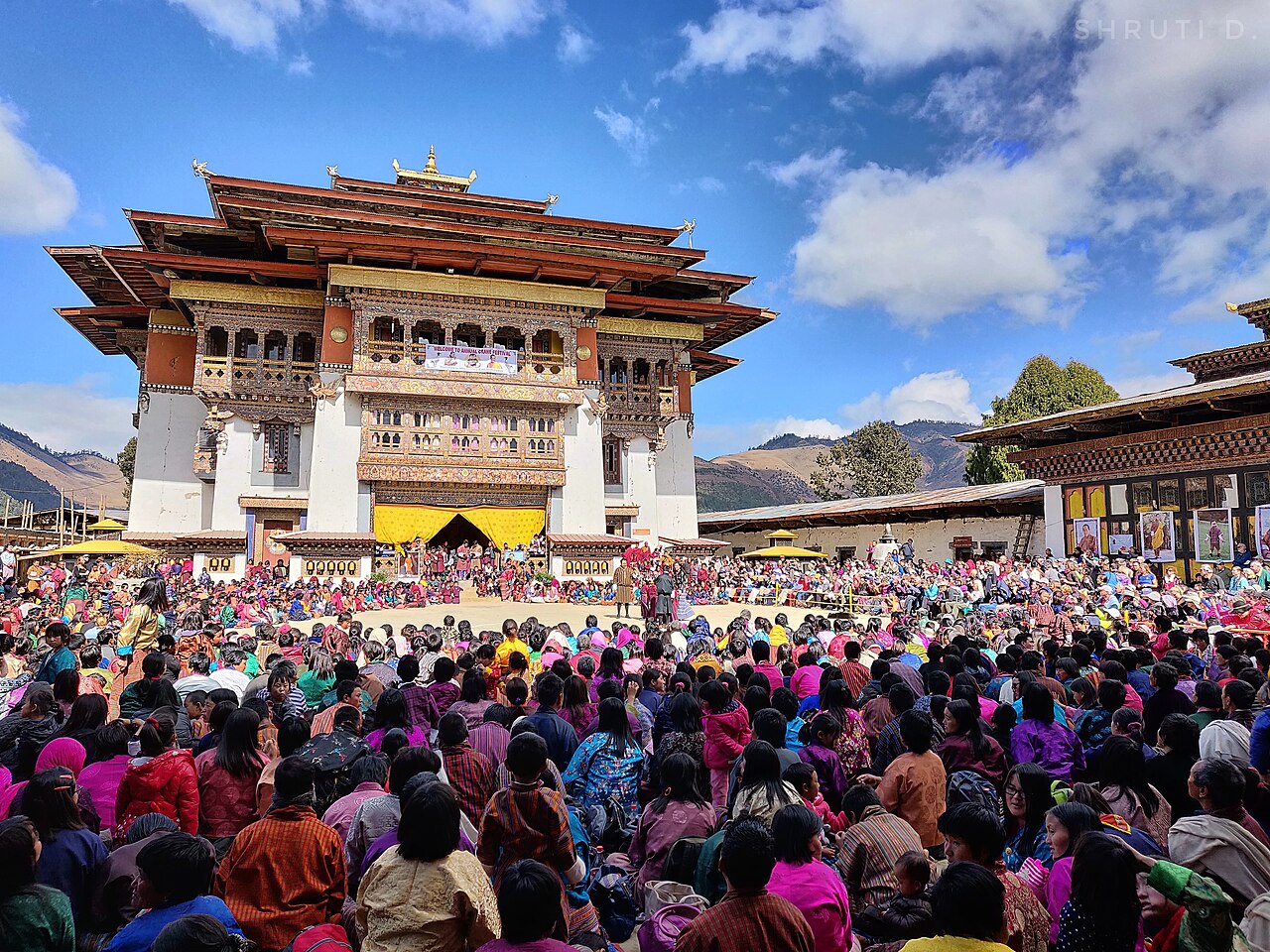
The Black-Necked Crane Festival 2026 falls on Wednesday, 11 November, in the courtyard of Gangtey Goenpa in Bhutan’s Phobjikha Valley. If you are reading this in early November, you can still make it, but only just. Rooms in the valley are limited, and the Route Permit is issued only on working days. This guide covers how to reach Phobjikha from India, where to stay, what the festival day looks like, and what the trip really costs for an Indian traveller.
Let me be upfront, my friend. I have not attended the crane festival myself, so this guide is based on research. Crane numbers come from the Royal Society for Protection of Nature (RSPN) counts as reported by BBS, permit and SDF rules come from our own Bhutan permits guide, and bus timings come from our Bhutan bus schedules guide. Hotel prices from listings are marked “approximate”. When we planned the DoW Mega Meet in Bhutan in 2016, Gangtey got two full nights, 18 and 19 November, because of the cranes. That instinct still holds 🙂
Quick Answer: How Do You Plan the Black-Necked Crane Festival Trip?
The festival is on 11 November 2026 at Gangtey Goenpa, Phobjikha, about 130 to 140 km (4.5 to 5.5 hours) from Thimphu. Indians need a free Entry Permit, a free Route Permit, and the Rs 1,200 per night SDF. Plan 5 nights in Bhutan, with 2 in Phobjikha. Budget Rs 14,100 to Rs 19,250 per person on a shoestring.
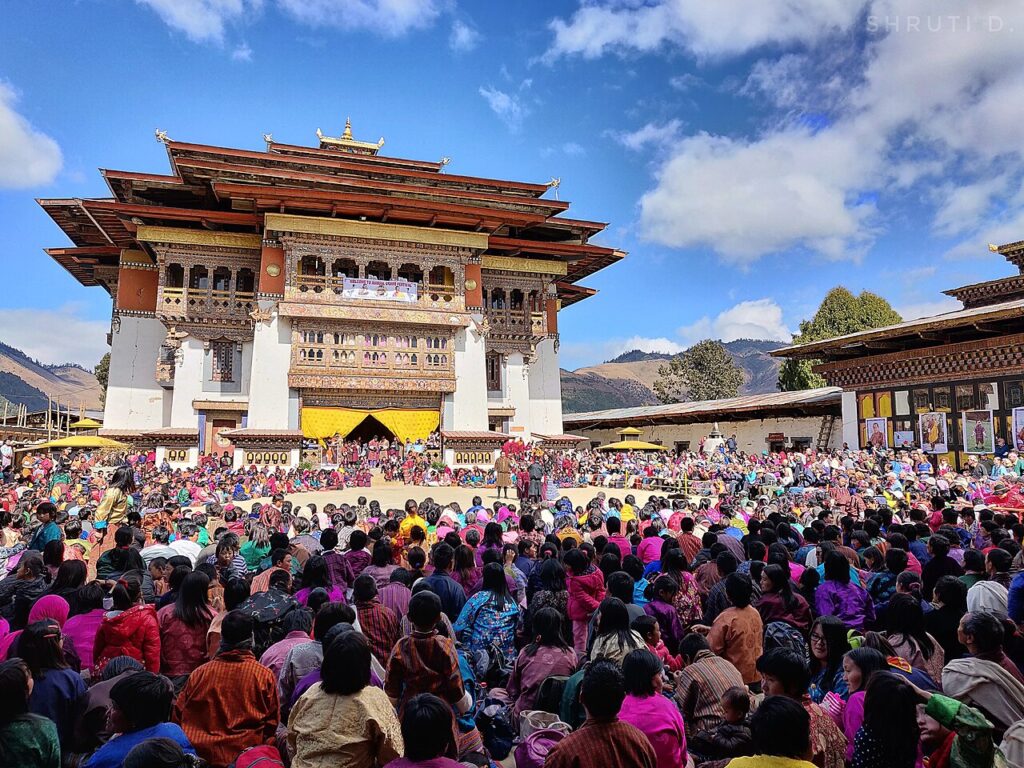
Phobjikha and the Crane Festival at a Glance
| Festival date | Wednesday, 11 November 2026 (fixed every year). A few older listings say 12 November, so confirm with RSPN or your hotel |
| Venue | Courtyard of Gangtey Goenpa, Phobjikha Valley, Wangdue Phodrang district |
| Organiser | RSPN with the local Phobjikha Environment Management Committee, since 1998 |
| Altitude | About 3,000 m on the valley floor |
| From Thimphu | About 130 to 140 km, 4.5 to 5.5 hours via Dochu La and Wangdue |
| From Punakha | About 80 to 85 km, 2.5 to 3 hours via Lawa La |
| Cranes in the valley | Late October to mid-February. Around 650 counted in Phobjikha in the 2024-25 RSPN winter count |
| Permits for Indians | Entry Permit + Route Permit (both free) + SDF Rs 1,200 per person per night |
| Budget, 5 nights per person | Rs 14,100 to Rs 19,250 (shoestring), Rs 27,475 to Rs 47,200 (mid-range), excluding travel to the border |
| Mobile network | B-Mobile and TashiCell. Indian SIMs only work near Phuentsholing |
| Difficulty | Easy. Road access, short walks, cold nights |
| Last verified | November 2026 |
When Is the Black-Necked Crane Festival 2026 and What Happens on the Day?
Quick answer: the festival is held every year on 11 November, also the Fourth King’s birth anniversary and a national holiday. It is a one-day event in the Gangtey Goenpa courtyard, with a crane dance by schoolchildren, masked dances, folk songs and conservation dramas. No 2026 timetable had been published when I wrote this.
RSPN started the festival in 1998 with the Phobjikha Environment Management Committee. The idea was clever. Phobjikha’s farmers share their fields with hundreds of endangered birds every winter, so the festival turns the cranes into something the valley celebrates and earns from. It has been held in the Gangtey Goenpa courtyard since 2005.
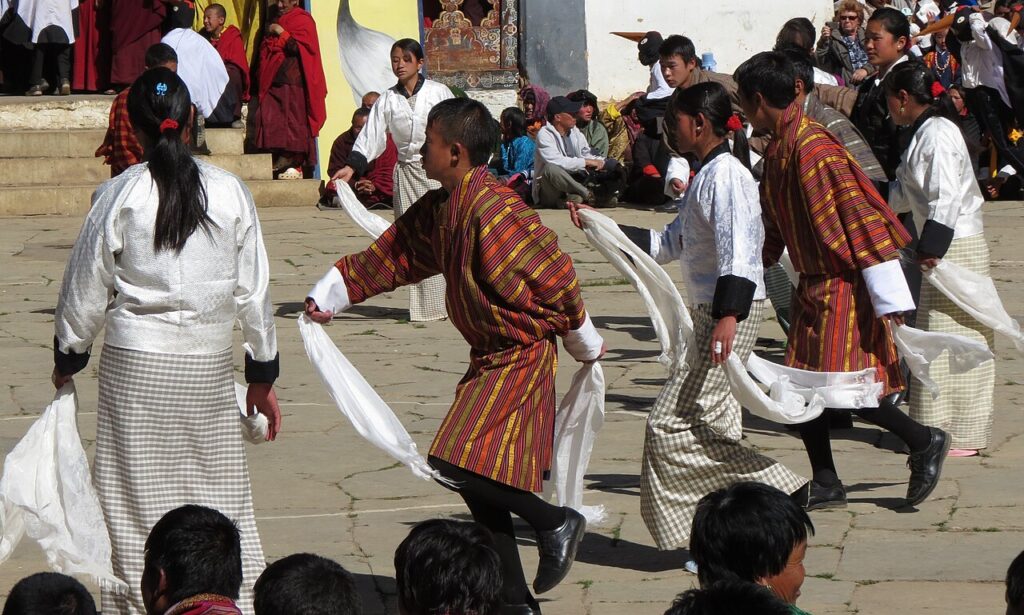
Here is what the programme usually includes, based on past RSPN programmes and reports from people who have attended:
- The crane dance: the highlight. Schoolchildren dressed as black-necked cranes bob their heads and flap their wings, copying the birds’ courtship dance.
- Masked dances (cham): performed by monks of Gangtey Goenpa.
- Folk songs and dances: by students and local groups.
- Conservation dramas: short plays with crane and environment themes, mostly in Dzongkha.
- Speeches and the opening ceremony: officials, conservationists and community leaders attend.
Timing: an old RSPN programme had guests arriving at 9:30 AM and the opening around 10 AM, with the event running into the afternoon. That is from 2012, so treat it as a rough guide only. Hence, I suggest being at the courtyard by 9 AM to get a spot where you can actually see the dancing. The courtyard fills up with locals, schoolchildren, officials and tourists.
Keep in mind that this is a different event from the Gangtey Tshechu, the monastery’s own religious festival. The Tshechu follows the lunar calendar and fell on 24 to 26 September in 2026, as I covered in the best time to visit Bhutan guide. People mix the two up all the time.
How Many Black-Necked Cranes Come to Phobjikha, and When?
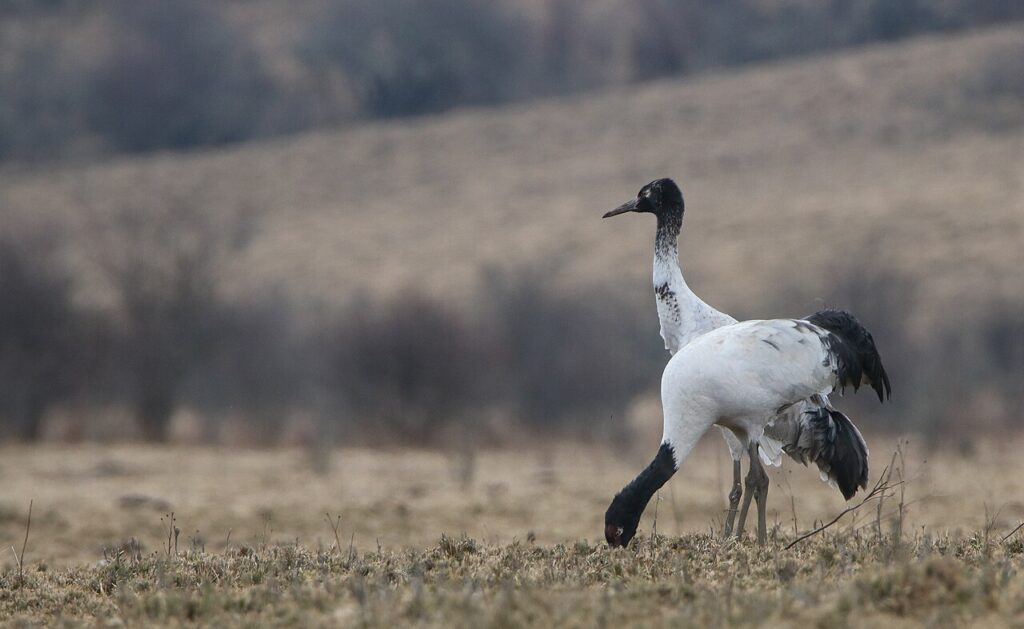
Quick answer: the cranes arrive from the Tibetan plateau in late October and leave around mid-February. Phobjikha holds most of Bhutan’s cranes, around 650 in the 2024-25 RSPN count reported by BBS. Mid-November, when the festival happens, is a good time to see them.
As per the BBS report on the RSPN count, Phobjikha recorded 650 cranes, 41 more than the winter before, while Bumdeling in Trashi Yangtse dropped to 59. A handful also winter in Tang and Chhumey in Bumthang, Khotokha in Wangdue, and Lhuentse. So if you only have time for one crane valley, it is Phobjikha, by a long way.
Locally the bird is called Thrung Thrung Karmo, and it is sacred. There is a popular belief that the cranes circle Gangtey Goenpa three times when they arrive in autumn and again before they fly back to Tibet. Whether you see that or not, watching them settle into the marsh at dusk is the reason most people make this drive.
Here is a detail I love. To protect the cranes, overhead power lines were never allowed across the valley, so Phobjikha was connected to the national grid by underground cable. India has a connection too. The same species breeds in Ladakh, as I wrote in my Tso Moriri guide, India’s only black-necked crane breeding ground.
What Permits Do Indians Need for Phobjikha?
Quick answer: no visa. You need a free Entry Permit (at Phuentsholing, Paro airport, or online via immi.gov.bt), which covers only Thimphu and Paro, and a free Route Permit from the Thimphu Immigration Office on a weekday to go to Phobjikha. You also pay the Sustainable Development Fee of Rs 1,200 per person per night.


The full process is in my Bhutan permits guide for Indians, so here are only the points that matter for a festival trip:
- Valid ID: Indian passport with 6+ months validity, or Voter ID. Aadhaar, PAN and driving licence are not accepted.
- The weekday trap: the Route Permit is issued only on working days. In 2026, 11 November is a Wednesday, so be in Thimphu on Monday 9 November at the latest. If you land in Thimphu on a weekend, you will lose a day.
- List Phobjikha and Punakha together on your Route Permit application, so you do not have to go back.
- SDF: Rs 1,200 per person per night, Rs 600 for children aged 6 to 12, free for children aged 5 and under. You can pay it while applying online on the Bhutan Immigration portal.
About guides: reports conflict on whether Indian tourists must hire a licensed guide for travel beyond Thimphu and Paro. Some official travel advisories say yes, and some recent travel reports say it was not asked for. Hence, ask the immigration officer directly when you collect your Route Permit. If a guide is required, your hotel or a licensed Bhutanese operator can arrange one, and you should add that cost to your budget.

How to Reach Phobjikha Valley from India
Quick answer: most Indians enter by road at Jaigaon-Phuentsholing (West Bengal), go to Thimphu for the Route Permit, then drive via Dochu La and Wangdue to Phobjikha. Flyers land at Paro, about 1 to 1.5 hours before Thimphu. By public bus, the easiest link is Wangdue to Phobjikha, which runs daily.
By Road from Phuentsholing (the classic Indian route)
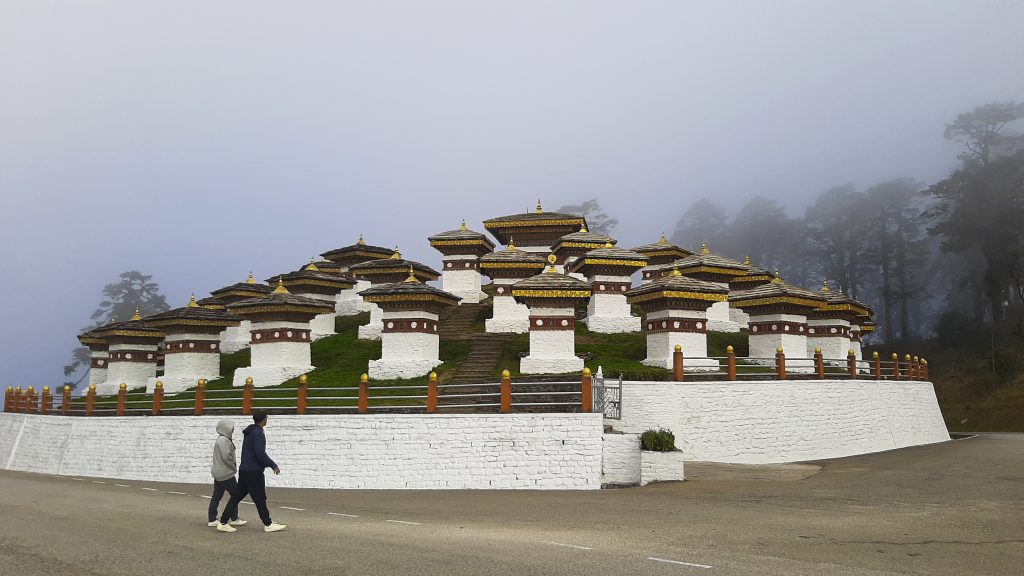
Reach Jaigaon from Siliguri or from Hasimara, the closest railhead. Cross into Phuentsholing, get your Entry Permit, and take a bus or taxi to Thimphu. Our bus guide lists the Phuentsholing to Thimphu bus at around 6 to 7 hours and BTN 180 to 225. From Thimphu, the drive to Phobjikha goes over Dochu La (about 3,100 m), down to Wangdue, and then climbs over Lawa La (about 3,300 m) into the valley. The last stretch from Wangdue has more than 30 hairpin bends, so if you get motion sickness, carry medicine.
By Air via Paro
Paro is Bhutan’s international airport, with flights from Indian cities including Delhi and Kolkata (check Druk Air and Bhutan Airlines for current routes and fares). You get your Entry Permit on arrival. Paro to Thimphu takes about 1 to 1.5 hours, and then it is the same road to Phobjikha. Flying saves a long road day, which matters when the date is fixed.
By Public Bus
Buses to Phobjikha exist, but they are infrequent. As per the operator timetables compiled in our Bhutan bus guide (not re-verified route by route in 2026, so treat them as a guide):
| Route | Operator | Days | Departs | Arrives |
|---|---|---|---|---|
| Thimphu to Phobjikha | Lhakpa Transport | Thu, Sat | 9:00 AM | 3:30 PM |
| Wangdue to Phobjikha | Lhakpa Transport | Daily | 2:30 PM | 6:00 PM |
| Phuentsholing to Phobjikha | Lhakpa Transport | Tue | 7:30 AM | 5:30 PM |
| Punakha to Phuentsholing (for the return) | Meto Transport | Tue, Fri, Sun | 7:30 AM | 4:00 PM |
In 2026 the direct Thimphu bus does not run on Tuesday 10 November. So, for a festival trip, take a morning bus from Thimphu to Wangdue and connect to the daily 2:30 PM Wangdue to Phobjikha bus. Book at the Thimphu bus terminal or on the Druk Ride app the day before, because festival week is busy.
Where to Stay in Phobjikha During the Crane Festival
Quick answer: choose a farmhouse homestay for the real valley experience and the lowest price (one listed rate is Nu 1,000 per person with breakfast and dinner), a mid-range hotel (my rough estimate is Rs 3,750 per room per night, verify locally), or a luxury lodge. Festival week rooms are limited, so book as early as you can.
Phobjikha is a farming valley, not a town. There is no hotel strip, which is why it is lovely and also why rooms run out around 11 November.
| Type | What you get | Approximate price |
|---|---|---|
| Farmhouse homestay | Room in a traditional Bhutanese house, home-cooked dinner and breakfast, a bukhari (wood stove) in many homes, and a host who knows where the cranes feed | One listed rate: Nu 1,000 per person with 2 meals. Expect around Nu 1,000 to 1,500. Verify locally |
| Mid-range hotel | Heated or semi-heated rooms, restaurant, some with valley views | Rough estimate of Rs 3,750 per room per night, more in festival week. Verify locally |
| Luxury lodge | Gangtey Lodge, Amankora Gangtey, Six Senses Gangtey and similar. Full board, guided walks | Typically hundreds of US dollars per night. Check directly |
My honest suggestion is the homestay. The festival exists to help local families earn from conservation, and a homestay puts your money straight into that. Ask for a room with a stove, close enough to Gangtey Goenpa to walk on festival morning.
In case everything in Phobjikha is full, stay in Wangdue or Punakha and do a day trip on 11 November. It means leaving very early (2.5 to 3 hours each way from Punakha), but it works. You will miss the dusk and dawn crane watching, though, which is half the magic.
What Else Can You Do in Phobjikha Besides the Festival?
Quick answer: visit Gangtey Goenpa, stop at the RSPN Black-Necked Crane Information Centre and look at the cranes through its spotting scopes, walk the 1.5-hour Gangtey Nature Trail, and go crane watching at dawn and dusk from the valley edge. Two nights is the right amount of time.
Gangtey Goenpa
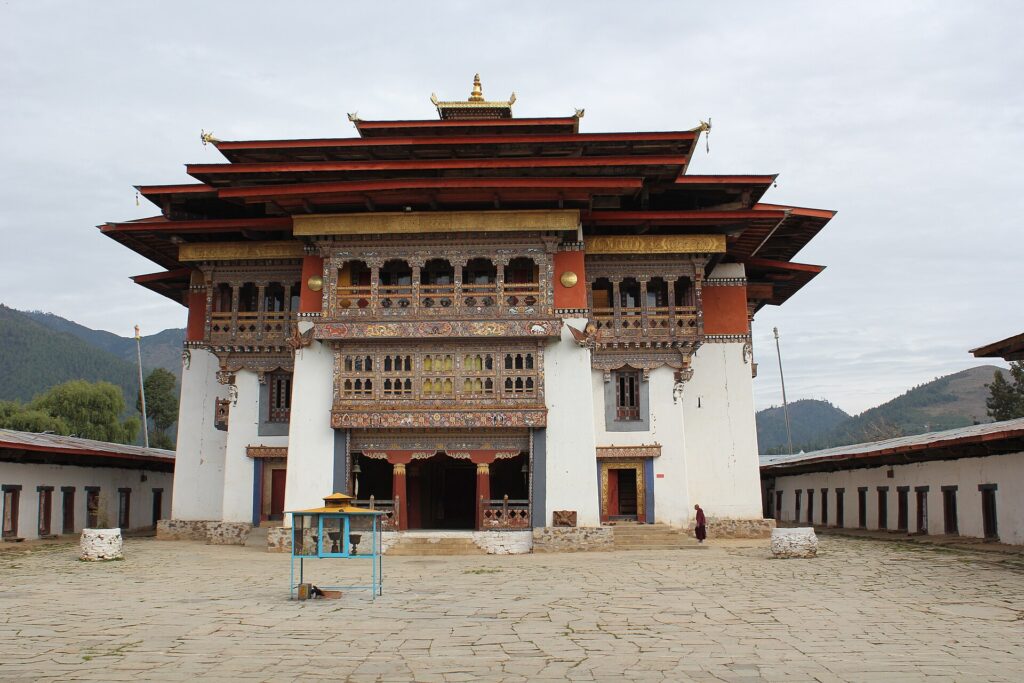
The monastery sits on a ridge above the valley and is the main seat of the Pema Lingpa tradition of the Nyingma school. It dates to the early 17th century, and the renovated monastery was consecrated in 2008. Dress modestly (full sleeves and long trousers or skirts), and do not photograph inside the temples. On festival day you will be standing in its courtyard anyway, so visit the inner halls on the day before or after, when it is quiet.
Black-Necked Crane Information Centre
Run by RSPN on the edge of the wetland, the centre has an observation room with spotting scopes, so you can see the cranes clearly without walking into the marsh. It also explains the valley’s conservation story, which makes the festival make more sense. Entry fees have been charged since 2015, but the amounts I found online conflict, so carry some cash and verify locally. Hours reported by travel guides are roughly 9 AM to 5 PM, often with a lunch break.
Gangtey Nature Trail
This is the walk I would not skip. The trail starts at the mani stone wall just north of Gangtey Goenpa, goes down through Semchubara village and pine forest, and ends at Khewang Lhakhang, taking about 1.5 hours. Along the way you pass a viewpoint over the marsh where the cranes roost. Do it on the morning after the festival, when the valley is quiet again. My Western Bhutan travel guide also covers the longer Shashi La trail (3 to 4 hours) and the mountain biking routes in the valley.
Crane Watching Etiquette
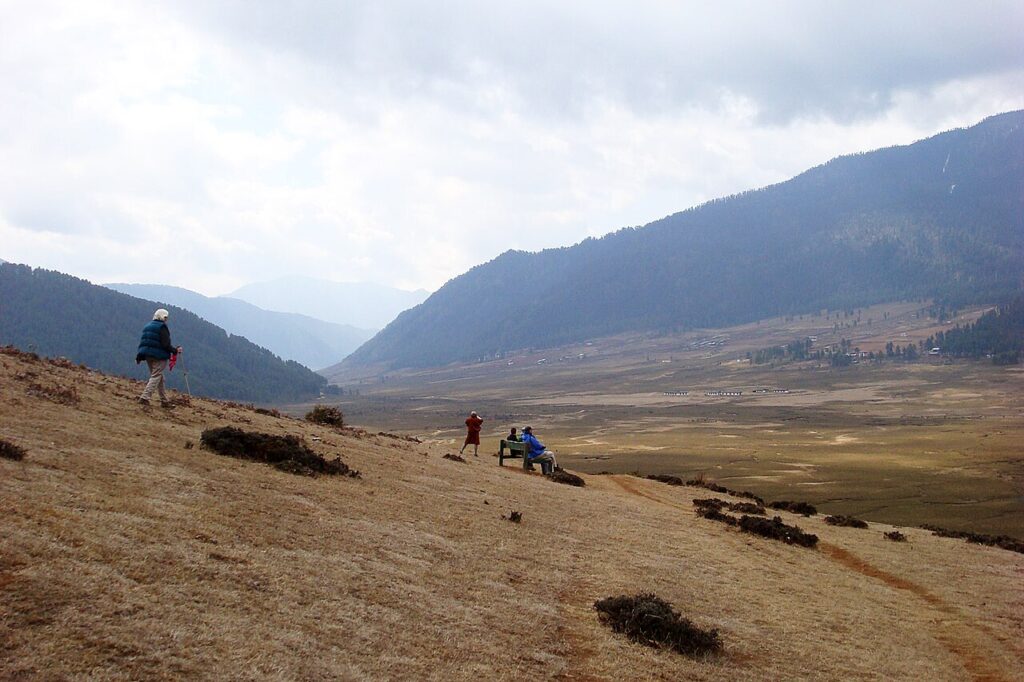
Phobjikha is a protected conservation area of about 163 sq km managed by RSPN, and its wetland is on the Ramsar list. Please follow these simple rules:

- Stay on the trails and roads. Do not walk into the marsh or chase the birds for a closer photo.
- Keep your voice low and avoid sudden movement, especially at dawn and dusk when the cranes fly in and out of their roost.
- Do not fly a drone. Drones need prior permission in Bhutan, and the noise disturbs the birds.
- Do not use flash or torches pointed at the roosting area after dark.
- Carry your trash back. Plastic in a wetland reaches the birds.
A 5-Night Crane Festival Itinerary from Phuentsholing
Quick answer: enter on Sunday 8 November, get the Route Permit in Thimphu on Monday 9 November, reach Phobjikha on Tuesday 10 November, attend the festival on Wednesday 11 November, move to Punakha on 12 November and exit on Friday 13 November. That is 5 nights in Bhutan and 5 nights of SDF.
| Day | Date (2026) | Plan | Night |
|---|---|---|---|
| 1 | Sun 8 Nov | Cross at Phuentsholing early, Entry Permit, bus or taxi to Thimphu (6 to 7 hrs) | Thimphu |
| 2 | Mon 9 Nov | Route Permit at Thimphu Immigration Office (list Phobjikha and Punakha). Thimphu sightseeing in the afternoon | Thimphu |
| 3 | Tue 10 Nov | Thimphu to Phobjikha via Dochu La and Wangdue. Crane centre, dusk crane watching | Phobjikha |
| 4 | Wed 11 Nov | Black-Necked Crane Festival at Gangtey Goenpa | Phobjikha |
| 5 | Thu 12 Nov | Dawn cranes, Gangtey Nature Trail, then to Punakha (2.5 to 3 hrs). Punakha Dzong | Punakha |
| 6 | Fri 13 Nov | Punakha to Phuentsholing (Meto bus at 7:30 AM on Fridays), exit to India | – |
If you fly in to Paro instead, replace Day 1 with Paro and do Tiger’s Nest on the way out, which adds a night. My Tiger’s Nest hiking guide has the details. For a longer loop that continues east from Phobjikha to Trongsa and Bumthang, see the Central Bhutan guide and my 7-day Bhutan road trip itinerary.
How Much Does a Phobjikha Crane Festival Trip Cost?
Quick answer: for the 5-night plan above, expect roughly Rs 14,100 to Rs 19,250 per person on a shoestring (buses, guesthouses, a homestay in Phobjikha) and Rs 27,475 to Rs 47,200 mid-range (shared taxi, hotels), excluding travel to the border. The SDF alone is Rs 6,000.
These are estimates built from the per-day ranges in my Bhutan trip cost guide plus the Phobjikha stay prices above. Festival week can push room rates up, so treat the upper end as more likely.
| Cost (per person, 5 nights) | Shoestring | Mid-range |
|---|---|---|
| SDF (Rs 1,200 x 5 nights) | Rs 6,000 | Rs 6,000 |
| Stay (Thimphu 2, Phobjikha 2, Punakha 1) | Rs 3,500 to 5,250 | Rs 9,375 to 20,000 (twin sharing) |
| Food (6 days) | Rs 2,400 to 3,600 | Rs 4,800 to 7,200 |
| Transport inside Bhutan | Rs 1,200 to 2,400 (buses) | Rs 4,800 to 9,000 (shared taxi) |
| Sightseeing and entry fees | Rs 1,000 to 2,000 | Rs 2,500 to 5,000 |
| Entry Permit and Route Permit | Free | Free |
| Total | Rs 14,100 to 19,250 | Rs 27,475 to 47,200 |
A few money tips. Indian rupees are accepted at par with the ngultrum, but carry enough cash because Indian cards do not always work and ATMs are thin outside Thimphu and Paro. If you are looking to cut costs further, my budget Bhutan tips go deeper.
Weather, Safety and Packing for Phobjikha in November
Quick answer: November days in Phobjikha are usually clear and sunny, but at about 3,000 m the nights are very cold, and frost is common by mid-November. Pack proper winter layers, start drives early, and allow for slow mountain roads. Altitude sickness is uncommon at this height, but take it easy on your first evening.
- Layers: thermal innerwear, a fleece, a down or padded jacket, a woollen cap and gloves. The festival courtyard is sunny but you sit on stone for hours, so carry a small mat or cushion.
- Roads: the Wangdue to Phobjikha road has many hairpin bends, and the passes can get frost or snow on early mornings. Drive in daylight. Check road conditions with your hotel or driver the evening before.
- Altitude: about 3,000 m is lower than most of Ladakh or Spiti. Drink water and skip heavy drinking on the first night.
- Dress code: wear full sleeves and long trousers or skirts to the monastery. Remove caps and shoes where asked.
- Emergency: carry your hotel’s number and your driver’s number. Medical facilities in the valley are basic, and Wangdue and Punakha are the nearest towns with hospitals.
- Network: buy a Bhutanese SIM (B-Mobile or TashiCell) at Phuentsholing or Paro. Indian SIMs work only near the border.
If you are travelling alone, my solo trip to Bhutan guide has more on safety and logistics. Keep in mind that the cranes are wild birds, so no one can promise you a close sighting. Spotting scopes and patience at dusk are your best bets.
Related Reading on DwD
- Western Bhutan travel guide: Thimphu, Paro, Punakha and Phobjikha
- Bhutan permits for Indians: Entry Permit, Route Permit and SDF
- Bhutan’s national parks and wildlife sanctuaries
- Best time to visit Bhutan, month by month with festivals
- Bhutan travel guide for first-timers
Frequently Asked Questions About the Black-Necked Crane Festival
When is the Black-Necked Crane Festival in 2026?
Wednesday, 11 November 2026, in the courtyard of Gangtey Goenpa in Phobjikha Valley. The date is fixed every year and coincides with the birth anniversary of the Fourth King. A few older listings say 12 November, so confirm with RSPN or your hotel.
Is there an entry fee for the crane festival?
I could not find a confirmed ticket price for 2026. It is a community event in a monastery courtyard, and tourist contributions support crane conservation. Ask RSPN or your hotel before you go, and carry some cash for donations.
Do Indians need a permit for Phobjikha Valley?
Yes. The Entry Permit covers only Thimphu and Paro, so you need a free Route Permit from the Thimphu Immigration Office, issued on working days. You also pay the SDF of Rs 1,200 per person per night. No visa is needed.
How far is Phobjikha from Thimphu?
About 130 to 140 km, which takes 4.5 to 5.5 hours via Dochu La and Wangdue. From Punakha it is about 80 to 85 km, or 2.5 to 3 hours, over Lawa La.
Is there a bus to Phobjikha?
Yes, but not every day from Thimphu. Operator timetables list a Thimphu to Phobjikha bus on Thursday and Saturday at 9 AM, and a daily Wangdue to Phobjikha bus at 2:30 PM. Verify at the bus terminal before travel.
When can you see black-necked cranes in Phobjikha?
From late October to around mid-February. November to January are reliable months. Dawn and dusk, when the cranes fly to and from their roost in the marsh, are the best times to watch.
How many cranes winter in Phobjikha?
The 2024-25 RSPN count, reported by BBS in February 2025, recorded 650 cranes in Phobjikha. I did not find a newer published count.
How much does a Phobjikha crane festival trip cost from India?
For 5 nights in Bhutan, roughly Rs 14,100 to Rs 19,250 per person on a shoestring and Rs 27,475 to Rs 47,200 mid-range, excluding travel to the border. The SDF alone is Rs 6,000 for 5 nights.
Final Thoughts: Is the Black-Necked Crane Festival Worth the Trip?
Yes, if you plan around two hard constraints: the Route Permit is a weekday job in Thimphu, and Phobjikha has very few rooms. Get both sorted and you get something rare, a festival that exists for a bird, in a valley that buried its power lines for the same bird. Stay two nights, choose a homestay, sit in the courtyard on 11 November, and walk the nature trail the next morning. The RSPN website is the best place to check for the final programme, and Wikipedia’s Phobjikha page has more on the valley’s history.
Since this guide is based on research and not my own festival visit yet, your updates matter a lot. If you have attended the crane festival, please share the timings, what your homestay cost and how many cranes you saw in the comments, so the DwD community gets current numbers. Feel free to share this guide with anyone planning Bhutan this November.
If you have any questions, feel free to ask in the comments section below 🙂
