


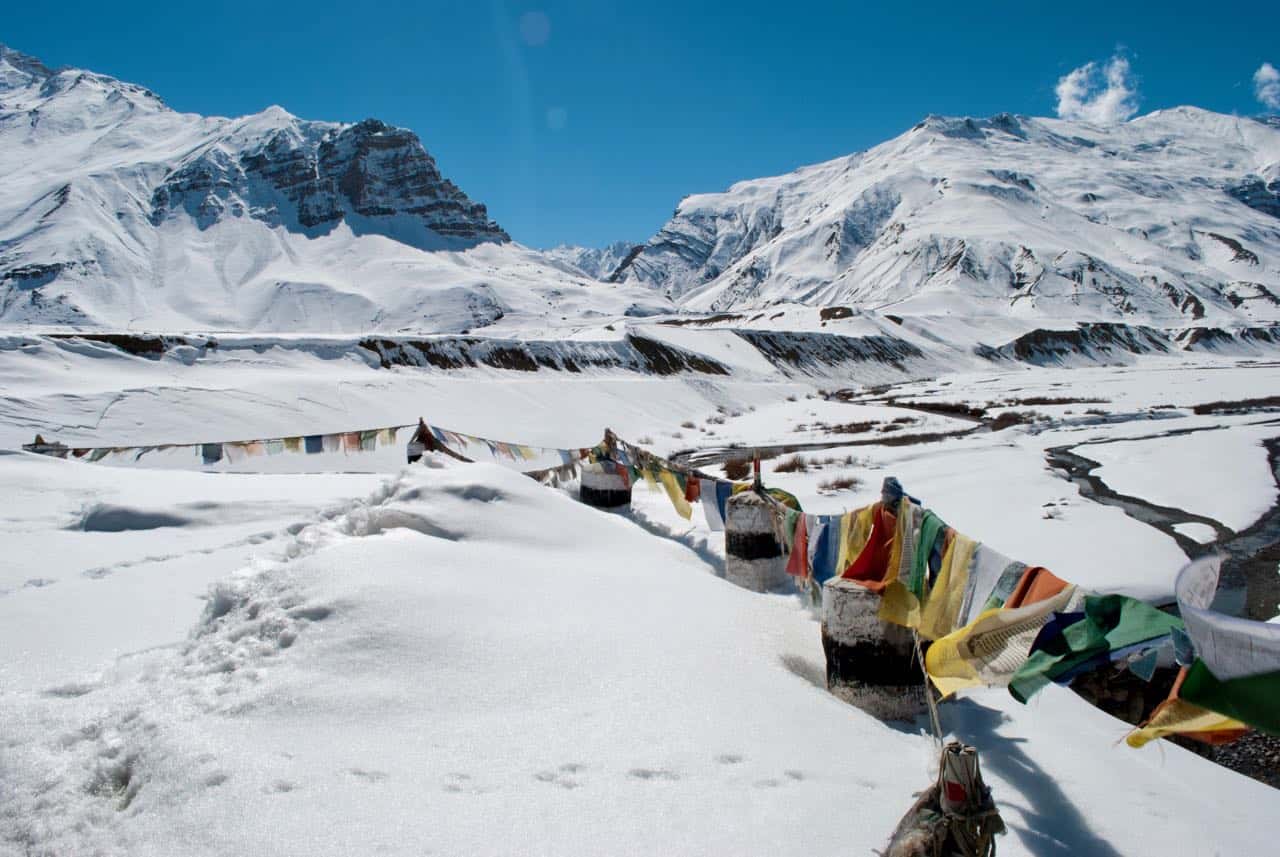
It is no longer a surprise that so many people plan a trip to Spiti Valley in March nowadays. Social media and Instagram reels have ensured that Spiti Valley does not remain a hidden paradise for travelers even in the winter months of January to March.
While the best time to visit Spiti Valley is May to September, more enthusiastic folks are venturing into Spiti in March for a high level of adrenaline and adventure.
But before you travel into such a cold desert of the trans-Himalayas in winters, knowing a few essential things will help in better planning and enjoying the overall experience of such an adventure trip.
Here is something most guides will not tell you upfront. At 12,000+ feet in March, you can genuinely get sunburned and frostbitten on the same day, thanks to fierce high-altitude UV bouncing off fresh snow while the wind chill is doing its own damage on the shaded side of your face. Keep that in mind as you read on, because it sets the tone for how you should pack and plan this trip.
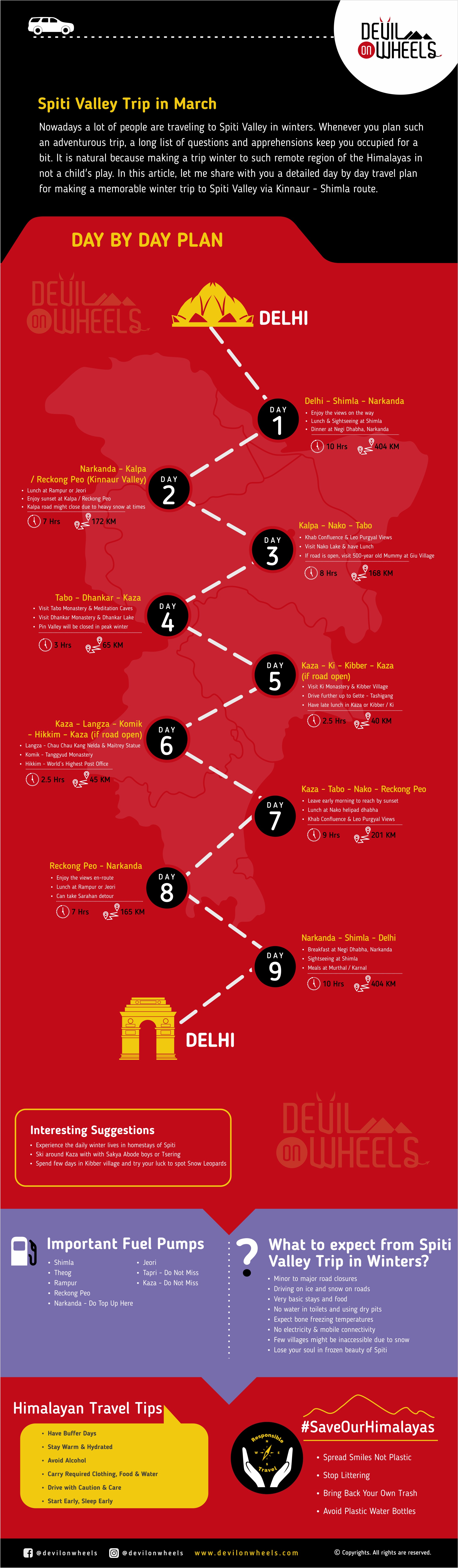
Download your FREE high-resolution version pdf copy of this Spiti in March day by day plan infographic guide. If you liked it and found it helpful, please feel free to share it with your family and friends to help them too.
Let's quickly dive into the details:
Quick Practical Info for Spiti Valley in March
Spiti Valley in March runs -5 to 5°C by day and -15 to -25°C at night, milder by the last week than the first. Malling Nala near Nako stays a genuine black ice trap through February and into March, with somewhat less snow and ice in January. Hence, time your drive for after sunrise.
| Best Route | Delhi – Shimla – Kinnaur – Kaza (Manali route closed Nov-May) |
| Temperature | Day: -5 to 5 C | Night: -15 to -25 C | Wind chill: below -20 C |
| Road Conditions | Snow and black ice common, especially near Nako and Schichiling. 4×4/SUV recommended. |
| Accommodation | Homestays only in most areas (Rs 500-1,000/night with meals). A few hotels open in Kaza. |
| Budget | Rs 1,000-1,500/day per person (stay + food). Carry Rs 20,000-25,000 cash minimum. |
| Entry Fee (Winter) | SADA fee at Sumdo checkpoint (per a Feb 2026 ADC Kaza-Tabo order): Rs 100 two-wheeler, Rs 200 car, Rs 300 SUV/MUV, Rs 400 bus. 4×4 owners need prior permission from ADC Kaza (verify locally, rules can shift). |
| Public Transport | HRTC bus Reckong Peo to Kaza runs daily, around Rs 550 one-way (verify locally, fares vary Rs 400-600). Kaza to Kibber bus if roads clear. |
| Mobile Network | BSNL postpaid works in Kaza. Jio/Airtel patchy. No signal between towns. |
| Key Highlight | Snow leopard spotting season (Jan-Mar) near Kibber and Pin Valley |
| Last Updated | September 2026 |
Can I Travel to Spiti Valley in March?
Quick Answer: Yes, but only via Shimla-Kinnaur. The Manali-Kaza road over Kunzum Pass stays shut from November to May, so a complete Spiti circuit is not possible in March. Expect -25 C nights, black ice near Nako, and a real chance of both sunburn and frostbite in the same day.
As I mentioned earlier, traveling to Spiti Valley in summer is the most pleasant time. But if you are looking for a wonderland called White Spiti, then February and March is the best time to travel for endless snowbound vistas. Keep in mind, only the Shimla-Kinnaur route is accessible in March. The Manali-Kaza road over Kunzum Pass remains closed from November to May.
However, as they say, everything comes with a price, and hence, a winter trip to Spiti Valley in March is no exception. Unless you are prepared well for the ice-age-like climate, the trip to Spiti in winters can turn out to be a nightmare. Hence, in this article, I will help you with certain important aspects that you should keep in mind when planning a trip to Spiti Valley via Kinnaur in March.
What Are the Important Tips for Spiti in March?
Quick Answer: Budget Rs 1,000-1,500/day for stay and food, carry Rs 20,000-25,000 in cash since ATMs stop working past Reckong Peo, pack heavy woolens plus SPF 50+ sunscreen, and build in 2-3 buffer days for snow-blocked roads near Nako and Schichiling.
You should know about these important tips before you plan a Spiti Valley trip in winter. These will help you set the right expectations and decide whether you are ready for such a trip or not.
Temperature and Cold Conditions
As you are planning this trip in winters to Spiti Valley, you must remember that it is called cold desert for a reason. The temperatures in March in Spiti Valley will be mostly sub-zero. Daytime in the sun hovers around -5 to 5 degree Celsius, but it drops to -15 to -25 degree Celsius at night, and the shaded side of a valley can stay well below zero even at noon. The wind chill will make it worse and may push the “feels like” temperature below -20 degree Celsius.
Limited Options to Stay
The second worry factor when planning a trip to Spiti Valley in March is accommodation. In winter, most of the hotels are closed in Spiti Valley. So, you will have to rely on traditional homestays and small guest houses. There are a couple of hotels in Kaza that may operate, however, do not bank on the services. As of 2026, expect to pay around Rs 500-1,000 per night at homestays, which usually includes basic meals.
Hence, it is advised that you carry your camping gear, including a good-rating sleeping bag and tents that can withstand extreme cold in case of need. Sleeping bags are anyways handy when staying at homestays in winters as you may not like or be used to the bedding provided by the hosts. For more details on where to stay, refer to my Spiti Valley homestays guide.
Limited Options to Eat
Much like places to stay shut down in winters in Spiti Valley, the options for eating out are minimal. Fresh raw vegetables or fruits are also hard to buy even in Kaza town. Restaurants or makeshift dhabas in Spiti Valley, as well as on the way, will be closed in March.
As homestays will be available during this time of the year in Spiti Valley, you will be able to eat basic food cooked at the homestay. Kaza’s main market may have a few local eating joints open. You should always pack the food from the homestay for lunch when going on day excursions from Kaza or traveling from one destination to another.
It is always better that you carry some packed food with you, especially when you are self-driving and have the space to carry them.
What Clothes to Carry and What to Pack
The next worry factor is what clothes to pack for the Spiti Valley winter trip. As in March, there will be winter conditions in Spiti Valley, so it is essential to carry layers of heavy woolen clothing so that you can adjust to the cold temperature accordingly.
It is absolutely necessary to carry heavy woolens for a Spiti Valley trip in March. Below is a list of some must-have items to pack when planning such a trip.
- Heavy woolen jacket or parka (windproof)
- Balaclava or monkey cap that covers ears
- Inner thermals (both upper and lower)
- Fleece jacket
- Heavy woolen clothing
- Woolen socks (carry at least 3-4 pairs)
- Warm insulated shoes or trekking boots (waterproof preferred)
- Warm hand gloves (waterproof)
- Sunglasses (UV protection for snow glare)
- High SPF sunscreen (SPF 50+ recommended)
You must also refer to this detailed list of clothes and things to pack for a Spiti Valley trip.
Water Difficulties and Dry Pit Toilets
Please note that due to freezing cold conditions in Spiti Valley in March, the water is frozen everywhere. There will not be any running water in pipes and hence, no running water in the toilets.
You will have to use dry pit toilets (basically a hole in the ground with sand or sawdust) as there will be no water. It also means that you will not be taking a bath unless you want to freeze yourself. Some generous hosts may provide you with hot water in buckets.
Roadblocks Could Be Common
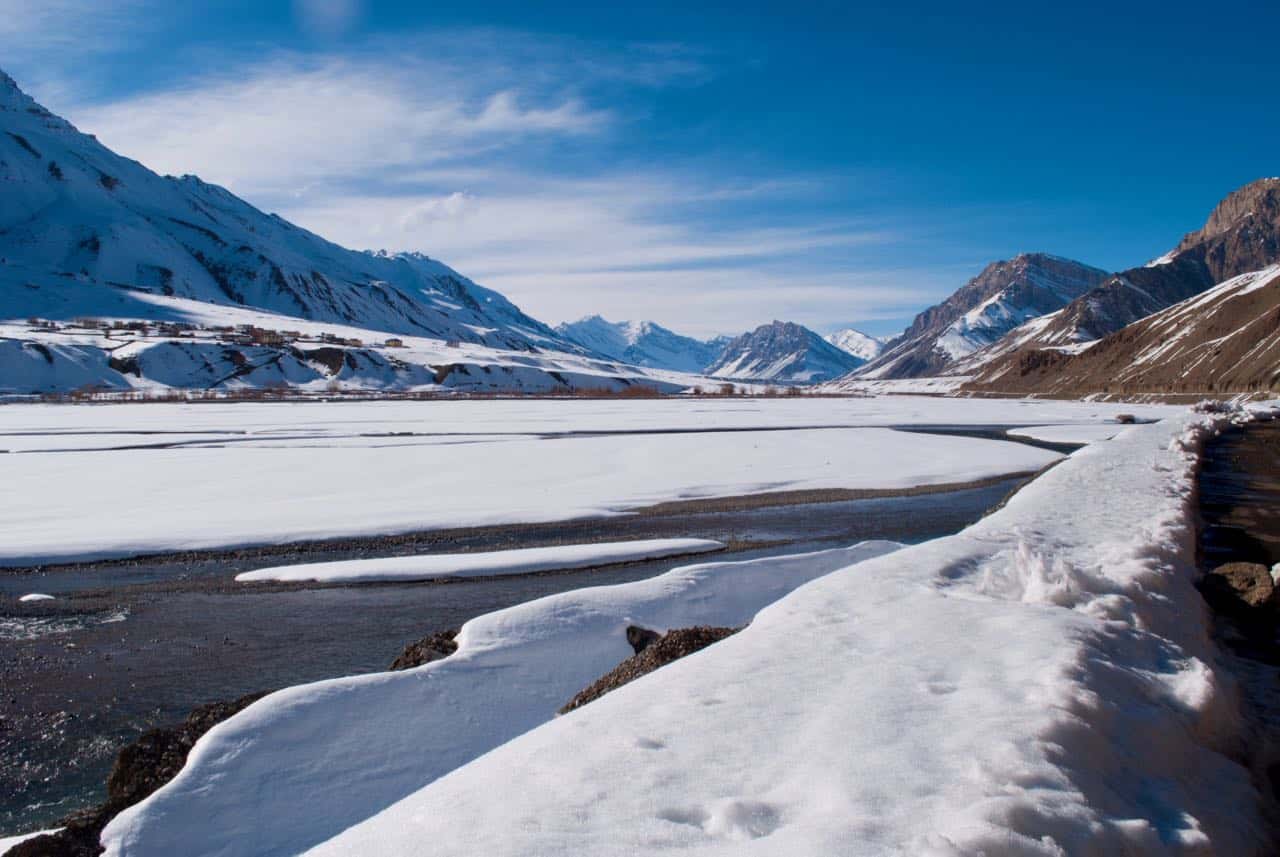
You must plan a trip to Spiti Valley in winter months with a few buffer days in hand. The roads from Shimla to Kinnaur to Kaza might close at several places due to heavy snowfall. Sometimes the roads might get closed for more than a week or even a month as happened a few years back.
Hence, that means you should not have anything critical back home to take care of in case such a road blockage happens. A road blockage of a couple of days is pretty common on a trip to Spiti Valley in winter months like March.


Snowfall Could Be Common in Winters
You should expect snowfall in Spiti Valley in March as well as on the way when you travel from Kinnaur Valley towards Spiti. Starting January, Spiti Valley starts to receive snowfall, and it becomes common in February and March especially.
Hence, you should plan your trip with this thing in mind that you might either get stuck in snowfall or have to return in between back home due to snowfall.
Roads Within Spiti Are Closed
Some of the roads to high villages like Langza, Hikkim, or Komic will be closed in March in Spiti. Similarly, the road from Kaza to Kunzum Pass may be open till Losar village, and you will not be able to reach beyond it.
On the south side of Spiti towards Tabo, the road to Pin Valley is closed in winters as well. Demul and Lhalung villages will also be out of reach due to heavy snow on their approach roads.
Snow and Ice on Roads
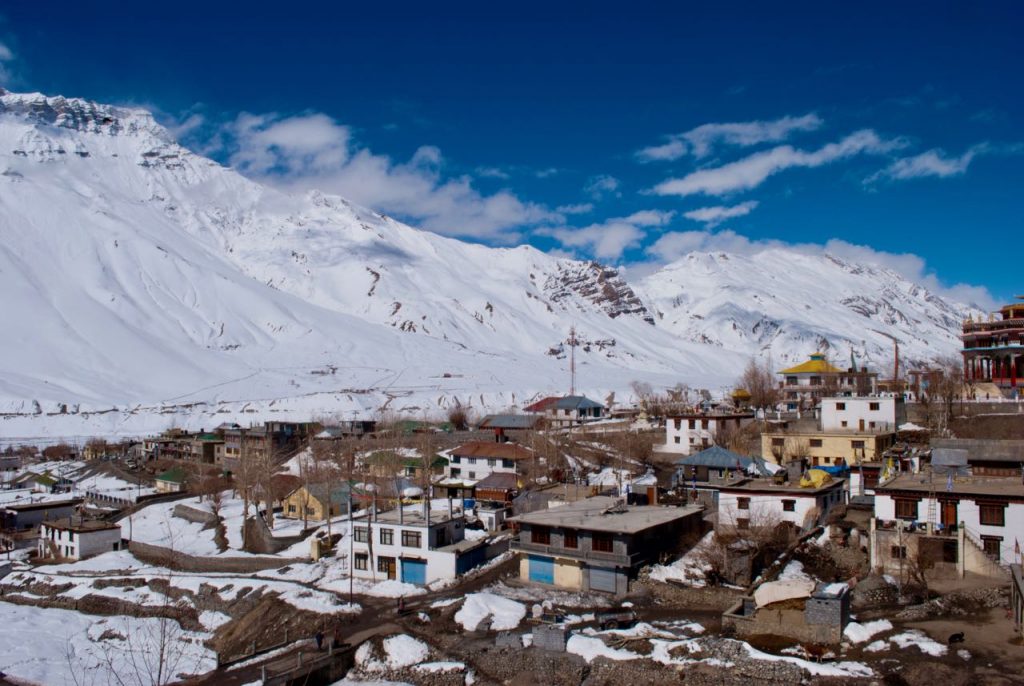
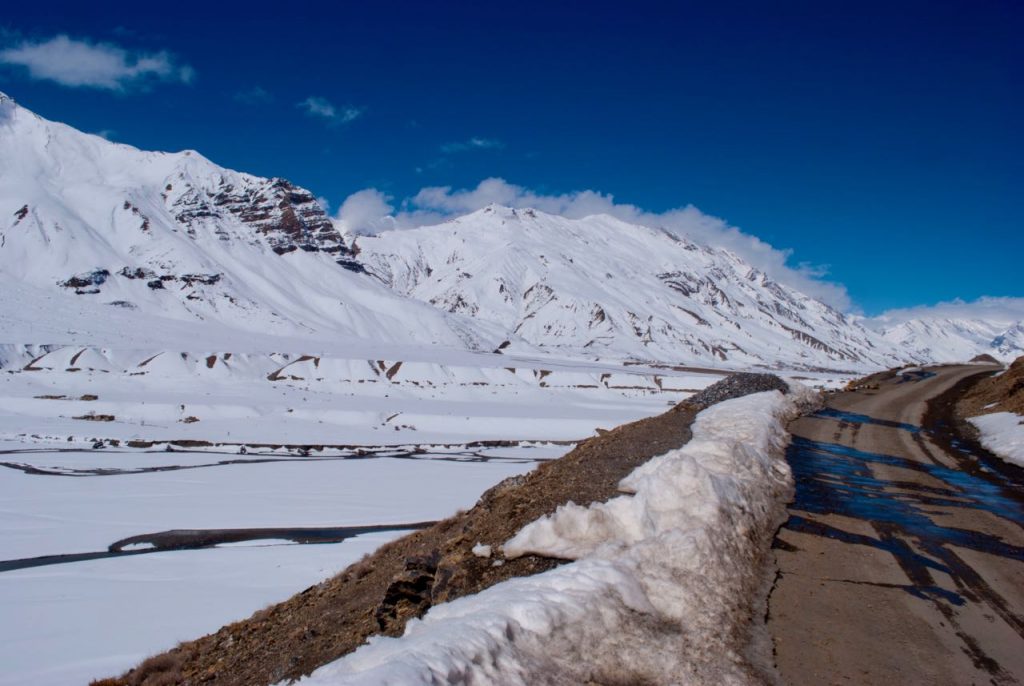
Due to freezing conditions in Spiti in March, the roads do have snow or black ice, especially around Nako and ahead of Schichiling village. So, make sure you are very cautious and careful when driving or riding on such roads.

Malling Nalla near Nako will be frozen, and vehicles do skid around it due to black ice. It is always better to start the day as the sun comes out so that you face less ice on roads. One small mistake can be fatal on such a trip or may get you stuck in the middle of nowhere without any help nearby.
Manali to Kaza Will Be Closed, So No Spiti Circuit Trip
As the road from Manali to Kaza will be closed due to heavy snow at Kunzum Pass and Rohtang Pass, you will not be able to make a complete Spiti circuit in March. The road from Manali to Kaza remains closed in the winter months from November to May.
Hence, you will have to plan a trip from the Shimla side to Spiti Valley and return from the Shimla-Kinnaur side as well. For a detailed route guide, refer to my article on planning a Spiti trip via Kinnaur.
Lakes Are Frozen or Unreachable
The lakes in Spiti Valley like Chandratal, Dhankar Lake, or Sopona Lake freeze in the winter months. From January to April/May, these high-altitude lakes remain frozen and their approach roads are blocked with snow.
Hence, it is better to keep them out of your winter Spiti trip plans. Frozen Nako Lake is one exception since it sits right next to the village and the main road.
Handful of Tourists
Making a winter trip to Spiti Valley is not everybody’s cup of tea. Very few tourists visit places like Spiti Valley in March. Only those who are OK with such harsh and cold conditions brave the adventure of such trips. It may look magical sitting here, but I can tell you from experience that the conditions are tough up there in the high Himalayas.
The best part of having a handful of tourists around is that you get to spend quality time at scenic spots with the least disturbance. You enjoy with locals, stay with them, and experience the authentic life of Spiti.
Budget and Carrying Cash
If you are looking for shared transport to make a budget trip to Spiti Valley in March, do not rely on other tourists being around. You may have to rent a private taxi during winters in Spiti Valley. So, plan your budget accordingly. A private taxi from Reckong Peo to Kaza can cost around Rs 8,000-10,000 one way as of 2026.
Also budget for the SADA entry fee at the Sumdo Army Check Post, the gateway into Spiti from the Kinnaur side. As per a February 2026 order from the ADC Kaza-Tabo office, this runs Rs 100 for two-wheelers up to Rs 400 for buses (Rs 200 for cars, Rs 300 for SUVs and MUVs), and if you are driving a 4×4, you will need prior permission from the ADC Kaza office before you reach Sumdo. Rules like this do shift season to season, so it is worth a call to the ADC office or a check with your homestay host before you set off.
For exact figures across different trip durations, my Spiti Valley budget breakdown covers all major expenses across 7-day, 10-day, and 14-day trips so you can plan your costs before departure.
ATMs in Kaza might not be functional in winter. Hence, you must carry enough cash with you on the Spiti trip to pay your bills. I would recommend carrying at least Rs 20,000-25,000 per person in cash. The last reliable ATMs are at Reckong Peo.
As you will be staying in homestays and eating basic food, the budget for the winter Spiti trip will be in control. You can expect about Rs 1,000-1,500 per day per person in Spiti Valley for stay and food as of 2026.
How Does Public Transport Work in Winter Spiti?
Public transport will be available from Shimla to Reckong Peo, Reckong Peo to Kaza, and Kaza to Kibber if the roads are clear. The HRTC bus from Reckong Peo to Kaza runs daily and costs around Rs 550 per person, though fares can range Rs 400-600 depending on the bus type (as of 2026, verify with HRTC for current fares). Within Spiti Valley as well, some buses and shared local jeeps run for local commute.
You must be wondering why the buses run when the roads are blocked with snowfall?
Well, what happens is that buses start from Reckong Peo or Kaza, and if the roadblock is not that major, both buses will come to respective blocked ends and exchange passengers. The passengers will get down at each end, then walk to the other end.
Of course, you cannot walk 50 KMs in a day. So, in such situations, it is important to know where the blockage is and if you will be able to walk to the other end or not. So, you may need more buffer days when planning a trip to Spiti Valley by public transport.
The bus from Kaza to Key and Kibber villages does run if the roads are clear of snow.
Difficulties with Cars and Bikes
Due to icy conditions in Spiti Valley in March, your vehicles will not perform optimally. The diesel in the supply pipes and even in the tanks may freeze. You may carry antifreeze liquids for your windshield water, but they do not always help based on quality.
Never use the water on the windshield as it will freeze on it immediately due to sub-zero temperatures. Doing this will block the visibility and get you in trouble or stuck for long hours. You might want to use hot water, but PLEASE DO NOT as it might crack the windshield.
As there will not be any mechanic easily available, the best is to make sure you have basic knowledge of repairs.
Fuel or petrol availability in Kaza might be limited at times in winters. It may delay your trip by a day or two. So, as soon as the operator at the petrol pump opens it, do not forget to tank up your vehicle. Otherwise, if you want to be on the safe side, it is best to carry spare fuel with you on a winter trip to Spiti Valley in March.
Sunburn and Frostbites, Sometimes on the Same Day
This one surprises most first-timers. At 12,000+ feet, the UV bouncing off fresh snow is fierce enough to burn exposed skin within an hour, even while the temperature sits well below freezing. So it is entirely possible to walk away from a single day in Spiti Valley in March with a sunburned face and frostbitten fingers at the same time. Always carry good hiking or trekking boots that keep your feet warm with woolen socks. Avoid getting your feet in contact with water as it will lead to frostbite.
Do not forget to carry sunglasses to avoid snow glare and make sure you apply high SPF sunscreen (SPF 50+ recommended) before going out in the sun with snow. It is not a good combination, and you should believe me when I say, it can burn the skin, literally burn. In case your skin is sensitive, it will not be good for many days to come. So, better go prepared than feeling sorry.
Skiing and Ice Skating Is Possible
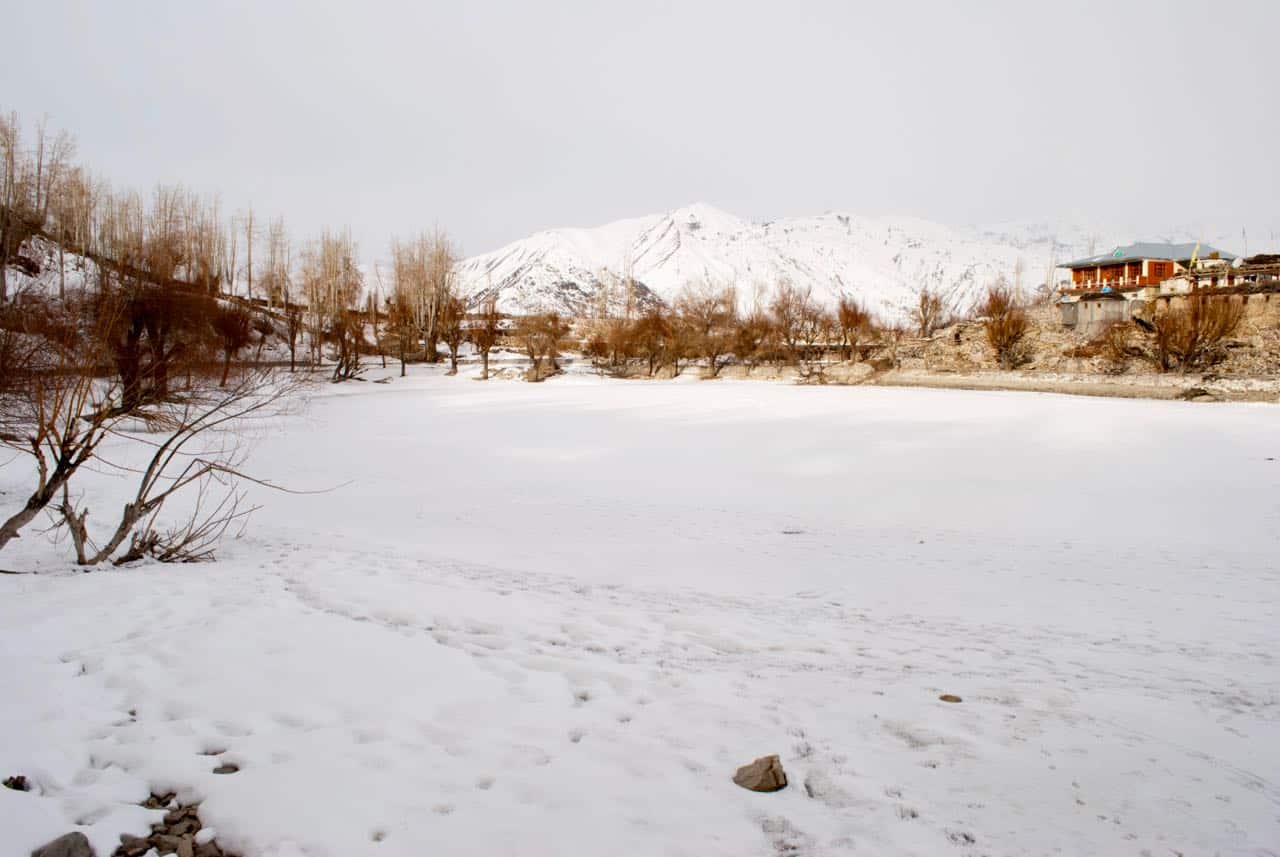
Those who are interested in skiing or ice skating may give it a try in Spiti Valley during the winter months of March. Locals develop ice rinks to have fun and as a pastime. Many locals have also started to learn to ski up there, and you can travel with them to have some fun.
Snow Leopards and Other Wildlife of Spiti Valley
March is the time when you can plan a trip to Spiti Valley for wildlife spotting, especially the elusive big cat, the Snow Leopard. January to March is the prime season for snow leopard sightings as these big cats descend to lower altitudes near Kibber and Pin Valley to hunt. Other wildlife like the Himalayan Ibex, Blue Sheep (Bharal), and Red Fox can also be spotted in winters in Spiti Valley.
You need the courage and heart to make such a trip. Snow leopard expedition packages from reputed operators typically cost between Rs 50,000 to Rs 1,40,000 per person for 8-10 day tours.
If you really understand the above challenges and are still interested to spot a snow leopard in Spiti Valley coming winters, feel free to give me a shout-out on my Instagram account in a DM and I will connect you with the very best in such tours.
Snowy Views with Deserted Trees
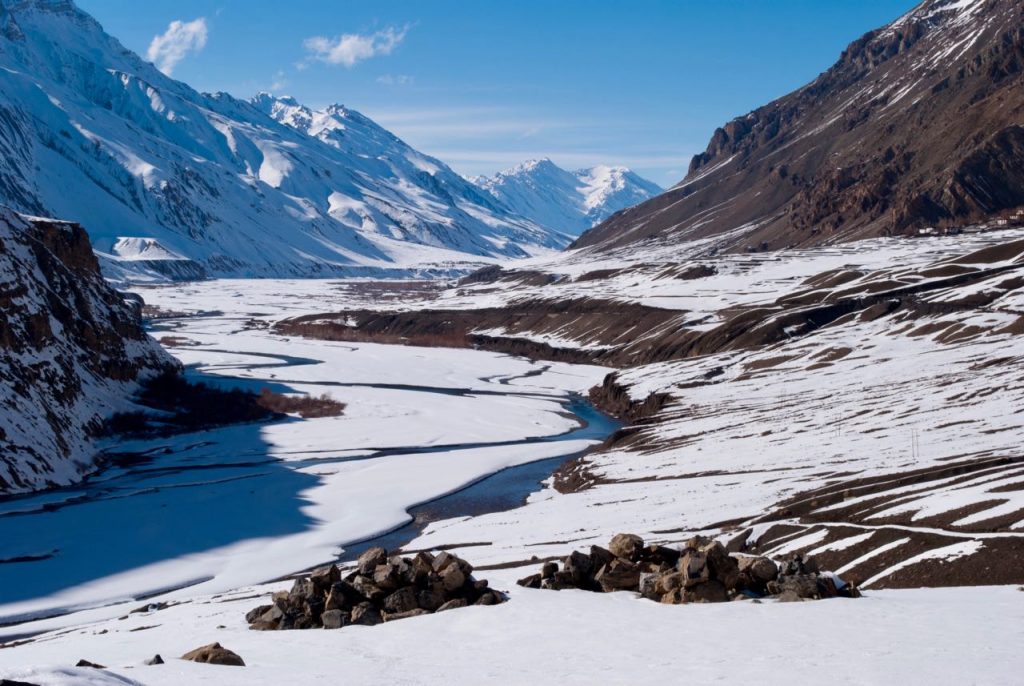
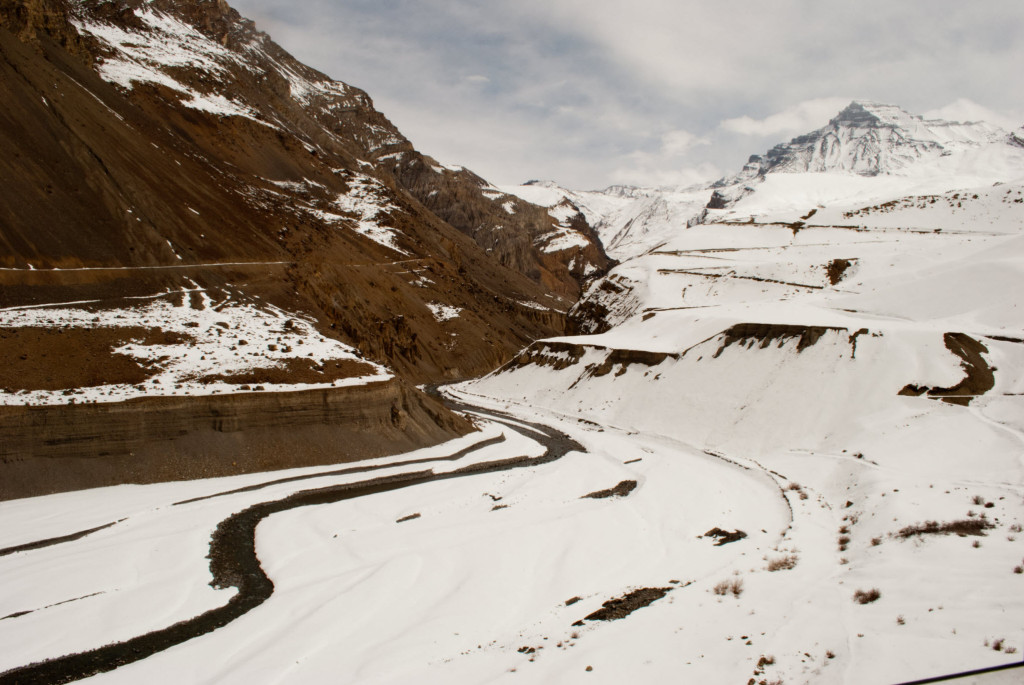
Lastly, the snowy vistas of Spiti in March will blow your mind and heart away. All the pain and suffering of harsh cold conditions and difficult drives will go away with the first sight of White Spiti.

The vast expanse of landscapes, snow-buried vistas, and frozen rivers will not let you settle without joy and excitement. You will keep wishing to stay there forever, but dreams do come to an end. For more photos and details, check my White Spiti in March itinerary.
What Is the Best 9-Day Itinerary for Spiti Valley in March?
Quick Answer: Delhi or Chandigarh to Narkanda, then Kalpa or Reckong Peo, Nako, Tabo, and Kaza (with day trips to Key and Kibber), returning the same way via Kinnaur since the Manali side is closed. Nine days covers the drive plus 2-3 buffer days for road blockages.
It is not like every month the itinerary for Spiti Valley will be different in a year. However, when making a trip to Spiti Valley in winters, you may need to take care of certain points. I have highlighted some special tips in the below itinerary for a Spiti Valley trip in March.
Day 1 – Delhi to Shimla or Narkanda
On this day you can leave Delhi in the morning and either reach Shimla or Narkanda. It is better to reach Narkanda to cut short the journey for the next day.
On the other hand, Shimla is more urban while Narkanda is more peaceful and may have snow lying around. So, you can expect Narkanda to be a bit colder than Shimla with snow around. The options of stay at Shimla are abundant, but Narkanda also has a decent number of options.
The road to Spiti Valley in March might be closed around Narkanda only in case of heavy snowfall.
Day 2 – Narkanda to Rampur to Reckong Peo to Kalpa
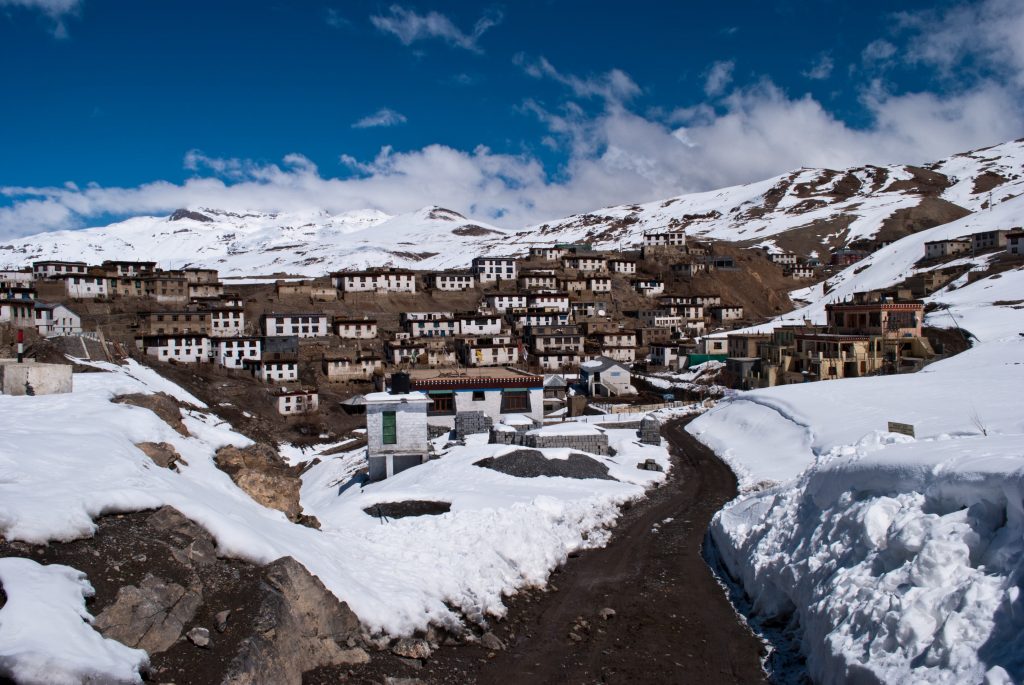
The next day you move from Narkanda or Shimla towards Kinnaur Valley. It will take about 6-7 hours to reach Kalpa from Narkanda and about 8-9 hours from Shimla. You can have an early lunch at Rampur before you enter Kinnaur Valley.
Kalpa being one of the most beautiful villages in Himachal makes an obvious night halt. As it will still be winter in March, the views of Kinner Kailash range from Kalpa will be amazing. The road might be closed to Kalpa in March, so you may have to stay at Reckong Peo. Chitkul will be closed and inaccessible due to heavy snow.
You should start early enough from Narkanda or Shimla to arrive at Kalpa well in time because most hotels will be closed in March. Hence, you will need some daylight to search for a decent guest house or hotel in Kalpa. You may also opt to stay at Reckong Peo. This is another point where the road might be closed further towards Spiti Valley in March.
Day 3 – Kalpa to Nako to Tabo
Nako will make a good spot for a lunch break. If conditions are favorable, you may find frozen Nako Lake, which is a beautiful sight. Night stay at Tabo will be advisable to visit Dhankar Monastery the next day before you head towards Kaza.
This day you travel to Tabo, which will take about 8-9 hours to reach from Reckong Peo. You should be able to do lunch at Nako village and visit the frozen Nako Lake when you are traveling to Spiti Valley in March.
Malling Nalla just ahead of Nako will be frozen, so do not forget to take a picture of it. You should drive with extra caution and care with snow and ice on the roads.
Finally, by evening, you will reach your first winter night stop in Spiti Valley, Tabo.
Day 4 – Tabo to Dhankar to Kaza
You can start from Tabo after having breakfast and visiting the oldest monastery in Tabo. On the way to Kaza, visit the Dhankar Monastery. You will not be able to visit Dhankar Lake as due to the presence of snow, the trek will be snowbound and the lake will be frozen anyway.
The road to Pin Valley bifurcating from Attargoo will be blocked as Pin Valley gets cut off from the rest of the world in winters. So, skip it and reach Kaza. Do not forget to take some amazing pictures on this winter trip to Spiti in March between Kaza and Tabo.
Day 5 – Kaza to Key to Kibber to Kaza
On Day 5, you can visit Key and Kibber villages. You will not be driving more than a couple of hours overall in the day. Explore these high villages along with the Chicham suspension bridge (13,596 ft) connecting Chicham village to Kibber village, which looks stunning when covered in a thin layer of snow.
The frozen views of the valley from the Key Monastery vantage point will be worth the pain you might have gone through over the last few days to reach Spiti Valley. It just blew me away at first sight when I did my first winter trip to Spiti Valley. I am sure Spiti in March will be equally impressive for you.
Day 6 – Kaza to Langza to Komic to Hikkim
This will be another day to hang out around Kaza. Mostly the roads to Langza, Komic, and Hikkim are closed in the winter months. So, that is one downside of visiting Spiti Valley in March. However, if you are feeling good and the weather is favorable, you might drive to the most nearby road head to Langza and then attempt to trek to the Langza and Komic villages.
PLEASE do not attempt to plan this trek alone in winters because with snow, you may get lost. Always take a local guide with you.
If the road to Langza, Komic, and Hikkim is not open, you can travel towards the Kunzum Pass route, almost up to Losar the road might be open. Again as you pass through Rangrik village, the snowbound views of Spiti Valley in winters are absolutely stunning.
Day 7 – Kaza to Tabo to Kalpa or Sangla
As we discussed earlier, when making a trip to Spiti Valley in winters, you cannot do the entire circuit from Kinnaur to Spiti to Manali. The road from Kaza to Manali over Kunzum Pass will be closed in March.
So, now is the time to wrap up this snow-filled trip to Spiti Valley and start heading back home from Kinnaur Valley. You can either choose to stay at Kalpa or Reckong Peo at the same place where you stayed while coming over to Spiti. Or, you can go over to Sangla Valley this time to stay up there for a change.
The road to Chitkul will be closed in March, so that should not be on your plan 🙂 Spend some time in Sangla Valley. A few guest houses and hotels may be open in March in Kinnaur Valley.
Day 8 – Kalpa or Sangla to Narkanda
You can plan a late start from Sangla and after breakfast go over to Narkanda for the night stay. If you want to cut short the journey to home the next day, you can move to Fagu or Shimla to get used to the concrete jungle. You may even stay at Thanedar as well.
Day 9 – Narkanda to Delhi
Finally, this amazing adventure of Spiti Valley in March is going to end on this day. You can take an easy drive back home. It will take some time to get used to regular life and come out of the trance from the wonderland.
The snow views of the winter Spiti Valley trip will stay with you for a long time. Cherish them till you make another trip to Spiti Valley in winters 🙂
Final Thoughts on Spiti Valley in March
A trip to Spiti Valley in March is certainly one of the most adventurous journeys that you will ever take to the Himalayas. However, as this article explains, you should not get inspired by Instagram pictures alone. Leaving without planning to such a desolate place in such cold conditions can be a messy affair.
The trip to Spiti Valley in March requires sheer physical and mental strength and endurance. Knowledge never killed anyone, hence you should be informed and well prepared to get the most out of your adventure trip to Spiti Valley.
Do not forget to follow me for all the latest updates on the weather and road conditions of Spiti Valley. You can also check the Delhi-Kinnaur-Spiti road status page for live updates during the season.
If you have any questions, please feel free to ask them in the comments section below. In case one of your friends or family is traveling to Spiti Valley in March, do not forget to share this article with them. For discussions and finding travel partners, head over to the DwD Community 🙂
Frequently Asked Questions
Is Spiti Valley Open in March?
Yes, Spiti Valley is accessible in March but only via the Shimla-Kinnaur route. The Manali-Kaza road over Kunzum Pass remains closed from November to May. Road blockages of a day or two are common due to snowfall, so always keep buffer days in your plan.
How Cold Is Spiti Valley in March?
Temperatures in Spiti Valley in March range from -5 to 5 degree Celsius during the day and drop to -15 to -25 degree Celsius at night, colder in the first half of the month than the last. Malling Nala near Nako, at 12,713 ft, stays frozen with black ice through February and into March, easing off a little in January, so drive that stretch after sunrise. Heavy woolen layers, thermals, and a windproof jacket are essential.

Is Manali to Spiti Road Open in March?
No. The Manali to Kaza road via Kunzum Pass and Rohtang Pass is closed from November to May due to heavy snowfall. Even with the Atal Tunnel bypassing Rohtang, the road from Gramphu to Kaza via Batal is snowbound. The only route to Spiti in March is via Shimla and Kinnaur.
How Many Days Are Enough for Spiti in March?
A minimum of 9 days is recommended for a winter Spiti trip from Delhi. This includes 2 days each way for the drive, 3-4 days in Spiti (Kaza, Key, Kibber, Tabo, Dhankar), and at least 1-2 buffer days for road blockages. If traveling by bus, add 1-2 extra days.
Can I See Snow Leopard in Spiti in March?
Yes, January to March is the prime snow leopard spotting season in Spiti Valley. The big cats descend to lower altitudes near Kibber and Pin Valley areas to hunt Bharal (Blue Sheep). You will need to book with a specialized tour operator, and expeditions typically cost Rs 50,000 to Rs 1,40,000 per person for 8-10 days.
Is There Mobile Network in Spiti in March?
BSNL postpaid works in Kaza and some major villages like Tabo and Reckong Peo. Jio and Airtel have limited coverage in Kaza town but are unreliable elsewhere. Between towns, there is practically no mobile signal. For more details, check my Spiti Valley mobile connectivity guide.
What Vehicle Is Best for Spiti in March?
A 4×4 SUV is strongly recommended for a winter Spiti trip. Roads have black ice and snow patches, especially around Nako and Schichiling. A sedan can technically make it on clear days, but you will be at higher risk if conditions deteriorate. Carry snow chains if possible. Bikes are not recommended for winter Spiti unless you have extensive cold-weather riding experience.
