


Last Updated: September 2026
Planning a trip to Leh Ladakh, Spiti Valley, or Zanskar in September? In my experience, this is genuinely one of the best months to go, and I say that every year to anyone who asks. The monsoon is winding down over lower Himachal, the skies clear up, crowds thin out compared to July and August, and Spiti and Zanskar start showing those golden harvest colors that photographers chase all year. The trade-off is that nights get properly cold, especially in the second half of the month, and the high passes on the Zanskar side start their slow march toward winter closure. In this post, I will cover everything you need for a September trip, including current road conditions on both highways, weather patterns, bike rental and taxi rates, the latest on Galwan Valley access, and practical tips from years of traveling these roads.
Quick Answer: As of September 2026, both the Manali – Leh Highway and Srinagar – Leh Highway are OPEN. Ladakh sees cooling but still pleasant days (15-20°C) with nights dropping toward or below freezing later in the month, while the approach roads through Manali and Kinnaur see monsoon risk ease off but not disappear entirely in the first half of September. Indians do not need a stamped Inner Line Permit anymore, just an online Environment and Development Fee (EDF) of about Rs 590 for a 7-day trip. Keep buffer days in your itinerary, especially if you are headed to Zanskar late in the month, and read on for the full breakdown.
Practical Info Box: September 2026 Snapshot
- Manali – Leh Highway: OPEN (opened for the 2026 season on May 12, no fresh closure reported since)
- Srinagar – Leh Highway: OPEN, Zoji La clear, less crowded than July-August
- Leh temperature (September): 15-20°C day, dropping to -2 to 5°C at night, colder in the second half
- Permit: No stamped ILP for Indians. Online EDF, about Rs 590 for a 7-day trip
- Budget (7-8 days, shared among 3-4): Rs 20,000 – Rs 35,000/person (budget), Rs 40,000 – Rs 60,000/person (mid-range), verify locally as peak-season rates ease
- Galwan Valley: Still not open for tourists as of September 2026
- Best network: BSNL postpaid (widest coverage outside Leh town)
What is the Weather Like in Ladakh, Spiti and Zanskar in September?
Quick Answer: September is when the monsoon retreats and the region gets its clearest skies of the season. Leh sees daytime temperatures of 15-20°C and nights that drop to -2 to 5°C, noticeably colder than August once the sun goes down. Spiti and Zanskar cool further still, with nights in Kaza already flirting with the freezing mark by the second half of the month.
In Leh, daytime temperatures hover around 15-20°C in early September and ease down toward the lower end of that range as the month goes on. Nights are the real story though, dropping to -2 to 5°C, colder than anything you would have felt in July or August. Pack proper thermals, not just a fleece. The upside of this cooling is genuinely clearer air and sharper mountain views, since the last of the monsoon moisture clears out of the atmosphere by mid-month. If you are planning to camp anywhere from Pangong to Nubra, my camping in Ladakh guide is worth a read, a good sleeping bag rated for sub-zero nights is not optional in September.
Spiti Valley also cools noticeably in September. Based on regional weather data, daytime temperatures in Kaza run roughly 12-17°C, sliding toward 8-10°C by the very end of the month, while nights are already brushing 0°C or dipping below it in the back half of September. This is also when Spiti puts on its best show visually, the barley fields around Kaza and Langza turn golden before harvest, which is why September is my personal favorite month to recommend Spiti to first-timers who want the classic postcard shot without the July crowds.
Zanskar follows a similar cooling pattern, and being higher and more remote, it feels it even more. Padum sees noticeably colder nights than in August, and given how exposed the valley is, I would not be surprised to hear of a light dusting of snow at Pensi La toward the very end of the month in some years. The Pensi La approach from the Kargil side and the Shinku La route from Darcha both remain open through September, but this is the month where the window genuinely starts to narrow, more on that in the Zanskar section below.
The lower hill stations like Shimla, Manali, and the Kullu Valley finally start shaking off the monsoon by September, though the first half of the month can still bring the occasional heavy spell before things dry out properly. If your route passes through these areas, especially in the first two weeks, expect the odd delay. I still suggest starting early in the morning, ideally by 5-6 AM, to cross any water crossings before the day warms up. For more on this, check my article on why you should start early and sleep early on Himalayan trips.
Leh Weather by Month: IMD Station Data for Planning Beyond September
Quick Answer: According to the India Meteorological Department’s Leh station table (2011-2024), Leh averages a daily maximum of 16.4°C and minimum of 0.7°C in October, falling to 9.7°C and -4.8°C in November and 3.7°C and -10.9°C in December. Snow and cold, not rain, are the issue after September.
| Month | Mean daily minimum (°C) | Mean daily maximum (°C) | Mean rainfall (mm) | Rainy days |
|---|---|---|---|---|
| January | -13.4 | 1.9 | 3.7 | 2.6 |
| February | -8.8 | 5.9 | 7.6 | 3.4 |
| March | -3.2 | 9.7 | 2.5 | 2.1 |
| April | 1.7 | 14.8 | 8.4 | 2.6 |
| May | 6.0 | 19.8 | 2.7 | 1.9 |
| June | 10.3 | 23.3 | 8.9 | 3.4 |
| July | 15.1 | 27.8 | 13.8 | 4.8 |
| August | 14.9 | 27.8 | 8.6 | 3.6 |
| September | 9.1 | 23.5 | 8.9 | 2.6 |
| October | 0.7 | 16.4 | 2.7 | 1.1 |
| November | -4.8 | 9.7 | 0.5 | 0.6 |
| December | -10.9 | 3.7 | 1.7 | 1.0 |
This table is long-term monthly averages, so it will not match any single day. Keep in mind that the September ranges I quoted above are what I would expect you to feel during a trip (cold mornings, pleasant afternoons), while IMD’s September figure of 9.1°C minimum and 23.5°C maximum is the average across the whole month, including its warmer first half. Both are useful, just for different questions.
What does the table tell you for an October or winter plan? Based on this data and my research (not a winter trip of my own), October is the last month with a daytime maximum above 15°C, but the average night is already close to freezing at 0.7°C. By November the average minimum is -4.8°C and the daytime maximum drops below 10°C. From December to February the average night sits between -8.8°C and -13.4°C, with January the coldest month in the dataset. Rainfall is tiny in every one of these months (0.5 to 7.6 mm), so winter in Leh is about cold and dry air, not monsoon-style downpours.
Hence, if you are planning around October, carry thermals, a proper down jacket and a sleeping bag rated for sub-zero nights, and check the Manali – Leh and Srinagar – Leh highway status before you commit, because the high passes can close once snowfall begins. For live conditions, use the IMD Leh forecast page and our Manali – Leh Highway status page. Feel free to ask in the comments if you want a month-specific packing list.
How Are the Road Conditions on Manali – Leh Highway in September?
Quick Answer: The Manali – Leh Highway is OPEN as of September 2026, no fresh closure reported since the road opened for the season on May 12. Monsoon-related halts on the Manali side ease off through the month, and the Darcha-Leh stretch, sitting in the rain shadow, stays largely dry throughout.
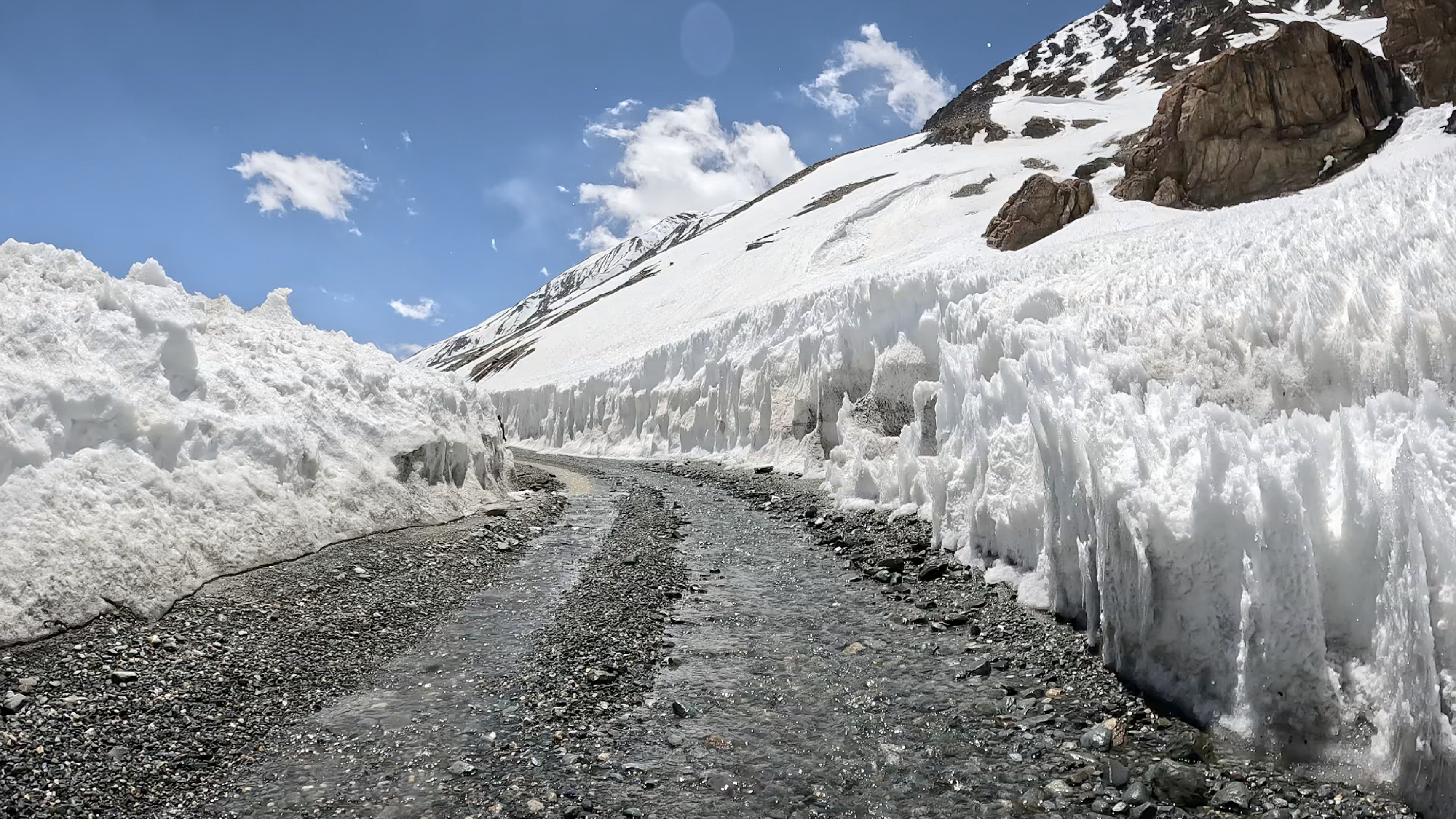
BRO connected both ends and cleared the highway for civilian traffic on May 12, 2026, and as of this update there has been no new closure since. By September, road conditions have settled compared to the peak-monsoon chaos of August. You will still encounter rough patches and the odd water crossing between Darcha and Pang, but the frequency of short weather-related halts drops noticeably once you cross Baralacha La onto the Ladakh side. Right after Pang, the terrain opens into the vast, flat More Plains stretch, arguably even more striking in the clearer September light than during the hazier monsoon months.
The stretch between Batal and Gramphu (about 47 km) remains the trickiest part of the whole highway, with multiple nallah crossings. Glacial melt still raises water levels after noon even in September, so if you are driving from Manali towards Leh, or coming from the Spiti side via Kunzum Pass, plan to cross this stretch before 11 AM. Keep in mind that the Manali side (Rohtang and Gulaba) can still see a short landslide halt after heavy rain in the first half of the month, worth watching, even though the risk is genuinely lower than it was in August. A flash flood briefly shut the highway near Jispa in late June 2026, and BRO cleared it the same day, a reminder that this belt can still throw up short, sharp closures even outside the monsoon peak.
Key passes on this route and their approximate altitudes: Rohtang Pass (13,050 ft), accessible via Atal Tunnel for most travelers now, Baralacha La (16,040 ft), Lachalung La (16,620 ft), Tanglang La (17,480 ft). All of these are typically clear and motorable in September, though the road generally stays open into October before winter snowfall forces a closure, and the summer HRTC bus service on this highway typically wraps up around the end of September. For a detailed breakdown of this route, refer to my complete guide to Manali – Leh Highway and how to plan your journey on this route.
What is the Status of Srinagar – Leh Highway in September?
Quick Answer: The Srinagar – Leh Highway is fully OPEN in September 2026, with Zoji La Pass clear and noticeably less crowded than the July-August rush. The Zoji La Tunnel achieved an excavation breakthrough on June 9, 2026, though it will not be operational until 2028.
The Srinagar – Leh Highway remains fully operational in September, and this is genuinely a good month to take it. Traffic thins out considerably compared to peak season, the road passes through the same beautiful stretches of Kashmir Valley, Sonamarg, Drass and Kargil before reaching Leh, and the major obstacle, Zoji La Pass (11,575 ft), stays completely clear this time of year.


One important update for 2026: the Z-Morh Tunnel near Sonamarg is now operational, bypassing a difficult stretch and making the highway more reliable. The much bigger Zoji La Tunnel achieved its excavation breakthrough on June 9, 2026 (the final blast at the East Portal near Minamarg). Surfacing, ventilation, and electrical work are still ongoing, and the operational target has been pushed to February 2028. Once complete, this tunnel will cut a 3-hour crossing down to about 15 minutes and finally give Srinagar and Kargil year-round connectivity, something this route has never had.
By September, the Independence Day convoy restrictions on the Kashmir side are behind you, and the heavy tourist rush around Zoji La has thinned out as well, making this one of the more relaxed months to drive this highway. The road between Sonamarg and Drass can still see an occasional landslide after rain in the first half of the month. I suggest reading the Srinagar – Leh Highway status page for the latest real-time updates before you travel.
How to Reach Spiti Valley in September and What Are the Road Conditions?
Quick Answer: Both the Manali – Kaza route (via Kunzum Pass) and the Shimla – Kinnaur – Kaza route (via NH-5) are open in September 2026. Monsoon-driven landslide risk on the Kinnaur stretch eases through the month but has not fully disappeared, especially in the first two weeks.
Spiti Valley can be reached via two routes in September, and both remain open. The Manali – Kaza route via Rohtang Pass (or Atal Tunnel), Gramphu, Batal, and Kunzum Pass is the more adventurous option. Road conditions on the Batal-Gramphu stretch are still rough with multiple water crossings, though the volume of water has usually dropped compared to peak monsoon. If you are entering Lahaul-Spiti through the Atal Tunnel, remember that every vehicle now needs a free e-Aagman e-pass (register in advance at eaagman.hp.gov.in, there is no mobile network at the barrier), plus the SADA entry fee of Rs 200 per car or Rs 50 per two-wheeler collected at Sissu for non-Himachal-registered vehicles. There is no toll on the Atal Tunnel itself, that Rs 200 you may have heard about is this Sissu district fee, not a tunnel toll.

The Shimla – Kinnaur – Kaza route via Narkanda, Rampur, Reckong Peo, Nako, and Tabo is the longer but relatively safer option most months. By September, this belt has already seen its share of monsoon disruption this season, NH-5 was hit by three separate landslide closures over the summer, at Chaura (between Jeori and Wangtu) on July 31, at Nigulsari on August 6, and at Jeori/Pashada Khad on August 11, all of which reopened within hours to a couple of days. Maling Nala, between Pooh and Nako, remains the single most chronic landslide point on this stretch and stays under a standing advisory through September, even though the pace of new closures typically slows down compared to peak monsoon. For a dedicated, regularly updated look at this specific stretch, see my Kinnaur – Spiti road status guide.
In case you are a first-timer, I would still suggest taking the Shimla route to enter Spiti and exit via Manali, giving you the best of both worlds. September rewards this plan particularly well, since you get the golden harvest-season light on the way in and clearer high-altitude views heading out toward Kunzum and Rohtang.
HRTC buses operate daily from both Manali and Shimla to Kaza through September before the schedule thins out as the season winds down. The Manali – Kaza bus departs around 5-6 AM and takes 9-12 hours. The Shimla – Kaza bus departs early morning and takes 16-18 hours. For a detailed planning guide, check how to plan Spiti Valley via Manali and the pillar article on best time to visit Spiti Valley month by month.
Can You Visit Zanskar Valley in September and Which Route is Best?
Quick Answer: Yes, September is one of the best months for Zanskar, though it is also when the seasonal window starts to genuinely narrow. You still have three route options: the classic Kargil – Pensi La road, the Darcha – Shinku La road, and the Leh – Nimmu – Chilling river route, all open through September.
September is genuinely one of the best months to visit Zanskar, the roads are stable, the crowds are far thinner than July or August, and the valley takes on a beautiful autumn character. That said, this is also the month where you should keep an eye on the calendar rather than treat the season as wide open. Here are your options:
Route 1: Kargil – Pensi La – Padum (Classic Route). This is the traditional approach, about 240 km from Kargil. Pensi La (14,500 ft) remains clear through September and typically stays passable into October or even November before early snow shuts it for the winter, though a light dusting of snow this early is not unheard of in some years. The road is mostly tarmac until Rangdum, after which it gets rougher. This is the most reliable route.
Route 2: Darcha – Shinku La – Padum (New Route). The Nimmu – Padum – Darcha highway construction was completed in 2024, and this route stays operational through September and typically into October. Shinku La (16,580 ft) is a high pass, and by September the stretch near the top can already turn slippery with early ice even before real snowfall arrives, so treat it as a 4×4-only crossing. This route connects Zanskar directly to Lahaul Valley and Manali, making a loop itinerary possible. Note that this is still not a route with a regular scheduled bus service, HRTC ran a one-time trial minibus over Shinku La in June 2024, and as of 2026 there is still no confirmed regular service, so budget travelers should plan around shared taxis rather than expecting a bus.
Route 3: Leh – Nimmu – Chilling – Padum (River Route). This route follows the Zanskar River gorge and offers stunning scenery, arguably at its best in September’s clearer light. The road is being improved as part of the Nimmu – Padum – Darcha project. Conditions are rough but passable for experienced drivers. For a comprehensive planning guide, see my complete guide to the Manali – Leh via Zanskar route. If you do not have your own vehicle, budget travelers can still make this trip using buses and shared taxis, as I explain in my guide to visiting Zanskar Valley by public transport.
What is the Latest Update on Galwan Valley Tourist Access?
Quick Answer: As of September 2026, Galwan Valley is still not open for regular tourism. The government’s Battlefield Tourism plan missed its original June 2025 target, and the war memorial construction is still ongoing.
Galwan Valley has been in the news ever since the 2020 India-China standoff. The Indian government has been working on opening parts of Galwan for domestic tourists under a “Battlefield Tourism” initiative, with the plan originally targeting the fifth anniversary of the 2020 clash (mid-June 2025) as a symbolic opening date. That date came and went. The Galwan War Memorial, at an altitude of about 14,500 ft, is still under construction, and this is the main reason cited for the repeated delays.
As of September 2026, access to the Galwan area remains restricted to the Indian Army and security forces. The Ladakh administration, in coordination with the Indian Army, continues building visitor infrastructure, including planned facilities along the route from Durbuk and a museum commemorating the 2020 conflict, but there is still no confirmed opening date. I suggest checking with the Leh District Administration or the official Ladakh permit portal at lahdclehpermit.in for the latest updates before planning a visit.
Keep in mind that this is a sensitive border area. Even when it opens, access will likely be regulated with specific checkpoints, time slots, and identification requirements. Carry your Aadhaar card and a valid ID at all times. If you hear reports of it being open by the time you read this, make sure to confirm through official channels and not just social media posts.
What Are the Taxi Rates and Bike Rental Prices in Leh for September 2026?
Quick Answer: September sits in the shoulder season, so you should find a bit more room to negotiate than in the July-August peak, though rates rarely drop drastically since demand stays healthy through the month. Rates below are as of the 2025-2026 season, always confirm locally.
Here is a rough breakdown of current rates as of the 2025-2026 season. Keep in mind these can change, so always confirm locally.
Taxi Rates in Leh (As of 2025-2026)
Taxi rates in Ladakh are regulated by the taxi union. Some common routes and approximate costs:
- Leh to Nubra Valley (via Khardung La): Rs 8,000 – Rs 10,000 one way
- Leh to Pangong Tso: Rs 8,000 – Rs 10,000 one way
- Leh to Tso Moriri: Rs 10,000 – Rs 12,000 one way
- Full Ladakh circuit (7-8 days): Rs 35,000 – Rs 50,000 depending on vehicle and itinerary
For the latest verified taxi rates, check my detailed article on Leh Ladakh taxi rates. You can also look at my list of recommended taxi drivers for Ladakh where I have shared contacts of reliable local drivers.
Bike Rental Rates in Leh (As of 2025-2026)
Bike rentals in Leh are plentiful, and September rates typically ease slightly from the peak-season highs. Some typical rates:
- Royal Enfield Classic 350: Rs 1,800 – Rs 2,100 per day
- Royal Enfield Himalayan: Rs 2,200 – Rs 2,500 per day
- KTM Adventure 390: Rs 2,500 – Rs 3,000 per day
- Scooter (Activa/Access): Rs 800 – Rs 1,200 per day
Most rental agencies are located on Fort Road and Changspa Road in Leh. Always inspect the bike thoroughly before renting, take photos of any existing damage, and confirm that insurance is included. A security deposit of Rs 5,000 – Rs 10,000 is standard. For more details, you can check my article on Leh Ladakh bike rental rates.
How Much Does a September Trip to Ladakh Cost Per Person?
Quick Answer: September still falls close to peak-season pricing, though with slightly more room to negotiate. A budget trip runs Rs 20,000 – Rs 35,000 per person, and a mid-range trip runs Rs 40,000 – Rs 60,000 per person, for a 7-8 day trip shared among 3-4 people.
September costs stay close to the peak-season range, though the crowd thinning out means slightly better odds of negotiating on taxis and accommodation than in July or August. Here is a rough budget breakdown per person for a 7-8 day Ladakh trip in 2026:
Budget Breakdown (Per Person, 7-8 Days)
- Transport (Delhi to Leh and back): Rs 3,000 – Rs 5,000 by bus, Rs 8,000 – Rs 12,000 by shared taxi, Rs 15,000 – Rs 25,000 by flight
- Local sightseeing taxi (shared among 4): Rs 8,000 – Rs 12,000 per person
- Accommodation: Rs 500 – Rs 1,000/night for budget guesthouses, Rs 1,500 – Rs 3,000/night for mid-range hotels
- Food: Rs 500 – Rs 800/day at dhabas and local restaurants
- Permit (EDF, no separate ILP fee): about Rs 590 for a 7-day trip
- Bike rental (if applicable): Rs 1,800 – Rs 2,500/day plus fuel
- Fuel (self-drive, for 4 sharing): Rs 3,000 – Rs 5,000 per person
Total estimate: Rs 20,000 – Rs 35,000 per person for a budget trip, Rs 40,000 – Rs 60,000 for a mid-range trip (7-8 days). These numbers assume sharing costs among 3-4 people and are as of the 2025-2026 season, verify locally since rates shift year to year. Solo travelers will spend more on transport. For a detailed cost calculation, see my article on how to calculate cost for a Leh Ladakh trip.
What Permits Do You Need for Ladakh, Spiti and Zanskar in September?
Quick Answer: Indian tourists do NOT need a stamped Inner Line Permit anymore, that requirement ended in 2021. You only need to pay the Ladakh Environment and Development Fee (EDF) online, about Rs 590 for a 7-day trip, and the receipt covers Nubra, Pangong, Tso Moriri, Hanle, Turtuk and Umling La together. If you are entering Lahaul-Spiti via the Atal Tunnel, that district has a separate, free vehicle e-pass requirement, see the Spiti section above.
This is a point of genuine confusion, so let me be direct about it: as of 2026, Indian tourists do not need a separate, stamped Inner Line Permit (ILP) to visit any of the restricted areas in Ladakh. That physical stamping process was replaced back in 2021 by the Ladakh Environment and Development Fee (EDF), which you pay entirely online. No visit to a Tourist Information Center, no in-person stamping, no queue.
- Environment Fee: Rs 400 per person (one-time)
- Wildlife Protection Fee: Rs 20 per person, per day
- Red Cross Fund contribution: Rs 50 per person, one-time and optional
- Total for a 7-day trip: approximately Rs 590 per person
- Where to apply: Online at lahdclehpermit.in, the official LAHDC Leh portal. Register, pay, and print your own receipt
- Documents needed: Government ID (Aadhaar preferred), passport-size photo
- Receipt validity: 21 days, and one receipt covers Nubra Valley, Pangong Tso, Tso Moriri, Hanle, Turtuk, and Umling La
Foreign nationals are a different story. They still need a genuine Protected Area Permit (PAP), which has to be processed through a registered Leh travel agent, unlike the Indian EDF which you can do yourself from your phone.
By September, the online portal usually runs faster than during peak season since the tourist rush has eased, but I still suggest applying 2-3 days before you plan to visit restricted areas rather than at the last minute. For a complete step-by-step guide, refer to my article on how to get Ladakh Inner Line Permits online.
What Should You Carry for a September Himalayan Trip?
Quick Answer: Pack for cooler days than August and properly cold nights, plus light rain gear for the first half of the month on the Manali and Shimla sections of your route. Warm layering matters more in September than in any earlier summer month.
Packing for September means shifting your priorities compared to a June or July trip. Daytime sun is still strong at altitude, but nights are properly cold now, not just cool. Here is what I suggest:
- Clothing: Cotton t-shirts for daytime, a proper down or heavy fleece jacket for evenings, windbreaker for passes, good thermals for camping or any late-month travel
- Rain gear: Waterproof jacket and rain cover for bags (still useful for the Manali and Shimla sections in the first half of September, less critical after that)
- Footwear: Waterproof trekking shoes with good ankle support, plus sandals for dry stretches
- Sun protection: Sunscreen (SPF 50+), UV sunglasses, hat or scarf. UV rays are intense above 10,000 ft even as temperatures drop
- Medical kit: Diamox (for AMS prevention, consult your doctor first), basic first aid, ORS, paracetamol, any personal medications
- Emergency supplies: Flashlight/headlamp, portable charger, offline maps (Google Maps or Maps.me), snacks, water bottles
For a comprehensive packing checklist, check 40 must-have things to carry on a Ladakh self-drive trip. Also, do read about Acute Mountain Sickness and the importance of acclimatization, because AMS is no joke at these altitudes. Spend at least 1-2 days acclimatizing in Leh before heading to higher areas like Khardung La or Pangong.
How is Mobile Network and Connectivity in Ladakh in September?
Quick Answer: BSNL postpaid has the widest coverage outside Leh town. Jio and Airtel now offer 5G in Leh itself, but coverage drops off fast once you leave the city.
Mobile connectivity in Ladakh has improved over the years but is still patchy in many areas. Here is what you can expect in September 2026:
- Leh town: Jio, Airtel, BSNL, and VI all work. Jio and Airtel both offer 5G in Leh now.
- Nubra Valley (Diskit, Hunder): BSNL postpaid works best. Jio has limited coverage.
- Pangong Tso: Very limited. BSNL postpaid may work intermittently at Spangmik.
- Tso Moriri: Almost no network. BSNL postpaid may get a faint signal.
- Manali – Leh Highway: Network drops after Rohtang/Atal Tunnel and returns only at Leh. Brief signals at Keylong and Sarchu.
- Spiti Valley: BSNL works in Kaza. Other networks are unreliable.
- Zanskar: Very limited connectivity. BSNL postpaid in Padum.
I always recommend carrying a BSNL postpaid SIM if you want the best coverage across Ladakh. Download offline Google Maps for the entire region before you leave home. For a detailed network guide, see mobile phone connectivity in Leh Ladakh.
What Are the Local Taxi Union Rules and Self-Drive Regulations?
Quick Answer: Self-drive cars and bikes travel freely in Ladakh, but commercial taxis registered outside Ladakh (from Manali, Srinagar, or elsewhere) cannot legally do local sightseeing within the region.
This is an important topic that catches many travelers off guard. Ladakh has a strong local taxi union, and there are rules about which vehicles can ply for hire. Here is what you need to know:
- Self-drive cars and bikes are allowed. If you are driving your own vehicle or a rented bike/car from outside Ladakh, you can travel freely.
- Commercial vehicles from outside Ladakh face restrictions. Taxi cabs registered in J&K, Himachal, or other states cannot operate for local sightseeing within Ladakh. This means if you hire a taxi from Manali to Leh, that taxi cannot take you for Nubra or Pangong. You will need to hire a local Ladakh-registered taxi for those trips.
- Rented bikes from Leh are fine. They are locally registered.
- Rental cars from outside (like Zoomcar, Revv) are treated as personal vehicles, so they are allowed.
These rules can change, and enforcement varies. In case you are planning to hire a taxi, coordinate in advance. For self-drive tips, read my article on 7 useful tips for a self-drive to Leh Ladakh. For a full breakdown of what is currently allowed for self-drive and rented cars in Ladakh, see my self-drive car ban guide.
Practical Tips for Traveling in September
Based on my experience of traveling these roads for over a decade, here are some specific tips for September travel:
- Start early, always. Whether you are crossing water crossings on Manali – Leh or tackling the Batal – Gramphu stretch, morning hours are safest when water levels are low.
- Keep 1-2 buffer days, more if you are headed to Zanskar late in the month. Road closures due to landslides are less frequent than August but still possible in the first half of September, and the high passes on the Zanskar routes are where the real seasonal risk lives this month. Do not plan a tight itinerary.
- Carry cash. ATMs in Leh work but can run out of cash during peak season. ATMs are non-existent in Nubra, Pangong, Zanskar, and most of Spiti. I suggest carrying Rs 10,000 – Rs 15,000 in cash as backup.
- Fuel up at every opportunity. Petrol pumps exist at Leh, Karu, Diskit (Nubra), and Upshi. In Spiti, the only reliable pump is at Kaza. Do not pass a fuel station without topping up. For the complete fuel guide, see fuel availability in Leh Ladakh.
- Acclimatize properly. Spend at least 2 full days in Leh before heading to higher altitudes. AMS is a real danger above 10,000 ft. Drink plenty of water, avoid alcohol, and do not overexert on Day 1.
- Check road status the morning you travel, not days before. This matters even more for Zanskar-bound trips in September, an early snow flurry at Shinku La or Pensi La can change things overnight that were fine the day before.
- Join the DwD Community. For real-time road updates, finding travel partners, and getting answers to your specific questions, the DwD Community and our YouTube channel are your best resources. You can also check the DoW Travel Calendar from the main menu for upcoming group trips.
- Respect the mountains. Carry your trash back, do not honk unnecessarily, and support local businesses. This is what responsible travel means, and it is something we at Discover with Dheeraj take very seriously.
Related Reading on Discover with Dheeraj
If you are planning a September trip, these articles will help you with detailed planning:
- Most Common Itinerary for Leh Ladakh by Road
- Best Time to Travel to Ladakh and Zanskar Valley
- Manali – Leh Highway Status (Updated Regularly)
- Delhi – Kinnaur – Spiti Valley Road Status
- Nubra Valley Travel Guide
- Pangong Tso Lake Travel Guide
Frequently Asked Questions
Is September a good time to visit Ladakh?
Yes, September is genuinely one of the best months for a Ladakh trip, and it is the month I personally recommend most often to first-timers who ask. Both highways are open, the monsoon has largely cleared out giving you sharper mountain views, and crowds are noticeably thinner than July or August. Days stay pleasant at 15-20°C in Leh, though nights get properly cold, so pack accordingly.
Is it safe to ride a bike in Ladakh in September?
September is one of the better months for a bike ride to Ladakh. Roads are open, passes are clear, and monsoon-related water crossings on the Manali – Leh route ease off compared to August. The main thing to prepare for is the cold, nights drop well below what you would feel in summer, so ride with proper thermal layers under your riding gear, along with a helmet, gloves, and riding jacket.
Can I visit Spiti Valley in September?
Absolutely, and many people consider September the best month for Spiti. Both the Manali – Kaza and Shimla – Kaza routes are open, the barley fields turn golden before harvest, and Kinnaur’s monsoon landslide risk eases considerably compared to July and August, though it has not disappeared entirely in the first half of the month. Keep buffer days in your itinerary and start early for nallah crossings.
Is Zanskar Valley accessible in September?
Yes, and September is one of the best months to go, via the Kargil – Pensi La route, the Darcha – Shinku La route, or the Nimmu – Zanskar road. That said, this is also when the seasonal window starts narrowing, both Pensi La and Shinku La typically stay open into October but early snow is a real possibility by the second half of September, so avoid a tight itinerary if you are traveling late in the month.
Which mobile network works best in Ladakh?
BSNL postpaid has the widest coverage across Ladakh, including remote areas like Nubra, Pangong, and Zanskar. Jio and Airtel both offer 5G in Leh town but drop off quickly outside the city. I recommend carrying a BSNL postpaid SIM as a backup along with your primary number.
How much does a Ladakh trip cost in September?
A budget trip to Ladakh for 7-8 days costs approximately Rs 20,000 – Rs 35,000 per person when sharing expenses with 3-4 people. A mid-range trip costs Rs 40,000 – Rs 60,000 per person. September prices sit close to peak-season levels, though you may find slightly better negotiating room on taxis and accommodation as the July-August rush thins out. Solo travelers can expect to spend 20-30% more.
Can I visit Galwan Valley as a tourist?
As of September 2026, Galwan Valley is not open for regular tourism. The Indian government’s Battlefield Tourism initiative missed its original mid-2025 target date, and the Galwan War Memorial is still under construction. Access remains restricted to the Indian Army and security forces. Check with the Leh District Administration for the latest status before planning a visit.
Do I need a permit for Ladakh?
No, Indian tourists do not need a stamped Inner Line Permit anymore, that process ended in 2021. You only need to pay the Ladakh Environment and Development Fee (EDF) online, about Rs 590 for a 7-day trip (Rs 400 one-time environment fee plus Rs 20 per day wildlife fee, with an optional Rs 50 Red Cross contribution). Apply online at lahdclehpermit.in and the same receipt covers Nubra Valley, Pangong Tso, Tso Moriri, Hanle, Turtuk, and Umling La. Foreign nationals still need a genuine Protected Area Permit through a registered Leh travel agent.
I hope this guide helps you plan your September trip to Ladakh, Spiti, or Zanskar. This is genuinely one of my favorite windows on these roads, cooler air, clearer skies, autumn colors in Spiti and Zanskar, and a lot more breathing room than the July-August rush. If you have specific questions about your itinerary, feel free to ask in the comments below or reach out through the DwD Community. If you know someone planning a Himalayan trip this September, do share this article with them 🙂 …
Happy travels, my friend. See you on the road!
