


In a world dominated by instant messaging and emails, the humble postcard still holds a charm that no technology can replicate. Now imagine sending one from 14,400 feet above sea level, from a tiny post office perched in the trans-Himalayan desert of Spiti Valley. That is Hikkim village for you, home to what is recognized as the world’s highest post office.

I have visited Hikkim multiple times during my trips to Spiti, and every visit feels different. The light changes, the colors shift, and the silence of the valley hits you in a new way each time. In this detailed travel guide, I will cover everything you need to know about planning a trip to Hikkim village, the next in my series on ‘Villages of Spiti.’
Last Updated: November 2026
Let's quickly dive into the details:
What Makes Hikkim Village Special?
Hikkim is a small Spiti village at about 14,400 feet, roughly 16 km from Kaza, known for India Post’s highest permanent post office. Visitors come to send a postcard, see Jurassic-era fossil country, walk past traditional Spitian houses and enjoy dark night skies. A half day is enough, ideally clubbed with Langza and Komic.
Hikkim is famous for housing the world’s highest permanently structured post office at 14,400 ft (4,400 meters). The village sits between Komic and Langza, the other two high-altitude villages near Kaza. There is a post office at a higher elevation at Qomolangma in Tibet (17,060 ft), the Mount Everest Base Camp Postal service. However, that is not a permanent structure. So, the ‘world’s highest’ stature remains a bit disputed, though Hikkim’s post office is recorded in the Limca Book of Records.
I believe such accolades don’t matter much to a true lover of mountains, do they? As long as we get to soak in the serenity and wilderness of this beautiful land. Besides the post office, Hikkim is also known for its marine fossils from the Jurassic era, stunning night skies, and a way of life that has remained largely unchanged for centuries.
A quick note on the numbers, because you will see two figures online. The village is usually quoted at 14,400 feet (4,400 metres), while the special postmark carries 4,440 metres (about 14,567 feet), and the houses themselves are spread across a range of heights. Hence, treat 14,400 to 14,570 feet as the honest range instead of arguing over the last 100 feet. The Wikipedia entry on Hikkim lists both figures.
Hikkim was also long cited as home to the world’s highest polling station. News reports in The Tribune now name Tashigang (about 15,256 feet) as the holder of that record, so the post office is the claim that Hikkim still owns.

Where Is Hikkim Village Located?
Hikkim lies in Lahaul and Spiti district of Himachal Pradesh, about 16 km and 45 minutes by road from Kaza. It sits between Langza and Komic on the high-village circuit above the Spiti river, at roughly 14,400 feet. Keep in mind that the last stretch is steep, narrow and partly unpaved.
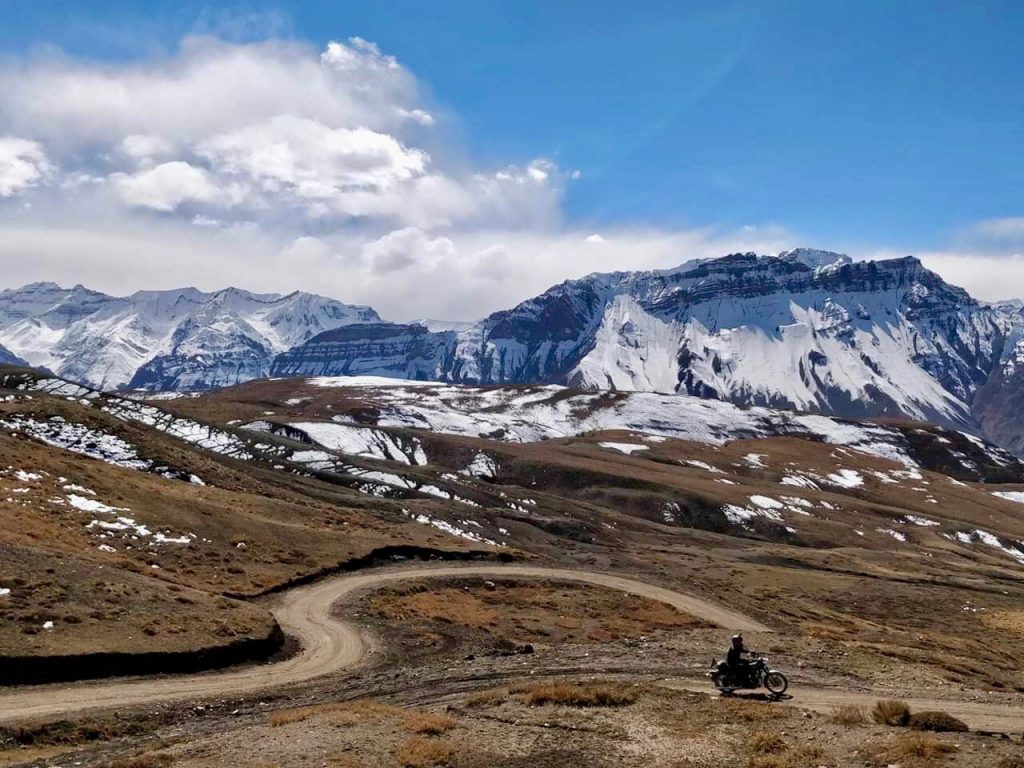
Hikkim is situated at an altitude of approximately 14,400 feet in the Spiti Valley of Himachal Pradesh. It is about 16 km from Kaza, the main town and administrative center of Spiti. The drive from Kaza takes around 45 minutes on a winding uphill road with some dizzying turns. You approach Hikkim while going to Komic and Langza villages from Kaza.
At a bird’s eye view, Hikkim looks like an extension of Komic or Langza, as they all are structured in a similar pattern, and Hikkim falls somewhere in the middle of the two. The village is small, with only about 50-60 houses, but the layered fields reflecting shades of green and brown against the snow-capped peaks make it one of the most photogenic settlements in all of Spiti.
What Is the Best Time to Visit Hikkim?
June to September is the best window for Hikkim, with daytime temperatures of 10 to 20 degrees Celsius, open roads and a working post office. From November to March it falls below -20 degrees Celsius, snow cuts off the village and the post office closes for winter. Kunzum Pass usually shuts around October or November.
The best months to visit Hikkim are June to September, when the weather is pleasant with daytime temperatures between 10 to 20 degrees Celsius. Roads are accessible, the post office is operational, and the village comes alive with green fields and clear skies. Even on a warm June afternoon, the temperature drops sharply within minutes once the sun dips behind the ridge, so carry a proper down jacket even in peak summer.
I am an advocate of choosing your own experience and time to visit any place. The best time to visit Hikkim or Spiti Valley depends on the kind of experience you are seeking (every season has its pros and cons) and on the route (Manali to Kaza or Shimla to Kaza) you take.
Winter months (November to March) are extremely harsh, with temperatures dropping to -20 degrees Celsius or lower. The valley gets covered under several feet of snow, making Hikkim very difficult to reach. Since the Atal Tunnel opened in 2020, Rohtang is no longer the winter bottleneck on the Manali side. The real barrier is Kunzum Pass, which usually closes around October or November and reopens between late May and June depending on snow clearance (dates change every year). Hence, the Manali to Kaza route is generally not an option in winters, and you can check our Manali Kaza road status page for the latest. The Shimla and Kinnaur route stays open through the year in principle, but snow and black ice make it tricky. In case you want to attempt it, read our guide to planning a Spiti Valley trip in winters first. A white-blanketed Hikkim during winters looks hauntingly beautiful if you are willing to brave the challenges.
Monsoon months don’t see much rain in Spiti itself, as the valley lies in a rain shadow region. However, the roads leading to Spiti from Manali or Shimla witness rainfall and landslides, leading to blockages and closures including Rohtang Pass and Kunzum Pass.
For a detailed and month-by-month guide on when to travel to Spiti, please refer to our article ‘Best Time to Visit Spiti Valley – A Month by Month Guide‘
How to Reach Hikkim Village from Kaza?
Hikkim is 16 km from Kaza by road, about 45 minutes in a taxi. A private taxi covering Hikkim, Langza and Komic costs roughly Rs 2,500 to Rs 3,500. A state bus runs in limited numbers, and self-drive works with an SUV or a strong motorcycle. There is no rail or air link.
Hikkim does not have rail or air connectivity. It is connected to the nearest town of Kaza by road. Here are your options to reach Hikkim.
By Taxi from Kaza
The most convenient option is to hire a taxi from Kaza. A day trip covering Hikkim, Langza, and Komic costs approximately Rs 2,500 to Rs 3,500 (as of 2026, verify locally for current rates). Split between four people, that works out to roughly Rs 625 to Rs 875 each. You can also check our list of taxi drivers for Spiti Valley for trusted contacts.
Hikkim is 45 minutes of a terrific drive away (16 km) from Kaza. The sinuous roads offer spellbinding views. The ascent gets steep at points and there are many hairpin bends. Keep in mind that the road is unpaved in sections, so a vehicle with decent ground clearance is recommended.
By Bus (Budget Option)
You can board a state transport bus that operates between Kaza and nearby villages. The frequency is limited, typically one bus per day during peak season. As listed in our Langza, Komic and Hikkim sightseeing guide, the HRTC service leaves Kaza at around 5 PM with a fare of about Rs 150. Since it runs in the evening and schedules change with the season, it suits an overnight stay in the village better than a same-day return. Please confirm the timing at the Kaza bus stand. For details on public transport around Spiti Valley, refer to our article How to make a budget trip to Spiti Valley by public transport.


By Bike or Self-Drive
If you are riding a bike or driving your own vehicle, the road from Kaza to Hikkim is manageable for an SUV or a motorcycle with decent power. Sedans can attempt it, but I suggest exercising caution on the steep and narrow stretches. The road surface is a mix of tarmac and gravel.
How to Reach Kaza
Kaza is connected to Manali, Shimla, and Chandigarh by a network of buses and roads. From Manali, the drive goes through Rohtang Pass (or Atal Tunnel, which opened in 2020 and has made the journey significantly easier) and Kunzum Pass. From Shimla, buses reach Reckong Peo, and from there you board another bus to Kaza. For a complete guide on planning the route, check our Spiti Valley Most Common Itinerary.
If you are self-driving via Manali, you will need a permit to cross Rohtang Pass (not required for Atal Tunnel). For details on getting Rohtang Pass permit, please read our article How to get Rohtang Pass Permit Online
By Train or Air
The nearest railway station is Joginder Nagar (364 km from Kaza), which is a narrow gauge station. The major nearest railway station is Chandigarh (about 500 km from Kaza). Chandigarh is the nearest international airport, and Bhuntar (Kullu) is the nearest domestic airport with limited flight connectivity. The onward journey can be made by taxi, self-drive, or bus.

What Are the Best Things to Do in Hikkim Village?
The best things to do in Hikkim are sending a postcard from the highest post office, visiting the small village monastery, looking for ammonite fossil country, walking through the lanes of the village and stargazing at night. Most visitors need two to three hours here, or a night if they stay over.
Hikkim may be a small village, but it offers several memorable experiences. Here are the top things to do when you visit.

Send a Postcard from 14,400 Feet
This is the main attraction of Hikkim, and honestly, it is a lovely experience. You can buy a postcard from the small cafe opposite the post office and send it to yourself or your loved ones. The postcard gets a special Hikkim stamp marked “4440 m.” Sending a postcard costs about Rs 25 (as of 2019, so confirm locally). Recent traveller reports put it anywhere between Rs 20 and Rs 50, and there is no official tariff published for Hikkim, so carry small change and verify locally.
The credit for establishing and running this post office goes to Rinchen Chhering (the spelling varies across sources), the postmaster who, as per widely cited accounts, has been working here since its inception in 1983. Staffing can change, so do not plan your day around meeting him. The post office caters to a cluster of 4-5 villages and also serves as Rinchen’s living quarters, which is a traditional Spitian house. Be it the residents of tiny villages like Gette or monks from hilltop monasteries like Ki, they all get their mail from Hikkim post office.
The absence of stable mobile networks and internet connectivity makes the presence of traditional mail highly important. For some people here, this is the only mode of communication with the rest of the world. A message from Hikkim travels a long and difficult journey, from the village to Kaza by foot, then by bus to Reckong Peo, then to Shimla, and further to Delhi, from where it goes to the rest of the world.
Like any other Indian post office, this one also offers savings account services to local farmers and villagers. Traveling from Delhi to this village between the towering brown mountains feels like a pilgrimage, an ode to the mammoth network that is the Indian Post (with over 155,000 post offices).

Visit the Village Monastery
A deep-rooted culture and truly organic lifestyle is the soul of any village in Spiti Valley. Proximity to Tibet, the influx of Tibetan Buddhists, and the remote location have helped preserve the purity of Spitian culture. Like other villages in the valley, Hikkim too has a monastery which lies at the far end of the village.
You may not find this monastery anything extraordinary if you have already been to Ki, Tabo, or other ancient monasteries in the region. However, it is worth a visit if you are here to explore Hikkim and understand more about its people and their faith. The peaceful setting and the simplicity of the prayer hall have their own quiet charm.

Explore Marine Fossils from the Jurassic Era
Being Langza’s cousin in topography and geological history, Hikkim too is fossiliferous. Millions of years ago, this region was submerged under the Tethys Sea, and you can find ammonite fossils and fossilized crustaceans from the Jurassic era right on the village’s land. Though Hikkim is not as popular as Langza for fossil hunting, the finds here can be equally fascinating.
Although it is exciting to get your hands on an ancient marine fossil high up in the Himalayas, it is important to understand that these fossils are the archaeological heritage of the Indian subcontinent. Many countries have strict protocols for the conservation of fossil wealth, and these Mesozoic era relics found in Spiti have their counterparts in the Alps.
Travelers visiting Langza are especially focused on taking a fossil back home as a souvenir. A responsible travel alternative to this is buying a replica from local shops, instead of eroding one from the land where it belongs. By taking this small step towards conserving the natural history of Spiti Valley, we can all contribute to responsible travel in the region.
Walk Around the Village
There is no better way to explore a place than by walking around, observing, and interacting with locals. If you are looking for an immersive experience of Hikkim, take a stroll down to the houses, fields, the monastery, and the village school. The people of Spiti are generous, hospitable, and extremely helpful.
The mud and stone houses with white walls, red windows, and blue doors are a characteristic of all villages in Spiti Valley. Fluttering Buddhist prayer flags carry pious words through the mountain air. Yaks and Himalayan Blue Sheep wander about leisurely, well-layered green fields stretch across the slopes, and the captivating view of Chau Chau Kang Nilda peak (Langza offers the best views of this peak) fills your soul with tranquility.

Stargaze Under the Spiti Night Sky
Being a sky lover, this has been my favorite activity whenever I am in Spiti. The night sky at Spiti is magical, with millions of stars looking down upon you, the Milky Way seems like an arm’s length away (no city offers this view), and the moon is a giant white-spotted ball, all of this silhouetted against the trans-Himalayan mountains.
At night, Spiti becomes a mysterious land, totally gripping you in its charm. Same goes for Hikkim. Try your hand at astrophotography if you are into it. Spiti is one of the best places in the world for night sky photography, thanks to the high altitude, minimal light pollution, and clear skies. Or simply gaze at the stars and make twinkling memories of a lifetime.
What Are the Hikkim Post Office Timings and How Does the Mail Work?
India Post publishes no official timetable for the Hikkim post office. Travellers report roughly 9 AM to 5 PM, closed on Sundays and public holidays, and a winter closure when snow cuts off the village. A postcard costs about Rs 25 and reports of delivery time range from 10 days to a month.
Let us look at what you can realistically expect. Hikkim runs as a branch office of India Post (the PIN code is 172114 as listed on Wikipedia) and shares its building with the postmaster’s traditional Spitian home. It is a working post office, not a museum. Since there is no published timetable, treat the hours above as traveller reports. A Sunday or a public holiday visit may find the door shut, my friend.
In case you are travelling in the shoulder months of May or October, ask your Kaza driver or homestay host whether the office is open before you head out. The Wikipedia page notes that the post office closes during the heavy-snow winter months, and the village stays cut off from the rest of Himachal for about half the year.
Your card follows the long route described above, from Hikkim to Kaza, then Reckong Peo and Shimla, and onwards to Delhi. Reported delivery times range from 10 to 15 days to a month, and one traveller account I have read mentions a postcard taking nearly a year to reach its destination. Hence, do not mail anything time-sensitive from here, and write the address in clear block letters with the PIN code. Ask for the special 4440 m postmark, which is the whole point of the stop 🙂 …
Where to Stay in Hikkim Village?
Hikkim has very few places to stay. Tsedup’s House is the well-known homestay, offering a basic bed, bathroom and three local meals. Homestays here and in nearby villages cost roughly Rs 500 to Rs 1,500 per night including meals (as of 2025). Most travellers instead stay in Kaza and visit Hikkim as a day trip.
Hikkim has limited but authentic accommodation options. The houses are built in a clustered fashion, looking like white bunches from a distance. There is one well-known homestay in the village, Tsedup’s House, which provides basic facilities with bed, bathroom, and three full meals. Everything is local and Spitian styled. An excellent way to explore the village would be to spend a night here.
Homestay rates in Hikkim and nearby villages are typically in the range of Rs 500 to Rs 1,500 per night including meals (as of 2025, verify locally for current rates). Alternatively, you can try your luck with other houses. The ever-benevolent villagers can open their doors for you if you wish to spend a night. Just ask respectfully. In case you want to see the homestay model at its most organized, I suggest checking out Demul village, Spiti’s homestay hub where nearly every household hosts travelers on rotation.
There are also homestays in neighboring villages of Langza and Komic. Here is a comprehensive list of homestays in Spiti Valley.

What to Eat in Hikkim?
Food in Hikkim is simple and filling. A small cafe opposite the post office serves tea, thukpa and momos when available. Homestay meals bring Spitian dishes such as siddu, chha gosht and butter tea. Expect to spend Rs 100 to Rs 300 per meal (as of 2025). Carry your own snacks and water for the day.

There is a little cafe right opposite the post office where you get various local dishes, tea, and beverages to keep you energized for the next leg of your journey. The cafe also sells postcards and basic stationery, which is the key attraction of Hikkim. I suggest trying thukpa (a warm Tibetan noodle soup) or momos if available, as these are staple comfort foods in Spiti.
If you are staying at a homestay, you will be served traditional Spitian meals. Expect dishes like siddu (steamed bread), chha gosht (meat curry), and butter tea. The food is simple, filling, and perfectly suited for the cold climate. In my previous articles on Langza and Kibber, I have elaborated on what to eat at these villages, should you make a stop there along with Hikkim.

How Much Does a Trip to Hikkim Cost?
A day trip to Hikkim costs roughly Rs 750 to Rs 1,125 per person if you share a taxi, eat at the cafe and send a couple of postcards. A private taxi for the Hikkim, Langza and Komic loop is Rs 2,500 to Rs 3,500 per vehicle. A homestay night adds Rs 500 to Rs 1,500 (as of 2025).
Hikkim is a budget-friendly destination. Here is a quick breakdown of expected costs per person (as of 2025, verify locally for current rates).
| Expense | Budget (INR) | Mid-Range (INR) |
|---|---|---|
| Taxi from Kaza (day trip: Hikkim + Langza + Komic) | Rs 625-875 per person (shared) | Rs 2,500-3,500 (private) |
| Homestay per night (with meals) | Rs 500-800 | Rs 1,000-1,500 |
| Meals at the cafe | Rs 100-200 | Rs 200-300 |
| Postcards and stamps | Rs 25-50 | Rs 25-50 |
Doing the math for a budget day trip (shared taxi Rs 625 to Rs 875, cafe meals Rs 100 to Rs 200, postcards Rs 25 to Rs 50), you land at roughly Rs 750 to Rs 1,125 per person. Add Rs 500 to Rs 800 for a homestay night with meals and the total becomes Rs 1,250 to Rs 1,925. These are 2025 figures with the 2026 taxi quote, so tweak the math for your group and verify locally.
For a detailed cost breakdown of your entire Spiti trip, refer to our article on Spiti Valley trip cost and budget.
Do You Need Permits for Hikkim?
Indian citizens need no special permit to visit Hikkim, Langza, Komic or most of Spiti Valley as of 2026. The Atal Tunnel route needs no Rohtang permit either. Foreign nationals may need an Inner Line Permit for certain areas of Spiti and Kinnaur, so they should check the latest rules before travelling.
As of 2026, Indian citizens do not need any special permits to visit Hikkim, Langza, Komic, or most of Spiti Valley. However, if you are traveling via the Manali route and crossing Rohtang Pass (not through Atal Tunnel), you will need a Rohtang Pass permit. The Atal Tunnel does not require any permit.
Foreign nationals may need an Inner Line Permit (ILP) for certain areas in Spiti and Kinnaur. Hence, I suggest checking the latest permit requirements before your trip if you are a foreign national. For the most current permit information, keep in mind that regulations change periodically, so verify with the Kaza SDM office or check our permits article for the latest updates.
Practical Tips for Your Trip to Hikkim
Acclimatise in Kaza at 12,500 feet for at least a day before heading to Hikkim at 14,400 feet. Carry cash, since there is no ATM in the village, and fill your tank in Kaza. Mobile networks are patchy, so download offline maps. Dress in layers, drink water and avoid alcohol to reduce altitude risk.
- Stay hydrated: Drink plenty of water and refrain from consuming alcohol to prevent altitude sickness from taking a toll. At 14,400 feet, Acute Mountain Sickness (AMS) is a real concern. Acclimatize in Kaza (12,500 ft) for at least a day before heading to the high villages.
- Sun protection: Always wear sunscreen (SPF 50+) and carry a refillable water bottle. The sun gets harsh in summers at Spiti. And here are the tips on carrying clothes to Spiti.
- Mobile network: Phone networks do not work well in Hikkim. As of the last reports I have, only BSNL has limited connectivity, and even that is patchy. Jio and Airtel signals are available in Kaza but drop off on the way to Hikkim. For detailed insights, refer to Tips on Phone Connectivity in Spiti Valley.
- Cash is king: There are no ATMs in Hikkim. The nearest ATM is in Kaza, and even those can run out of cash during peak season. Carry enough cash for your entire sub-itinerary around Kaza.
- Fuel planning: The nearest petrol pump is in Kaza. Make sure your tank is full before heading out to the high villages. There is no fuel available between Kaza and Hikkim.
- Carry essential medicines: Keep basic medicines for headache, nausea, and diarrhea. A small first-aid kit goes a long way in remote Spiti.
- Respect local culture: Remove your shoes before entering the monastery. Ask before photographing locals. Do not litter, and carry your waste back to Kaza.
We have summed up the best of prerequisites for Spiti Valley in 14 mistakes people commit on a Spiti Valley Trip. Do have a look before you travel.
Hikkim vs Langza vs Komic: Which High Village Should You Prioritise?
If you can only visit one, choose Langza for the fossils and the Buddha statue. Hikkim is the pick for the post office and a quiet village walk, and Komic for its monastery and the highest motorable village claim. All three sit within about 20 km of Kaza, so the full loop works as a half-day or full-day trip.
| Village | Approx. altitude | Main draw | Distance guide |
|---|---|---|---|
| Langza | About 14,500 ft | Buddha statue, fossils, Chau Chau Kang Nilda views | About 14 km from Kaza |
| Hikkim | 14,400 to 14,570 ft | Highest post office, village walk | About 16 km from Kaza |
| Komic | About 15,000 ft | Tangyud Monastery, highest motorable village claim | About 3 to 4 km beyond Hikkim |
Altitudes in Spiti vary by source, so keep in mind that the table is a guide and not a survey. My suggestion is to do all three in one loop, since the distances are short and the real cost is the time spent on slow mountain roads. In case your day is tight, I suggest skipping the monastery stops and keeping time for the post office and a walk through Hikkim’s lanes.
How to Club Hikkim with Nearby Villages?
Most travellers cover Langza, Hikkim and Komic together in one loop from Kaza, starting around 8 to 9 AM and returning by 3 to 4 PM. The distances are short, but the roads are slow, so keep three to four stops and about six hours in total. Add Kibber and Key if you have another day.
Most travelers visit Hikkim as part of a day trip from Kaza that covers the three high-altitude villages: Langza, Komic, and Hikkim. Here is a suggested itinerary for the day.
- Morning: Start from Kaza around 8-9 AM. Head to Langza village first (about 14 km, 30-40 minutes). Spend an hour exploring the Buddha statue, fossil grounds, and the stunning views of Chau Chau Kang Nilda.
- Mid-morning: Drive from Langza to Hikkim (about 5 km by my earlier estimate, 15 minutes; some sources count closer to 10 km, so keep a buffer). Visit the post office, send your postcards, grab tea at the cafe, and walk around the village. Spend 1-1.5 hours here.
- Afternoon: Head to Komic village (about 3 to 4 km from Hikkim). Visit the ancient Tangyud Monastery. Komic is often cited as one of the highest motorable villages in the world.
- Return: Drive back to Kaza by 3-4 PM. This leaves you time to explore Kaza town or rest before the next day’s adventures.
If you have more time, I suggest adding Kibber and the local sightseeing circuit around Kaza to your plans. For your complete Spiti sub-itinerary covering all these villages, check our Spiti Valley Most Common Itinerary.

What Else Should You Read Before Visiting Hikkim?
- Manali to Kaza road status, to check whether Kunzum Pass is open before you leave.
- How to plan a Spiti Valley trip in winters, if you are visiting between November and March.
- Hidden gems of Spiti Valley, for more offbeat villages beyond this circuit.
- Ki and Kibber, the high-altitude villages of Spiti Valley, an easy addition to your Kaza sightseeing.
- Spiti Valley budget guide 2026, for a whole-trip cost view.
Frequently Asked Questions
Is Hikkim really the highest post office in the world?
Hikkim claims to have the world’s highest permanently structured post office at 14,400 feet (4,400 meters). There is a seasonal post office at the Everest Base Camp in Tibet at a higher elevation, but it is not a permanent structure. Hikkim’s post office is recorded in the Limca Book of Records for this distinction.
How much does it cost to send a postcard from Hikkim?
Sending a postcard from Hikkim costs approximately Rs 25, though recent reports range from Rs 20 to Rs 50 and no official tariff is published. You can buy postcards and stationery from the small cafe opposite the post office. The postcard receives a special Hikkim stamp marked 4440 m, making it a unique souvenir.
What are the Hikkim post office timings?
India Post does not publish an official timetable for Hikkim. Travellers report roughly 9 AM to 5 PM, closed on Sundays and public holidays, but treat this as approximate. The office also closes in winter when heavy snow cuts off the village, so ask in Kaza before you travel.
How long does a postcard from Hikkim take to arrive?
Reported delivery times range from 10 to 15 days to about a month, because mail travels from Hikkim to Kaza, Reckong Peo, Shimla and Delhi before reaching its destination. Some travellers have reported far longer delays, so do not post anything urgent from Hikkim.
Can I visit Hikkim in winter?
Technically yes, but it is extremely challenging. The Manali to Kaza road usually closes in winter because Kunzum Pass gets heavy snow, even though the Atal Tunnel now bypasses Rohtang. You can reach Kaza via the Shimla route in winter, though road conditions can be treacherous. The post office may not be operational during winter months.
Is there mobile network in Hikkim?
Mobile connectivity in Hikkim is very limited. Only BSNL has patchy coverage. Jio and Airtel signals that work in Kaza drop off on the way to Hikkim. Download offline maps and inform your family before heading out from Kaza.
How many days do I need for Hikkim?
A half-day trip from Kaza is sufficient to explore Hikkim. Most travelers combine Hikkim with Langza and Komic in a single day trip from Kaza. For a deeper experience, spending a night at Tsedup’s homestay is a wonderful option.
Do I need a permit to visit Hikkim?
Indian citizens do not need any special permits to visit Hikkim as of 2026. Foreign nationals may require an Inner Line Permit (ILP) for certain areas in Spiti and Kinnaur. Check the latest regulations before your trip.
Is Hikkim safe for solo travelers?
Yes, Hikkim and Spiti Valley are very safe for solo travelers, including solo women. The locals are warm and hospitable. The main concerns are altitude sickness and road conditions, not personal safety. Carry enough cash, inform someone of your plans and acclimatize properly before visiting the high villages.
What is the altitude of Hikkim village?
Hikkim village sits at approximately 14,400 feet (4,400 meters) above sea level, though the post office postmark reads 4,440 meters (about 14,567 feet). This makes it one of the highest inhabited villages in India. Proper acclimatization is important before visiting.
What is the temperature in Hikkim village?
Hikkim’s daytime temperatures range from 10 to 20 degrees Celsius during June to September, the best time to visit. Winters (November to March) are brutally cold, dropping below -20 degrees Celsius as snow cuts off the village, and the post office often shuts through the coldest stretch.
Conclusion
The hamlet of Hikkim is one of the many gems of Spiti, where a traveler can experience the life of a trans-Himalayan village, a landscape like no other, and to top the list, post a mail from one of the highest post offices in the world at 14,400 feet above sea level.
Have a travel question?? You can subscribe to my YouTube channel and leave a comment to ask your travel questions about traveling to the Himalayas.
Hikkim village should be clubbed with the neighboring villages (Langza, Komic, Kibber, and Dhankar monastery) in your sub-itinerary for Spiti Valley. I hope this detailed travel guide for Hikkim village will help you plan your journey better and make it a memorable one 🙂 …
Do you still have any questions or need help in planning your trip to Hikkim? If yes, please feel free to post them in the comments section below or connect with us through the DwD Community. If you know your friends or family are planning a trip to Hikkim or Spiti Valley, do share this article with them to help them plan better.
Happy traveling to you!!!
Do follow @soulful_worldview on Instagram for updates on my next adventure.
