


Last Updated: February 2026
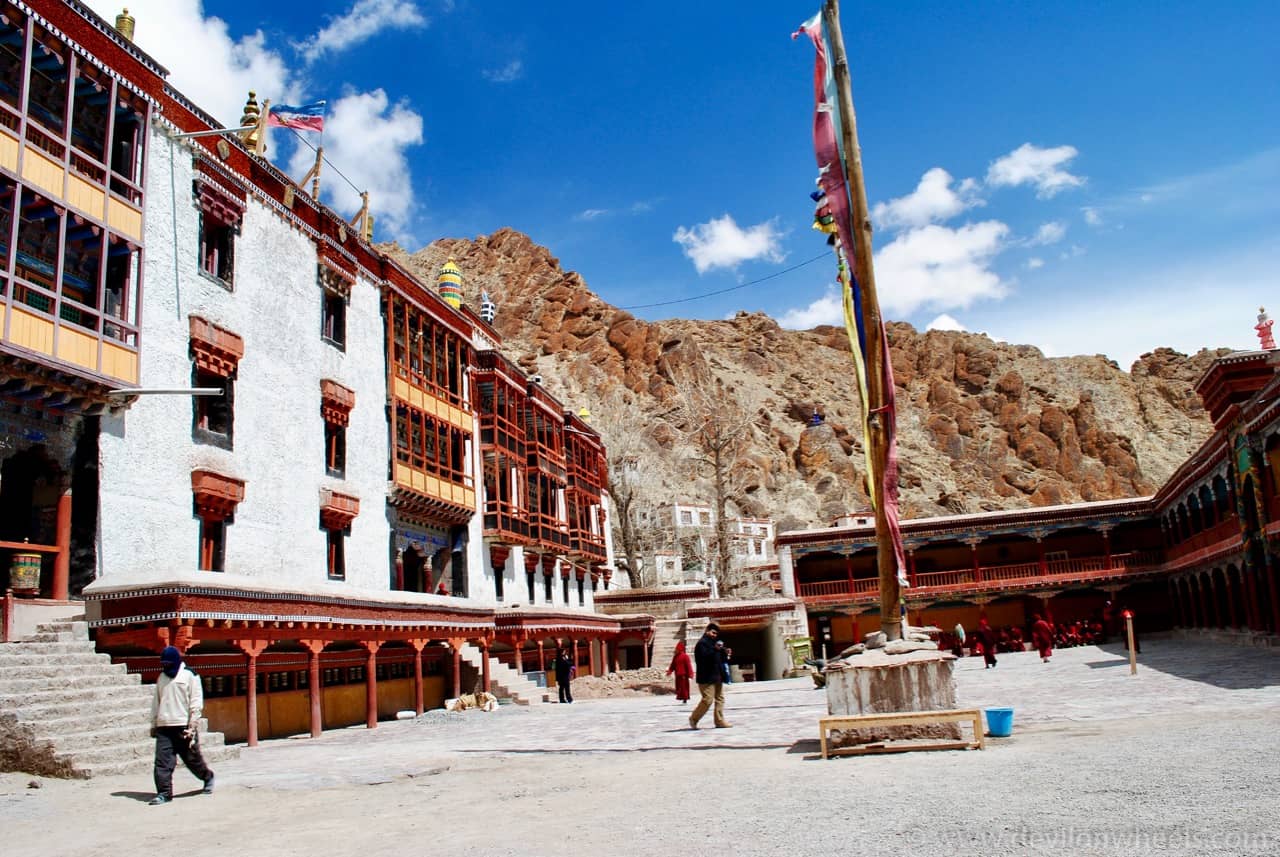
Are you planning a trip to Leh Ladakh and wondering whether Hemis Monastery is worth visiting? Let me put it this way. At an altitude of about 12,000 feet, Hemis Monastery is the largest and wealthiest Tibetan Buddhist monastery in all of Ladakh. It sits in a sheltered gorge on the west bank of the Indus River, only about 45 km from Leh town, and is one of the most visited monasteries on a trip to Leh Ladakh. Whether you are here for the famous Hemis Festival, the centuries-old history, or simply soaking in the spiritual atmosphere of the place, this guide covers everything you need to plan your visit in 2026.
Hemis Monastery sits inside Hemis National Park, home to one of Asia’s highest snow leopard densities. The park’s 2026 camera-trap census counted 126 individually identified snow leopards across 956 trap locations, a more precise figure than the “about 200” estimate most travel sites still quote.
Let's quickly dive into the details:
What Are the Key Facts About Hemis Monastery?
Hemis Monastery is one of the most important monasteries in Ladakh and a must-visit on any Ladakh itinerary. Here are the essential details you need to know before visiting.
| Detail | Information |
|---|---|
| Altitude | About 12,000 feet (3,650 meters) |
| Distance from Leh | About 45 km (1 hour drive) |
| Lineage | Drukpa Kagyu (Red Hat sect of Tibetan Buddhism) |
| Founded | Before 11th century, re-established in 1672 |
| Entry Fee | INR 50 for Indians, INR 200 for foreigners (as of 2025) |
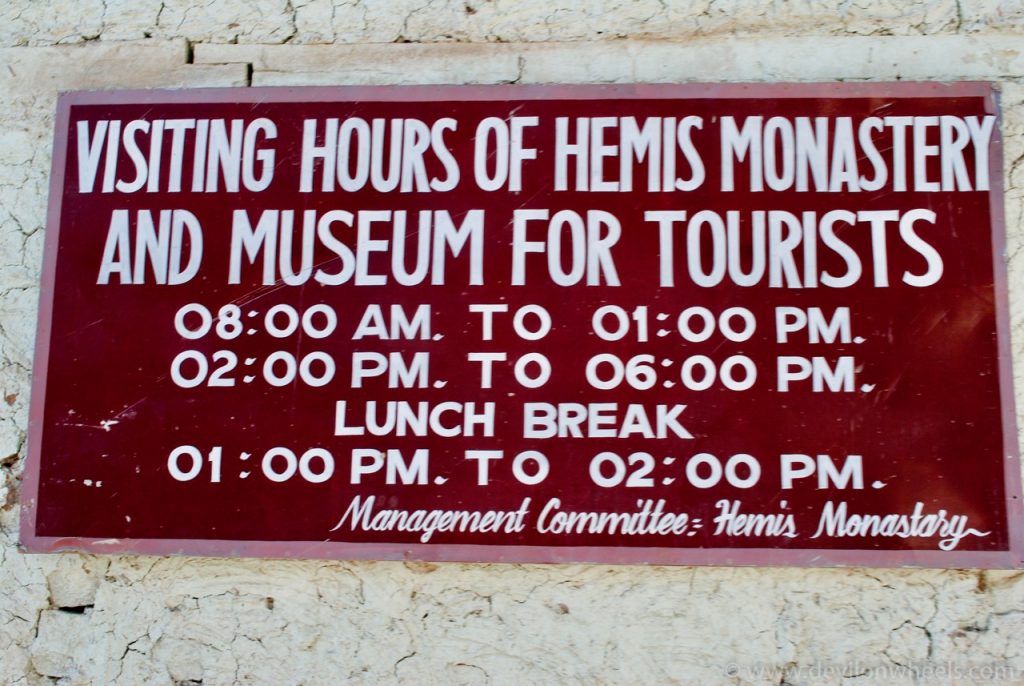
| Visiting Hours | 8:00 AM to 1:00 PM, 2:00 PM to 6:00 PM (daily) |
| Camera Fee | INR 100 (no photography inside prayer hall and museum) |
| Hemis Festival 2026 | June 24-25, 2026 (tentative, based on Tibetan lunar calendar) |
| Hemis Festival 2027 | July 13-14, 2027 (tentative) |
| Nearest Airport | Kushok Bakula Rimpochee Airport, Leh |
| Mobile Network | BSNL, Airtel postpaid, Jio works near Leh |
What Is the History of Hemis Monastery in Ladakh?
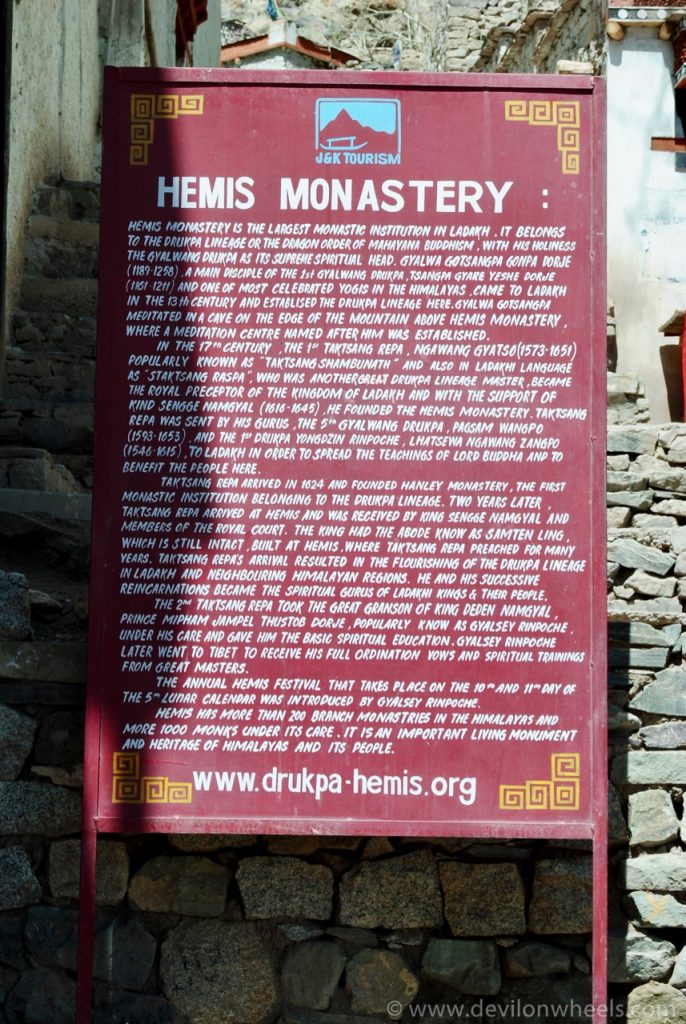
Hemis Monastery has a rich and layered history that goes back centuries. It belongs to the Drukpa Kagyu lineage of Tibetan Buddhism and is said to have existed before the 11th century. The monastery was then re-established in 1672 by the Ladakhi King Sengge Namgyal, one of the most powerful rulers in Ladakh’s history. So, it is fair to say that this place carries a great deal of historical and spiritual weight.
The history of Hemis is closely connected to Naropa, a pupil of the tantric master Tilopa and teacher of Marpa, the great translator. Marpa later taught the famous Tibetan saint Milarepa, and this chain of teacher-student relationships forms the foundation of the Kagyu lineage of Himalayan Buddhism. A biography of Naropa was discovered in the Hemis Monastery and later translated into various languages by A. Grunwedel. It describes how Naropa met Tilopa and the spiritual tasks that Tilopa assigned to achieve enlightenment.
Naropa is considered the “Abbott of Nalanda,” the famed monastery and university in present-day Bihar. When Nalanda was sacked by Afghan-Turkish invaders, Naropa is believed to have traveled northward, eventually reaching Hemis, where he met Tilopa. They then traveled back to another university in the kingdom of Magadha in Bihar, called Otantra, which no longer exists. Naropa went on to become the founding father of the Kagyu lineage of Himalayan esoteric Buddhism. Hence, Hemis became the principal seat of this Kagyu tradition in Ladakh, and that legacy continues to this day.
There is also a controversial story that proclaims Hemis to be the origin of an unknown gospel of Christianity. According to this account, during his “lost years,” Jesus is said to have traveled to India. However, historians find significant uncertainty in this claim, as the evidence is considered fabricated, rendering the entire account a hoax. Still, it makes for an interesting topic of discussion if you visit.
What Is the Architecture of Hemis Monastery Like?
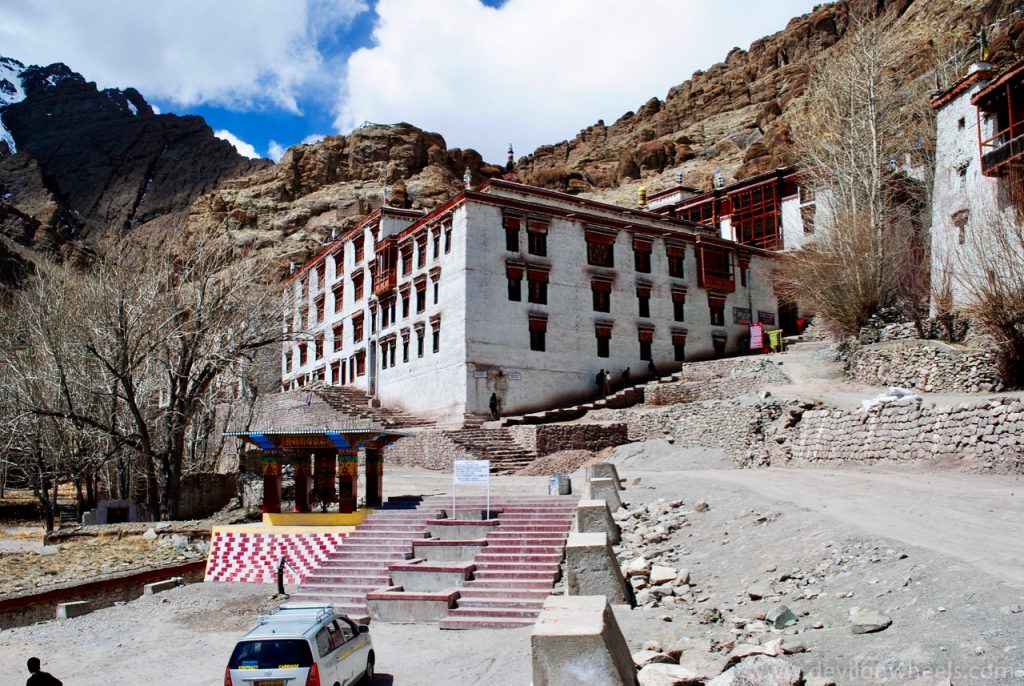
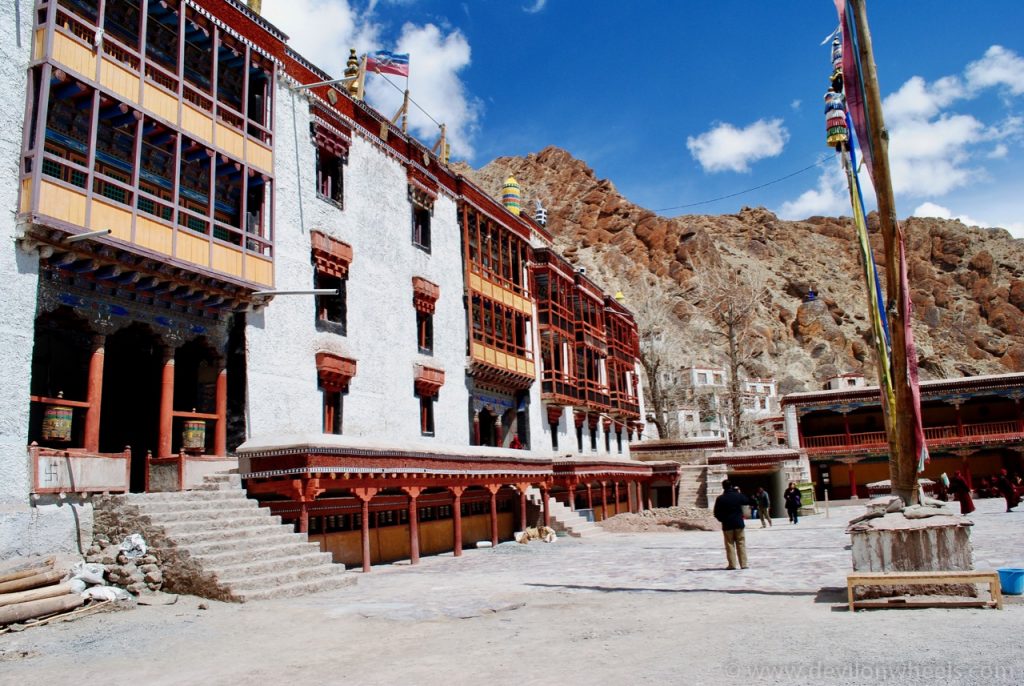
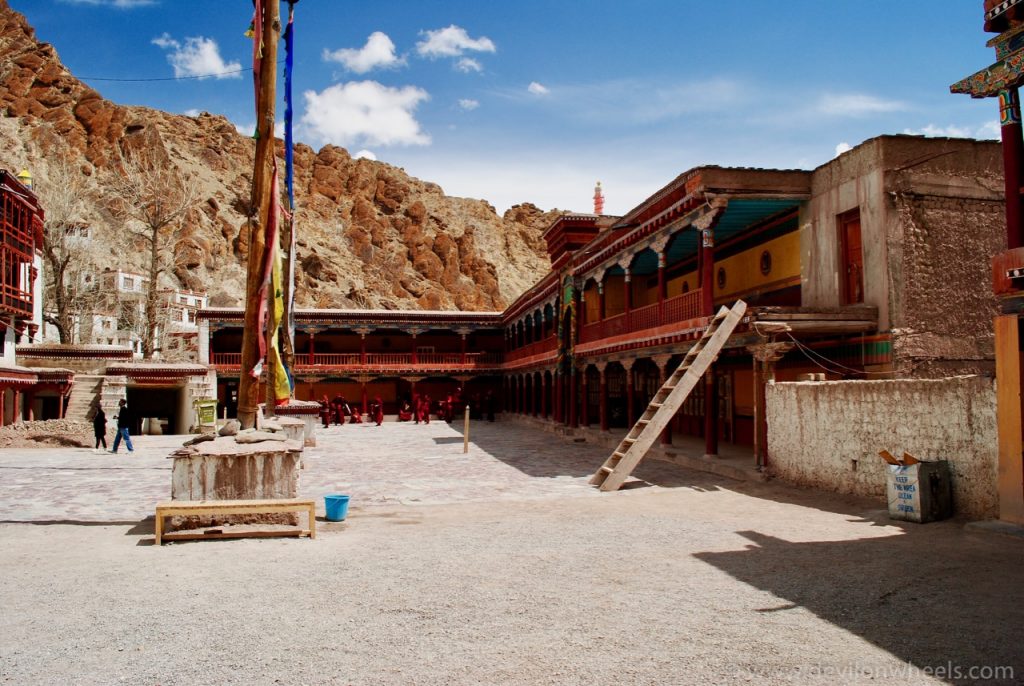
Hemis Monastery is a fine example of Tibetan-style architecture, and the way it is built into the mountain slope is quite something. The entire complex follows a tiered layout, with structures stepping down the hillside. This design was not just for aesthetics. It optimizes natural light, ventilation, and also provides stability against landslides, which is an important consideration in this terrain.
The complex is arranged around a central courtyard, which serves as the main gathering space for rituals, prayers, and the annual Hemis Festival. Flanking this courtyard are the two major structures: the Dukhang (Assembly Hall) and the Tshongkhang (Temple). The Dukhang is where monks gather for daily prayers and is the focal point of the monastery’s spiritual life. Its walls are adorned with murals depicting the life and teachings of Lord Buddha, along with scenes from the Hemis Festival itself.
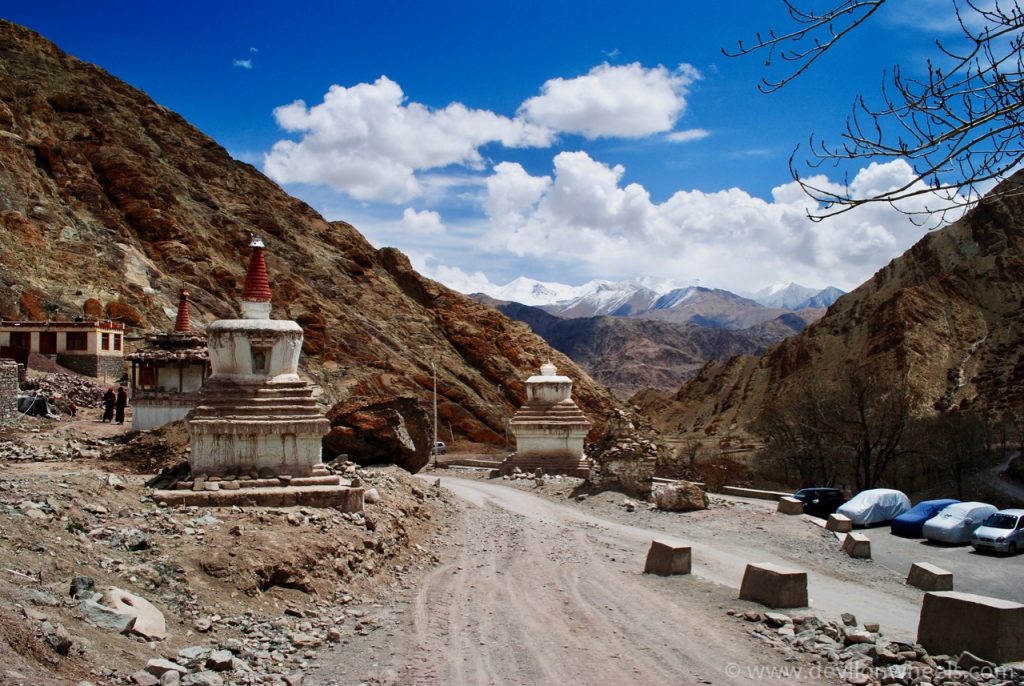
On the northern side, you will find two smaller assembly halls that house guardian deities and the Wheel of Life. The white-walled buildings set against barren brown mountains, topped with fluttering prayer flags, create a visual contrast that you will remember long after your trip. I have visited many monasteries across Ladakh, and the setting of Hemis in this sheltered gorge is one of the most photogenic.
What Is the Hemis Festival and When Is It Celebrated?
The Hemis Festival is the biggest and most famous monastery festival in Ladakh, and if you can time your trip around it, the experience is truly special. It is a two-day celebration dedicated to Lord Padmasambhava (Guru Rinpoche), the founder of Tibetan Buddhism’s Nyingma order. The festival falls on the 10th day of the fifth month of the Tibetan calendar, which usually translates to June or July in the Gregorian calendar.
What makes the Hemis Festival even more significant is that the birth anniversary of Guru Rinpoche falls once every 12 years. On that year, the celebrations reach an extraordinary level of festivity. People believe that Guru Rinpoche’s life mission was to improve the spiritual condition of all living beings. Hence, at the festival, sacred rituals are observed to attain spiritual strength and good health.
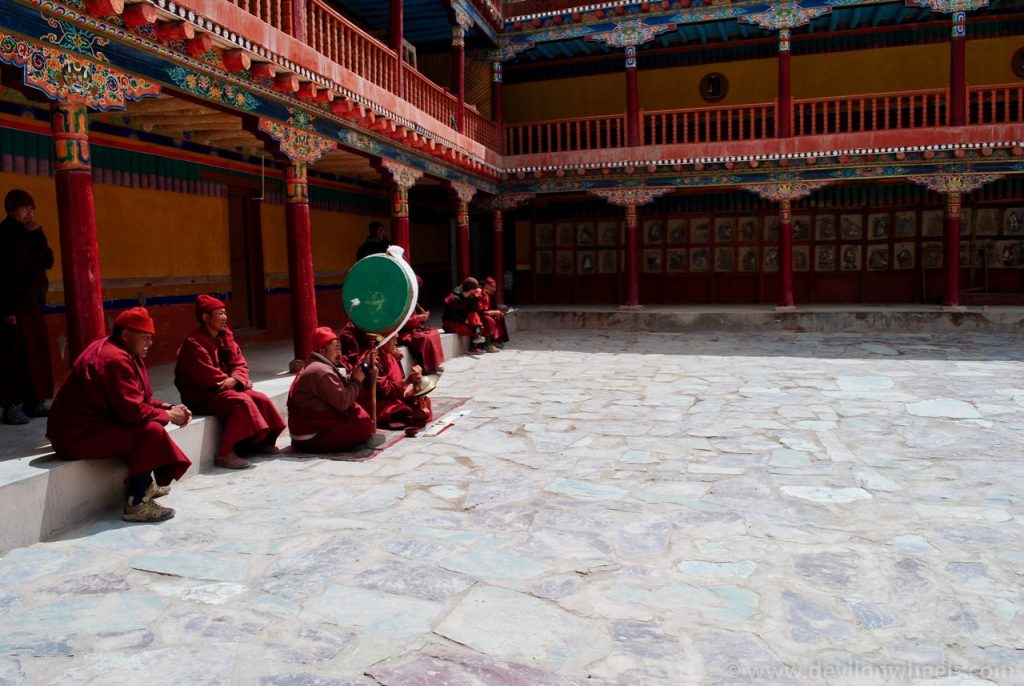
The Hemis Gompa festival is celebrated in the courtyard of the monastery. Early in the morning, the beating of drums, the clash of cymbals, and a spiritual wail of pipes signal the start of the celebrations. The portrait of Guru Rinpoche is then ceremoniously unveiled for all to worship and pay homage. During the festival, a massive 22-feet-high thangka of Guru Padmasambhava, intricately woven with the finest silk, is also displayed. This thangka is one of the largest in Ladakh, and seeing it unfurled is a sight you will not forget easily.
The main attraction of the festival is the mystic masked dance, called Cham Dance, which is one of the most sacred festivities of the Buddhist tradition. It is part of a tantric ritual and is performed only at those Gompas that follow the Tantric Vajrayana teachings. You can also see monks performing traditional Ladakhi music in full swing, making it a vibrant cultural experience. If you are interested in other festivals of Ladakh, do check our detailed festival calendar.
Hemis Festival Dates (2025, 2026, 2027)
The Hemis Festival dates shift each year based on the Tibetan lunar calendar. Keep in mind that these are tentative dates and may vary slightly.


- Hemis Monastery Festival 2027 Date: July 13 – July 14 (tentative)
- Hemis Monastery Festival 2026 Date: June 24 – June 25 (tentative)
- Hemis Monastery Festival 2025 Date: July 5 – July 6
I suggest planning your Ladakh trip around the Hemis Festival dates if you want to experience one of the most vibrant cultural events in the region. However, keep in mind that accommodation in Leh gets booked up quickly during festival time, so plan well in advance. Ideally, book your hotels at least 2-3 months before the festival dates.
What Can You See Inside Hemis Monastery?
Besides the annual festival, Hemis Monastery has plenty to offer even during a regular visit. Here is what you can explore inside the monastery complex.
The Dukhang (assembly hall) houses a copper gilded statue of Lord Buddha, along with a large statue of Guru Padmasambhava, the monastery’s patron saint. The walls of the Dukhang are decorated with beautiful murals and a wide collection of historical and religious paintings called Thangkas. You will also find various stupas and statues made of gold, silver, and other precious metals. The intricate designs, ancient murals, and a three-dimensional mandala are highlights that art and history lovers will appreciate.

There is a museum within the monastery that is well worth your time. It houses a collection of Tibetan books, Thangka paintings, gold statues, and Stupas embedded with precious stones. You can also see historical weapons, carriers, and even a stuffed vulture pup among the artifacts. The library on the premises contains rare Buddhist manuscripts. Do note that photography is not allowed inside the prayer hall and the museum area. The camera fee of INR 100 applies only to the courtyard and exterior areas of the monastery.
Gotsang Hermitage Near Hemis
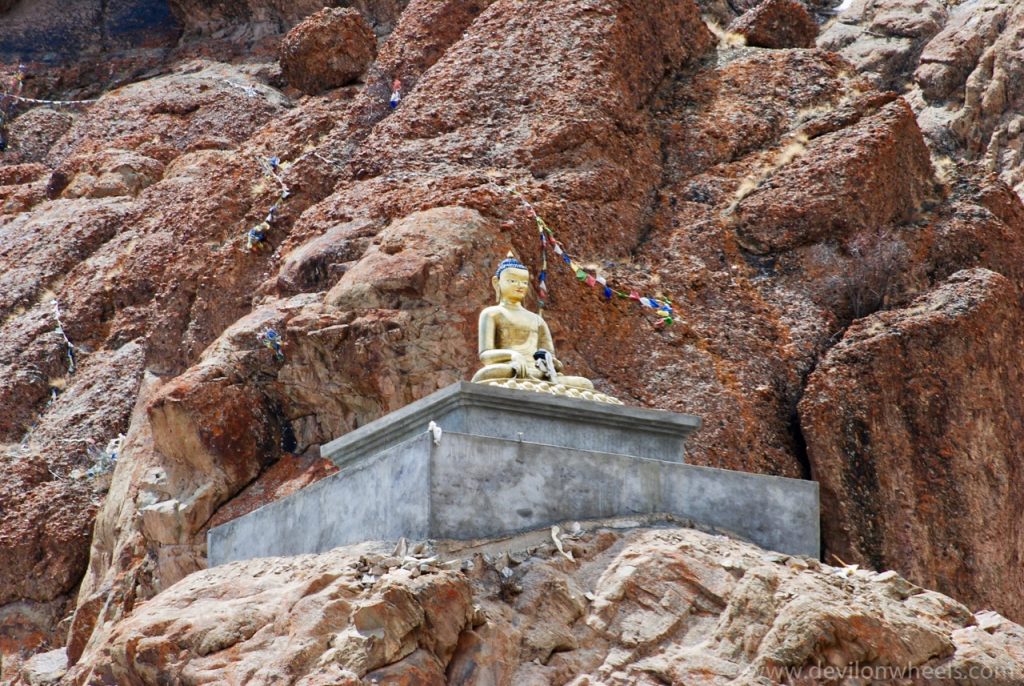
About 3 km uphill from the main monastery sits the sacred Gotsang hermitage, which is said to have been founded by the great Gyalwa Kotsang. Inside the cave, you can see a handprint and footprint on a rock that are believed to be of spiritual significance. The hermitage is adorned by fluttering Buddhist prayer flags and is visible from far away. The walk takes about 30-40 minutes each way, and the trail is moderately steep. If time permits, I strongly suggest this walk. It gives you a peaceful view of the valley below, and you will likely have the place to yourself since most visitors skip it.
Hemis Monastery is also the center of the Drukpa lineage where they train Lamas for all the monasteries in the region. Although only about a dozen Lamas actually reside at Hemis full-time, the monastery has several hundred Lamas attached to its various subsidiary monasteries across Ladakh.
What About Hemis National Park?
Hemis Monastery sits within the boundaries of the Hemis National Park, which is the largest national park in India, covering an area of about 4,400 sq km. The park is famous as one of the best places in the world for spotting the elusive Snow Leopard. It is home to an estimated 200 snow leopards, along with Bharal (blue sheep), Tibetan wolves, Eurasian brown bears, and golden eagles.
The entry fee for Hemis National Park is about INR 20 for Indian nationals and INR 100 for foreign tourists (as of 2025, verify locally for current rates). Snow Leopard tracking expeditions typically happen from December to March when these cats descend to lower altitudes following the Bharal herds. If you are interested in a Snow Leopard trek, you will need special permission from the Chief Wildlife Warden’s office. I suggest booking well in advance as these treks fill up quickly and groups are limited.
When Is the Best Time to Visit Hemis Monastery?
If you want to catch the Hemis Festival, then June to July is the time to go, specifically around the festival dates (June 24-25 in 2026). Otherwise, May to September is a good time to visit when the weather in Ladakh is pleasant and all the roads are open.
The roads to reach Ladakh via Manali and Srinagar are closed from November to May because of heavy snow. So, traveling via air is the only option to reach Leh and Hemis Monastery during the winter months. Hence, the best time to visit Hemis Monastery is the same as the best time to visit Leh Ladakh, that is, from May to September or October when roads from both Srinagar and Manali side are open.
However, the road from Leh to Hemis Monastery remains open even in winter. So, if you fly into Leh during winter (December to February), you can still visit Hemis. Just keep in mind that the temperatures drop to minus 20 degrees Celsius or lower, and you need to be prepared for extreme cold. On the positive side, a winter visit gives you a chance to see the monastery draped in snow, which is a completely different experience. For more on visiting Ladakh in winter, check our guide on Leh Ladakh in winters.
How to Reach Hemis Monastery from Leh?
Hemis Monastery is about 45 km from Leh town, and the drive takes roughly 1 hour on a decent road. The route goes along the Indus River valley, passing through Karu, and the road is well-maintained. Here are the different ways to reach Hemis.
By Road from Delhi: The most common way is to drive to Leh first, either via the Manali – Leh Highway or the Srinagar – Leh Highway. Once in Leh, Hemis is an easy day trip. Most people visit Hemis on their trip to Pangong Tso, either on the way there or while returning, since the Karu junction is common to both routes.
By Local Taxi from Leh: You can hire a taxi from Leh for a monastery day tour that includes Hemis, Thiksey, Shey Palace, and Stakna Monastery. The official union-approved rate for this Indus Valley monastery tour is about INR 4,865 per vehicle (as of 2026). If you also want to include Chemrey Monastery, the rate goes up to about INR 6,194 per vehicle. For the full updated rate list, check our Leh Ladakh taxi rates page.
By Self-Drive or Bike: If you have your own vehicle or a rented bike, the drive from Leh to Hemis is straightforward. Head south on the Leh-Manali Highway, turn left at Karu junction (about 35 km from Leh), and then it is another 10 km on a narrow but paved road to the monastery. The road is suitable for all vehicle types, including sedans and hatchbacks. Fuel up in Leh before starting. For self-drive tips for Ladakh, check our detailed guide.
By Local Bus: JKSRTC buses ply within the Ladakh region and there are buses from Leh towards Karu and beyond. However, the bus connectivity to Hemis specifically can be limited. I will suggest checking with the Leh bus stand for current schedules. A private vehicle or shared taxi is the more practical option for the monastery tour.
By Air: The nearest airport is Kushok Bakula Rimpochee Airport in Leh, which is well connected with Delhi, Mumbai, Srinagar, and Chandigarh. Flights operate daily during the summer season. From the airport, you can hire a taxi to your hotel in Leh. I always suggest spending at least one full day in Leh for acclimatization before heading out to explore monasteries or other high-altitude areas. If you are visiting Ladakh by air, you can easily fit Hemis into your itinerary on Day 2 or Day 3.
By Train: The nearest major railway station from Leh is Jammu Tawi, at a distance of about 812 km via the Srinagar – Leh Highway. It is a long 3-day journey with overnight halts at Srinagar and Kargil. Joginder Nagar railway station is about 635 km from Leh via the Manali – Leh Highway, but it is not a major station.
Where Should You Stay When Visiting Hemis Monastery?
Most travelers visit Hemis Monastery as a day trip from Leh, so there is no real need to find accommodation at Hemis itself. You can cover Hemis along with other monasteries nearby, including Stakna, Thiksey, and Shey Palace, all in a single day from Leh. What many travelers also do is visit Hemis on their way to Pangong Tso or while coming back. So, your base remains at Leh.
If you specifically want to explore the Hemis National Park for a Snow Leopard sighting or want a quieter experience away from Leh, there are a few homestays and guesthouses available in Hemis village. However, options are limited, so book in advance if you plan to stay overnight. For accommodation options in Leh itself, you can check our guide on budget hotels and accommodation in Leh Ladakh.

Some travelers also visit Hemis Monastery along with a local sightseeing tour from Leh, which includes attractions like Gurudwara Pathar Sahib, Magnetic Hill, and the Sangam (confluence of Indus and Zanskar rivers). But I will recommend keeping the monastery tour and local sightseeing tour on separate days so you do not rush through either.
Where Can You Eat Near Hemis Monastery?
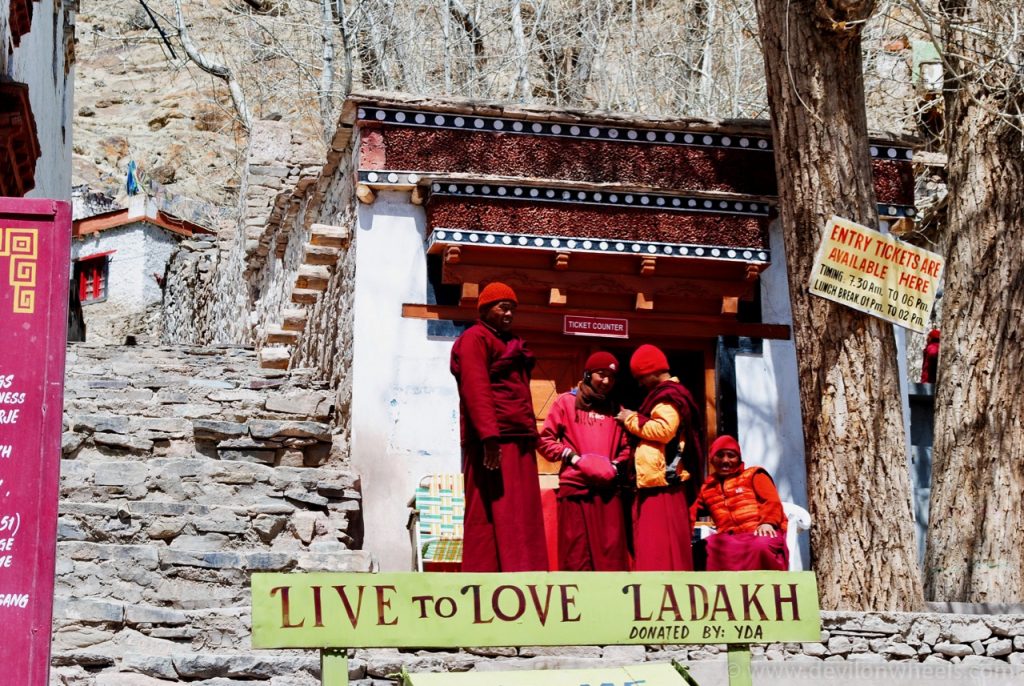
There are a couple of eating stalls around the Hemis Monastery parking area where you can grab quick bites like Maggi, momos, and chai. However, it is always a good idea to carry food and water with you for the day, as it can be a long outing when you combine Hemis with other monasteries. Inside the monastery, there is a dining and rest hall where they serve tea, coffee, and biscuits for free. It is a lovely gesture by the monks, and I suggest taking a few minutes to sit there and soak in the atmosphere.
If you plan to eat a proper meal, your best bet is to eat before leaving Leh or after returning. The restaurants and dhabas along the main highway near Karu also offer basic meals. Keep in mind that at 12,000 feet, it is important to stay hydrated, so carry at least 1-2 liters of water per person.
Which Other Monasteries Can You Visit Near Hemis?
The road from Leh towards Hemis passes through some of the most famous monasteries in Ladakh. Here is a suggested monastery tour itinerary that you can do in a single day from Leh.
- Shey Palace (15 km from Leh): The former summer palace of the Kings of Ladakh, with a copper-gilt statue of Buddha.
- Thiksey Monastery (19 km from Leh): Often called the “Mini Potala Palace” because of its striking resemblance to the Potala in Lhasa, Tibet. Try to catch the morning prayer at 6:30 AM if you start early.
- Stakna Monastery (25 km from Leh): A smaller but beautiful monastery perched on a hill overlooking the Indus River.
- Hemis Monastery (45 km from Leh): The largest and wealthiest monastery in Ladakh.
This entire circuit can be covered comfortably in 5 to 6 hours, including time spent at each monastery. I suggest starting early in the morning (by 8 AM) so you are back in Leh by afternoon and can rest.
If you have more days in Ladakh and are interested in exploring monasteries beyond the Hemis circuit, I also recommend visiting Alchi Monastery (about 67 km from Leh) and Likir Monastery (about 62 km from Leh) on a separate day. These are on the Srinagar side and offer a very different architectural style, with Alchi being famous for its ancient wall paintings from the 11th century.
What Are Some Important Tips for Visiting Hemis Monastery?
Here are some practical tips that will help you make the most of your visit to Hemis Monastery and stay safe during your Ladakh trip.
- Photography: Photography is not allowed inside the prayer hall and the museum. You will need to pay an INR 100 camera fee for clicking pictures in the courtyard area. Carry cash for this as digital payments may not work reliably.
- Altitude sickness: Hemis is at about 12,000 feet. If you have just arrived in Leh by flight, do not visit Hemis on Day 1. Give yourself at least one full day to acclimatize. Carry Diamox or consult your doctor before the trip.
- Carry warm clothes: Even in summer, the temperature can drop suddenly, especially inside the monastery halls which do not get direct sunlight. A wind-cheater or light jacket is a must. For detailed packing tips, check our guide on what clothes to carry for a Ladakh trip.
- Dress modestly: Hemis is a functioning monastery with resident monks. Please dress respectfully and maintain silence inside the prayer halls. Remove your shoes before entering the prayer halls.
- Carry water and snacks: While stalls are available outside, it is better to carry your own supplies for the day. Staying hydrated at altitude is important.
- Permits: As of 2026, domestic tourists need to pay the Ladakh Environment Fee (Green Tax) to visit places in Ladakh. You can apply for it online. For the complete process, check our guide on how to apply for Ladakh permits online.
- Footwear: Wear comfortable walking shoes. There are steps to climb inside the monastery complex, and the Gotsang hermitage trail requires proper footwear.
- Time needed: Plan at least 1 to 1.5 hours for Hemis Monastery alone. If you are combining it with other monasteries, plan for a full half-day. Add another 1.5 hours if you want to walk up to Gotsang hermitage.
- Best visiting time of day: I suggest visiting Hemis in the morning when the light is good for photography and the crowds are smaller. During the Hemis Festival period, arrive early (by 8 AM) to get a good spot in the courtyard.
Does Mobile Network Work at Hemis Monastery?
BSNL and Airtel postpaid numbers work fine in and around Leh, and you should get decent connectivity on the Leh to Hemis road as well. Reliance Jio has also expanded its coverage in Ladakh significantly since 2018 and works in most areas near Leh. However, keep in mind that prepaid SIMs of most networks do not work in Ladakh due to security restrictions. For a detailed breakdown of which network works where, check our guide on mobile phone connectivity in Leh Ladakh.
At Hemis Monastery itself, you should have signal on Airtel postpaid and BSNL. Jio coverage can be spotty once you leave the main highway and enter the gorge. I will suggest downloading offline maps on Google Maps before your trip, just to be on the safer side.
How Much Does a Hemis Monastery Visit Cost?
A visit to Hemis Monastery is very affordable. Here is a rough budget breakdown per person for a day trip from Leh.
| Expense | Cost (Per Person, approx.) |
|---|---|
| Taxi (shared, 4 people, Indus Valley monastery tour) | INR 1,200 – INR 1,550 |
| Hemis Monastery entry fee | INR 50 |
| Camera fee | INR 100 |
| Lunch and snacks | INR 200 – INR 400 |
| Total per person | INR 1,550 – INR 2,100 |
These are approximate costs as of 2026. The taxi cost is based on the official union rate of INR 4,865 for the Indus Valley monastery tour (Shey, Thiksey, Stakna, Hemis), divided among 4 people. If you add Chemrey Monastery, the rate is about INR 6,194 per vehicle. If you are riding a rented bike or driving your own car, the cost will be even lower (just fuel, about INR 300-400 for the round trip). For a complete budget breakdown for your entire Ladakh trip, check our guide on how to calculate the cost of a Ladakh trip.
Conclusion
Hemis Monastery is a soulful reminder of the deep Buddhist culture and history that Ladakh has preserved over centuries. The Naropa-Tilopa-Marpa-Milarepa lineage, the Cham dances of the Hemis Festival, the quiet beauty of the Gotsang hermitage, and the Snow Leopards of Hemis National Park all come together to make this one of the most significant places in Ladakh. Even if you cannot see everything in one trip, Hemis Monastery is something you just do not want to miss.
I hope this guide helps you plan your visit to Hemis Monastery in 2026. If you have any questions about your Ladakh trip, feel free to ask in the comments section below, and I will be happy to help. Also, if you know your friends or family are planning a trip to Ladakh, do share this article with them. For more travel guides and updates, you can also join the DwD Community or check the DoW Travel Calendar from the main menu 🙂 …
Have a travel question?? You can subscribe to my YouTube channel and leave a comment to ask your travel questions about traveling to the Himalayas.
Related Reading
- Best Leh Ladakh Itinerary 2026 (12-14 Day Road Trip Plan)
- How to Apply for Ladakh Permits Online (Step-by-Step Guide)
- Leh Ladakh Taxi Rates 2026 (Updated Rate List)
- Festivals of Ladakh (Complete Calendar and Dates)
- Local Sightseeing in Leh (Complete Tour Guide)
Frequently Asked Questions
What is the entry fee for Hemis Monastery?
The entry fee for Hemis Monastery is INR 50 per person for Indian nationals and INR 200 for foreign tourists. There is an additional camera fee of INR 100 if you want to take photographs in the courtyard area. Photography is not allowed inside the prayer hall and museum. Carry cash as digital payment may not be reliable.
What are the visiting hours of Hemis Monastery?
Hemis Monastery is open daily from 8:00 AM to 1:00 PM and then again from 2:00 PM to 6:00 PM. The monastery remains open on all days including national holidays. I suggest visiting in the morning hours when the light is good and the crowds are smaller.
How far is Hemis Monastery from Leh?
Hemis Monastery is about 45 km from Leh town. The drive takes approximately 1 hour on a well-maintained road along the Indus River. You head south on the Leh-Manali Highway, turn left at Karu junction (35 km), and then drive 10 km to the monastery. Most travelers visit Hemis as part of a monastery day tour from Leh that also includes Shey, Thiksey, and Stakna monasteries.
When is the Hemis Festival in 2026?
The Hemis Festival 2026 is expected to be held on June 24-25, 2026. The exact dates depend on the Tibetan lunar calendar and may shift slightly. The festival is a two-day celebration featuring masked Cham dances, traditional music, and the unveiling of a giant thangka of Guru Padmasambhava. In 2027, the expected dates are July 13-14.
Can I visit Hemis Monastery in winter?
Yes, you can visit Hemis Monastery in winter. The road from Leh to Hemis remains open throughout the year. However, you will need to fly into Leh since the Manali and Srinagar highways are closed from November to May. Temperatures in winter can drop to minus 20 degrees Celsius or lower, so be prepared for extreme cold. The Snow Leopard tracking season (December to March) is an added reason to visit in winter.
Is Hemis Monastery worth visiting?
Absolutely. Hemis Monastery is the largest and wealthiest Buddhist monastery in Ladakh with a history dating back to before the 11th century. It houses a remarkable collection of Thangka paintings, Buddhist artifacts, a museum, and a library with rare manuscripts. The setting in a mountain gorge surrounded by the Hemis National Park makes it even more special. It is easily one of the must-visit places during a Ladakh trip.

Do I need a permit to visit Hemis Monastery?
You do not need a separate permit for Hemis Monastery itself. However, as of 2026, all tourists visiting Ladakh need to pay the Ladakh Environment Fee (Green Tax). Domestic tourists can apply for this online. For the complete process, check our guide on how to apply for Ladakh permits online.
Can I see Snow Leopards near Hemis Monastery?
Hemis Monastery is located within the Hemis National Park, which is one of the best places in the world for Snow Leopard sightings with an estimated 200 snow leopards. However, Snow Leopard tracking expeditions happen during winter months (December to March) and require special permits from the Chief Wildlife Warden’s office. These treks are multi-day expeditions and need to be booked well in advance.
How much does a taxi cost from Leh to Hemis Monastery?
The official union-approved rate for an Indus Valley monastery tour (covering Shey, Thiksey, Stakna, and Hemis) is about INR 4,865 per vehicle as of 2026. If you add Chemrey Monastery, the rate is about INR 6,194 per vehicle. Shared among 4 people, this works out to about INR 1,200-1,550 per person. You can also ride a rented bike to Hemis for significantly less, just the fuel cost.

1 Comment
Comments section gets closed in 90 days. To ask your travel questions, you can follow my YouTube Channel for a faster reply or for a much slower reply follow me on Instagram. :)
Nice post…