


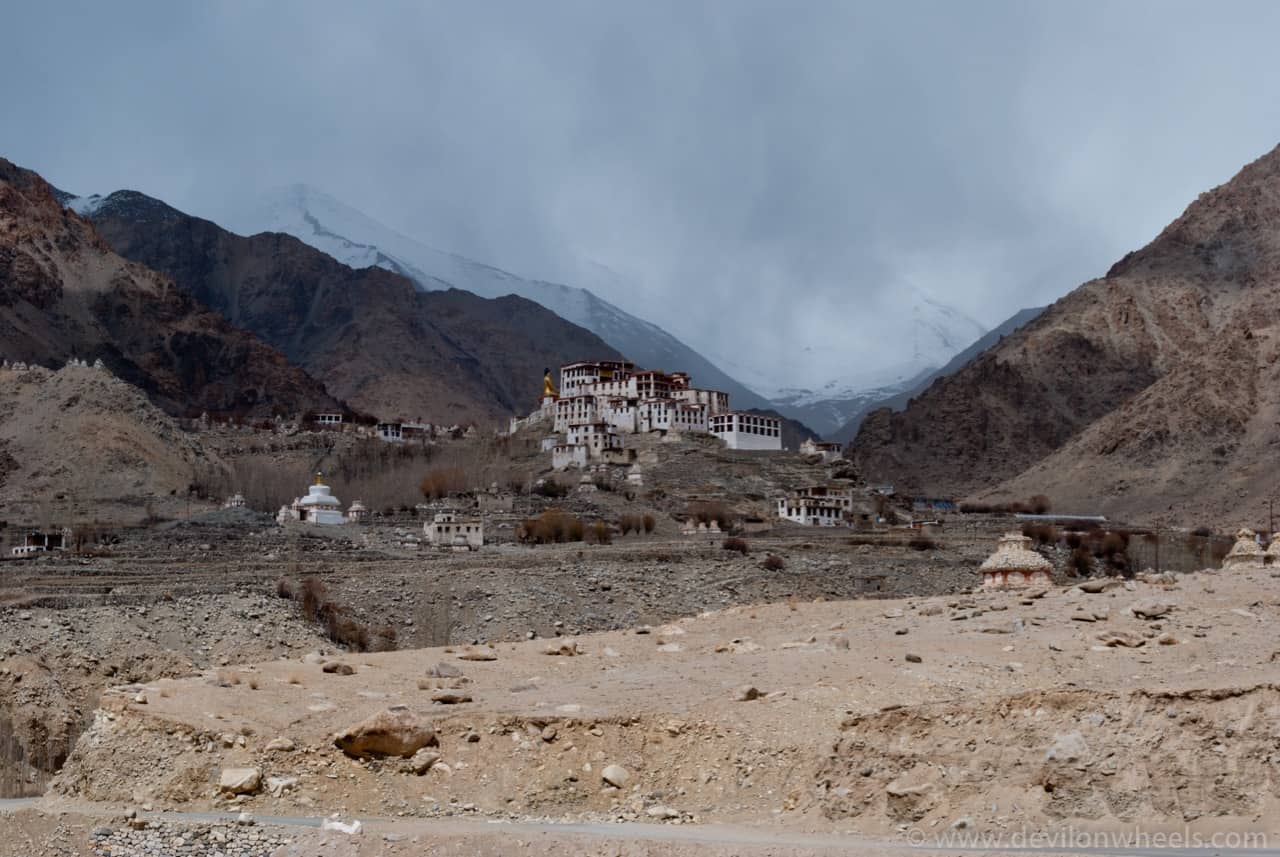
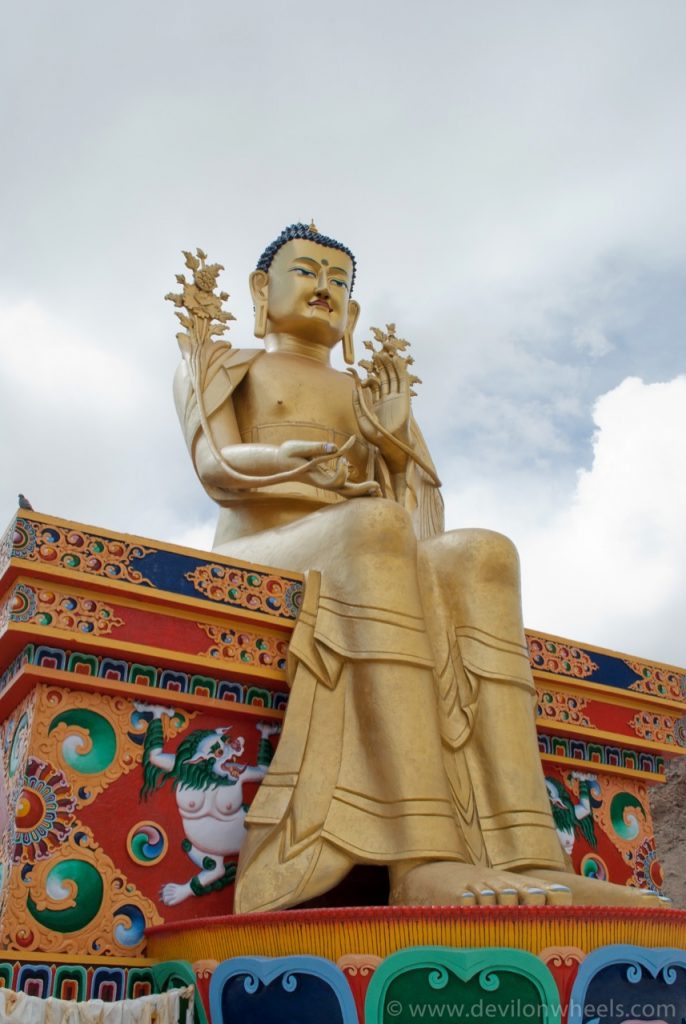
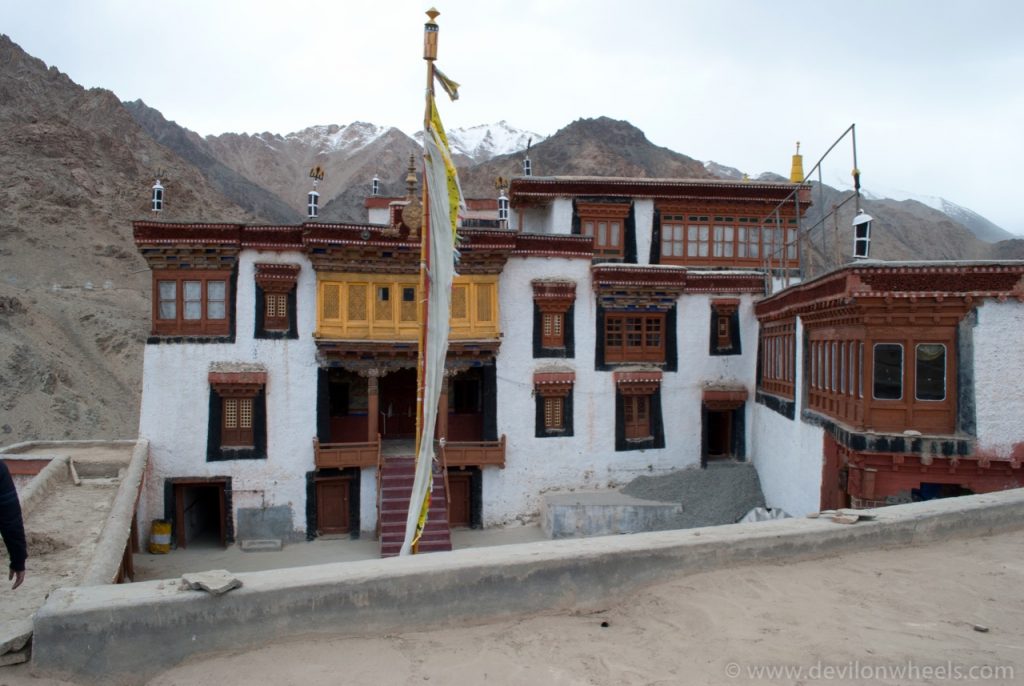
Likir Monastery sits on a hilltop about 52 km west of Leh, overlooking the barren brown landscape of Sham Valley in Ladakh. It is one of the oldest and most visually striking monasteries in the region, with a massive 75-foot gilded Maitreya Buddha statue visible from kilometers away. If you are planning a Sham Valley sightseeing day trip from Leh, Likir is one stop you should not skip.
I visited Likir during my Ladakh trip, and what stayed with me was not just the monastery itself but the drive to get there. The 5 km diversion road from the Srinagar-Leh Highway winds through a quiet valley, and the monastery appears suddenly on a hilltop, almost like it is keeping watch over the entire village below. In this guide, I will cover everything you need to know to plan your visit, from history and timings to how to reach, where to stay, and practical tips that most guides miss.
Quick Facts: Likir Monastery is 52 km west of Leh (about 1.5-2 hours by road), sits at 3,700 meters, and is free to enter (only the small museum charges Rs 20). It is open 7 AM to 7 PM daily, best visited May to September or during the February Dosmoche festival, and pairs naturally with a full Sham Valley day trip covering Magnetic Hill, Sangam, and Alchi.
Let's quickly dive into the details:
What Is Likir Monastery and Why Should You Visit?
Quick answer: Likir Monastery (Likir Gompa) is an 11th-century Gelugpa Buddhist monastery 52 km west of Leh in Ladakh’s Sham Valley, famous for its 75-foot gilded Maitreya Buddha statue completed in 1999. It is the seat of Ngari Rinpoche, the Dalai Lama’s younger brother, combining history with striking hilltop architecture.
Likir Monastery, also called Likir Gompa or Klu-kkhyil, is a Buddhist monastery belonging to the Gelugpa sect of Tibetan Buddhism. It was originally established in 1065 AD by Lama Duwang Chosje under the orders of King Lha-Chen Gyal-Po, the fifth king of Ladakh. The word “Likir” translates to “The Naga-Encircled,” representing the two great serpent spirits, Nanda and Taksako.
The monastery you see today is not the original 11th-century structure. A fire destroyed the old building, and the present complex was rebuilt in the 18th century. It was initially part of the Kadampa order before being converted to Gelugpa principles in the 15th century by Chosje, an advocate of meditation.
What makes Likir special among Leh’s many sightseeing spots is its combination of history, architecture, and that towering Maitreya Buddha statue completed in 1999. The monastery also holds the distinction of being the seat of Ngari Rinpoche, the younger brother of the Dalai Lama, although he does not permanently reside here.
What Can You See Inside Likir Monastery?
Quick answer: Inside Likir, you will find two prayer halls (Dukhang) with statues of Maitreya and Tsong Khapa, a giant thousand-armed Avalokiteswara statue, colorful Thangka paintings, a small museum, and the Gokhang temple. Set aside 2-3 hours to see the complex properly.
Likir houses around 120 Buddhist monks and a school run by the Central Institute of Buddhist Studies that accommodates approximately 30 students. The school teaches in three languages: Hindi, English, and Sanskrit. Here is what you will find inside the monastery complex.
The Two Prayer Halls (Dukhang)
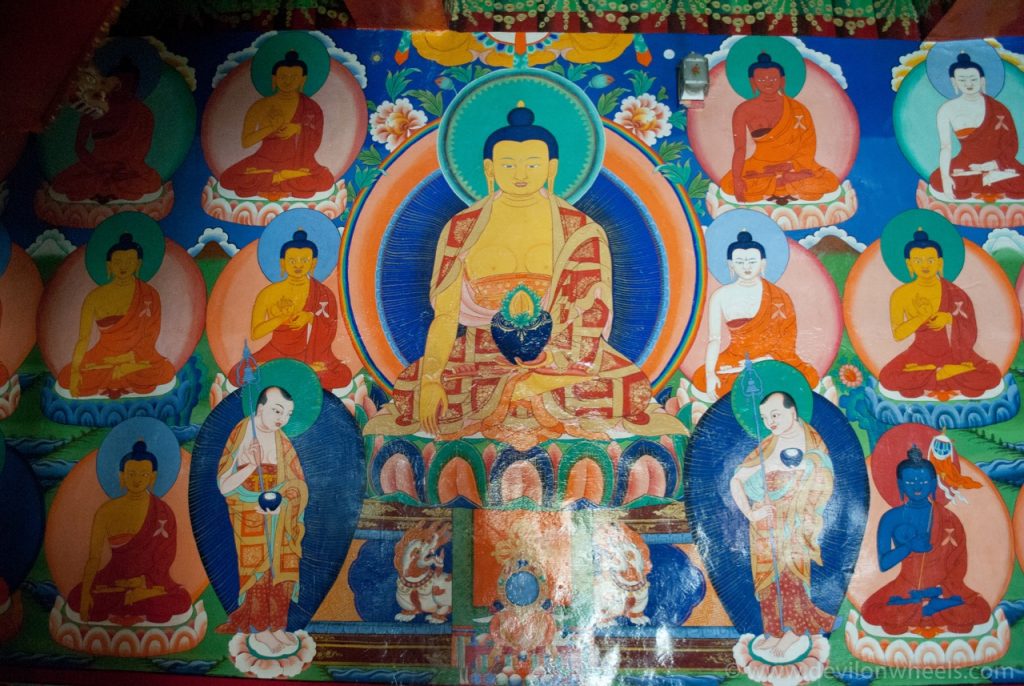
There are two prayer halls called Dukhang. The older one on the right side has seating arrangements for monks and a throne for the Head Lama of Likir. Inside, you will find statues of Maitreya Buddha, Bodhisattva, Amitabha, Sakyamuni, and Tsong Khapa. The newer Dukhang on the other side houses a giant statue of Avalokiteswara with a thousand arms and eleven heads, along with vivid murals of confessional Buddhas and Sakyamuni on either side.
Thangka Paintings and the Courtyard
Brightly colored Thangka paintings hang in the verandah, depicting the Guardians of the Four Directions. The courtyard houses a rare Jupiter tree. The monastery also has innumerable manuscripts, additional thangka paintings, and a collection of earthen pots that give you a sense of how deeply rooted this place is in centuries of Buddhist tradition.
The Gokhang Temple and Museum
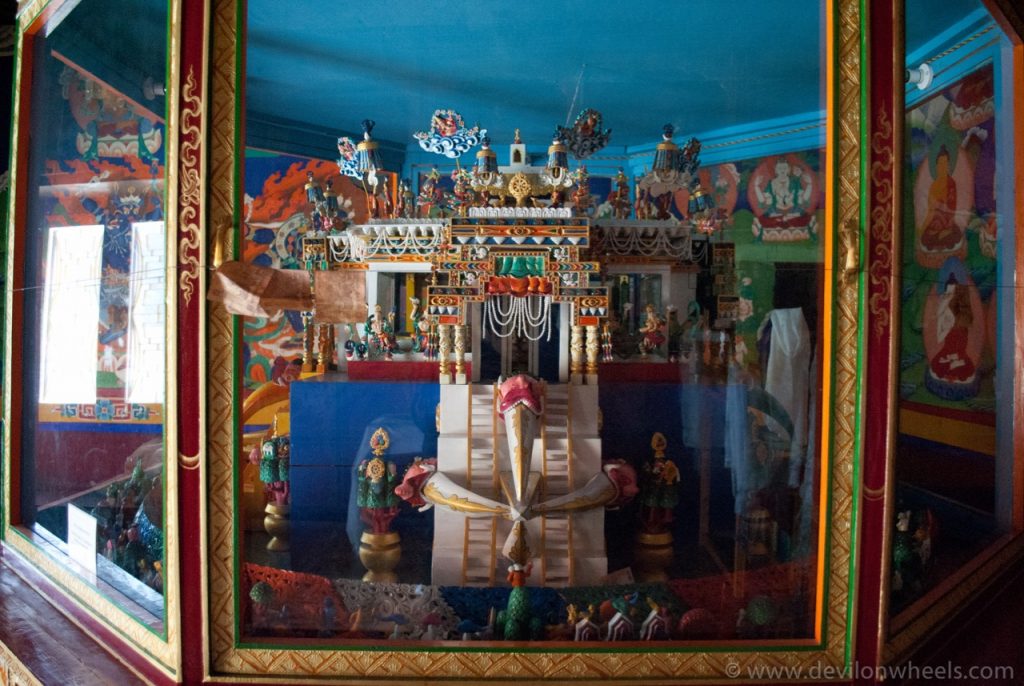
Do not miss the Gokhang temple nearby, where you might find monks performing rituals with drum beats. There is also a small but well-maintained museum at the top of the monastery. The museum entry fee is Rs 20 per person (as of 2019, verify locally for current rates). You can easily spend 2-3 hours exploring the entire complex.
When Is the Dosmoche Festival at Likir Monastery?
Quick answer: Dosmoche is Likir’s masked-dance (Cham) festival, held on the 27th-29th day of the 12th Tibetan month, usually in February. In 2026 it fell on February 15-16. In 2027, it is expected around February 10-11 based on the Tibetan lunar calendar, so confirm exact dates closer to your trip.
Every year, the Dosmoche festival is celebrated at Likir from the 27th to the 29th day of the 12th month of the Tibetan calendar. This typically falls in February on the Gregorian calendar. In 2026, the Likir Dosmoche was held on February 15-16. Based on Tibetan lunar calendar conversions, the 2027 edition is expected to fall around February 10-11, though I would suggest confirming the exact dates with the monastery or the local tourism office closer to your travel dates, since calendar conversions can shift by a day or two.
During Dosmoche, monks wear elaborate brocade robes and wooden or papier-mache masks representing wrathful deities and protector spirits, and perform the sacred masked Cham dances to drive away evil spirits from the village. Each dance sequence follows specific drum and cymbal rhythms, and the festival traditionally closes with the ritual burning of an effigy representing evil forces, a symbolic cleansing before the new year. There are also votive offerings, traditional sports, music, and food stalls set up around the monastery. If you happen to be in Ladakh during winter, timing your visit with Dosmoche is a memorable experience. Keep in mind that the dates shift every year because of the Tibetan lunar calendar, so check the exact dates before planning.
How to Reach Likir Monastery from Leh?
Quick answer: Likir sits 52 km west of Leh via a 5 km diversion off the Srinagar-Leh Highway, roughly a 1.5-2 hour drive. Most travelers hire a taxi as part of a Sham Valley day trip. There is no direct bus, only JKSRTC services that drop you near the diversion point.


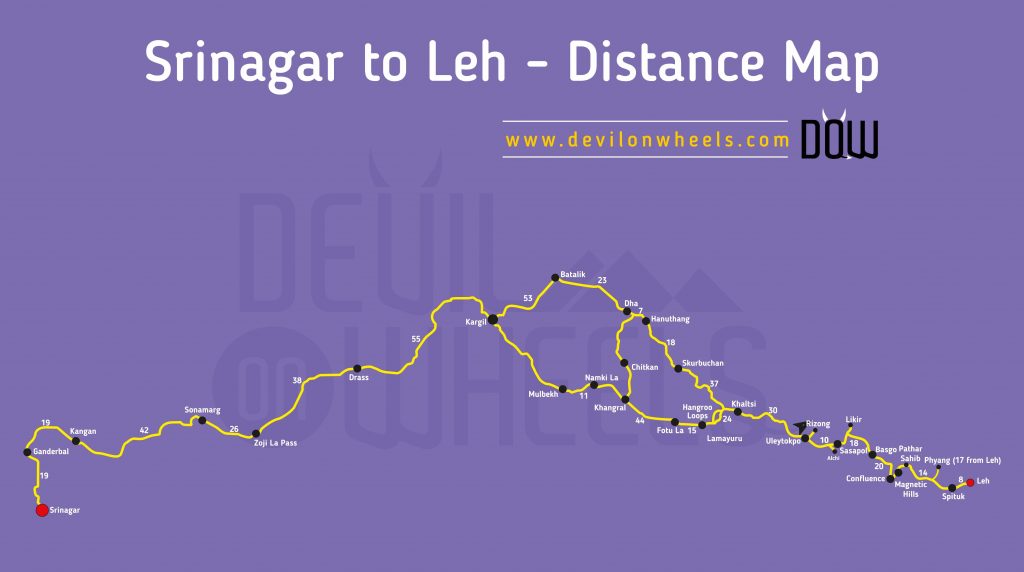
Likir is located 52 km west of Leh town, in the Sham Valley region. You reach it by taking a 5 km diversion road from the Srinagar-Leh Highway, about 9 km before the Saspul bridge. The drive from Leh takes about 1.5 to 2 hours depending on road conditions and stops. As of September 2026, this stretch of the Srinagar-Leh Highway is open and in good condition for the travel season, as it usually is between May and October.
By road (private vehicle or taxi): This is the most common way to visit. You can hire a taxi from Leh for a Sham Valley day trip that covers Likir along with Magnetic Hill, Gurudwara Pathar Sahib, Sangam (confluence of Indus and Zanskar rivers), and nearby monasteries. A taxi for a full Sham Valley day trip from Leh costs approximately Rs 3,500-5,000 depending on the vehicle and how many stops you make (rates fluctuate with fuel prices and season, so confirm current LTDA-approved fares with your taxi union or hotel before booking). You can also reach Likir if you are traveling from Kargil to Leh. After about 51 km west of Leh, look for the diversion point about 6 km before Saspul bridge, take a right, and drive 5 km to the monastery.
By bus: The JKSRTC buses operate within Ladakh, but there is no direct bus to Likir village. You would need to take a bus heading towards Kargil or Khalsi, get off near the Likir diversion point on the Srinagar-Leh Highway, and then hitchhike or walk the remaining 5 km to the monastery. This is doable but not the most convenient option.
By air: The nearest airport is Kushok Bakula Rimpochee Airport in Leh, well connected to Delhi, Mumbai, and Srinagar. From the airport, hire a taxi to your hotel in Leh. After acclimatizing for a day, plan a day trip to Likir and the rest of Sham Valley. If you are planning a Leh Ladakh itinerary, a Sham Valley day trip is usually scheduled for Day 2 or Day 3.
By train: The nearest major railway station is Jammu Tawi, about 700 km from Leh. From Jammu, you take a taxi or bus to Srinagar and then continue on the Srinagar-Leh Highway, which is a 2-3 day journey with overnight halts at Srinagar and Kargil. Some travelers prefer to stay overnight at Alchi or Likir after Kargil for better acclimatization.
What Is the Best Time to Visit Likir Monastery?
Quick answer: May to September is the best window, with pleasant 15-25°C days and both the Srinagar and Manali highways open. Visit in February for the Dosmoche festival if you can handle -15 to -20°C winter temperatures and fly into Leh.
The best time to visit Leh Ladakh is from May to September, and the same applies to Likir. During these months, the roads from both Srinagar and Manali are open, the weather is pleasant (15-25 degrees Celsius during the day), and the monastery is most accessible.
However, if you want the most special experience at Likir, plan your visit during the Dosmoche festival in February. The road from Leh to Likir remains open even in winter since it is on the Srinagar-Leh Highway stretch that stays accessible from the Leh side. You would need to fly into Leh during winter months since the highways from Manali and Srinagar close from November to May due to heavy snowfall. Be prepared for temperatures dropping to -15 to -20 degrees Celsius if you visit in winter.
Pro tip: Visit the monastery between 7 AM and 9 AM to witness the morning prayer ceremony. The sound of monks chanting in the prayer hall, combined with the early morning light hitting the Maitreya statue, is something you will remember long after you leave Ladakh.
Where to Stay Near Likir Monastery?
Quick answer: Most visitors see Likir as a day trip from Leh, but a few homestays like the Old Likir Traditional Farm Stay offer overnight stays (roughly Rs 1,000-2,000 per night with meals). Staying at Likir or nearby Alchi can also help with acclimatization.
There are a few guesthouses and homestays in Likir village where you can stay overnight. One well-known option is the Old Likir Traditional Farm Stay, which has about 4 rooms and offers an authentic Ladakhi homestay experience. Expect to pay around Rs 1,000-2,000 per night for a basic room with meals at a Likir homestay (as of the last time I checked, rates may have crept up since, so confirm directly when booking).
Many travelers choose to stay overnight at Likir or nearby Alchi for acclimatization purposes. If you have just flown into Leh, sleeping at a lower altitude like Likir (3,700 meters compared to Leh’s 3,500 meters, so similar) or Alchi (3,100 meters) for the first night can help with altitude sickness prevention. This is especially useful if you are traveling from Srinagar to Leh and want to break the journey.
That said, most visitors cover Likir as a day trip from Leh. If you are doing the Sham Valley circuit, you will typically leave Leh early morning, visit Magnetic Hill, Gurudwara Pathar Sahib, Sangam, and Likir, and return to Leh by evening. For accommodation in Leh, there are plenty of budget and mid-range options.
Where to Eat Near Likir?
Quick answer: Food options at Likir village itself are limited to a few tea and snack stalls. Most travelers eat at Nimmu village (about 32 km from Leh, an hour from Likir), which has several dhabas serving momos, thukpa, and samosas.
If you are making a day trip, I would suggest having your meals at Nimmu village, which is on the way to Likir at a distance of about 32 km from Leh. Nimmu has several local shops right on the road that serve authentic Ladakhi and Tibetan food, including momos, thukpa, and samosas. The drive from Nimmu to Likir takes about an hour.
At Likir village itself, there are a few tea and snack shops near the monastery, and some homestays serve meals to non-guests as well. The food options are limited though, so it is a good idea to carry water and some snacks with you, especially if you are traveling with kids or have dietary preferences.
How Much Does It Cost to Visit Likir Monastery?
Quick answer: A Likir day trip from Leh costs roughly Rs 1,000-1,600 per person on a shared taxi, or Rs 3,500-5,000 total for a private taxi covering the full Sham Valley circuit. The monastery itself is free to enter, only the small museum charges a fee.
Likir is one of the more budget-friendly monastery visits in Ladakh. Here is a rough cost breakdown for a day trip from Leh.
| Expense | Estimated Cost (per person) |
|---|---|
| Monastery entry | Free (no entry fee) |
| Museum entry | Rs 20* |
| Taxi (Sham Valley day trip from Leh, shared) | Rs 800-1,200 per person |
| Taxi (private, full Sham Valley circuit) | Rs 3,500-5,000 total |
| Meals at Nimmu/Likir | Rs 200-400 |
| Total (budget, shared taxi) | Rs 1,000-1,600 |
If you are on a self-drive trip by car or motorcycle, your only expenses will be fuel and food. The monastery itself has no entry charge, only the small museum costs Rs 20.
*A quick honesty check on that museum fee: Rs 20 is what I confirmed on the ground, and it is what I have kept in the table above since I could not verify an official update for 2026. A few other travel sites now quote different figures for the museum, so treat this as one of those “verify locally” situations, carry a little extra cash just in case, and feel free to drop a comment if you have paid a different rate recently so I can update this guide for other travelers.
What Are the Important Tips for Visiting Likir?
Quick answer: Visit between 7-9 AM for morning prayers, dress modestly, remove shoes and hats in prayer halls, carry cash (no ATMs at Likir), and acclimatize in Leh for at least a day before the trip since Likir sits at 3,700 meters.

Here are some practical things to keep in mind before and during your visit to Likir Monastery.
Timings: The monastery is open from 7 AM to 7 PM daily. If you want to see the morning prayer ceremony, arrive before 9 AM. Photography is allowed in most areas, but some prayer halls restrict it, so check with the monks before clicking inside.
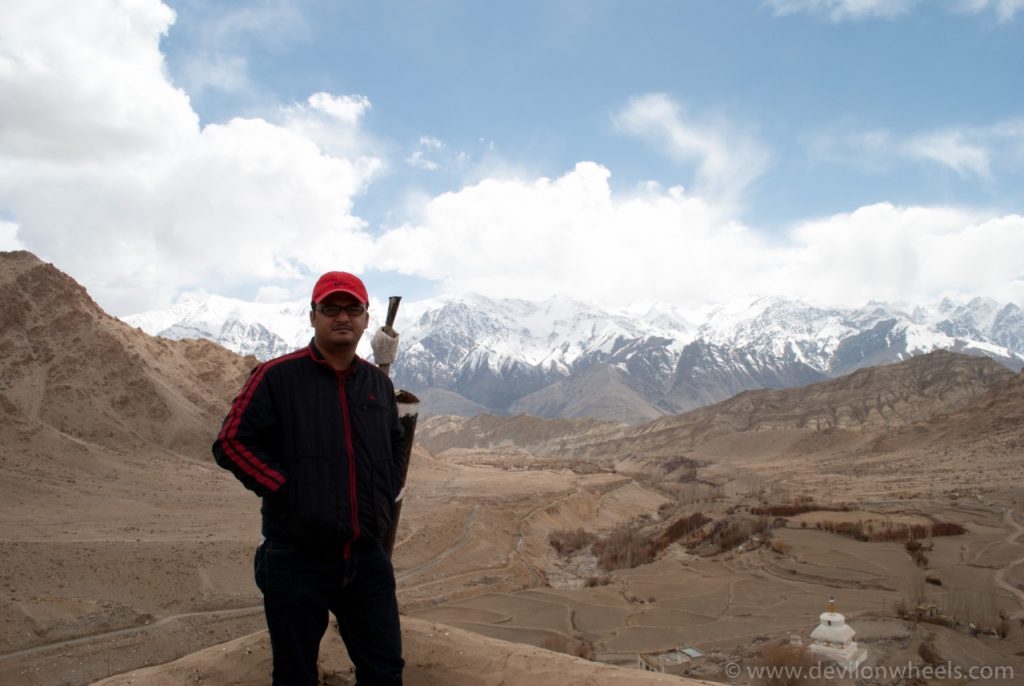
Altitude and AMS: Likir sits at 3,700 meters (about 12,139 feet). If you have just arrived in Leh, do not plan Likir for your first day. Spend at least one day acclimatizing in Leh before heading out. AMS (Acute Mountain Sickness) can affect anyone regardless of fitness level, so take it seriously.
Dress code: While there is no strict dress code, wearing modest clothing is respectful. Remove shoes before entering prayer halls. Hats should be removed inside temples.
Cash only: There are no card machines or ATMs at Likir. Carry enough cash for the museum entry, food, and any donations you wish to make. The nearest ATMs are in Leh.
Mobile connectivity: BSNL has the widest coverage in Ladakh and usually works around the Likir area. Jio and Airtel postpaid connections also work on the Srinagar-Leh Highway stretch, but signals can be patchy in the village itself. Do not rely on mobile data for navigation here.
Mobility: Reaching the main prayer halls and museum involves a moderate uphill walk and some stairs. This is manageable for most fitness levels, but it can be tiring for elderly visitors or those with mobility issues, especially given the altitude. A motorable road runs most of the way up, so you do not need to trek from the village.
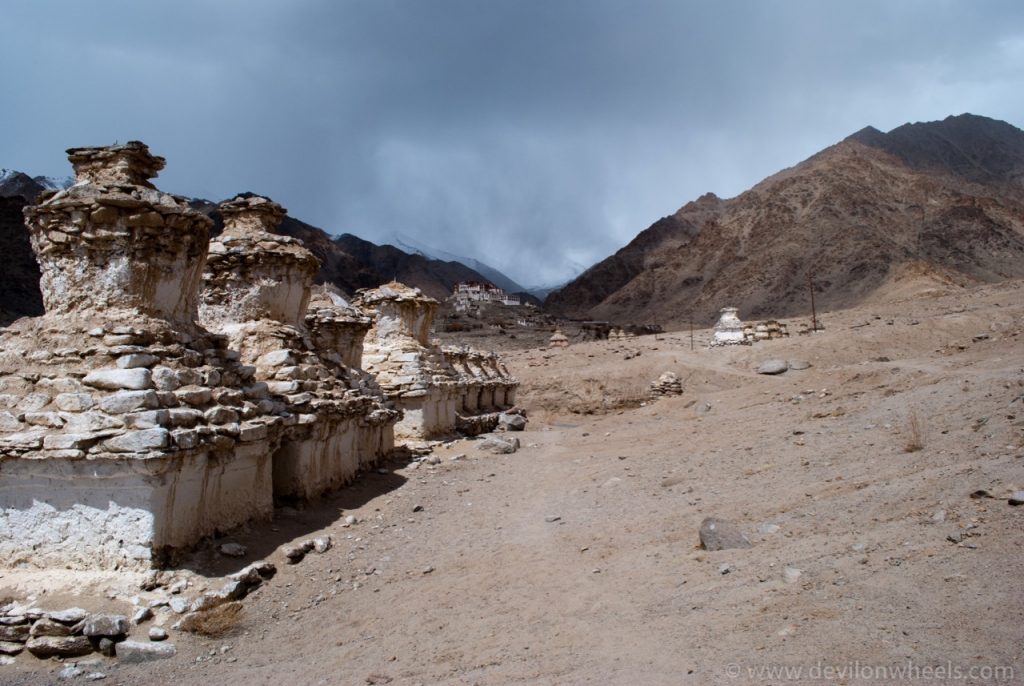
What Else Can You Visit Near Likir?
Quick answer: Likir is part of the Sham Valley circuit, easily combined with Magnetic Hill, Gurudwara Pathar Sahib, Sangam, Basgo Palace, Alchi Monastery, and, with extra time, Lamayuru Monastery further west.
Likir is part of the Sham Valley circuit, which is one of the most popular day trips from Leh. Here are the places you can combine with a Likir visit.
- Magnetic Hill (30 km from Leh): The famous optical illusion spot where vehicles appear to roll uphill.
- Gurudwara Pathar Sahib (25 km from Leh): A Sikh shrine maintained by the Indian Army, with free langar.
- Sangam (35 km from Leh): The confluence of the Indus and Zanskar rivers, where you can see two different colored waters meeting.
- Alchi Monastery (67 km from Leh): One of the oldest monasteries in Ladakh with unique Indo-Kashmiri art. Alchi is about 20 km further from Likir.
- Basgo Palace (40 km from Leh): Ruins of a 15th-century citadel with two temples housing massive clay statues.
- Lamayuru Monastery (127 km from Leh): If you have time, extend the trip to Lamayuru, the oldest monastery in Ladakh, known for its moonland landscape.
A typical Sham Valley day trip from Leh covers Magnetic Hill, Pathar Sahib, Sangam, and either Likir or Alchi (or both if you start early). Since Likir (52 km), Basgo (40 km), and Alchi (67 km) all sit along the same stretch of the Srinagar-Leh Highway, a full day covering all three plus Magnetic Hill and Sangam is doable if you start by 8 AM, though it makes for a long day. Splitting Likir and Basgo on one day and Alchi (with Lamayuru if you have time) on another is more relaxed. If you are doing the Srinagar to Leh road trip, you will pass through this area on your way, so you can visit Likir without any detour.
How Does Likir Compare to Other Monasteries in Ladakh?
Quick answer: Likir is quieter than Thiksey or Hemis, with a Maitreya statue second in scale only to Diskit’s. Most travelers rate Alchi’s ancient art slightly higher if you can visit only one Sham Valley monastery, but Likir wins on crowd-free hilltop views.
Ladakh has over 25 monasteries, and travelers often ask which ones are worth visiting if they have limited time. Here is how Likir stacks up.
| Monastery | Distance from Leh | Best Known For | Crowd Level |
|---|---|---|---|
| Likir | 52 km | 75-ft Maitreya statue, Dosmoche festival | Low |
| Thiksey | 19 km | Mini Potala Palace, sunrise views | High |
| Hemis | 45 km | Hemis festival, largest in Ladakh | Medium |
| Diskit | 118 km | 32-meter Maitreya statue, Nubra views | Medium |
| Alchi | 67 km | Oldest, Indo-Kashmiri art | Low |
| Basgo Palace | 40 km | 15th-century citadel ruins, giant clay statues | Low |
| Lamayuru | 127 km | Moonland landscape, cave meditation | Low |
Likir is less crowded than Thiksey or Hemis, which makes it a more peaceful visit. The 75-foot Maitreya statue is second only to the 32-meter statue at Diskit in Nubra Valley in terms of scale. If you are short on time and can visit only one Sham Valley monastery, I would recommend Likir over Basgo but behind Alchi, which is older and has more unique artwork. Ideally, do both.
Practical Information at a Glance
| Location | Likir Village, Sham Valley, 52 km west of Leh |
| Altitude | 3,700 meters (12,139 feet) |
| Sect | Gelugpa (Yellow Hat) Tibetan Buddhism |
| Founded | 1065 AD (rebuilt 18th century) |
| Entry Fee | Free (Museum: Rs 20, verify locally) |
| Timings | 7 AM to 7 PM daily |
| Time Needed | 2-3 hours |
| Best Time | May to September (or February for Dosmoche) |
| Mobile Network | BSNL works, Jio/Airtel postpaid patchy |
| ATM | None (nearest in Leh) |
| Nearest Fuel | Leh |
| Road Status | Open as of September 2026 (Srinagar-Leh Highway); closes to non-Leh-side traffic in late autumn |
Conclusion
Although Likir somewhat stands isolated today, it was once on a very lucrative trade route to Leh via Hemis. There is a lot to see around Likir, and the nearby villages are extremely scenic. The monastery is a photographer’s paradise, and the 75-foot golden Maitreya statue against the Ladakhi sky is a sight you will carry with you.
I hope this travel guide helps you plan a visit to Likir Monastery on your Ladakh trip. If you have any questions about visiting Likir or planning your Sham Valley itinerary, feel free to drop a comment below or reach out to the DwD community. We are always happy to help fellow travelers 🙂
Last Updated: September 2026
Frequently Asked Questions
Is there an entry fee for Likir Monastery?
No, there is no entry fee to visit Likir Monastery. However, the small museum inside the complex charges around Rs 20 per person (this is the last rate I could confirm on the ground, so please verify locally as it may have changed). The monastery is open daily from 7 AM to 7 PM.
How far is Likir Monastery from Leh?
Likir Monastery is about 52 km west of Leh, on a 5 km diversion from the Srinagar-Leh Highway. The drive takes approximately 1.5 to 2 hours from Leh by taxi or private vehicle.
Can I visit Likir Monastery in winter?
Yes, the road from Leh to Likir remains open in winter since it is on the Srinagar-Leh Highway stretch accessible from the Leh side. You would need to fly into Leh as the highways close from November to May. The Dosmoche festival in February is a great reason to visit in winter.
What is the height of the Buddha statue at Likir?
The gilded Maitreya Buddha statue at Likir Monastery is 23 meters (75 feet) tall. It was completed in 1999 and is one of the tallest seated Buddha statues in Ladakh, visible from several kilometers away.
Is Likir Monastery worth visiting?
Yes, especially if you are doing a Sham Valley day trip from Leh. Likir is less crowded than Thiksey or Hemis, has a stunning hilltop location, the impressive 75-foot Maitreya statue, colorful murals, and the monastery is the seat of the Dalai Lama’s brother. It pairs well with visits to Magnetic Hill, Pathar Sahib, and Sangam.
How do I reach Likir Monastery by bus?
There is no direct bus to Likir. Take a JKSRTC bus from Leh heading towards Kargil or Khalsi, get off at the Likir diversion point on the Srinagar-Leh Highway, and walk or hitchhike the remaining 5 km to the monastery. A shared taxi is a more practical option.
When is the Dosmoche festival at Likir?
Dosmoche is celebrated on the 27th to 29th day of the 12th month of the Tibetan calendar, which typically falls in February. The exact dates change every year. In 2026, the Likir Dosmoche was held on February 15-16. The 2027 edition is expected around February 10-11 based on the Tibetan lunar calendar, but confirm exact dates closer to the time with the monastery or the Ladakh festival calendar.
Can I combine Likir with Basgo and Alchi in one day?
Yes. Likir, Basgo, and Alchi lie along the same stretch of the Srinagar-Leh Highway, roughly 52 km, 40 km, and 67 km from Leh respectively. A full day covering all three plus Magnetic Hill and Sangam is doable if you start by 8 AM, though it makes for a long day. Splitting Likir and Basgo on one day and Alchi on another, with Lamayuru if you have time, is more relaxed.
Is Likir Monastery accessible for elderly visitors or people with mobility issues?
The monastery involves a moderate uphill walk and some stairs to reach the upper halls and museum, so it is manageable for most fitness levels but can be tiring for elderly visitors or those with mobility issues, especially at 3,700 meters altitude. A motorable road runs most of the way up, so you do not need to trek from the village.

1 Comment
Comments section gets closed in 90 days. To ask your travel questions, you can follow my YouTube Channel for a faster reply or for a much slower reply follow me on Instagram. :)
Good description regarding Likir Monastery.