


Last Updated: October 2026
Thinking of making a trip to Spiti Valley in winters? It is one of the most raw and rewarding experiences you can have in the Indian Himalayas. But let me be straightforward with you, my friend. A winter trip to Spiti is nothing like the summer circuit. The Manali route is closed, half the villages are cut off, temperatures drop to -25°C at night, and you could get stuck for days if a heavy snowfall blocks the road near Nako or beyond.
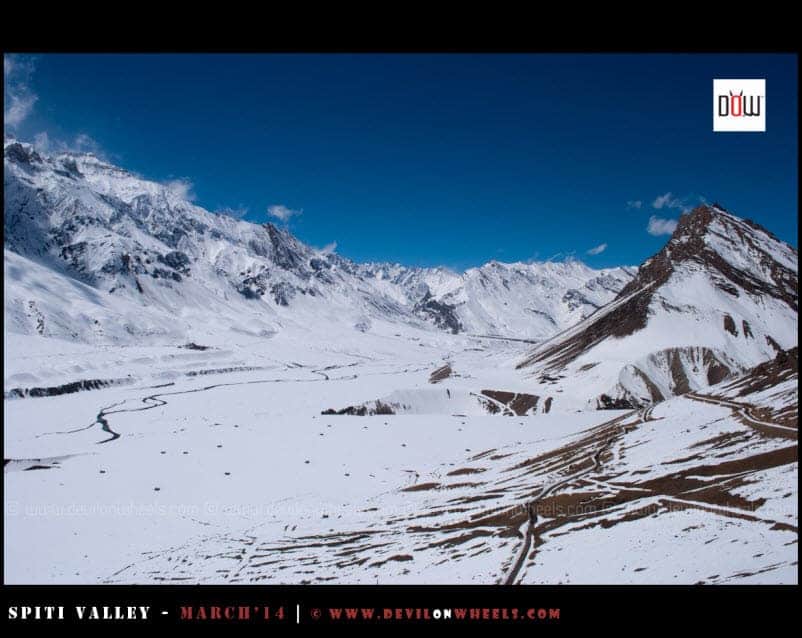
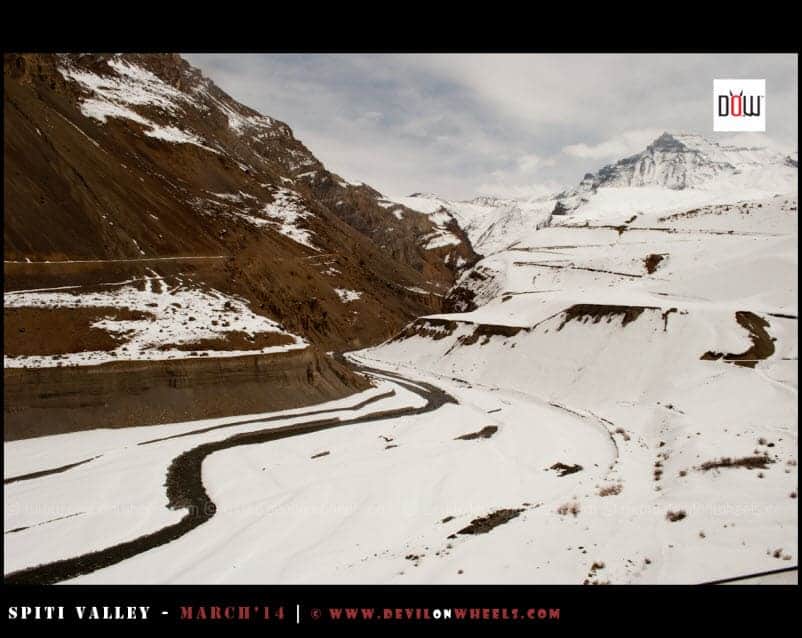
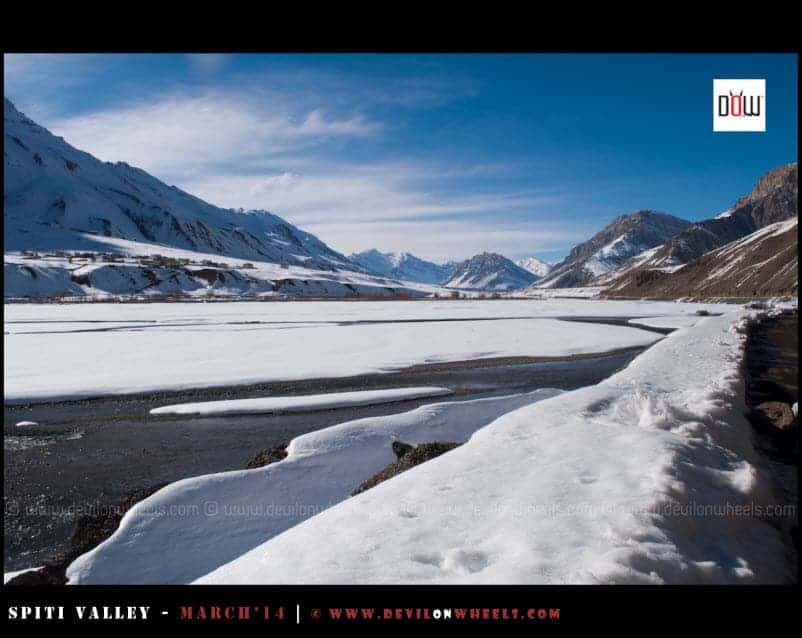
I have seen too many travelers head to Spiti in winters without doing their homework, and then panic when they realize there is no running water in the toilets, patchy electricity and a mobile signal that vanishes the moment the power does. Hence, I decided to put together this complete planning guide for the 2026-27 winter season, covering everything you need to know before you commit. The photos in this article are from my own winter trip to Spiti in March 2014, and the facts around them (fares, networks, rules) have been re-checked for this season. If you plan well, winter Spiti will reward you with some of the most stunning landscapes and genuine local hospitality you will ever experience. If you do not plan well, it can quickly turn into a survival situation.
Also, do make sure you avoid the common mistakes people commit on a Spiti Valley trip as those become even more critical in winters.
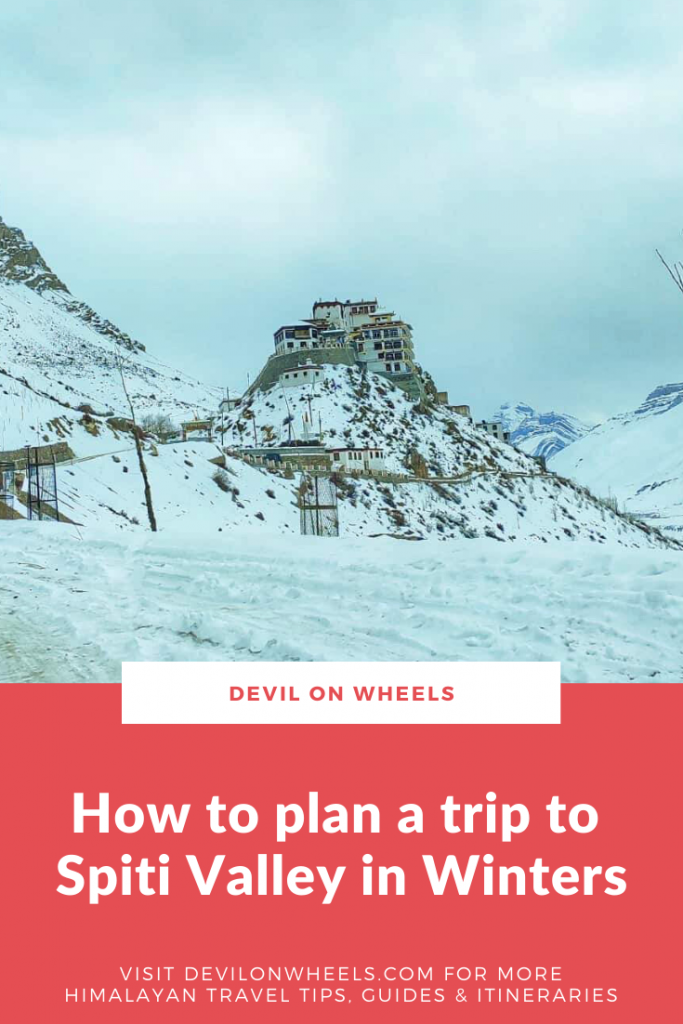
Winter Spiti in 60 seconds (as of October 2026):
- Only route: Shimla – Reckong Peo – Nako – Tabo – Kaza via NH-5. Manali side (Atal Tunnel – Gramphu – Batal – Kunzum Pass) stays shut roughly November to May.
- Permit: none for Indian nationals. Foreign nationals need a Protected Area Permit (Rs 250 at Reckong Peo).
Let's quickly dive into the details:
Can You Actually Visit Spiti Valley in Winters?
Quick answer: Yes, but only via the Shimla-Kinnaur route through Reckong Peo and Nako. The Manali side is buried under snow from about November to May. BRO keeps the Hindustan-Tibet Highway (NH-5) open to Kaza, but heavy snowfall can close it for days.
Yes, you can visit Spiti Valley in winters, but only through the Shimla-Kinnaur route via Reckong Peo and Nako. The Manali side (Atal Tunnel, Gramphu, Batal and Kunzum Pass) stays buried under snow from November through May, so the only lifeline is the Hindustan-Tibet Highway (NH-5) that BRO keeps operational year-round up to Kaza. For the current day-to-day position of this road, I keep the NH-5 road status and driving guide updated.
That said, “operational” in winter does not mean smooth driving. The road can close for a couple of days after heavy snowfall, especially around the Nako and Spillow sections, and black ice on the higher stretches near Nako and Tabo is the real daily hazard. In rare cases (like 2013 and 2019), closures have lasted weeks. So while the answer to “can I go?” is yes, the real question is whether you are prepared for what winter Spiti demands.
I would not recommend a winter trip to Spiti for first-time Himalayan travelers. If you have never dealt with sub-zero temperatures, icy roads, and zero connectivity, start with something like a winter trip to Kinnaur Valley (Kalpa or Sangla) before attempting Spiti. My Kinnaur in winters itinerary is a good warm-up.
Skip winter Spiti, my friend, if you have a heart or lung condition, are travelling with small kids or elderly parents, or need working internet and a fixed return date.
When Is the Best Time to Visit Spiti Valley in Winter?
Quick answer: November is the easiest winter month, March is the best balance of snow and accessibility, and December-January is the hardest, with night temperatures of -20°C to -30°C and the most road closures. February sits in between.
The winter season in Spiti runs from November to March, but each month offers a very different experience. Here is a quick breakdown to help you decide.
November: Early winter. First snowfall usually arrives mid-November. Roads are still manageable, temperatures range from -5°C to 5°C during the day. This is the easiest winter month for first-timers.
December-January: Peak winter. Heavy snowfall, temperatures drop to -20°C to -30°C at night. Road closures are most frequent. This is the hardest period, only for experienced travelers who can handle being stuck for days. It is also the stretch when snow leopard sightings are talked about the most (more on that below).
February: Still very cold but days start getting slightly longer. Snow is deep and pristine. Road closures still happen but BRO is usually quicker to clear. The Tibetan New Year, Losar, falls on 7 February in 2027 and is celebrated in monasteries across Spiti for roughly two weeks.
March: Late winter. Snow starts melting at lower elevations, shooting stones become a concern. Temperatures are more bearable (-5°C to 10°C during the day). Many consider this the sweet spot for winter Spiti as you get snow without the extreme deep-freeze conditions. For a more detailed month-by-month breakdown, refer to my best time to visit Spiti Valley guide, and the dedicated posts on Spiti Valley in February and Spiti Valley in March.
How to Reach Spiti Valley in Winter?
Quick answer: Reach Shimla, then Reckong Peo (8-10 hours), then Kaza (8-10 hours more). Kaza is about 420 km from Shimla. Overnight at Reckong Peo or Nako to acclimatize. Self-drivers need a SUV or 4×4 with snow chains.
In winter, there is only one route into Spiti Valley, and that is through Shimla via the Kinnaur route. Here are your options to reach the starting point.
By Bus from Delhi or Chandigarh
HRTC runs daily buses from Delhi ISBT to Shimla (Rs 500-900 for ordinary, Rs 1,200-1,800 for Volvo as of 2025-2026). From Shimla, you can take the daily HRTC bus to Reckong Peo (Rs 400-600, 8-10 hours, and up to 10-12 hours if there are landslide delays). From Reckong Peo, an HRTC bus runs to Kaza (about Rs 400-600, 8-10 hours depending on road conditions). Shimla to Kaza as a combined journey comes to roughly Rs 600-900 in fares. Treat these as ranges and confirm at the bus stand.
In winter, reports from travelers in 2025-26 describe a single daily bus leaving each end around 6 AM, with no online booking for this stretch, so ask at the Reckong Peo bus stand a day before. Hence, do not plan to reach Reckong Peo in the afternoon and leave for Kaza the same day. Keep in mind that the Reckong Peo to Kaza bus may not run on schedule if the road is blocked. The bus operators on both ends park the bus and wait until the road is declared safe. Sometimes passengers walk across the danger points on foot and exchange buses coming from either direction. This is very common among locals in winter.
By Private Vehicle
If you are driving your own car, only take a proper SUV or 4×4. A sedan will not survive the icy patches and snow-covered stretches beyond Reckong Peo. Carry snow chains for your tires, they are not optional in winter. The typical route is Delhi to Shimla to Narkanda to Rampur to Reckong Peo to Nako to Tabo to Kaza. Total distance is roughly 700-750 km from Delhi (different sources quote anything between 700 and 820 km), and it takes 2-3 days with overnight stops. Shimla to Kaza alone is about 420 km, with Reckong Peo to Kaza accounting for roughly 200 km of that.
If you are entering Spiti in your own 4×4, a local order from February 2026 reportedly asks 4×4 owners to take prior permission from the ADC office in Kaza before reaching the Sumdo check post. Treat that as a “verify locally” item. For a detailed route plan, check my Spiti Valley via Kinnaur planning guide and the winter Spiti itinerary for day-by-day planning.
What Are the Top 15 Things to Expect on a Winter Trip to Spiti?
Quick answer: Expect road closures, icy driving, homestay-only stays, no running water, -20°C nights, frozen engines, no power or signal for days, little medical help, and most villages cut off. The upside is silence, snow and warm hospitality.
Winter Spiti is a completely different world compared to summer. Your habit of unplanned trips to the Himalayas will not work here. Here are the 15 things you must be prepared for.
1. Road Closures Can Last Days to Weeks
This is the most likely thing that will happen. During extreme winters, snowfall can close the road for a couple of days, sometimes weeks. BRO keeps the Hindustan-Tibet Highway up to Kaza open throughout the year, but even they cannot clear roads during active heavy snowfall. Monthly closures have happened, 2013 being one example. Hence, go prepared with nothing urgent waiting back home even if you get stuck for a month, and carry enough cash to survive that period.
2. Driving on Ice and Snow Requires Real Skill
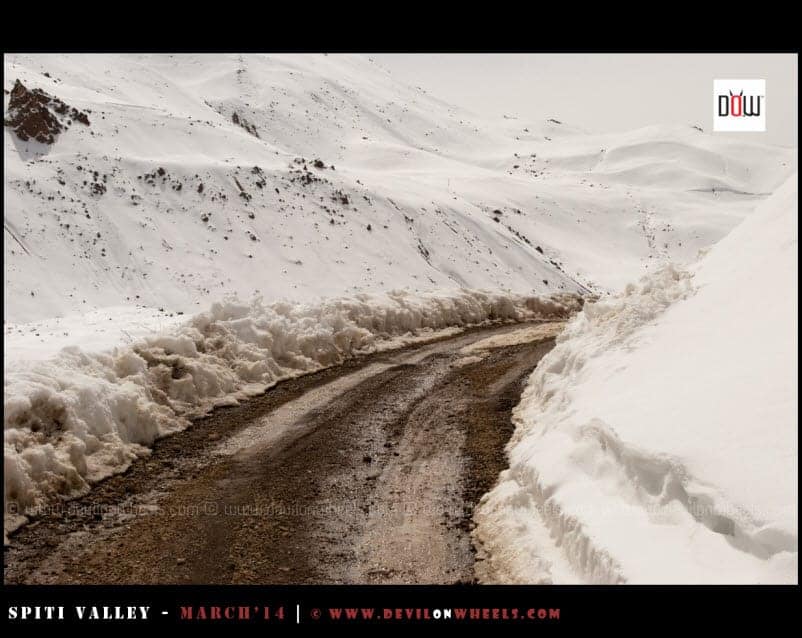
If you are riding or driving yourself, be extremely careful of the ice and snow on roads. The road surface becomes dangerously prone to skidding. You should have prior experience of driving in snow as one hard brake can send you flying down a gorge or crashing into the mountainside. Any help with the vehicle will be very scarce to find as most mechanic shops are closed. Hence, drive with extra caution on every icy patch.


3. Basic Stays and Very Basic Food
Most hotels and guest houses shut down for winter. Accommodation is available mainly as homestays where families provide basic rooms and home-cooked meals. Expect dal-chawal and Thukpa (Tibetan noodle soup), not a restaurant menu. Homestay rates in winter are around Rs 500-1,000 per night including basic meals (as of 2025-2026, and several sources agree on this range). In peak season the same villages charge Rs 1,000-1,200 a night with all three meals, so winter is genuinely cheaper. Do not expect mechanics, groceries, fruits, or bottled water to be readily available either. Plan well and carry everything you might need. Also read the tips on budgeting your Spiti trip and my list of homestays in Spiti Valley.
4. No Running Water in Toilets
Water in pipes freezes solid in winter Spiti. Toilets with running water will not be available. In winters, the regular toilets remain locked and only dry pits (traditional toilets) are used. Washrooms will also not have running water. You can boil water and use it quickly to wash your face and hands a couple of times a day. So, those of you who bathe every day and cannot live without it, winters may not be the right time to travel to Spiti Valley 😉
5. Bone-Freezing Temperatures Beyond Lower Kinnaur
As soon as you cross lower Kinnaur Valley and enter higher regions like Nako (3,662 m), you will experience genuinely bone-freezing temperatures. Kaza in January sees daytime temperatures of -5°C to 5°C and nighttime lows of -15°C to -25°C. Be prepared with proper winter gear, including thermal innerwear (2-3 pairs), a down jacket rated to -20°C, insulated waterproof boots, wool socks (5-6 pairs), and layered gloves. You will not feel your toes for most of the day once you cross Schichiling village (base of Dhankar) ahead of Tabo.
6. Slushy Roads and Shooting Stones
When the sun shines, snow and ice melt to make the road slushy. So apart from snow and ice, expect to drive through slush as well. Towards the end of winter (March-April), shooting stones become common as they come down along with dripping water. These are particularly dangerous during light snowfall that melts quickly.
7. Frozen Fuel and Vehicle Fluids
All fluids, including diesel in your car’s tank, can freeze in extreme cold. The car will need starting every few hours through the night to keep the engine warm. Cover the engine with thick cloth or a blanket when parked. Sometimes even the oil in hose pipes freezes solid. Parking on a slight upward incline can help, but it does not always work. This is why I always recommend petrol vehicles over diesel for winter Spiti.
Do not forget to prepare and refer to my list of 40 must-have things to carry on a self-drive trip to Spiti Valley.
8. Very Few Tourists and Limited Public Transport
There will not be many tourists around, so options of sharing vehicles will be limited. The HRTC buses do run between Reckong Peo and Kaza daily in winter, but they will park the bus at both ends if it is not safe to travel beyond a certain danger point. People walk across the danger points on foot and exchange buses coming from either direction. This foot-crossing of dangerous sections is very common among locals in winter. Hence, be ready for such an adventure and make sure you are keeping your family informed. If you want a private taxi instead, my list of taxi drivers for Spiti and Kinnaur has local contacts.
9. No Electricity for Days or Weeks
When it snows heavily, electric poles get buried or knocked down. Carry enough spare batteries and keep them warm, as cold drains batteries much faster. This includes your phone. Keep your phone inside your blankets and quilts while sleeping to prevent the battery from dying overnight. A power bank rated for cold weather (lithium iron phosphate, not standard lithium-ion) is worth the investment.
Carry enough cash as ATMs might not work. SBI bank in Kaza does provide cash through the POS machine they have installed inside the bank in case the ATM is not working. However, withdrawal is limited to Rs 1,000 per day (as of 2025, verify locally). Carry at least Rs 10,000-15,000 in small denominations. UPI works only when the network does, so do not rely on it.
10. No Mobile Signals for Extended Periods
Similar to electricity, do not expect mobile signals for days to weeks. In normal weather, BSNL and Jio 4G both work in Kaza town (Jio is usually the faster of the two, and weaker around Losar and Mane-Lhalung), while Airtel does not work inside Spiti Valley and only covers parts of Kinnaur. In winter, towers lose power with the rest of the village and even these two go quiet. Inform your family about your plans before entering the valley. Use any opportunity you get, whether it is WiFi at the bank, a hotel running a generator, or a brief window of signal, to send a message home. WhatsApp messages work better than voice calls in low-signal areas. For more details, read my article on mobile networks in Kinnaur and Spiti Valley.
11. Limited Medical Help
Do not rely on local medical facilities in winter Spiti. The community health center in Kaza provides basic care, but for anything serious, you would need evacuation. In emergencies, helicopters are sometimes used, but whether a helicopter can fly depends entirely on the weather. Shimla will be the nearest major hospital. Carry a month’s stock of any ongoing medicines plus a comprehensive first-aid kit. I would not recommend winter Spiti at all if you have any ongoing ailment or health condition that could worsen in extreme cold or high altitude.
12. Most Villages Are Under Hibernation
Roads to most tourist villages in Spiti including Dhankar, Lhalung, Demul, Langza, Komic, and Hikkim will be closed and can only be reached on foot, if at all. The roads to Ki Monastery and Kibber usually remain open. Do not attempt solo treks to these high-altitude villages in winter. Always travel with a local guide or villager who knows the terrain and weather patterns.
13. No Chandratal and No Full Circuit
The road ahead of Kaza towards Kunzum Pass and Chandratal Lake remains closed from November to mid-June. So you cannot do the popular Shimla-Spiti-Manali circuit in winter. The road clearance from Kaza towards Kunzum Pass starts in March, and in recent seasons BRO has opened it to light 4×4 traffic by the second half of May. Plan for the same route in and out (via Shimla-Kinnaur).
14. Locals Are Warm and Welcoming
The locals of Spiti will greet you with the same warmth and hospitality in winter as they do in summer, if not more. They will go out of their way to make you comfortable in their homes. You will experience real, local life. Sitting around the bukhari (traditional wood stove) with a Spitian family, drinking butter tea, and hearing stories of survival through harsh winters is an experience that no summer trip can match. You will witness the daily resilience of these mountain communities, and I am sure you will return as a changed person 🙂
15. The Frozen Beauty Will Stay With You Forever
The frozen beauty of Spiti Valley is absolutely stunning. The trans-Himalayan landscape covered in white, the frozen Spiti River, the silence that fills these valleys when everything is under snow. A part of your soul will be lost forever in winter Spiti from the very first sight of it 🙂
How Do You Prepare Your Vehicle and Fuel for Winter Spiti?
Quick answer: Fill up at Reckong Peo or Tapri before heading up, keep the tank near full, prefer petrol over diesel, carry snow chains, and have the battery and coolant checked in Shimla. Kaza has a petrol pump, but supplies can be interrupted when the road is shut.
Fuel is the one thing most winter travelers forget to plan. The reliable pump on the Kinnaur side is at Tapri (HPCL, NH-5), and Reckong Peo has pumps as well. Kaza has a petrol pump too, with pump prices in Kinnaur and Spiti around Rs 102-103 a litre as of mid-2026 (this can drift, so confirm at the pump). However, when the highway is blocked for a few days, fuel tankers cannot reach Kaza, so I always suggest arriving there with a nearly full tank and not counting on the Kaza pump for your return leg.
Keep in mind that diesel can gel in the extreme cold of December-January. If you must take a diesel vehicle, ask at the Shimla or Reckong Peo pump whether they are selling winter-grade diesel and keep your engine warm overnight. Before you leave Shimla, I suggest getting the battery tested, topping up antifreeze coolant and checking the tyres. There is no tyre shop between Reckong Peo and Kaza that you can count on in winter. For bikers, my guide to preparing your bike for a Spiti ride covers the basics, though I do not recommend a bike in peak winter at all.
What Should You Pack for a Winter Spiti Trip?
Quick answer: Pack in layers: 2-3 thermal sets, a down jacket rated to -20°C, windproof shell, insulated waterproof boots, a -15°C sleeping bag, UV sunglasses, SPF 50+, lip balm, a thermos, power banks, medicines and Rs 10,000-15,000 in cash.
Packing for winter Spiti is not about throwing in a few extra sweaters. The golden rule is layering, not loading. Here is a practical packing checklist based on what actually works in -20°C to -30°C conditions.
Clothing: 2-3 sets of thermal innerwear (Merino wool or synthetic), a down jacket rated to -20°C, a windproof outer shell, fleece mid-layers, 5-6 pairs of wool socks, waterproof insulated snow boots (sneakers will freeze), woolen cap and balaclava, layered gloves (wool inner + waterproof outer), and a good muffler or neck gaiter.
Gear: A sleeping bag rated to -15°C or lower (homestay blankets may not be enough), a headlamp with extra batteries, power banks (keep warm inside clothing), sunglasses with UV protection (snow glare is intense), sunscreen SPF 50+, moisturizer and lip balm (the cold and wind will crack your skin badly).
Essentials: At least Rs 10,000-15,000 in cash (small denominations), a month’s supply of any personal medicines, a basic first-aid kit, dry snacks and energy bars (shops may be closed), a thermos for hot water, and copies of your ID documents. For the complete list, check my 40 must-have things to carry guide and my article on what clothes to carry for a Spiti trip. If you are shopping for gear on a budget, my pick of winter jackets under Rs 5,000 is a decent starting point.
How Much Does a Winter Trip to Spiti Valley Cost?
Quick answer: A 7-day winter Spiti trip from Delhi by public transport costs roughly Rs 8,000-17,000 per person. Bus fares are Rs 2,200-5,400 round trip, homestays Rs 3,500-7,000 for 7 nights, extra food Rs 1,400-2,800 and local transport Rs 1,000-2,000. Self-drive adds Rs 4,000-6,000 of fuel.
Winter is actually the cheapest season to visit Spiti Valley because there are fewer tourists and homestay rates drop. Here is a rough budget breakdown for a 7-8 day winter trip from Delhi (as of 2025-2026, verify locally for current rates).
Transport (Delhi to Kaza and back by bus): Rs 2,200-3,600 per person with ordinary HRTC buses throughout (Delhi-Shimla Rs 500-900 each way, Shimla-Kaza Rs 600-900 each way). If you take the Volvo to Shimla (Rs 1,200-1,800 each way), it becomes Rs 3,600-5,400.
Accommodation: Rs 500-1,000 per night in homestays (including basic meals). For 7 nights, that is Rs 3,500-7,000.
Food (additional meals and snacks): Rs 200-400 per day extra beyond homestay meals. Total Rs 1,400-2,800 for 7 days.
Local transport and miscellaneous: Rs 1,000-2,000 for shared taxis to nearby villages, and so on.
Total budget estimate: Rs 8,000-17,000 per person for a 7-day winter trip by public transport (adding the low and high ends of each line above). If driving your own vehicle, add fuel costs of Rs 4,000-6,000 (Delhi to Kaza return). For a detailed cost breakdown, check my Spiti Valley trip cost guide, the budget trip by public transport guide and the Spiti Valley budget guide 2026.
What Can You Actually Do in Spiti in Winter?
Quick answer: Walk through snow-covered monasteries at Key and Tabo, spend evenings in a homestay with a local family, and try for snow leopards around Kibber between mid-January and early March. If your dates allow, Losar (Tibetan New Year) falls on 7 February 2027.

Key Monastery and Kibber are usually reachable, Tabo Monastery is right on the highway, and the stretch between Nako and Tabo is incredibly photogenic under snow. If you want to read how it looked when I did it, check my old photo tales, Freezing Key Monastery and Freezing Nako to Tabo.
Can You See Snow Leopards in Spiti in Winter?
Sometimes, and I am not going to promise you anything here. Based on research (I have not spotted one myself), the Kibber Wildlife Sanctuary area is the best-known place in India for snow leopard sightings, and the window most operators and wildlife groups quote is from mid-January to early March, when the cats come lower in search of prey. Sightings are usually distant, early morning or late evening, and never guaranteed. Go with a local guide and treat any sighting as a bonus. The Snow Leopard Trust has good background on the animal and responsible viewing.
Losar and Winter Festivals in Spiti
Losar, the Tibetan Buddhist New Year, falls on 7 February in 2027 (it was 18 February in 2026, so do not simply carry the date forward). Confirm local festival dates with your homestay host, as they can shift a few days. My festivals in Spiti and Lahaul month by month guide has the full calendar.
What Is the Recommended Itinerary for Winter Spiti?
Quick answer: Plan 9-11 days from Delhi: 2 days to reach Reckong Peo, a night at Nako to acclimatize, 3-4 days around Kaza, Tabo and Kibber, 2-3 days to return, and 2-3 buffer days. Never book a flight the day after you return.
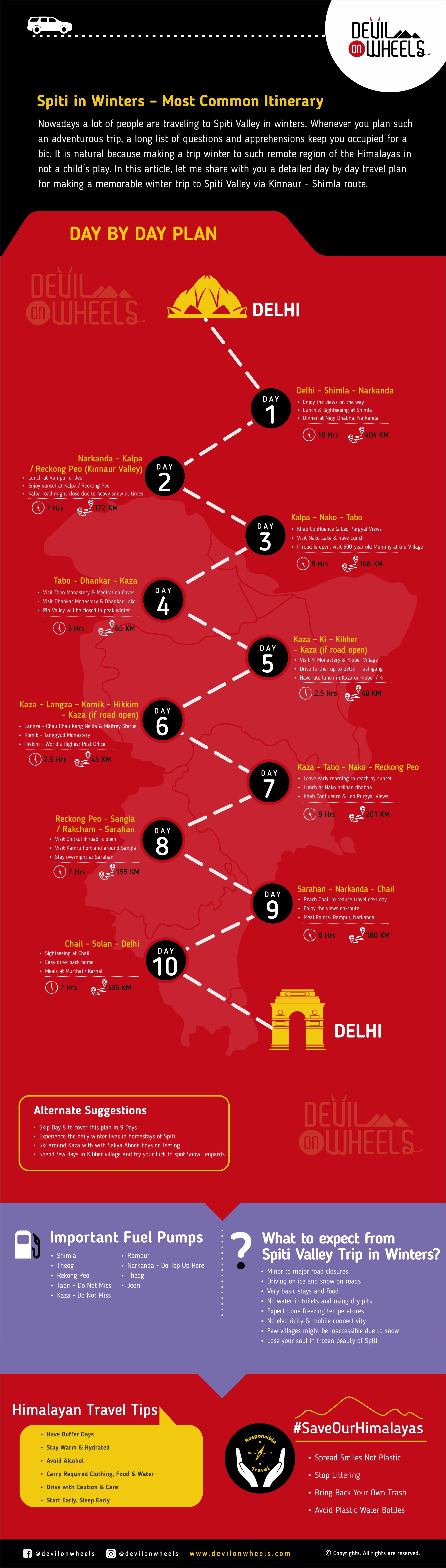
Download your FREE high-resolution PDF copy of this Spiti in Winters day-by-day plan infographic guide. If you liked it and found it helpful, please feel free to share it with your family and friends.
For a complete, detailed day-by-day itinerary with night stay recommendations, read my dedicated article: Spiti in Winters – Complete Day-by-Day Itinerary. That guide covers exactly where to stay each night, distances between stops, and how to balance basic amenities with the experience.
My pacing suggestion, mainly for altitude: night 1 in Narkanda or Rampur, night 2 in Reckong Peo (2,290 m), night 3 in Nako (3,662 m), nights 4-6 in Kaza (3,650 m) with Kibber and Key as day trips, night 7 in Tabo, then return. Keep the buffer days at the end so a closed road does not eat your return ticket.
What Permits Do You Need for Winter Spiti?
Quick answer: Indian nationals need no permit for Spiti via Shimla-Kinnaur. Foreign nationals need a Protected Area Permit (commonly called ILP), about Rs 250 at Reckong Peo, with no online application as of 2026. A small SADA vehicle entry fee may apply at the Sumdo check post, so keep cash.
Indian nationals do not need any special permit to visit Spiti Valley, including Kaza, Tabo, Key Monastery, and Kibber. The Inner Line Permit requirement for Indian tourists was removed several years ago. You can travel freely through the Shimla-Kinnaur-Spiti route without any permit. The free e-Aagman registration on the HP government portal is meant mainly for the Atal Tunnel side (the Chandratal circuit), which is closed in winter anyway, but check it once before you leave in case the rules change for your dates.
Foreign nationals, however, still need a Protected Area Permit (everyone calls it an ILP) for Spiti and the Kinnaur region. It is issued by the District Magistrate and SDM offices at Shimla, Reckong Peo and Kaza, at roughly Rs 250 at Reckong Peo and up to Rs 400 at Shimla (as of 2026, check the official Kinnaur district website). The usual rule is a group of at least two foreigners through a registered travel agency, though officers at Reckong Peo, Pooh and Kaza have discretion for solo travelers. In winter, processing may take longer due to reduced staff, so apply well in advance.
Separately, the Spiti Area Development Authority (SADA) collects a local vehicle entry charge at the Sumdo check post for Kinnaur-side entrants. Reported rates are Rs 100 (two-wheeler), Rs 200 (car) and Rs 300 (SUV) from a 2023 notification I could not re-confirm for 2026, so ask at the barrier. It is a development charge, not a permit, and usually cash only.
What Safety Precautions Should You Take?
Quick answer: Tell someone your full plan, drive only in daylight and arrive by 3-4 PM, carry 3-4 days of dry rations, acclimatize at Reckong Peo and Nako before Kaza (3,650 m), and trust local advice when they say a stretch is unsafe.
Winter Spiti is not a casual vacation. Here are the safety measures that are non-negotiable.
Always inform someone: Before entering the valley, share your complete itinerary with family and friends. Set a check-in schedule (for example, “if you do not hear from me in 48 hours, contact the DC office in Kaza”).
Never travel alone after dark: Start your driving early in the morning and reach your destination before 3-4 PM. Temperatures drop rapidly after sunset, and icy roads in darkness are extremely dangerous. NH-5 near Nigulsari also has a standing night-traffic restriction because of falling rocks.
Carry emergency supplies: Extra fuel (if self-driving), dry rations for 3-4 extra days, a shovel, tow rope, jumper cables, and snow chains. If traveling by bus, carry enough food and warm clothing to survive an unplanned overnight halt.
Watch for AMS: Kaza sits at 3,650 m (11,980 ft) and altitude sickness can hit anyone. Acclimatize properly at Reckong Peo (2,290 m) and Nako (3,662 m) before pushing to Kaza. If you experience severe headache, nausea, or breathlessness, descend immediately. Do not push higher. Read my AMS and acclimatization guide before you go.
Respect local advice: If locals or the bus driver says the road ahead is not safe, listen to them. They know these mountains better than any GPS or travel blog. Being stuck for an extra day is far better than being caught in an avalanche zone.
Check conditions before each leg: Look at the forecast from the India Meteorological Department and ask your homestay host or the bus stand about the road. My Kinnaur-Spiti road status post has more.
What Places Can You Visit in Winter Spiti?
Quick answer: Accessible in winter: Kaza, Key Monastery and Kibber (usually), Tabo, Nako and the highway villages. Usually closed: Langza, Komic, Hikkim, Demul, Lhalung, Dhankar village road, Chandratal and everything on the Manali side. Pin Valley depends on the snow.
Not everything that is accessible in summer will be open in winter. Here is a realistic list of what you can and cannot visit.
Accessible in winter: Kaza town, Key Monastery (usually), Kibber village (usually), Tabo Monastery, Nako village, and the main highway villages between Reckong Peo and Kaza. My Kaza travel guide lists what is open in town.
Usually inaccessible in winter: Langza, Komic, Hikkim, Demul, Lhalung, Dhankar (road to the monastery closes, though the new monastery near the highway may be accessible), Chandratal Lake, Kunzum Pass, and anything on the Manali side.
Possible but weather-dependent: Pin Valley (Mud Village) may be accessible if snow has not been too heavy, but verify locally before attempting. The road is narrow and gets buried quickly after fresh snowfall.
Practical Info Box: Winter Spiti at a Glance
| Detail | Information |
|---|---|
| Best Winter Months | November (easiest), March (best balance of snow and accessibility) |
| Peak Winter | December-January (-20°C to -30°C at night) |
| Only Route | Shimla – Reckong Peo – Nako – Tabo – Kaza (via NH-5) |
| Distance from Delhi | ~700-750 km (2-3 days drive), Shimla to Kaza ~420 km |
| Kaza Altitude | 3,650 m (11,980 ft) |
| Homestay Cost | Rs 500-1,000/night with meals (2025-2026) |
| Budget (7 days, bus) | Rs 8,000-17,000 per person |
| Bus (Reckong Peo – Kaza) | HRTC, ~Rs 400-600, 8-10 hours, one daily bus each way in winter |
| Mobile Network | BSNL and Jio in Kaza (unreliable in winter), Airtel does not work in Spiti |
| Permit (Indians) | Not required |
| Permit (Foreigners) | Protected Area Permit (ILP), ~Rs 250 at Reckong Peo |
| Nearest Hospital | CHC Kaza (basic), Shimla (major) |
| ATM | SBI Kaza (unreliable), carry Rs 10,000-15,000 cash |
Final Thoughts
A trip to Spiti Valley in winters is not for everyone, and there is no shame in deciding it is not for you after reading all of this. But if you do decide to go, plan meticulously, carry the right gear, and most importantly, keep your expectations grounded. The frozen beauty of Spiti in winter is unlike anything else in India, but the challenges are equally real. Conditions change from week to week, and I am only one person, so please confirm the road and fares locally before you leave. This guide was last checked in October 2026 🙂
Feel free to share this article with anyone you know who is planning a winter trip to Spiti Valley. If you have been to Spiti in winter and have tips to add, please share them in the comments or in the DwD Community. Your experience could help another fellow traveler make a safer, better-planned trip. For discussions, queries, and finding travel partners for winter Spiti, check out the DwD Community from the link in the Main Menu of the website 🙂 …
Keep Reading
- Spiti Valley in March for the shoulder-month view
- Spiti Valley in February if Losar is your target
- Frozen and locked Kaza, my photo tale from the winter trip
- Spiti Valley FAQs on planning, sightseeing and routes
Frequently Asked Questions
Is Spiti Valley open in winter?
Yes, Spiti Valley is accessible in winter through the Shimla-Kinnaur route only. The Manali route via the Atal Tunnel, Gramphu and Kunzum Pass remains closed from about November to May. BRO keeps the Hindustan-Tibet Highway open up to Kaza year-round, though temporary closures of 2-7 days can happen after heavy snowfall.
How cold does it get in Spiti Valley in winter?
Kaza sees daytime temperatures of -5°C to 5°C and nighttime temperatures of -15°C to -25°C during December-January. In extreme cold snaps, temperatures can drop to -30°C at night. Higher villages like Kibber and Langza (if accessible) are even colder.
Can I visit Chandratal Lake in winter?
No. Chandratal Lake and the road beyond Kaza towards Kunzum Pass are completely closed from November through mid-June. There is no way to reach Chandratal in winter, and attempting to trek there would be extremely dangerous.
Is there mobile network in Spiti Valley in winter?
BSNL and Jio 4G both work in Kaza town in normal weather, and Jio is usually faster. Airtel does not work inside Spiti Valley. In winter, towers lose power during heavy snowfall and you can expect no signal for days. Tell your family your plan before entering the valley.
Do I need a permit for Spiti Valley in winter?
Indian nationals do not need any permit for Spiti Valley. Foreign nationals require a Protected Area Permit (commonly called ILP), around Rs 250 at Reckong Peo as of 2026, issued by the District Magistrate or SDM offices at Shimla, Reckong Peo or Kaza. Apply well in advance as processing may be slower in winter.
What is the best vehicle for winter Spiti?
A 4×4 SUV with high ground clearance is strongly recommended. Carry snow chains for all driven wheels. Avoid diesel vehicles if possible as diesel can freeze in extreme cold. If you do not own a suitable vehicle, traveling by HRTC bus is a safer and more practical option for winter Spiti.
How many days do I need for a winter Spiti trip?
Plan for a minimum of 7-8 days, but keep 2-3 extra buffer days because road closures can easily add unexpected halts. A comfortable winter trip with acclimatization stops would take 9-11 days from Delhi and back. Check my detailed winter Spiti itinerary for a day-by-day plan.
Can I ride a motorcycle to Spiti in winter?
Technically possible but extremely risky and not recommended unless you are a very experienced cold-weather rider. The icy roads, sub-zero temperatures, and risk of getting stranded make motorcycling in winter Spiti genuinely dangerous. If you still want to attempt it, read my guide on preparing your bike for a Spiti ride and carry all the winter safety gear mentioned above.
Is there a bus from Reckong Peo to Kaza in winter, and how much is it?
Yes, HRTC runs a bus on this route in winter, with reports of one daily departure from each end around 6 AM. The fare is roughly Rs 400-600 and the ride takes 8-10 hours. The bus may halt if the road is blocked, so keep a buffer day. See my budget trip by public transport guide for more fares.
Can I see snow leopards in Spiti in winter?
Possibly. The Kibber area is the best-known spot, with the most commonly quoted window being mid-January to early March. Sightings are usually distant and never guaranteed, so go with a local guide and treat a sighting as a bonus.

97 Comments
Comments section gets closed in 90 days. To ask your travel questions, you can follow my YouTube Channel for a faster reply or for a much slower reply follow me on Instagram. :)
Hi Dheeraj ,
Your blog is really informative and clear.
I am visiting HP on 16th of October 2018 – 25 October of 2018. I am interested going to Spiti valley.
Would you personally suggest this, what are the pros and cons of such a plan.
Any any alternatives that i could go with.
I am really interested in seeing snow, no matter where, but bound by a little tight schedule. What are my chances of seeing snow at that time( NOT necessarily SNOWFALL) .
SK, by that time of the year the snow will be all gone. Only snow will be possible if you are lucky to get any fresh snowfall, which indeed is possible by late October. It will surely be cold during that time but yes you can make a trip to Spiti valley at that time of the year
Hi Dheeraj,
Thanks a lot for the blog it helps a lot and is very detailed. As you are experienced I just want to ask that I am planning for Spiti in Jan first week. I want to visit Spiti because of Snow, will I get snow in Jan first week? Is it advisable to visit Spiti in Jan 1st week?
For an immersed experience of snow in Spiti, you should visit Spiti Valley in February or March. January sometimes have snow and sometimes it does not have snow.
Dear Dhheraj,
What would be an ideal time to catch the first snowfall in Spiti this year? Also, how different is the weather during December as compared to say February. And, of December and February which month gives us a better chance of accessing villages like Demul, Dhankar and Hikkim by car.
Thanks in advance.
Best will be to travel Spiti Valley in the month of February and March if you want to experience snow in Spiti Valley. Most upper villages will not have access by hiking/trekking. March has better chances of partial access
Thank you for your prompt reply. Also, does December hold any chances of access to the upper villages? And, approximately when does access to the upper villages get cut?
You can travel to upper villages in December. It does not snow much in December and upper villages get cut by Jan mid to Feb
Cool. That was really helpful. Thanks again.
Hi Dheeraj,
Thanks for the very detailed article. I have a question as I’m planning to go for this during winter.
Should I do this mid Jan or mid Feb? What will be the difference? Which month will be more harsh and when will it be snow covered?
If you are interested in snow, then go towards end of Feb-Mar.
hi ,
I am planning for spiti valley in july ..s their any snows on that time?
There wont be much snow left in July in Spiti Valley
Hi Dheeraj,
Thank you for an excellent article. Planning to go to kaza from shimla on my Scorpio next year around 19 th January. Never driven on snow or ice ever, it’ll be my first experience. Have done both ladakh and spiti trip on my car but in summers. We’ll surely keep your points in mind. Any last minute suggestions?
Hey Vikash, most of the stuff in my mind I have explained in the article itself. I will suggest you to refer: Spiti in Winters – Most Common Itinerary
I am planning to go spiti valley in december end.. so i can go buy road on car??
I am plannig to go from shimla-kalpa-kaza..roads are closed but i can go buy road on car??
Shimla – Kalpa – Kaza remains open all round the year but closes during the time of heavy snowfall only. Also, please read that the road may close from some days to some weeks, so plan accordingly. All depends upon the amount of snow.
Thanks man!!!.. we have take snow tyres chain with us??
Probable yes in case it snows around during that time. It might come very handy.
Shimla – Kalpa – Kaza remains open all round the year but closes during the time of heavy snowfall only. Also, please read that the road may close from some days to some weeks, so plan accordingly. All depends upon the amount of snow.
This is an excellently written article. Which month does the photos above depict though? I’ve been to spiti in May and September already and wanted to experience the winters there. So I have planned a trip there in early December (first week). This time I plan to go to pin valley as well. The best part is I know people there so i think there wouldnt be any problem for the stays. But anything else I should keep in mind? Also, would the water freeze which is being carried in a backpack?
Aman, the pictures are from March first week. I think whatever mentioned in the article must be kept in mind and make sure that weather is clear before entering Pin Valley. Pin Valley remains cut off from rest of Spiti Valley in winters and in case you take that road and snowfall happens overnight or on the way, you may get blocked for the whole of winters. Water will freeze overnight.
Hi
I am traveling to Spiti this Dec by 25th. And I have discussed it with Spiti Inbound to facilitate my trip. Any suggestions from your side ?
All the tips, suggestions and risks regarding winter trip to Spiti Valley has been mentioned under the article: How to plan a winter trip to Spiti Valley
Hi Dheeraj,
We planned to travel from 20th Jan 2018 will it be safe.
Amit, Spiti Valley will be quite harsh during that time of the year. Have you read the article above? Are you still interested in making the trip? If yes, we can discuss the plan futher.
Thanks for the reply so we have changed our date to First week of April 2018. So this date good enough to travel
You will still face the chill and harshness of the Spiti Valley plus the slush/snow slides is still common in the month of April Please read: Best Season to Travel on Road to Spiti Valley
Hi Dheeraj,
We are a group of 4 guys from Kolkata planning to travel from Shimla till Kibber this year between Dec 25 to 1st Jan-18. Researching on the trip I agree that the trip is very risky, but doable. I contacted some local taxi associations in Shimla, but no one is ready to venture that road in Dec end. Can you please provide some details or contacts if we want to hire a car from Shimla for this trip? Also it would be helpful if you can provide some local contacts along the way.
Arita, no one will be willing to take that road during the winters. You will have to make that journey either on public transport or your own transport. As mentioned in the article the road between Reckong Peo to Kaza can close from a couple of days to a couple of weeks to couple of months. So, no commercial person will be ready to take that risk when they have business down at their current locations.
Hello dheeraj ,
found your article v helpful for travelling in spiti. I am travelling to spiti from 4th nov through shimla kinnaur and will be back to shimla on 14th. what will be the temperature at that time in spiti? means can i expect a snowy roads? as i want to have glimpse of it. so selected november and not completing the circuit as every1 told kunzum will be closed. will i be able to see the roads covered with snow and passing in middle of it
Neeta, the temperature will be sub-zero mostly and nights will go below 0 as well. It will be cold and dry in Spiti Valley during that time and most hotels will be closed. You need to rely on basic food and basic stay. Rest I have provided tips for a trip to Spiti Valley in Winters above. Snow on the roads will only be possible if it snows during that time. Usually, there is not much snow in November.
thank you dheeraj for your guideline. I selected november so that we dont need to go through harsh winter of spiti unlike december january now i just hope that it snow during that time and also that we dont get stuck.
Best wishes for the trip, please go prepared.
Hi dheeraj,
Loved the way you described Spiti here. I travelled there last year from manali. It was mesmerising, though I agree with your AMS suggestions. This time I want to explore the Hindustan Tibet highway. I have never experienced snowing, hence want to do this trip in October. Will that be feasible?
Yes Rucha, October is just fine. Please read: 5 Reasons to Avoid Manali Kaza Road in October
Thanks a ton Dheeraj for a prompt reply. I researched last night and they say it doesn’t snow in October. Is that true? If yes, when does it start snowing there?
Yes Rucha, in October it snows a day or two and then it melts away. The main snow starts in November end and December. If you want to make a winter trip to Spiti with snow all around, then Feb – March will be a better time to visit, of course with risks of no light, road being closed from days to weeks.
In that case, is Ladakh safe to be travelled to in November?
Rucha, Ladakh has flight connectivity so that means you cannot get stuck for weeks to months in Leh.
Hey dheeraj, whats the best route to spiti valley during New Years time to avoid snow blocked roads and is the calley even accessible during that time.
Hi Harsh,
There is no such route that you can avoid from snow blocked roads. In case it snows very heavily, the Shimla – Kinnaur – Spiti road can close for weeks to months. So, plan with a calculated risk.
Regards
Dheeraj
Dheeraj,
Will it be worth going during that time.
And what route should be taken.
Unless you are used to such harsh conditions and very cold conditions, I will not recommend making the trip to Spiti Valley. Raw and basic food will be available and hotels will be closed. Stay options will be limited to home stays and even toilets will be dry pits without water.
If you still want to make the trip, you have to go from Shimla – Narkanda – Powari – Reckong Peo – Nako – Tabo – Kaza route and come back the same route.
Dheeraj,
Is it advisable to go on a trip to spiti trip in November 2nd or 3rd week??
What are the chances of finding snow ?? If not spiti at what places can i find snow starting Novemeber last week or even before??
Th
Well, it gets cold up there in winters in Spiti Valley. You can travel by road from Kinnaur – Shimla but avoid going from Manali side that late. Rest most of the suggestions in the article above holds true here as well.
Witch is the best time (month) to travel for spiti by bike with ice filled rodes
Jan End to February will be the best month in such a sense to make white Spiti Valley trip
Hi witch is the best time (month)
to visit spiti by bike
September is the best month but since you are interested in frozen Spiti Valley experience, Jan End to Feb will be great.
Hi Dheeraj,
We are planning to go to spiti valley in May first week. Plan is to go till kun zum la and trek to chandrataal. Would trekking be feasible? If not, any other treks you would suggest in the Spiti
No Charu, the road to Chandratal does not open and trekking is not feasible in the month of May to Chandratal. It is as if going into the dead land, so even if some insane agency/individual offer you something like this, please turn down the offer.
Thanks for the quick reply Dheeraj. In that case, what other treks we can do in the region, perhaps up to kunzumla. Could you share a few things
You can surely trek to the remote villages in Kaza and around towards Langza, Hikkim, Komic or Demul
Cool! Thanks a lot!
Can I do the full circuit of Spiti from Shimla to Shimla in End of July. Is it right time to do ? How many days should I have Shimla to Shimla ?
You can check a very balanced and most common itinerary for Spiti Valley followed by many travellers including me at the link here for 10-11 days: Most Common Itinerary for Spiti Valley.
Dheeraj Sir my question would be if we want to enjoy spiti valley with medium snow will april last week or may first week will good time to be there … pls let me know
Yes Yogender, April last week will let you enjoy snow in Spiti Valley. You can especially travel beyond Kaza till the point where road is open and enjoy in tons of snow towards Kunzum Pass.
hi DHIRAJ,
I GOT SOME BASIC IDEA FROM YOUR DESCRIPTION ABOUT TRIP TO KINNAUR, SANGLA VALLEY AND SPITI VALLEY.I AM PLANNING TO TRAVEL IN MARCH END TO SHIMLA, 26TH TO 29TH EXACTLY , AFTER WORD WHICH PLACES I CAN VISIT FROM THERE? I HAVE SARAHAN, SANGLA CHITKUL IN MIND, WILL BE SELF DRIVING CRV4WD AND HAD BEEN UPTO THANEDHAR IN APRIL END BEFORE 3 YR. WE ARE FAMILY OF 3. CAN U SUGGEST ITINERARY AND PLACES TO STAY AND ANY PARTICULAR PRECAUTIONS?
THANKS
MANISH
Hi Manish,
Request you to please avoid CAPS letters. I see you have just 4 days in hand and going to any of these places will basically mean lot of hectic driving in just 4 days. Are you starting from Delhi to Chandigarh?
Hi Dhiraj, thanks for prompt reply. I am in Shimla from 26 th to 29 th and then after I am free for 6 days as I am not sure of what to expect weather wise. Bhave plan to go upto chitkul , if u recommend for this time period. Actually I am coming from Gujarat.will start on 25 th march
Manish, for sure you can give a try to Sarahan, Sangla, Chitkul, Kalpa with 6 days in hand from Shimla. Refer: Kinnaur Valley – Most Common Itinerary
Hi Dheeraj,
I wil, be going to Spiti in end March. My itinerary is Kalka-Kufri-Reckong Peo-Kaza-Tabo-Chitkul-Narkanda-Kufri-Kalka. The period is from 17/03/ to 27/03. i think it must be filled with snow. Can you guide me with some taxi drivers? Also will it be more sunny during this dyas as it is winter end? Thanks in advance for your inputs
Hi Atit,
You can get connected directly to some drivers in Spiti Valley or Kinnaur Valley at the link: List of Taxi Drivers for Spiti Valley & Kinnaur Valley. These drivers can come and pick you up from Manali / Shimla / Delhi / Chandigarh too, of course with a price of pickup as well.
The rates of the taxis are about Rs 3000-3500 per day depending upon the number of days you plan to travel, more the days, less the price.
Otherwise, taxis in general are also available on the spot from Shimla or Manali from respective taxi stands
Weather depends upon during those days weather only. Sometimes sunny sometimes dark, we had sun only 1.5 day of our travel.
Thanks a lot. I believe PWD Guesthouses will be open at hat time, right?
It depends, sometimes yes, sometimes no. Depends upon the caretaker and toilets working or not.
Hey Dheeraj,
I have plans of visiting the Spiti Valley in mid-end Jan.
Is Dhankar & Pin accessible in this part of year ?
Also do let me know for homestays with contacts(if possible) at Tabo, Dhankar, Pin(if possible), Kibber.
Pin Valley is not accessible but Dhangkar should be accessible. You can get in touch with Tsering bhai +91 94-18-208987
Thanks Dhreeraj, So when is the best time to visit and see snow too ? how about end of May or 1st week of June ? will i get to see some snow ?
Sean, in case you are not interested to do whole circuit and are OK to go from Kinnaur and come back from Kinnaur only, then go in April end of May to get snow filled views.
I am planing to take a full circuit with 15 days in hand – starting from Shimla – Narkand – Kalpa – Nako – Tabo – kaza -Kibber – Manali and back to Shimla.
In that case, June will be apt time to do the entire circuit because the road from Kaza to Manali opens around second week of June.
Hi Dheeraj,
I have gone through the article and comments, I am planning a trip in first week of Jan 2017 and have few question.
Is it possible to cover the stretch till Chandra taal Lake and back to Shimla in 4 Days.
If not how far i can travel ?
Is it safe to drive a SUV, Based on road condition & Snow, I will be traveling with family , friends & a KID too.
Will there be too much snow on the roads.
The road beyond Kaza gets closed in winters, so Chandratal is not possible. You can travel up to Kaza at max. I will not recommend to make a trip with family and kids into Spiti Valley at that time of the year. It will be too dangerous to go up there with kids.
Hi Dheeraj,
I am planning to Visit Spiti starting from 25 Dec to 5 Jan 2017. I will be driving Bike from Delhi,
1- What preparation should I follow if travelling by bike to spiti from Dec end to Jan start
2- Can I expect White Spiti in this time frame(25 Dec to 5 Jan) as It is shown here (https://discoverwithdheeraj.com/spiti-in-winters-common-itinerary/) for March month.
Hi Pawan,
1. You have read the article above and that’s best pointers that you should keep in mind. Then, apart from that you sould definitely be prepared with stocks of food, dry fruits and heavy woollens and a heavy jacket. Do not forget woollens socks and if possible warm shoes.
2. It may not be completely white by that time as snowfall has just started but you may get glimpses of it. This much snow is better if you visit in Jan end to March.
Hi Dheeraj,
Thanks for info!!
BTW can you redirect me to the page where I can find some pics of Kaza/Spiti of time frame of Dec end to Jan start, if it wont be satisfying(in Pics) I will re-plan my travel for March month.
Try to explore this forum in case there is any: https://discoverwithdheeraj.com/india/lahaul-spiti-kinnaur-valley-travel-tales/
Hi Dheeraj,
How will be the weather in March? Any idea on availability of Public transport?
Anshul, it is all frozen in March. Check the travel tales section to read about my trip in March to Spiti Valley. The buses runs for sure between Reckong Peo and Kaza. Public transport is limited to road opening or closing.
Hi Dheeraj, I just came back from Kinnaur-Spiti trip this Oct-end. I am planning to visit Himachal again at the beginning of March. I would love to be in snow and beautiful places, considering that I already had the taste of the most beautiful places of Himachal just few days back. Can you please let me know which places should I cover in March, where there will be less chances of road block due to snow but can match upto Spiti standards. We are not self-driving. We will hire a car. Thanks for your help in advance.
Hi Ria, that is a bit difficult question comparing anything else in Himachal than Kinnaur – Spiti in March 😀 😀
I will be frank, it will be difficult to get such a place in March as both Pangi and Lahaul valley will be closed during that time and remain cut off. Those are the only places come close to the beauty of Spiti and Kinnaur Valley in Himachal. So, it will be better if you choose something like Tungnath – Chandrashilla – Deoria Tal – Rohini Bhugyal hikes in Uttarakhand to enjoy great views of Chaukhamba range and hike in wilderness of nature.
🙁 .. But anyway, thanks a lot 🙂
Hey can u provide contact detais of homestay in kaza for winters?
You can get in touch with Tsering bhai at +91 94-18-208987
Hi Dheeraj, I am planning to go to Himachal in December for 6-7 days. To be precise from 5th December to 13th December. I read your replies to other comments and realised that going to Spiti is not feasible. However, is is possible to explore other parts of Himachal on the said dates? Kindly suggest. Thank you in advance.
Yes Pushkar, the article describes how you can plan a trip to Spiti Valley and what shall be expected up there during that time period. You can surely try to visit Kinnaur Valley including Sarahan, Kalpa and Sangla during that time of the year. Chitkul will be closed in December.
Hi Dheeraj,
As always, thank you for this article and many others I’ve reliably used for my Himalayan trips. This November 16th, I’m planning to take a trip with my wife in an SUV. This is our first road trip so I thought of going till Kalpa/Sangla and returning to Shimla. Can i expect snow fall on the road to Kalpa region in mid November?
Mohid, in November unless it snows on the day you are traveling it will be hard to find snow on road to Kalpa. Surrounding peaks will surely be having snow on them though. Go prepared with heavy woolens.
Hi Dheeraj, thank you for this wonderful info, Is it possible to do Spiti in Oct’16? Plan is to do: Mandi – manali – Keylong -spiti – Kinnaur
we will be on bikes, thanks
Yes, it is possible to do Spiti but better plan before mid of October so that chances of getting stuck between Manali – Kaza are less scary.
Hi Dheeraj
Your article is awesome!!! That is u making me to go to this trip.. i hav been to keylong, manali, kashmir, kargil, srinagar before but this time i m planning to go leh via spiti ( Hindustan-Tibet HIghway) just bcz u hav desribed its beauty very well with pictures, so is it possible if i leave from palanpur(gujarat) on 29th Oct as my vacation starts from this date? or if Leh is not possible(due to winter & POK issue) than what r the other choice? bcz i know it will be winter time as i reach himachal on 1st of Nov.. we r frnds(5 Person) planing this trip with Duster RXZ 110ps Diesle. guide me if i m doing any wrong….
No Amin, it is not possible to make a trip to Leh from Spiti Valley or Manali – Leh Highway that late in the season. You can get stuck in the middle of no where for months and no help at all.
Amazing photographs. Very useful post.
Thank you 🙂