


Last Updated: July 2026
If you are planning a trip to Spiti Valley and wondering whether to enter from the Shimla-Kinnaur side or the Manali side, this article will help you decide. The Manali to Kaza route covers about 200 km (182 km via the Atal Tunnel) and can be completed in a single day. The Shimla-Kinnaur route, on the other hand, takes at least two to three days to reach Kaza. Both routes have their merits, but in this article, I will talk about the top five reasons why the Manali route to Spiti Valley might be the better choice for you, depending on your situation.
As of late July 2026, the Manali-Kaza road is open and in full peak-season use, so this is a good time to plan the trip. Keep in mind the Gramphu-Batal stretch still throws up water crossings and the odd slush patch during monsoon, so build in some buffer time and do not treat any single source (including this one) as the final word on road conditions. Always cross-check with my regularly updated Manali-Kaza Road Status page, the official Lahaul-Spiti district road status page (though it can lag behind ground reality), or a local driver before you leave.
I have already shared detailed articles on how to plan a trip to Spiti Valley via Kinnaur and Spiti Valley via Manali. Those articles cover step-by-step travel planning, places to visit, where to stay, food options, and itineraries. This article focuses specifically on the advantages of picking the Manali route when you cannot do the full circuit.
Let's quickly dive into the details:
What Are the Key Advantages of the Manali to Spiti Route?
The Manali route to Spiti Valley offers five clear advantages: it saves time (reach Kaza in 2 days from Delhi vs 3 days via Kinnaur), costs less (one fewer night of accommodation), has better public transport connectivity, is less prone to monsoon landslides, and lets you cross two iconic Himalayan passes. If you are short on days, this is the route to pick.
Practical Information for the Manali to Spiti Route
Before diving into the five reasons, here is the essential information you need for planning this route in 2026.
| Detail | Information |
|---|---|
| Current Status (Jul 2026) | Open, peak season. Expect rough patches between Gramphu and Batal. |
| Distance (Manali to Kaza) | ~200 km via Rohtang, ~182 km via Atal Tunnel |
| Travel Time | 10-12 hours by road |
| Route Opens | Mid-May to early June (depends on Kunzum Pass snow clearance) |
| Route Closes | Mid to late October |
| Key Passes | Rohtang Pass (3,980m) / Atal Tunnel, Kunzum Pass (4,551m) |
| HRTC Bus Fare | Rs 500-589 per person (Kullu/Manali to Kaza, 2026) |
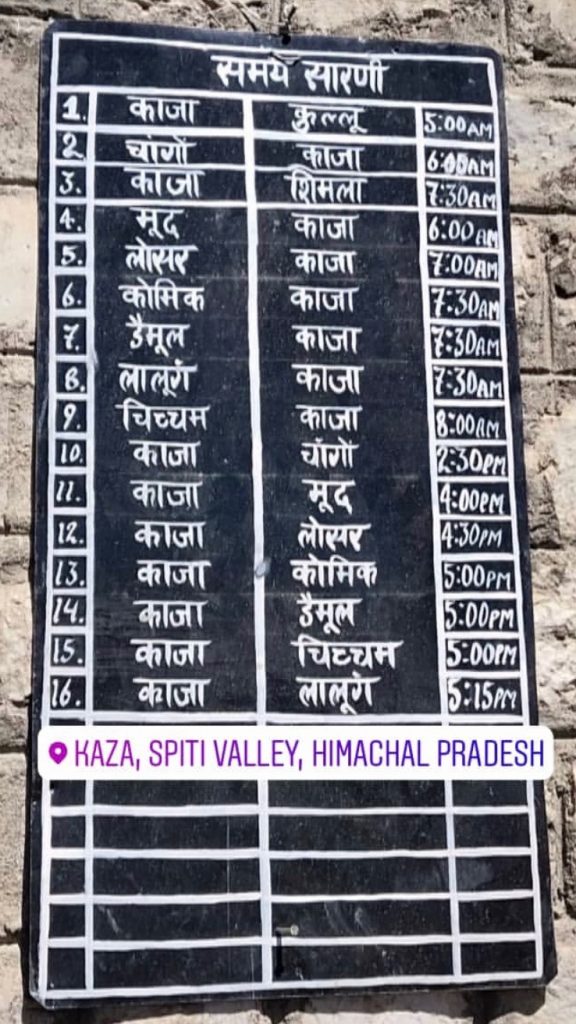
| Bus Departure | 4:30 AM from Kullu, about 6:00 AM from Manali Bus Stand |
| Atal Tunnel | 9.02 km, bypasses Rohtang Pass, saves 2-3 hours |
| Fuel | Last pump at Tandi (32 km before Jispa). No fuel until Kaza. |
| Mobile Network | BSNL postpaid works at Kaza. Jio/Airtel patchy beyond Manali. |
| Manali-Side Development Fee | Rs 100-400 (vehicle-type based) at the Losar barrier, in season |
Manali Route vs Kinnaur Route: Side-by-Side Comparison
In case you want the short version before reading the detailed reasons below, here is how the two routes stack up against each other on the factors that matter most for planning.
| Factor | Manali Route | Shimla-Kinnaur Route |
|---|---|---|
| Days from Delhi to Kaza | 2 days | 3 days |
| Distance from Delhi | ~772 km | ~791 km |
| Extra cost (approx.) | Baseline | Rs 1,500-2,500 more per person |
| Public transport | 2 bus changes, daily HRTC service | 3 bus changes, longer layovers |
| Monsoon (Jul-Aug) risk | Water crossings, generally shorter delays | Landslide-prone, can block roads for days |
| High passes crossed | Rohtang/Atal Tunnel + Kunzum Pass | None (river-valley drive) |
| AMS risk | Higher (rapid altitude gain in one day) | Lower (gradual acclimatization) |
| Best suited for | Short trips (5-7 days), tight budgets | First-timers, longer trips (8-10 days) |
Hence, if you can only pick one side and your days are limited, the table above should make the decision fairly clear. If you have more time, keep reading, because doing the full circuit lets you skip this trade-off entirely.
How Much Time Does the Manali Route Save Compared to Kinnaur?
The time savings alone make this route worth considering if your leave days are limited. From Delhi, you can reach Kaza via Manali in just two days. The Kinnaur route takes three days minimum.
Here is how the timeline works. You take an overnight Volvo from Delhi and reach Manali by morning. The next day, you start early (4:30-5:00 AM) and drive or take the HRTC bus through the Atal Tunnel, past Gramphu, over Kunzum Pass, and into Kaza by evening. That is Delhi to Kaza in under 36 hours of actual travel.
The Shimla-Kinnaur route is different. You reach Shimla on Day 1, then travel to Kalpa or Sangla on Day 2 (which itself is a long 8-10 hour drive), and finally reach Tabo or Kaza on Day 3. So you spend one extra day just getting to Spiti.
Distance-wise, the difference is not dramatic. Delhi to Kaza via Shimla-Kinnaur is about 791 km, while Delhi to Kaza via Manali is about 772 km. A mere 19 km difference. But the road quality and the number of halts make the Manali route significantly faster. The Delhi to Manali stretch (570 km) runs on well-maintained national highways, and you can cover it in 12 hours comfortably. The remaining 200 km from Manali to Kaza, while challenging, can be done in a single day.
Keep in mind, if you are short on days and the Manali-Kaza road is open (June to October), the Manali route is the clear winner for reaching Spiti quickly.
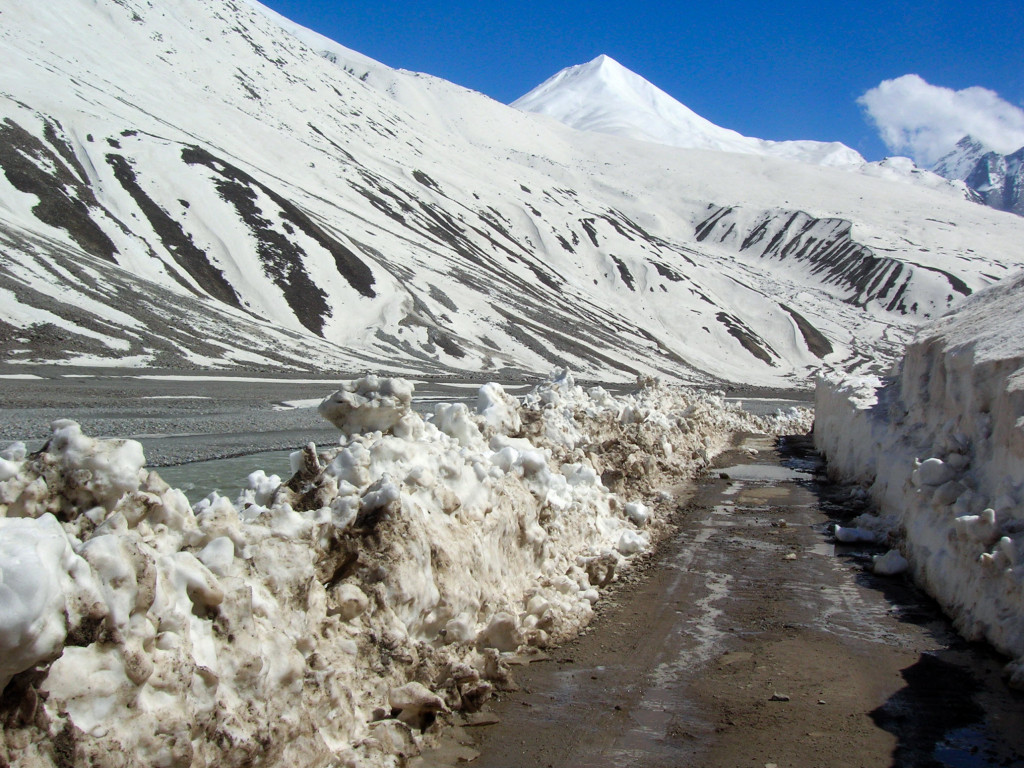
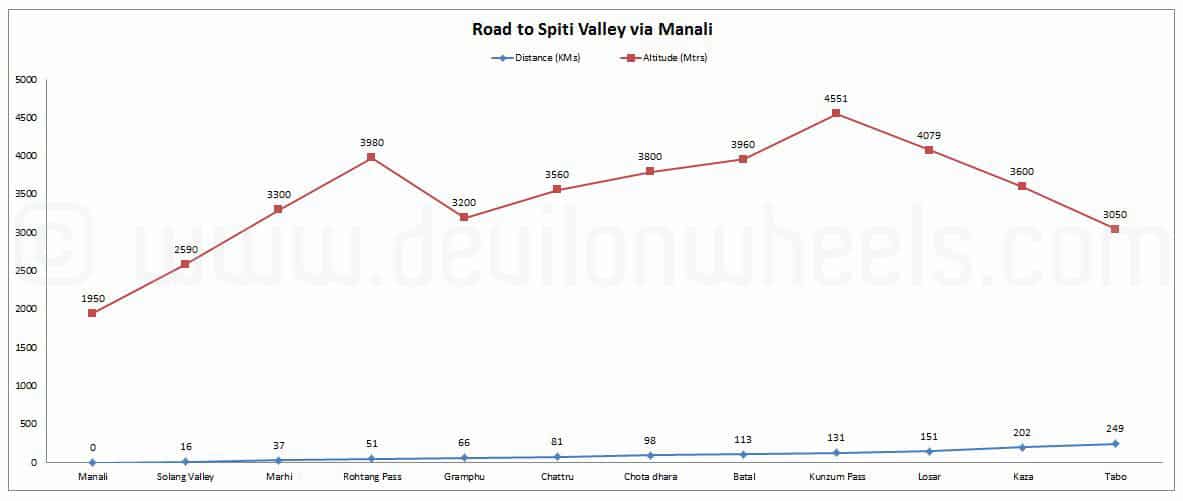
However, there is a trade-off you must be aware of. When you travel to Kaza from Manali, the altitude gain is abrupt. You go from Manali at 2,050m to Kunzum Pass at 4,551m within the same day. This rapid altitude change increases the risk of Acute Mountain Sickness (AMS). If you are a first-timer, consider descending to Tabo (3,280m) instead of stopping at Kaza (3,800m) on your first night. Starting 2 hours early from Manali gives you enough time to reach Tabo, and the lower altitude helps with acclimatization.
Is the Manali Route Safer from Landslides During Monsoons?
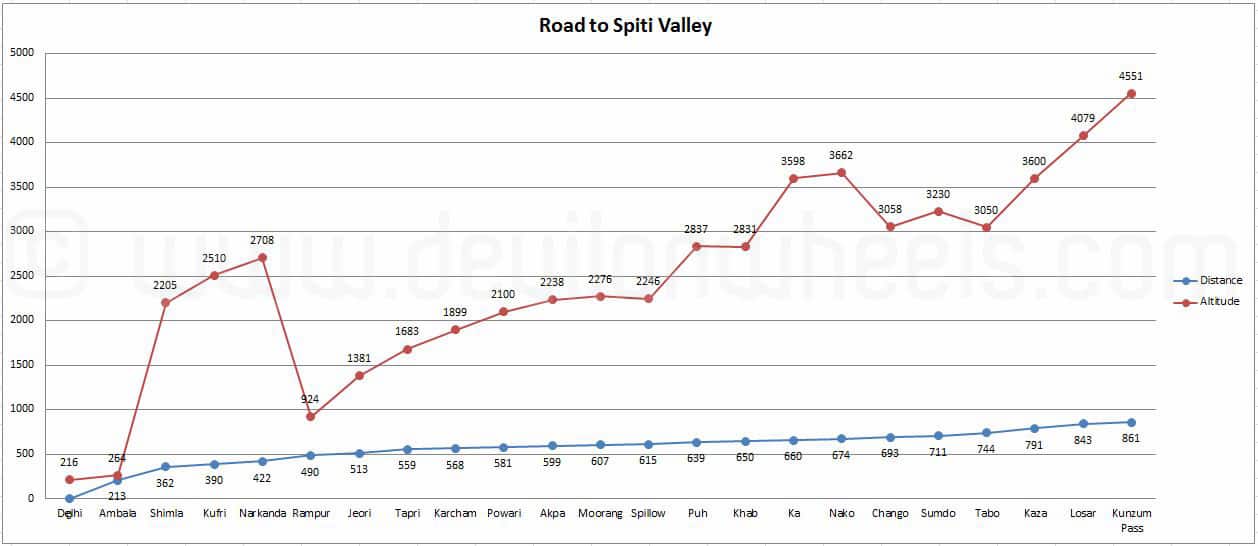
In terms of major landslide risk during July and August, the Manali route is generally the safer option. The Kinnaur Valley stretch between Reckong Peo and Nako is notorious for shooting stones and road closures during monsoons, sometimes stranding travelers for days.
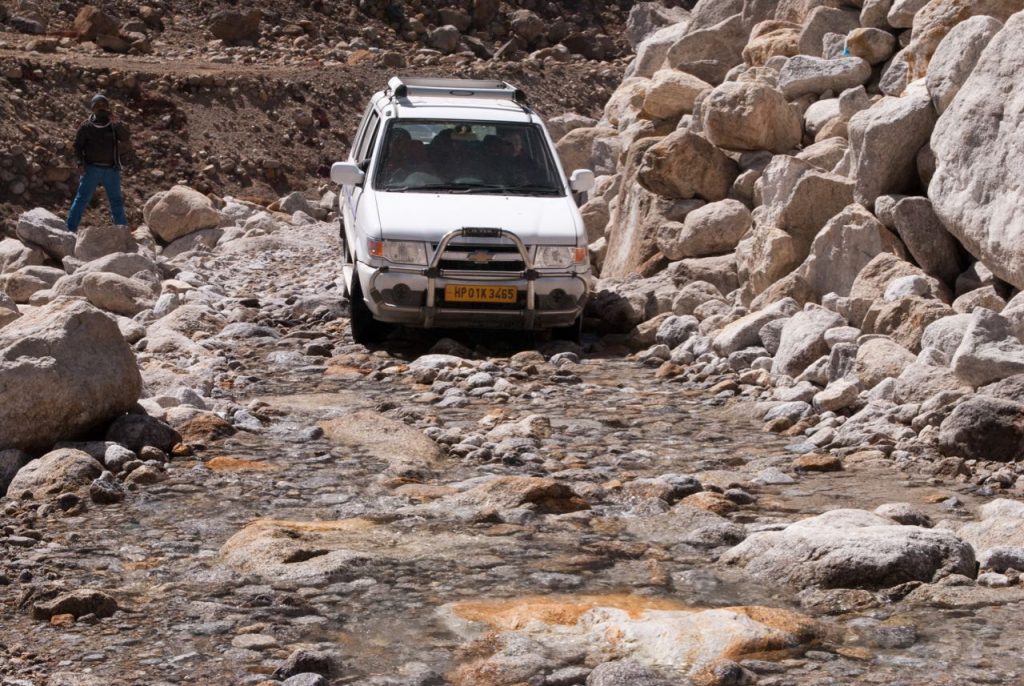
I will not pretend the Manali route is perfectly smooth, because it is not. The stretch from Gramphu to Kunzum Pass is one of the roughest roads you will drive on. Water crossings are common, especially before BRO completes repairs each season. But these water crossings, while inconvenient, are manageable if you start early from Manali (before 5 AM). The water levels in the nalas rise as the day warms up and glacial melt increases.
The Kinnaur side has a different problem. Monsoons bring sustained heavy rainfall to the Sutlej Valley, and zones like Malling Nalla ahead of Nako and several stretches between Reckong Peo and Pooh are prone to massive landslides. These are not water crossings you can time around. They can block the road for days.


If you are traveling to Spiti during July or August and have to choose one route, I would personally pick the Manali side. You enter the rain shadow region of Spiti faster, and the window of exposure to monsoon-damaged roads is shorter. The risk is almost a day less than traveling from the Kinnaur-Shimla side.
That said, my honest recommendation is to avoid traveling in the mountains during peak monsoon altogether. If you can, plan your trip for late September or early October when the roads are at their best and the weather is clear.
As of late July 2026, the Gramphu-Batal stretch has the usual monsoon-season water crossings and a few slush patches, but there have been no multi-day blockages reported on the Manali side this season. NH-05 in Kinnaur, on the other hand, saw a debris-flow closure near Pooh in early July 2026 that BRO cleared within half an hour, and the Maling Nalla stretch between Pooh and Nako remains on a standing high-alert advisory through the monsoon. This is exactly the pattern I am talking about above, so plan accordingly.
![How to prepare for cold weather motorcycle ride in Ladakh or Spiti Valley? [13 Important Tips]](https://discoverwithdheeraj.com/yt_vid_thumbs/ladakh/83.png)
How Good Is Public Transport on the Manali to Kaza Route?
The Manali route has better and more direct public transport connectivity to Kaza compared to the Shimla-Kinnaur route. You can reach Kaza from Delhi in just two bus changes, making it the preferred option for budget travelers using public transport.
The connectivity works like this. From Delhi, multiple HRTC and private Volvo buses run overnight to Manali. You reach Manali by early morning. Then, HRTC runs a daily bus from Kullu to Kaza via Manali during the open season (June to October). This bus leaves Kullu at 4:30 AM and Manali around 6:00 AM. As of mid-2026, the fare for the full Kullu-Kaza / Manali-Kaza run is approximately Rs 500-589 per person, a bit higher than the older Rs 400-600 figure you may still see on some sites. Women travelers get a 50% discount on HRTC buses.
The buses now go through the Atal Tunnel instead of over Rohtang Pass, which has cut down the travel time by 2-3 hours. You can expect to reach Kaza by 3:00 PM to 5:00 PM, depending on road conditions.
If you want to help with acclimatization, there is an HRTC bus from Kaza at 2:00 PM to Chango that can drop you at Tabo for the night. Sleeping at Tabo (3,280m) instead of Kaza (3,800m) on your first night makes a noticeable difference in how you feel the next morning.
Compare this with the Kinnaur route. From Delhi, you first take a bus to Shimla or Chandigarh, then another to Reckong Peo, and then a third bus to Kaza. That is three bus changes and three days of travel. From Chandigarh, it is two bus changes but still takes a day longer. Hence, for backpackers and solo travelers on a tight schedule, the Manali route is clearly more efficient.
Is the Manali Route to Spiti Cheaper Than the Kinnaur Route?
Yes, the Manali route is generally cheaper by Rs 1,500-2,500 per person compared to the Kinnaur route. The savings come from one fewer night of accommodation, one fewer day of food, and slightly cheaper bus fares.
Here is a quick budget comparison. On the Manali route, you spend one night in a bus (Delhi to Manali), then travel to Kaza the next day. Your only accommodation cost before reaching Spiti is the bus ticket itself. On the Shimla-Kinnaur route, you need at least two overnight stops (one at Shimla/Narkanda and one at Kalpa or Sangla) before reaching Spiti on Day 3.
Each extra night on the road means Rs 800-2,000 for accommodation plus Rs 300-500 for meals. Over one extra day, that adds up to Rs 1,100-2,500 per person. When you multiply this by the number of people in your group, the savings from taking the Manali route become significant.
For more detailed budget planning, check my article on tips for a budget trip to Spiti Valley and the complete Spiti Valley trip cost breakdown.
What High Passes Will You Cross on the Manali Route?
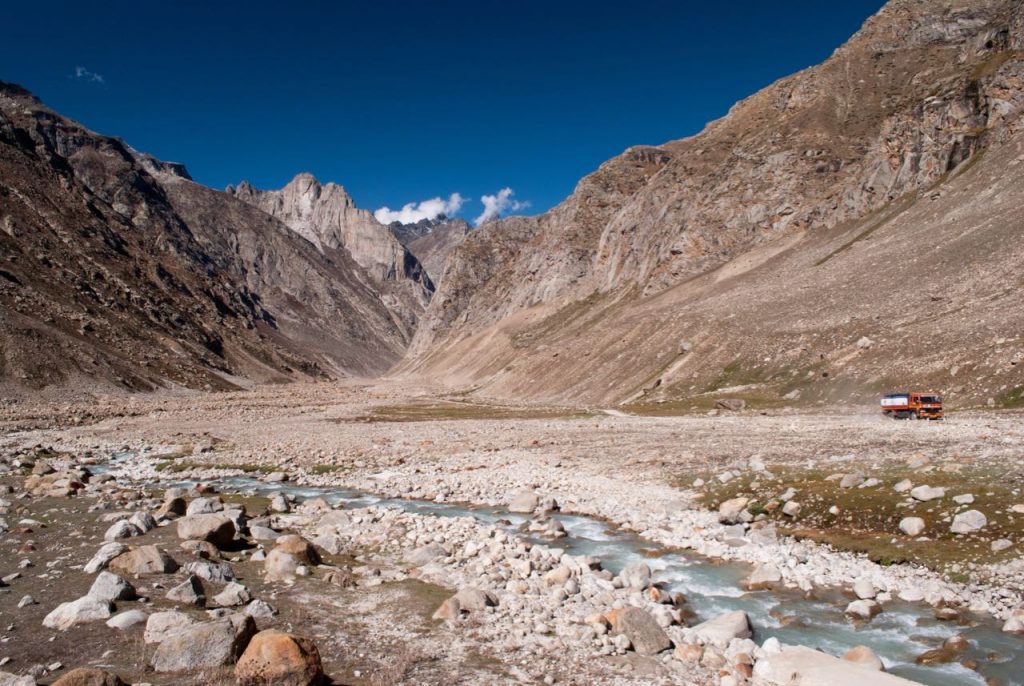
If you love crossing high-altitude passes, the Manali route gives you two iconic ones: Rohtang Pass (3,980m / 13,058 ft) and Kunzum Pass (4,551m / 14,931 ft). The Kinnaur route has no major pass crossings.
Rohtang Pass sits at the boundary between the Kullu and Lahaul valleys. Since the Atal Tunnel opened in October 2020, you no longer need to cross Rohtang Pass to reach Spiti. The tunnel bypasses it entirely. However, if you have the time and the pass is open, I would still recommend driving over Rohtang at least once for the experience. The views from the top on a clear day are worth the detour. Keep in mind that you need a Rohtang Pass permit if you choose to go over the pass instead of through the tunnel.
Kunzum Pass is a different experience altogether. At 4,551m, it is one of the highest motorable passes in Himachal Pradesh. The road leading up to it from the Batal side is rough but the landscape is otherworldly. At the top, there is the Kunzum Devi temple. It is a tradition to drive around the temple in a clockwise direction to pay respects before entering Spiti Valley. Do stop here for a photograph and to soak in the view of the Spiti Valley stretching out below.
If crossing high passes is on your bucket list, the Manali route delivers two in a single day. The Kinnaur route, while scenic in its own way, is more of a river-valley drive along the Sutlej and Spiti rivers without any major pass crossings.
What About the Atal Tunnel and How It Changes the Manali Route?
The Atal Tunnel, which opened in October 2020, is the single biggest change to the Manali-Spiti route in the last decade. It has made the journey shorter, faster, and less dependent on weather at Rohtang Pass.
Before the tunnel, every vehicle going from Manali to Spiti had to cross Rohtang Pass, which was unreliable in bad weather and required a permit with daily vehicle caps. The tunnel bypasses Rohtang entirely. It sits at 10,171 ft (3,100m), is 9.02 km long, and takes about 15-20 minutes to drive through. No permit is needed for the Atal Tunnel itself.
The practical impact is significant. The tunnel saves about 46 km of distance and 2-3 hours of travel time compared to the Rohtang Pass route. It also eliminates the uncertainty of Rohtang Pass closure due to weather, which used to be a common issue especially in early June and late September. Now, even when Rohtang Pass itself is closed due to fresh snowfall, the Atal Tunnel remains open and the road to Spiti via Gramphu continues to function (as long as Kunzum Pass is clear).
Atal Tunnel to Kaza: Distance and Waypoint Breakdown
The distance from the Atal Tunnel (south portal) to Kaza is approximately 150-155 km, and it takes about 7 to 9 hours to drive under normal conditions. This is the stretch most people actually mean when they search for “Atal Tunnel to Kaza distance,” since it covers the whole Spiti-bound road from where the tunnel begins to where the journey ends at Kaza. Here is how that distance breaks down waypoint by waypoint, cross-checked against the National Highway 505 distance markers.
| Waypoint | Distance from Previous Point | Cumulative from Atal Tunnel (South Portal) | Road Notes |
|---|---|---|---|
| Atal Tunnel South Portal | Start point | 0 km | Altitude 3,060m. Tarmac, well-graded |
| Atal Tunnel North Portal | 9.02 km (through the tunnel) | ~9 km | Lit, paved tunnel, 15-20 min drive |
| Gramphu junction | ~7 km (via Khoksar) | ~16 km | Turn off the Keylong-bound road here for Spiti |
| Chhatru | 20 km | ~36 km | Tar thins into a dirt-and-boulder track along the Chandra river |
| Batal | 32 km | ~68 km | Roughest driving on the route. Water crossings common in Jul-Aug |
| Kunzum Pass (4,551m) | 11 km | ~79 km | Steep switchbacks up to the pass |
| Losar | 18 km | ~97 km | Descent into Spiti. SADA development fee barrier in season |
| Kaza | 57 km | ~154 km |
A few things worth knowing about this stretch. The tar road holds up reasonably well from the tunnel through Gramphu and much of the way to Chhatru, then thins into a dirt-and-boulder track for the roughly 43 km between Chhatru and Kunzum Pass via Batal, which is the hardest driving on the entire Manali-Kaza route. This is also where most of the water crossings sit, since glacial melt off the surrounding peaks feeds directly into the nalas the road crosses, and levels rise through the day as the sun warms the ice. Past Kunzum Pass, the descent through Losar to Kaza runs on steadily better tarmac, and this last 57 km stretch is usually the quickest hour and a half to two hours of the whole day. Hence, if you are budgeting time for the Atal Tunnel to Kaza leg specifically, plan for 3 to 4 hours to cover the rough Gramphu-Kunzum section alone, even though it is only around 43 km of that total.

For more details on the route and current road conditions, check my regularly updated Manali-Kaza Road Status page.
Should You Do the Full Spiti Circuit Instead?
If you have 8-10 days, my recommendation is to skip the route debate entirely and do the full Spiti circuit. Enter from one side and exit from the other. This way, you get the best of both routes.
The most popular circuit is to enter Spiti from the Shimla-Kinnaur side (gradual altitude gain, less AMS risk, beautiful Sutlej Valley) and exit via Manali (dramatic pass crossings, faster return). This is also what I recommend for first-timers because the gradual ascent through Kinnaur Valley helps your body acclimatize before you hit the higher altitudes of Spiti.
However, if you only have 5-7 days and the Manali-Kaza road is open, entering from Manali is the practical choice. You save a full day of travel, which means one extra day to explore Kaza, Langza, Hikkim, Kibber, or Chandratal Lake.
For the most common circuit itineraries, check my detailed Spiti Valley itinerary guide. And for month-by-month route availability, check best time to visit Spiti Valley.
Important Things to Keep in Mind for the Manali Route
Before you finalize the Manali route, here are a few important things you should know.
Fuel up at Tandi. The last petrol pump on this route is at Tandi, about 32 km before Jispa. There is no fuel available between Tandi and Kaza (approximately 170 km). If you are driving, fill your tank completely at Tandi. For bikes, consider carrying extra fuel.
AMS is a real concern. The rapid altitude gain from Manali (2,050m) to Kunzum Pass (4,551m) in a single day puts stress on your body. Symptoms include headache, nausea, and breathlessness. Drink plenty of water, avoid alcohol the night before, and do not push through severe symptoms. If possible, descend to Tabo for your first night instead of staying in Kaza.
Road opening is weather-dependent. The Manali-Kaza road typically opens between mid-May and early June, once BRO clears snow from Kunzum Pass. However, I always recommend waiting at least 2-3 weeks after the official opening. By mid-June, the road has been driven on by enough vehicles, BRO has completed initial repairs, and conditions become much more predictable.
There is a local development fee, and where you pay it depends on your route. The Spiti Area Development Authority (SADA) collects a vehicle-based development fee, reported as roughly Rs 100 for two-wheelers, Rs 200 for cars, Rs 300 for SUVs/MUVs, and Rs 400 for buses and trucks (per a 2023 implementation report in The News Himachal). Here is the part that matters for Manali-route travelers specifically. The collection point shifts seasonally. It sits at Sumdo in winter (relevant to Kinnaur-side entry) and moves to a barrier at Losar once the Manali-Kaza road opens for the summer. So if you are entering from Manali, expect to pay this fee at Losar, not Sumdo. Carry small cash denominations, since card and UPI payments are not reliable at these barriers. Rates and enforcement have been reported inconsistently by different travelers, so treat these numbers as indicative and verify locally before you travel.
Carry cash. ATMs are unreliable in Spiti. The ATM at Kaza does not always work. Carry enough cash to cover your entire stay in the valley.
Conclusion
To sum it up, the Manali route to Spiti Valley wins on time, cost, public transport access, pass crossings, and monsoon safety. If you have limited days and the road is open, this is the route to pick. If you have more time, do the full circuit and experience the best of both sides.
I hope this article, along with its companion piece on 5 reasons to travel Spiti from the Shimla-Kinnaur route, helps you make an informed decision. Every route has its charm, and honestly, both sides of Spiti are worth experiencing at least once.
For more detailed route planning, also check the introduction to the Hindustan-Tibet Road and the complete HT Road guide.
If you have questions about planning your Spiti trip, feel free to ask in the comments below or join the DwD Community through the link in the main menu. Fellow travelers in the community are always happy to share their recent experiences and help you plan better. Looking forward to hearing about your Spiti adventures 🙂
Related Reading
- Manali-Kaza Road Status (Updated Regularly)
- Best Time to Visit Spiti Valley
- Spiti Valley Most Common Itineraries
- Spiti Valley Trip Cost and Budget Breakdown
- Inner Line Permits for Kinnaur, Lahaul, and Spiti
- Mobile Phone Connectivity in Spiti Valley
Frequently Asked Questions
Is the Manali to Kaza road open throughout the year?
No. The Manali to Kaza road is seasonal and typically opens between mid-May and early June once BRO clears snow from Kunzum Pass (4,551m). It closes again in mid to late October with the first heavy snowfall. The exact dates vary each year depending on winter snowfall and spring temperatures. For the latest updates, check the Manali-Kaza road status page.
How long does it take to travel from Manali to Kaza?
The journey from Manali to Kaza takes approximately 10-12 hours by road. The distance is about 200 km via Rohtang Pass or 182 km via the Atal Tunnel. HRTC buses depart Manali at 5:00 AM and typically reach Kaza by 3:00-5:00 PM. In a private vehicle, the time depends on road conditions and water crossings.
Do I need a permit to travel from Manali to Spiti Valley?
Indian nationals do not need an Inner Line Permit (ILP) for Spiti Valley. However, if you choose to cross Rohtang Pass instead of using the Atal Tunnel, you will need a Rohtang Pass permit (available online). Separately, there is a SADA development fee based on vehicle type (roughly Rs 100-400), collected at the Losar barrier when entering from Manali in season, or at Sumdo in winter for Kinnaur-side entry. This is a local toll, not a permit, so carry cash and verify the rate locally.
Is the Manali route to Spiti safe for first-time travelers?
Yes, with proper preparation. The main concerns are AMS due to rapid altitude gain and rough road conditions between Gramphu and Kunzum Pass. First-timers should start early, stay hydrated, avoid alcohol, and consider spending the first night at Tabo (3,280m) instead of Kaza (3,800m) for better acclimatization. Travel after mid-June when roads are more stable.
Can I take a sedan on the Manali to Kaza road?
Sedans can make the journey, but an SUV or high-ground-clearance vehicle is strongly recommended. The road between Gramphu and Losar has unpaved sections, water crossings, and loose gravel that can be challenging for low-clearance cars. If you are driving a sedan, travel after mid-June when the worst patches have been repaired by BRO and water levels are lower in the morning.
What is the cheapest way to reach Spiti from Delhi via Manali?
The cheapest option is to take an HRTC ordinary bus from Delhi to Manali (Rs 700-900, overnight) and then the HRTC bus from Manali to Kaza (Rs 500-589). Total transport cost one-way comes to about Rs 1,200-1,500 per person. Women travelers get 50% discount on HRTC buses. For detailed budget planning, check the budget Spiti trip by public transport guide.

Should I enter Spiti from Manali or Shimla side?
It depends on your time and priorities. If you have only 5-7 days, enter from Manali to save a full day of travel. If you have 8-10 days, do the full circuit (enter from Shimla-Kinnaur, exit via Manali). The Shimla-Kinnaur route offers gradual altitude gain and beautiful Sutlej Valley scenery, while the Manali route offers dramatic pass crossings and faster access. My detailed comparison is in 5 reasons for the Shimla-Kinnaur route.
Is there a toll or development fee when entering Spiti from the Manali side?
Yes. The Spiti Area Development Authority (SADA) collects a vehicle-based development fee at a barrier that shifts seasonally between Sumdo (winter, Kinnaur-side entry) and Losar (summer, once the Manali-Kaza road is open). Reported rates are roughly Rs 100 for two-wheelers, Rs 200 for cars, Rs 300 for SUVs/MUVs, and Rs 400 for buses and trucks. This is a local toll, not an Inner Line Permit, and it is collected in cash, so carry small denominations and verify the exact rate locally.
What happens if Kunzum Pass closes suddenly while I am in Spiti Valley?
Kunzum Pass can close temporarily due to fresh snowfall, landslides, or BRO maintenance work, even in the open season. If this happens while you are already inside Spiti Valley, your practical backup is to exit via the Shimla-Kinnaur route through Sumdo, Nako, and Reckong Peo instead of waiting for Kunzum to reopen. This is one more reason to keep a day or two of buffer in your itinerary and to carry enough cash, since this detour adds a day of travel and extra fuel and accommodation costs.
