


Are you looking for a complete list of things to carry when you travel on any kind of trip? Be it mountain travel or beach travel or you go hiking or camping, you need different things depending on the type of trip. And if you are heading to the Himalayas, that list gets a whole lot more specific.
There are so many of us who like traveling to the core of our souls and keep on visiting new, beautiful places every now and then. Sometimes the plan arises out of nowhere and you have no time to think about what goes into the bag. Most of the time in these cases, we forget one or more essential things to carry while going on a trip. You can imagine a situation where you need to rush and search desperately for a small thing such as soap where even a tissue paper would have come in handy. Such situations are especially true when you are traveling to remote corners of the Himalayas.
I have been traveling through Ladakh, Spiti, Zanskar, Uttarakhand, and Kinnaur for over fifteen years now. In that time, I have forgotten things I should not have, and I have carried things I never needed. This list is the result of all those lessons. I hope it saves you from repeating my mistakes. 🙂
Last Updated: September 2026. This list has been expanded with Himalayan-specific items, altitude medicine essentials, and monsoon travel additions based on fifteen-plus years of travel experience across Ladakh, Spiti, and Uttarakhand. In this update I corrected the permit section: Indian travellers no longer need a stamped Ladakh ILP, but the paperwork you do need is listed below.
A hill station packing list for 2026, whether you are headed to Shimla, Manali, Mussoorie, or Nainital, needs to go beyond a standard beach or city kit, because hill roads change condition faster than plains routes do. As of 29 September 2026, IMD says the southwest monsoon is withdrawing from Himachal Pradesh and Uttarakhand, with fully dry conditions expected across much of north-west India from 30 September, but isolated rain is still forecast in Uttarakhand into early October (The Week, 29 September 2026). Hence, carry rain gear plus one warm layer, because October nights in the hills turn cold quickly.
- Rain jacket or poncho plus a waterproof backpack cover: non-negotiable from June to early October, not optional extra gear
- One warm layer (fleece or light woolen), even in September and October, since hill station nights run 10-15°C cooler than the plains
- Power bank of 20,000 mAh or more: hill towns lose electricity for hours during heavy rain
- Offline or printed maps with at least one alternate route marked, since primary hill roads can shut overnight. Check the current NH-5 Shimla to Spiti road status before you leave
- Basic medicine kit: Paracetamol, ORS, antiseptic cream, and a motion-sickness tablet for winding hill roads
- Torch or headlamp, since power cuts during storms often outlast your phone’s flashlight
- One buffer day built into the itinerary: a landslide-hit hill road can take 24 to 48 hours to clear
- Valid photo ID and vehicle documents: checkposts tighten during active weather advisories, and Lahaul-Spiti needs a free e-Aagman e-pass for your vehicle
Let's quickly dive into the details:
What are the essential things to pack for a trip?
Since luggage packing is a challenge for most travelers whether solo or with a group, it is always better to have a list ready for yourself. This list covers trips of all kinds: mountain trips, beach vacations, city travel, trekking, and camping. I have divided it by category so you can pick and choose what applies to your specific trip. Feel free to bookmark this page and use it before every trip as a cross-check.
Keep in mind, this is not a one-size-fits-all list. You need to adapt it based on where you are going, how long you are traveling, and whether you are solo or with a group. But the basics remain the same for all of us.
Practical Info: How to Use This List
| Trip Type | Key Additions to Basic Kit |
|---|---|
| Mountains / Ladakh / Spiti | AMS medicines, thermals, gloves, sunscreen SPF 50+, glucose drinks, ILP permits |
| Trekking / Hiking | Trekking poles, gaiters, rain gear, 2-litre water bottle, energy bars |
| Beach | Sunscreen SPF 50+, extra shorts, flip-flops, thin bed sheet |
| City / Business | Formal clothes, laptop, power bank, travel pillow for flights |
| Road Trip (self-drive) | DC to AC inverter, vehicle documents, extra fuel container, offline maps |
Basic Travel Kit to Carry on Any Trip
There are certain items that you carry on any kind of trip, regardless of destination. I call these the basic travel kit. If you get these right, you have already won half the battle. Let us look at these basic travel kit items.
- Itinerary Printout (at least 2 copies)
- Travel Guide / Map Print Out (at least 2 copies, plus offline maps on your phone)
- At least two copies of Photo IDs for all members
- Mobile phone
- Mobile Charger
- Pen and a small Diary
- Bag locks (2 or more)
- Backpack or Carry bag
- Extra spectacles with cover
- Torchlight or Flashlight
- Small Scissor
- Watch (analog recommended for high-altitude areas where phone battery drains fast)
- Swiss Knife. I have a Victorinox Huntsman Red Swiss Army Knife which I have been using for nearly a decade now. It has helped in many situations in mountains and still works as new. One of the best products I have bought in life.
- Power Bank: extremely useful when short on electricity, which is common in remote Himalayan villages
- Hand Sanitizer (Dettol, Lifebuoy): Recommended
- Sunglasses: Recommended (UV-rated, essential in mountains where UV is severe)
- Multi-Plug: Recommended for remote areas
- Small water bottle (500 ml minimum, 2 litre for mountains)
- Match Boxes or Flint or Cigarette Lighter
- Couple of candles
- Plastic Bags / Plastic Zip Lock Bags
- Twist-ties, safety pins. You can find twisties at the link: Twist Tie 20m (Pack of 2)
- Novels or two (for long nights at high-altitude guesthouses with no internet)
- Pens, pencils, colors, crayons, chocolates, toffees for distribution among local children: this is part of DoW Responsible Travel
- DC to AC Inverter: an extremely useful item often neglected. It helps you charge your phone, camera, and laptop from the car’s cigarette socket. I own a Targus 200W Power Inverter with USB Fast Charging Port and it has proven its worth on every Himalayan drive.
Are you planning to carry a Laptop to Leh or any high-altitude destination? If yes, please do read the article: Carrying Laptop to Ladakh or High Altitudes
What Documents Should You Carry for a Trip to the Himalayas?
Quick answer: carry two photocopies of a government photo ID per person, your vehicle papers, hotel confirmations, and the online receipts for the Ladakh EDF and the Lahaul-Spiti e-Aagman e-pass, printed, because checkposts often have no network.
This is one section that most generic packing lists skip entirely. For Himalayan travel in India, documents are not just nice-to-have. In some cases, you cannot proceed without them.
- Valid Photo ID: Aadhaar card, Voter ID, Passport, or Driving Licence (carry at least 2 photocopies per person)
- Ladakh EDF receipt: As of 2026, Indian tourists no longer need a stamped Inner Line Permit in Ladakh. It was replaced by an online Environment and Development Fee (about Rs 590 for a 7-day trip), paid at lahdclehpermit.in. Carry a printout of the receipt for Nubra, Pangong and Tso Moriri. Our guide on the Ladakh EDF and permit process has the full steps. Foreign nationals still need a Protected Area Permit.
- e-Aagman e-pass for Lahaul and Spiti: Every vehicle entering Lahaul-Spiti district needs a free e-Aagman registration at eaagman.hp.gov.in, and the SADA entry fee at Sissu (Rs 200 per car, Rs 50 per bike) is paid in cash for non-Himachal plates. Fill the form 24-48 hours ahead, since there is no mobile network at the barrier. Read about permits for Kinnaur, Lahaul and Spiti before you go.
- Uttarakhand border areas: Some areas like Mana and Nelong Valley need a permit from the district administration. Check locally before you travel.
- Vehicle Documents: RC book, insurance, driving licence. Pollution certificate for entry into some states.
- Rohtang Permit: Only if you are driving over Rohtang Pass itself (not needed if using the Atal Tunnel). Book online in advance, see our Rohtang Pass permit guide.
- Hotel booking confirmations: Printout or screenshot in phone gallery (no internet in many areas)
- Emergency contact numbers written on paper: Do not rely only on your phone for this
- Medical prescription for any controlled medicines you are carrying (Diamox, etc.)
Eateries to Carry on a Trip
No trip is complete without carrying the things to eat. Most of the time food is available at any destination we travel to. However, at some places in Spiti or Ladakh or when camping in remote Himalayan regions, food can be hard to find. This is especially true when you are on dietary restrictions.
Hence, it is always good to carry basic eateries on your trips.


- Chocolates, toffees, chips, chewing gums, mouth freshener, dry fruits (almonds, raisins, cashews: excellent at altitude for quick energy)
- Energy Bars or Protein Bars for quick snacks
- Glucon-C or Glucose powder: Mix in water and drink regularly at high altitude. Provides instant energy when appetite reduces due to AMS.
- ORS packets (at least 5): critical for hydration at altitude and on long drives
- Any restrictive diet items
- Pre-cooked food if needed
- Tea bags and instant coffee sachets: very handy in remote villages where chai is served but nothing else is available
Camera Kit for Travelers
If you are a photographer or an enthusiast like me, you should be prepared for a lack of electricity when traveling to the Himalayas. Hence, go prepared with your entire camera kit to take those shots that become lifetime memories. Also, do not forget to carry things to help you charge your camera gear.
Here are some things to carry from a photographer’s standpoint on any trip.

- Camera with bag
- Camera Charger and its cable
- Camera Battery (always carry at least one spare: cold weather drains batteries fast)
- Camera Cleaning Kit including Lenspen
- Tripod
- Filters (UV filter essential for Himalayan mountains)
- Remote Release
- Photography Handbook
- Extra Camera Battery, if possible
- Extra Remote Release Battery, if possible
- Extra memory cards: carry multiple smaller ones rather than one large one
- Head lamps for night photography, if required
- Silica gel packs: for keeping camera gear moisture-free, especially during monsoon travel
Toiletries to Carry on a Trip
Keeping yourself sanitized on trips is always necessary. It helps you avoid getting sick away from home and makes you feel refreshed. Let us look at some of the toiletry items you should carry on your trips.
- Tooth Brush
- Tooth Paste
- Toilet Soap
- Shampoo Pouches according to the schedule or a small shampoo bottle
- Tissue Papers (wet wipes are better for mountain trips)
- Face wash if required
- Hair Oil
- Deodorants
- Moisturizing Cream: non-negotiable for mountains. The dry air at high altitude cracks skin fast.
- Lip Balm / Lip Guard: carry at least 2. Cold dry winds destroy lips within hours at altitude. Coconut oil or Vaseline works great too.
- Cologne Talc
- Comb
- Small Mirror
- Feminine Hygiene, if required
- Mustard Oil (small bottle): old traveler’s trick. Apply a few drops in nostrils to prevent dryness and nosebleeds at high altitude. Many experienced Himalayan travelers swear by this.
- Sunscreen SPF 50+ or higher: not optional in the mountains. UV radiation increases significantly with altitude. A good rule of thumb is SPF 50+ for anything above 8,000 feet.
Are you going to Leh or Ladakh and confused about what clothes to carry? If yes, check the link: Tips for Carrying Clothes for Leh – Ladakh Trip
Shaving Kit
If you are one of those who do not like grown hair, then do not forget to carry your shaving or grooming kit. Here is a quick look at things you should not forget to carry on your trip.
- Shaver / Razor / Trimmer
- Shaving Blades (keep some extra blades)
- Shaver Brush
- Shaving Foam or Cream
Clothing Kit: What to Pack for Different Trip Types
Clothing forms an essential part of any trip. If you are planning to carry too many clothes, you end up lifting heavy bags. Hence, always try to travel light and carry clothes that you need as per the trip. Choosing ActiveWear or Athleisure will help you minimize the number of clothing items you carry on a trip along with traveling light.
- Clothes as per the schedule (3-4 days worth, wash at guesthouses)
- Towels
- Socks (carry more than you think: socks get wet in mountains)
- Handkerchiefs
- Slippers (for indoor use at guesthouses and homestays)
- At least one light jacket
Air Travel Essentials
When it comes to air travel, you have some things you must never forget, for example, your tickets and your identity documents. Some people need items that help them to sleep on a flight. Let’s look at the list of things to carry when you travel by air.
- Air-ticket Printout (if flying with e-tickets, keep screenshot in phone gallery)
- Credit/Debit Card photocopy (both sides, from which booking was made: strike off the CVV number)
- Identity documents
- Authentication Letter if someone else’s Credit/Debit Card
- Travel Pillow for rest
- Eyeflaps to avoid light when sleeping
- Earbuds to help with air pressure on ears
What Are the Must-Have Things to Carry for Mountain Trips?
When in the mountains, always protect yourself from the sun, cold, and dryness. What type of clothing you carry depends on your Himalayan travel destination and the season. Let us look at some of the must-have things to carry on a mountain trip.
- Digital Thermometer (Optional but useful if camping)
- Cold Cream
- Lip Guard
- Hats / Caps (both sun cap and warm beanie)
- Heavy Woolen Clothing including woolen socks (essential for severe cold and snow). I have been using my fleece zipper Quechua Forclaz 50 for 5-6 years and it acts as a really warm base layer below any jacket or windcheater.
- Woolen Hand Gloves (for severe cold and snow)
- At least 2 pairs of thermal. If you do not know where to buy them, you can check the Amazon link: Full Sleeves Round Neck Thermal Top & Trouser Set
- Rain / Snow Protection Gear: a lightweight rain jacket takes barely any space but saves you completely in sudden showers. Monsoon trips to Himachal and Uttarakhand need this without exception.
- Gaiters for snow or water crossings. Quechua gaiters are very good: Fleece Thermal Waterproof Snow Gaiters
- Sunscreen SPF 50+ (apply every 2 hours above 10,000 feet)
- Glucose powder / Glucon-C packets for high-altitude energy
- Oxygen cylinder or pulse oximeter if going to Ladakh or Spiti (above 14,000 ft)
Planning a self-drive trip to Ladakh? Read this complete resource: 40 must-have things to carry on a self-drive trip to the Himalayas.
What to Carry for Trekking and Hiking Trips?
When you go for long treks in the Himalayas or short hikes on your trips, you must carry certain things. It is important and helpful to get support from a trekking stick, which helps you walk uphill and reduces pressure on your knees. As the weather can change in the Himalayas, it is important to carry rain or snow gear always with you. And as you need walking or running shoes, you should carry trekking shoes to protect against cuts and twists.
Let us look at some of the most important things you must carry when going on treks in the Himalayas or anywhere.
- Mountains Must-Haves (see section above)
- Trekking Poles: hard wooden stick or adjustable trekking pole. Also handy in snow for grip.
- Rain / Snow Protection Gear like Rain Coat / Rain Suit
- Hats / Caps
- Gaiters for snow or water. Quechua gaiters are very nice: Fleece Thermal Waterproof Snow Gaiters
- Water Bottles (snow treks need more water than we think: 3 litres per person per day minimum)
- Trekking Shoes. If you are looking for good waterproof trekking shoes, you will not go wrong with Forclaz 500 Hiking Shoes. Though I used them for about 7 years, they never proved me wrong.
- Headlamp (preferably one per person, not just one for the group)
- Blister pads / moleskin: trekking always brings blisters on the first day
- Waterproof dry bag to protect camera, documents, and phone
- Emergency whistle
Pro Travel Tip: Do not forget to check my complete list of 12 must-have things to carry on a trekking/hiking trip.
Beach Must-Haves: Things to Carry for a Beach Trip
When you travel on a beach, you must protect yourself from the sun rays causing sunburn. If you are traveling with a kid, it becomes a must to protect his soft skin. Then you need to tackle sand and the heat. Given below is a list of things to carry when you travel on a beach.
- Hats / Caps
- Sunscreen lotion (SPF 50 or greater) or Sunblock
- 2-3 Extra Shorts
- An extra slipper and extra towel for backpack
- Thin single bed sheet: if not interested in beach shack / bed always
- Lip Guard with sunscreen
- Long-sleeved over shirt and a thin pair of pants as nights get a bit cold at beaches
- After-sun lotion or aloe vera gel: sunburn relief
Medicine / First-Aid Kit to Carry on Himalayan Trips
When you are traveling to remote places like Ladakh or Spiti Valley, medical help could be hours away. You must always carry a basic medical kit on any trip you undertake. Even if you do not get to use it, chances are you may end up helping someone else in need. It happens all the time with me.
Let us look at some of the medicines you should carry on your trip to the Himalayas in your first-aid kit. For a proper understanding of altitude sickness and how to acclimatize, read my guide on Acute Mountain Sickness and acclimatization.
Disclaimer: Medicines listed here are just my suggestions as they suit me and you should always consult your doctor before taking any of these.
- ORS or ORS-L Tetra Packs: at least 5 in number
- Pain Relief Spray
- Pain Relief Cream or Gel
- Betadine: Antiseptic cream
- Savlon or Dettol: Antiseptic solution
- Combiflam or Flexon: Pain Killers
- Crocin or Paracetamol: Mild Fever
- Avomine: Relief from Dizziness, Motion Sickness and Vomiting
- Digene: Relief from Flatulence, Indigestion, acidity (mild)
- Zinetac 150mg: Acidity or gastric problems (only if severe)
- Eno Sachets: Quick Gastric Relief
- Entroquinol: Relief from Loose motion (mild)
- Metrogyl: Relief from Loose motion (high)
- D-Cold Total or Vicks Action 500 for cold
- Pudin Hara for stomachache
- Crepe Bandage (2): for fractures and sprains
- J&J Band-Aid Fast Heal Wash proof: Long, Square and circle patches
- Cotton and Dressing Bandage
- Becosules for vitamin B-complex
- Eye Tone for soothing eyes
- Nasivion for blocked and dry nose (especially useful at altitude)
- Ongoing Regular Medicines, if any
- Diamox (Acetazolamide) 250mg: for Acute Mountain Sickness prevention and treatment. Consult your doctor before carrying, especially if you are allergic to sulfur drugs. Most mountain medicine doctors recommend starting 24 hours before reaching high altitude.
- Dexamethasone: emergency treatment for severe AMS / HACE (High Altitude Cerebral Edema). Carry only if trained to use it or if prescribed by a doctor.
- Paracetamol: for altitude headaches. Ask your doctor before you leave which painkiller suits you, since some people cannot take Aspirin or Ibuprofen.
- Throat lozenges: very useful in dry mountain air
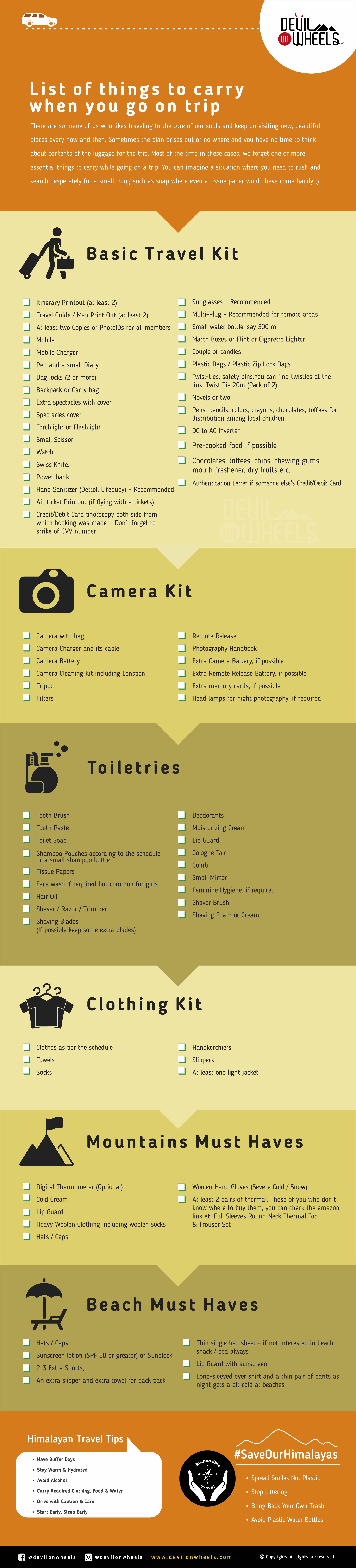
Download your FREE high-resolution PDF copy of this packing list infographic guide. If you liked it and found it helpful, please feel free to share it with your family and friends to help them too.
Electronics and Gadgets to Carry on a Trip
This is a section I added after years of realizing that electronics are often an afterthought. In the Himalayas, where electricity is unreliable and mobile networks are patchy, the right electronics can make a huge difference. Here is my electronics checklist for any trip.
- Power Bank (20,000 mAh or above for longer trips: phone cameras drain battery fast at altitude)
- Mobile Charger + Cable
- Universal Adapter / Multi-Plug
- DC to AC Inverter for car charging
- Laptop + Charger (if needed)
- Offline Maps downloaded: Google Maps offline or Maps.me. Very important when there is no mobile data in Lahaul, Zanskar, or deep Spiti.
- Backup SIM or WiFi device if traveling internationally
- Headphones / Earphones
- Satellite communicator (optional but recommended for solo trekkers): devices like SPOT or Garmin inReach allow SOS signals even with zero mobile coverage. In areas like Zanskar or Borasu Pass, this can be a life-saver.
- E-reader (Kindle): lighter than books for long trips
What to Carry for Responsible Himalayan Travel?
At DwD, we travel differently. The DoW Causes initiative has been going strong for years, and every time I go to the mountains, my bag includes a few extra things that have nothing to do with my personal comfort but everything to do with the communities we visit. If you are serious about responsible travel in the Himalayas, keep in mind that these items matter.
- Stationery for local school children: pens, pencils, crayons, notebooks, color books. School supplies are expensive and scarce in remote Himalayan villages.
- Over-the-counter medicines for local dispensaries: Paracetamol, bandages, antiseptic cream. Village dispensaries are often understocked.
- Reusable water bottle and cloth bag: plastic bottles are a major pollution problem in mountain areas. Say no to single-use plastic.
- Dry waste trash bags: carry your trash back to towns where disposal facilities exist
- Woolens or warm clothing to donate in high-altitude villages (especially in winter)
For other details about traveling with the DwD Community, finding travel partners, and discussions, please go through the DwD Community (also linked in the main menu of the website). 🙂
Conclusion
I feel a cross-check of luggage with this list before leaving would be helpful to many of us in reducing the chances of forgetting some small things while we go on a trip. This way, we can enjoy the trip without worrying over the availability of items in whatever town or trek we check in to. 🙂
This list may not be perfect for each one of us, but at least we can tweak it according to our picks and save it in our archives for future trip references. Feel free to keep adding your valuable thoughts and suggestions in the comments section below. This way, we may end up making it a completely comprehensive list for all of us and others seeking this kind of list.
If you know your friends or family are planning a trip, do share this article with them to help them make a memorable trip. And if you want to connect with fellow travelers from the DwD Community planning similar trips, check the DoW Travel Calendar from the link in the main menu of the website.
Disclaimer: Again to remind you that the medicines listed above are just my suggestion as they suit me and you shall always consult your doctor before taking any of the above medicine.
Related Reading
- 40 Must-Have Things to Carry on a Ladakh Self-Drive Trip
- 12 Must-Have Things to Carry on a Trekking/Hiking Trip
- The Ultimate Guide to Packing for Long-Distance Motorcycle Riding
- Become a Pro at Packing Your Backpack
- Tips for Carrying Clothes for Leh – Ladakh Trip
- Carrying a Laptop to Ladakh or High Altitudes
Frequently Asked Questions
What are the most important things to carry on a trip to the Himalayas?
The most important items for any Himalayan trip are: valid photo ID and permit documents, AMS medicines (Diamox and Paracetamol, after consulting a doctor), warm layers (thermals, woolen gloves, fleece jacket), sunscreen SPF 50+, lip balm, a high-capacity power bank, offline maps downloaded on your phone, ORS packets, and dry fruits for energy. Do not forget your vehicle documents if self-driving.
What medicines should I carry for a trip to Ladakh or Spiti Valley?
For Ladakh and Spiti, carry Diamox 250mg (for AMS prevention, consult your doctor first), Paracetamol for altitude headaches, ORS packets (at least 5), Avomine for motion sickness, Combiflam for pain, Metrogyl for stomach issues, Nasivion for dry/blocked nose, and standard antiseptics and bandages. Always consult your doctor before taking any of these, especially Diamox, as it does not suit everyone.
How many pairs of clothes should I carry for a 10-day Himalayan trip?
For a 10-day trip, 4-5 sets of clothes are enough. Most guesthouses and homestays in Ladakh and Spiti let you hand-wash clothes, and they dry quickly in the dry mountain air. Focus on base layers: at least 2 thermals, 3-4 regular T-shirts or shirts, and 2 pairs of trek pants or cargo pants. Carry one good down jacket and one rain jacket.
Do I need an Inner Line Permit and what documents should I carry for restricted areas?
As of 2026, Indian nationals do not need a stamped Inner Line Permit in Ladakh. You pay the Environment and Development Fee online (about Rs 590 for 7 days) at lahdclehpermit.in and carry the printed receipt for Pangong Tso, Nubra Valley, Tso Moriri and Hanle. For Lahaul and Spiti, register your vehicle on the free e-Aagman portal. Carry at least 2 photocopies of your Aadhaar card or other photo ID per person, and keep printed copies, as checkposts often do not have internet. Foreign nationals still need a Protected Area Permit.
What should I carry for responsible travel in the Himalayas?
The DwD Community recommends carrying stationery (pens, pencils, notebooks) for local school children, over-the-counter medicines for village dispensaries, a reusable water bottle to avoid single-use plastic, and dry waste bags to carry your trash back to towns. Small things like these make a real difference for the communities that host us in the mountains every season.
What should I NOT pack for a trip to the mountains?
Avoid overpacking clothes (you will wear the same 2-3 things anyway), heavy hardcover books (carry an e-reader instead), glass bottles (they break), single-use plastic water bottles, and anything that requires a constant power supply without a backup plan. In Spiti and Zanskar, electricity can be unreliable or absent for hours. Pack light, pack smart.
Is a power bank necessary for a Himalayan trip?
Yes, absolutely. Electricity is unreliable in many villages across Ladakh, Spiti, and Zanskar. Power outages are common, and charging facilities may only be available for 2-3 hours a day. Carry a power bank of at least 20,000 mAh. If you are on a trek lasting more than 3 days, consider a solar charger as backup.
What documents do I need for a self-drive trip to Ladakh?
For a self-drive trip to Ladakh, carry: valid Driving Licence, RC book (Registration Certificate) of the vehicle, Insurance papers (valid), Pollution Under Control (PUC) certificate, the printed Ladakh EDF receipt, the e-Aagman e-pass if you enter Lahaul-Spiti, and photocopies of all members’ Aadhaar cards. If you are renting a vehicle, the rental agency should provide the RC and a No Objection Certificate (NOC).
What should I pack differently for a hill station trip during an active monsoon or landslide advisory?
When IMD or the state administration has an active yellow or orange alert, add a full rain jacket, a waterproof bag liner, a printed alternate route, and one extra buffer day to your usual hill station list. As of 29 September 2026, IMD reports the monsoon withdrawing from Himachal Pradesh and Uttarakhand, so the heavy-rain risk is easing, but isolated showers are still forecast in Uttarakhand into early October. Do not rely only on a folding umbrella. Check the live road status for your specific route before you leave, since a single landslide can shut a hill road for 24 to 48 hours.

How do I check road status before a hill station trip in Himachal or Uttarakhand?
Check the state PWD or NH helpline, the BRO account for that specific highway, and a recently updated route guide like our NH-5 Shimla to Spiti road status a day or two before departure, not a week before. Hill roads in Himachal and Uttarakhand change status quickly during the monsoon months of July through September, and a route that was fine on Monday can be blocked by Wednesday.
What is the one item people most often forget for a hill station trip?
A printed or offline copy of an alternate route. Most travelers carry a phone with Google Maps, but mobile networks in hill areas drop during heavy rain, exactly when you need a detour around a landslide the most. Keep a physical map or a downloaded offline map (Maps.me or Google Maps offline) for at least one backup road, along with the basics: rain gear, a power bank, and ORS.
