


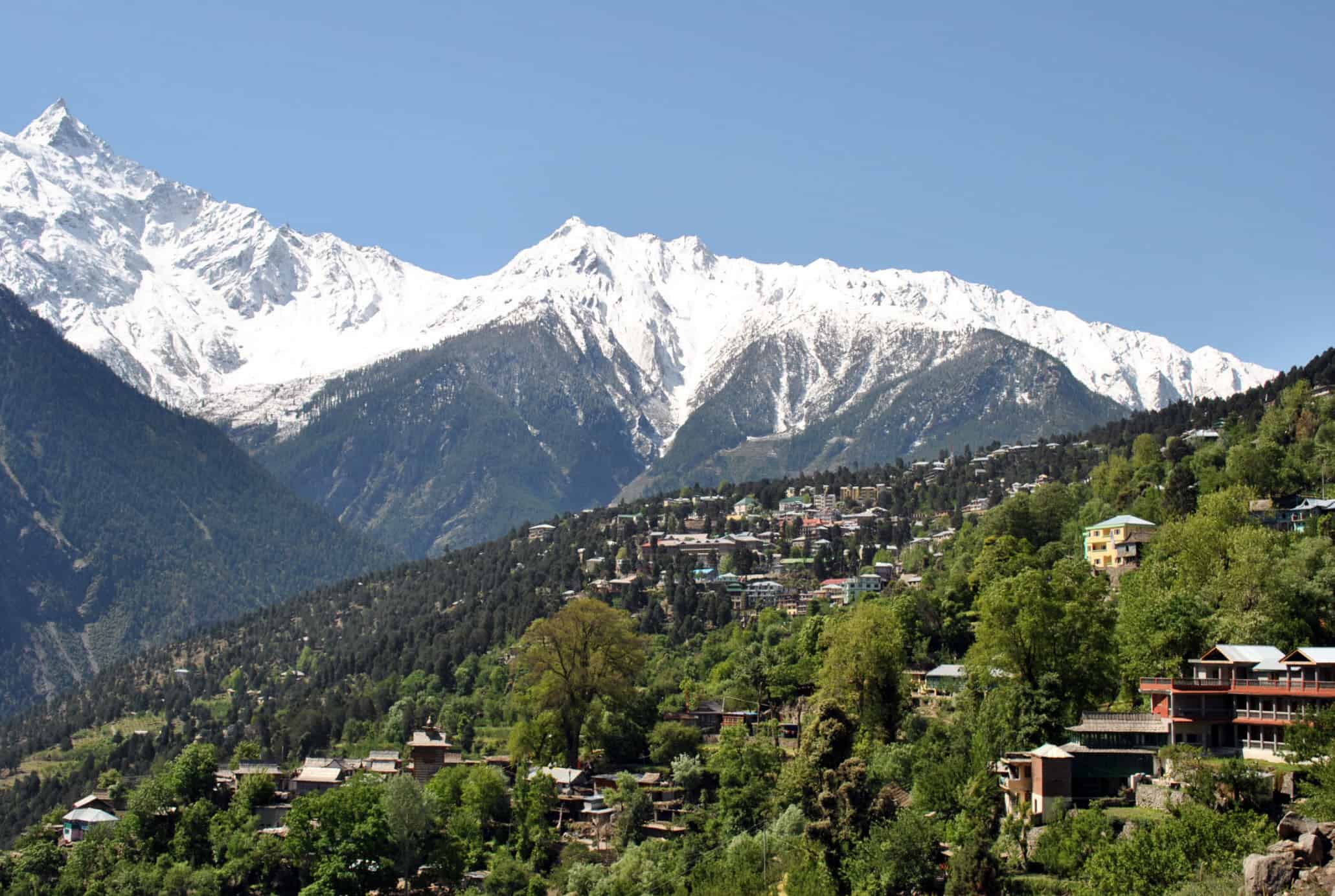
As soon as winter arrives, I am sure the thought of making a trip to Kinnaur in winters starts forming in the adventurous mind like yours 🙂 And I will say, why not? Kinnaur Valley is as beautiful in winters as in any other season. The snow-covered Kinner Kailash range, frozen roads, empty villages, and the raw silence of a Himalayan winter make it one of the most rewarding offseason trips you can plan from Delhi.
However, along with this excitement come real concerns. Will the roads be open? Will you find hotels? Is it safe to drive? These are valid questions when you are heading into a remote tribal belt of Himachal Pradesh during peak winter. I have driven through Kinnaur in winters myself, and in this guide, I will share a practical day-by-day itinerary along with everything you need to know before you go.
Last Updated: September 2026, ahead of the 2026-27 winter season.
Let's quickly dive into the details:
Quick Overview: Kinnaur Winter Trip at a Glance
Quick answer: A winter trip to Kinnaur Valley typically takes 7 to 8 days from Delhi. The best months are December and January for guaranteed snowfall, though November and February also work. Roads remain open to Reckong Peo and Kalpa most of the time, but Chitkul closes from December to mid-March. Budget around Rs 1,500 to 3,000 per day depending on your travel style. You will need warm layers rated for minus 5 to minus 15 degrees Celsius, and buffer days for potential road closures due to snowfall.
| Best Months | December, January, February |
| Duration | 7-8 days from Delhi (minimum 5 days) |
| Route | Delhi – Shimla/Narkanda – Sarahan – Kalpa – Sangla – Return |
| Road Status | Open to Reckong Peo/Kalpa. Chitkul closed Dec-March. |
| Temperature | -5°C to 5°C (can drop to -15°C at higher points) |
| Budget (per person/day) | Rs 1,500-3,000 depending on travel style |
| Key Highlight | Snow-covered Kinner Kailash views from Kalpa |
| Difficulty | Moderate. Icy roads, limited services, cold. |
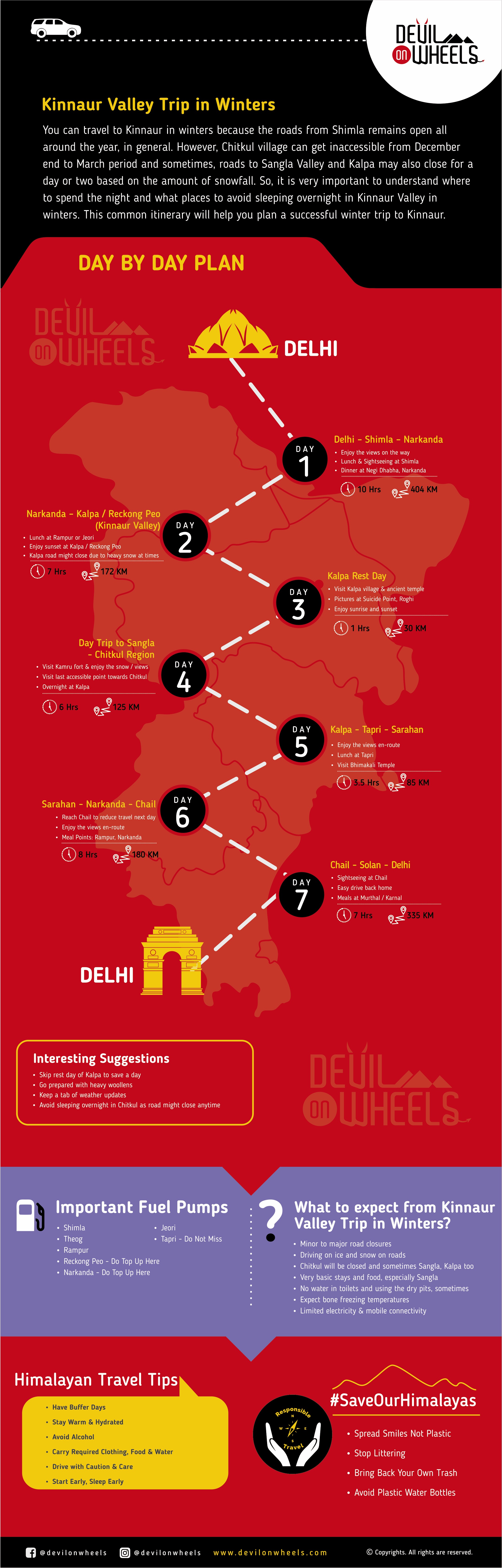
Download your FREE high-resolution PDF copy of this Kinnaur winter trip infographic guide. If you find it helpful, please feel free to share it with your family and friends.
How to Plan a Kinnaur Valley Winter Trip?
Quick answer: Base yourself at Kalpa or Reckong Peo, keep 1-2 buffer days, and treat Sangla and Chitkul as day trips rather than overnight halts during peak winter.
Planning a winter trip to Kinnaur requires a slightly different approach compared to a summer visit. In my previous article, trip to Kinnaur Valley in winters, important tips, I discussed what to expect and what not to expect. If you have already read it, you will have a fair idea of road conditions, road closures, open hotels, and places to visit in Kinnaur in winters.
In this article, I will share the most common itinerary for a Kinnaur winter trip. Unlike planning a trip to Spiti in winters, there are fewer variables here. The roads to Kinnaur from Shimla remain functional for most of winter. That said, you should keep your itinerary flexible because snowfall can close specific stretches for a few days at a time.
The key principle is simple. Do not plan overnight stays at places where road closures can trap you for days. Sangla Valley, for example, can get cut off after heavy snowfall. Kalpa and Reckong Peo are safer bets because BRO and PWD actively clear those roads.
Are the Roads Open in Kinnaur Valley in Winters?
Quick answer: Yes, NH-5 to Reckong Peo stays open all winter under BRO/PWD maintenance, though Karcham-Sangla and the Chitkul road can shut for days after heavy snowfall.
Most roads in Kinnaur Valley remain open throughout the year, with some important exceptions. The road from Shimla to Reckong Peo via NH-5 stays operational even in peak winter because BRO, GREF, and PWD teams actively clear snow on this stretch. However, you should expect delays of a few hours to a couple of days after heavy snowfall events.
Here is a breakdown of road accessibility during winter months:
- Shimla to Narkanda: Open year-round, but snow accumulation on the road is common from December to February. Drive carefully, especially early morning when ice forms.
- Narkanda to Rampur: Generally open. The descent from Narkanda reduces altitude and snow cover significantly.
- Rampur to Reckong Peo: Open year-round. This is the lifeline of Kinnaur and gets priority clearance.
- Reckong Peo to Kalpa (7 km): Open most of the time. May close for 1 to 2 days after heavy snowfall, but clears quickly.
- Karcham to Sangla/Rakcham (18 km): This stretch can close for several days after snowfall. Sangla Valley is more vulnerable to extended closures.
- Sangla to Chitkul (28 km): Closed from December to mid-March. Snow accumulation makes it impassable.
Keep in mind that the stretch around Narkanda can also see temporary closures during heavy snowfall. If you are on a tight schedule, Kalpa and Reckong Peo should be your primary base, not Sangla Valley.


One more thing worth knowing. There is a toll barrier at Chaura on NH-5 near Reckong Peo, run by the local SADA authority. As per District Kinnaur’s own 2025 notification, it applies only to Himachal-registered commercial vehicles, not private tourist cars or bikes. So your own self-drive car should not be charged here, though keep some cash handy just in case ground-level enforcement lags the official rule.
What Is the Best Itinerary for Kinnaur in Winters? (7-8 Days)
Quick answer: Delhi to Shimla/Narkanda, then Kalpa or Reckong Peo as your base, a day trip to Sangla, a night at Sarahan on the way back, and 1-2 buffer days for snowfall.
![How to safely carry luggage or extra fuel on Spiti or Ladakh Bike Ride? [10 Safety Tips]](https://discoverwithdheeraj.com/yt_vid_thumbs/ladakh/87.png)
This itinerary covers the most accessible and rewarding parts of Kinnaur Valley in winter. It spans 7 to 8 days from Delhi and includes buffer time for road closures. You can shorten it to 5 to 6 days if you skip Sarahan or the return via Chail.
Day 1: Delhi to Shimla or Narkanda
- Distance: approximately 350 km to Shimla, 410 km to Narkanda
- Drive time: 8 to 10 hours depending on traffic and weather
- Shimla sightseeing includes the Ridge, Mall Road, Lakkar Bazaar, and Jakhu Temple
- Narkanda is about 60 km from Shimla and takes roughly 2 hours beyond
- Expect snow on the road between Shimla and Narkanda from December onwards
- Overnight at Shimla or Narkanda, whichever suits your timing
Day 2: Shimla/Narkanda to Kalpa or Reckong Peo
- Distance: approximately 230 km from Shimla, 170 km from Narkanda
- Drive time: 8 to 9 hours from Shimla through the beautiful Hindustan-Tibet Highway
- Plan lunch at Rampur. There are a few decent dhabas here.
- The road to Kalpa might be temporarily closed due to snow, but the road to Reckong Peo stays open. If Kalpa road is blocked, stay at Reckong Peo or walk the 7 km uphill to Kalpa.
- Overnight at Kalpa or Reckong Peo
Pro Tip: If you are driving to Kinnaur Valley in winters, make sure to read the article 40 must-have things to carry on a self-drive trip to the Himalayas
Day 3: Rest Day at Kalpa
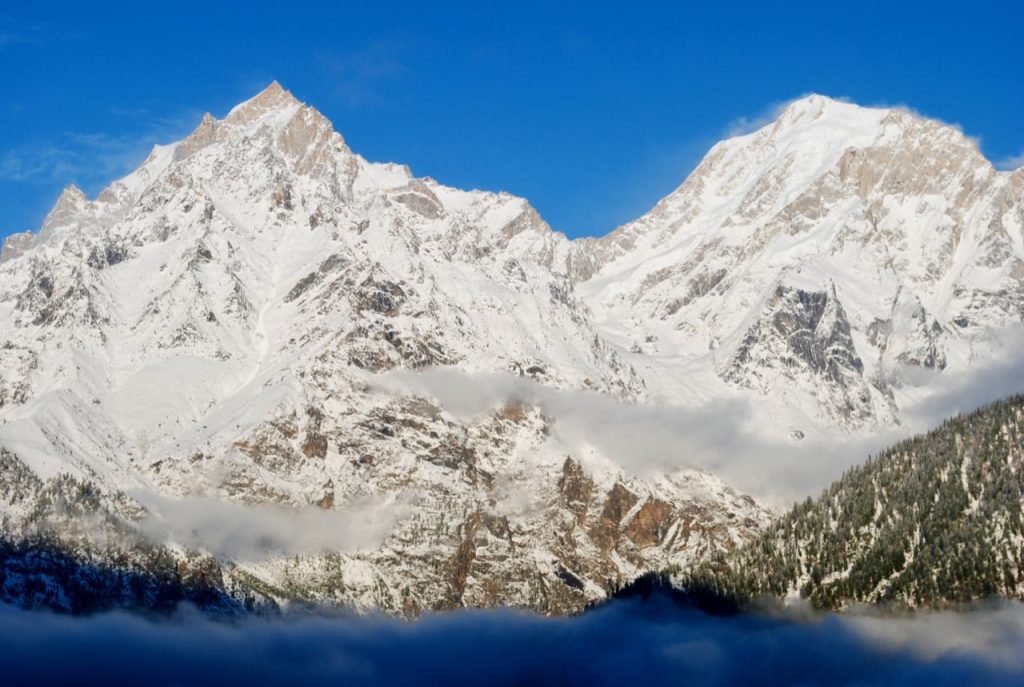
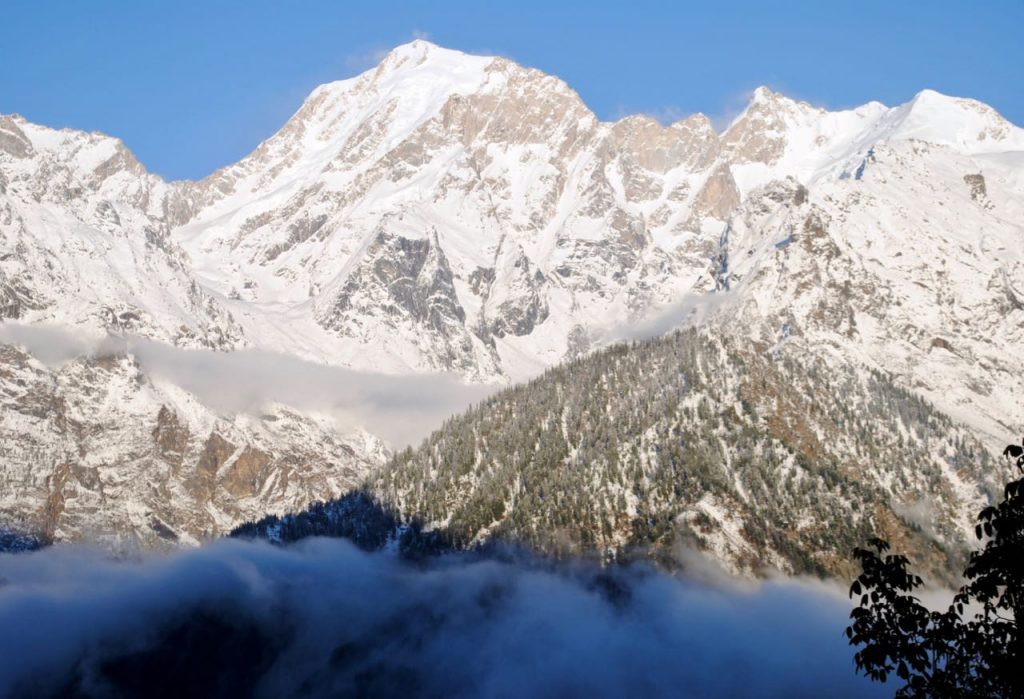
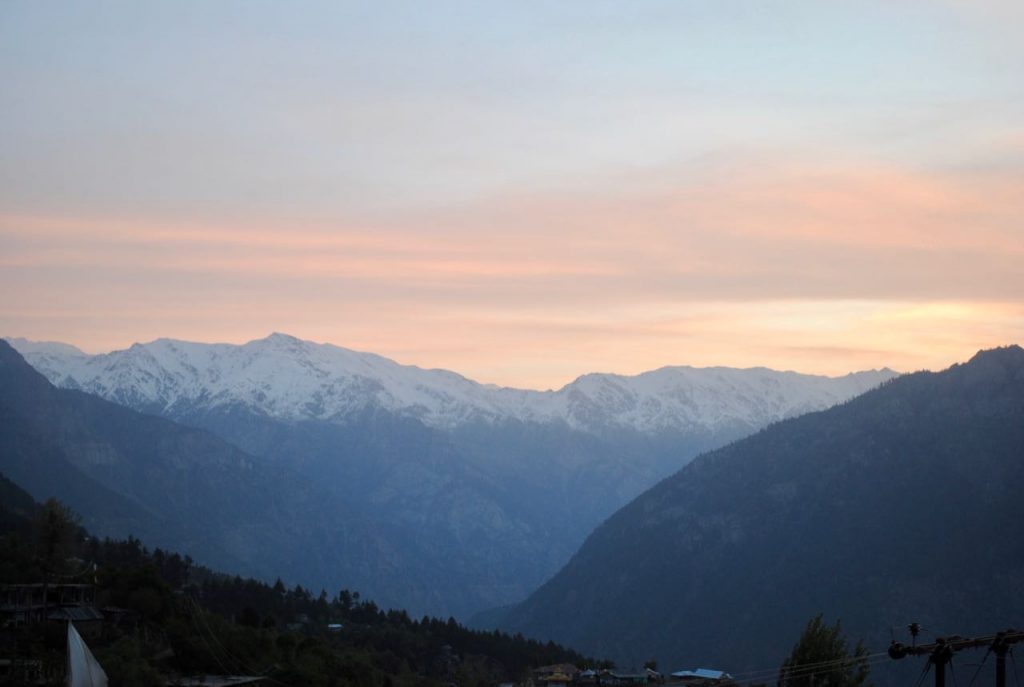
- Spend the day soaking in the views of Kinner Kailash. On a clear winter morning, the snow-covered peaks turn golden at sunrise.
- Visit the Chandika Devi Temple at Kothi Village, about 3 km from Reckong Peo
- Walk or hike to Roghi Village from Kalpa. The cliff road is stunning in winter.
- Visit the “suicide point” or straight drop point for photographs
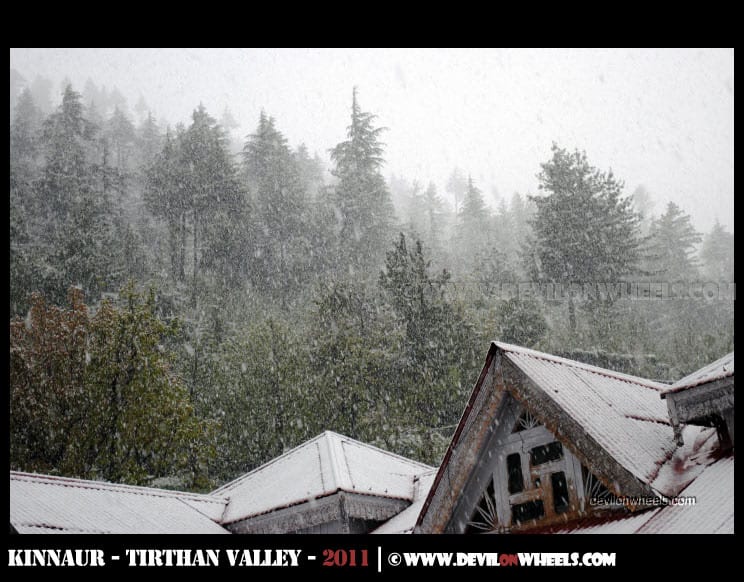
- If it snows while you are there, the experience multiplies tenfold
- Overnight at Kalpa
Day 4: Day Trip to Sangla Valley or Drive to Sarahan
- Leave for Sangla Valley (Baspa Valley) after breakfast
- Visit Kamru Fort and the trout hatchery area across the river in Sangla
- Drive time from Kalpa to Sangla: approximately 3 hours
- You have two options here. Option A: make a day trip to Sangla Valley and return to Kalpa or Reckong Peo for overnight. Option B: if you have fewer days, continue to Sarahan after visiting Sangla and stay overnight there.
- Important: Do not plan an overnight stay in Sangla Valley in winter. If heavy snowfall hits, the Karcham-Sangla road can close for several days, leaving you stranded.
- Overnight at Kalpa or Sarahan
Interesting Fact: Did you know there is a difference between NH-22 and Hindustan-Tibet Highway?
Day 5: Kalpa to Sarahan
- Drive time: approximately 4 to 5 hours
- Visit the Bhimakali Temple at Sarahan. It is one of the 51 Shaktipeethas and entry is free. The temple is open from 6 AM to 8 PM.
- Visit Annapurna Dhaba for a meal. Check reviews in the DwD Community.
- Sarahan sits at 7,589 feet and the snow views of the surrounding peaks from here are spectacular
- Overnight at Sarahan. HPTDC Srikhand is the most popular stay option.
Day 6: Sarahan to Narkanda to Chail or Delhi
- Leave early and enjoy the drive back through the valley
- Plan lunch at Narkanda. Negi Dhaba is a reliable option, check reviews in the DwD Community.
- Instead of staying at Narkanda or Shimla, consider taking the inner route from Kufri to Chail (if open). This route sometimes closes due to snow.
- Drive time: 6 to 14 hours depending on where you plan to stop
- Overnight at Chail or push through to Delhi
Day 7: Chail to Delhi
- If you have this extra day, relax in Chail during the morning
- Roam around and leave for Delhi by afternoon
- Drive time: approximately 8 hours to Delhi
- Overnight at Delhi
Day 8-9: Buffer Days
Keep 1 to 2 buffer days in case roads close due to snowfall or landslides. In my experience, at least one road closure of a few hours to a full day is quite common during a winter trip to Kinnaur. These buffer days can also be used if you want to spend an extra day enjoying the frozen beauty of Kalpa or exploring the valley at a slower pace 🙂
How Much Does a Kinnaur Winter Trip Cost?
Quick answer: A 7-day winter trip from Delhi costs roughly Rs 8,500-12,000 per person on a budget plan and Rs 17,000-28,000 on a mid-range plan, mainly because winter hotel rates drop and crowds thin out.
A winter trip to Kinnaur is more affordable than a summer trip because hotel rates drop significantly and tourist crowds thin out. Here is a rough budget breakdown for a 7-day trip from Delhi. For a detailed calculation, check the Kinnaur Valley trip budget guide.
| Expense | Budget (per person) | Mid-Range (per person) |
|---|---|---|
| Transport (self-drive fuel) | Rs 4,000-5,000 | Rs 4,000-5,000 |
| Transport (HRTC bus both ways) | Rs 1,500-2,000 | Rs 2,500-3,500 (Himmani Deluxe) |
| Accommodation (7 nights) | Rs 3,500-5,000 | Rs 7,000-14,000 |
| Food (7 days) | Rs 2,500-3,500 | Rs 4,000-6,000 |
| Miscellaneous | Rs 1,000-1,500 | Rs 2,000-3,000 |
| Total (7 days) | Rs 8,500-12,000 | Rs 17,000-28,000 |
Hotel rates in winter range from Rs 500 to 800 per night for basic homestays and guest houses, Rs 1,000 to 1,500 for decent hotels, and Rs 3,000 or more for comfortable options like HPTDC properties (as of the 2025-26 season, verify locally as rates are revised most years). Many hotels in Sangla Valley and Chitkul remain closed in winter, so your choices are limited. Kalpa and Reckong Peo have the most reliable winter accommodation.
Where Are the Petrol Pumps in Kinnaur Valley?
Fuel is not an issue on the Shimla to Reckong Peo route as there are multiple petrol pumps along the way. However, I recommend doing a top-up at Narkanda, Rampur, and Reckong Peo or Tapri to stay on the safer side. Here is the list of petrol pumps on this route:
- Theog
- Narkanda (do a top-up here)
- Rampur (after crossing the town, the last one on the right side is reliable)
- Jeori
- Tapri (reliable pump, good for a final top-up before Sangla diversion)
- Reckong Peo
In case you are heading into Sangla Valley or beyond Reckong Peo, fill your tank at Tapri or Reckong Peo. There are no fuel stations in Sangla Valley, Chitkul, or on the road towards Spiti from Kinnaur.
Can You Reach Kinnaur from Manali in Winters?
The short answer is no, not via the usual route. The road from Manali to Kaza to Kinnaur remains closed during winter months. Both Rohtang Pass and Kunzum Pass stay shut for about six months from November to May. Even though the Atal Tunnel bypasses Rohtang Pass, the road beyond Sissu towards Kunzum La and Kaza is still impassable in winter.
Similarly, the Jalori Pass route from Manali to Kinnaur gets heavy snowfall starting January and becomes unreliable.
However, there is an alternative. If you want to reach Kinnaur from Manali in winter, take the route via Manali to Mandi to Rohanda to Karsog to Rampur Bushahr. This route has no high passes and remains open year-round. It adds about 3 to 4 hours to the journey compared to the summer route, but it works.
Why Should You Visit Kinnaur Valley in Winter?
Quick answer: Fewer crowds, discounted hotels, snow-covered Kinner Kailash views, and a rare look at authentic Kinnauri village life.
I get this question a lot, and my answer is always the same. If you love the mountains and do not mind a bit of hardship, a winter trip to Kinnaur is absolutely worth it. Here is why:
- Almost zero crowds. The villages that are packed with tourists in summer feel completely different in winter. You get the mountains to yourself.
- Discounted hotels. Most hotels offer 30 to 50 percent discounts in winter because demand drops significantly.
- Snow-covered Kinner Kailash. The views from Kalpa of the snow-covered Kinner Kailash range are unmatched. Sunrise and sunset paint the peaks in shades of gold and pink.
- Snowfall experience. If you are lucky enough to catch a snowfall in Kalpa or along the highway, the entire landscape transforms into a winter wonderland.
- Authentic local life. With tourists gone, you see how locals actually live through winter. The apple orchards are bare, the slate-roofed houses are covered in snow, and the temples feel more serene.
Hence, a road trip to Kinnaur in winters will not disappoint you at all. Everyone should make this trip at least once in a lifetime.

What Should You Pack for a Kinnaur Winter Trip?
Quick answer: Thermals, a down jacket, waterproof outer layer, sturdy boots, and enough cash. That is the shortlist, temperatures can drop to minus 15 degrees Celsius at higher points.
Packing for a Kinnaur winter trip is critical because temperatures can drop to minus 15 degrees Celsius at higher points. Here are the essentials:
- Thermals: At least 2 sets of thermal innerwear (top and bottom)
- Down jacket: A good quality down or synthetic insulated jacket is non-negotiable
- Waterproof outer layer: Snow and sleet are common. A waterproof windbreaker keeps you dry.
- Warm accessories: Woolen cap, muffler, gloves (preferably waterproof), thick socks
- Sturdy footwear: Waterproof trekking boots with good grip. Sneakers will not work on icy roads.
- Sunglasses and sunscreen: Snow reflection causes snow blindness and sunburn even in winter
- Hot water flask: Carry a thermos. Hot water availability at dhabas can be unpredictable.
- Cash: ATMs in Kinnaur can be unreliable. Carry enough cash for the entire trip. The nearest reliable ATM is at Reckong Peo.
- Power bank and charger: Cold drains phone batteries fast. Keep your phone in an inner pocket close to your body.
How to Reach Kinnaur Valley in Winters by Bus?
If you are not driving, HRTC buses are your most reliable option for reaching Kinnaur in winter. The budget trip to Kinnaur by public transport is very much doable even in winter, though you need to plan around reduced schedules.
- Delhi to Shimla: HRTC Volvo buses run daily. Fare is approximately Rs 800 to 1,200 for ordinary and Rs 1,500 to 2,000 for Volvo/semi-deluxe.
- Shimla to Reckong Peo: Multiple HRTC buses daily (approximately 9 services including ordinary and Himmani Deluxe). Fare ranges from Rs 430 to 650. Journey takes 8 to 10 hours.
- Reckong Peo to Kalpa: Shared taxis or local buses available. The 7 km ride costs Rs 50 to 100.
- Reckong Peo to Sangla: 1 to 2 HRTC buses daily from Reckong Peo. Fare approximately Rs 80 to 120. In winter, service may be reduced or cancelled after snowfall.
Keep in mind that winter schedules may change without notice, and fares above are as of the 2025-26 season. Buses might get delayed or cancelled if roads are blocked. Always have a backup plan and extra cash for hiring a private taxi if needed. Verify current schedules and fares with HRTC before travel, as frequencies and rates are revised most winters.
What to Expect on a Kinnaur Winter Trip?
Quick answer: Icy roads at dawn, fewer open hotels, occasional frozen water pipes, patchy non-BSNL network beyond Reckong Peo, and far fewer fellow travelers than in summer.
A winter trip to Kinnaur is not your typical vacation. Here are the realities you should be prepared for:
- Icy roads: Black ice forms on roads overnight, especially between Shimla and Narkanda, and around Kalpa. Drive slowly, especially in the early morning hours.
- Limited hotel options: Many hotels close for winter, especially in Sangla Valley. In Kalpa and Reckong Peo, enough stay options remain open year-round.
- Frozen water pipes: At higher altitudes, water supply can freeze. Hotels may provide buckets of warm water instead of running water. Toilets at some locations switch to dry pits.
- Basic food options: Restaurant choices shrink in winter. Expect dal-rice, rajma-chawal, maggi, and eggs as the standard menu at most dhabas.
- Network coverage: BSNL postpaid has the widest coverage in Kinnaur. Jio and Airtel work in Reckong Peo and Kalpa but get patchy in Sangla Valley and beyond.
- Fewer fellow travelers: You might be the only tourist at some places. This is part of the charm, but also means less help available if you run into trouble.
You can also check this short video on the Discover With Dheeraj YouTube Channel about practical tips for making a winter trip to Kinnaur. If you like my videos, please do not forget to subscribe.
Is Chitkul Open in Winters?
No. Chitkul, the last inhabited village on the Indo-Tibet border, is not accessible in peak winter. The road from Sangla to Chitkul closes by December and reopens around mid-March, depending on snow clearance. The village itself sees very heavy snowfall, with temperatures dropping well below minus 10 degrees Celsius.
If you are visiting Kinnaur in late November or early March, there is a slim chance the road to Chitkul might be open. But do not plan your trip around it. Treat it as a bonus if it works out.
Related Reading
- Kinnaur Valley Complete Travel Guide (Kalpa, Sangla, Chitkul)
- Kinnaur Winter Trip, Most Important Tips
- Best Time to Visit Kinnaur Valley, Month by Month
- How to Calculate the Cost of a Kinnaur Trip
- Kinnaur Valley Summer Itinerary
- Hotels and Accommodation in Kinnaur Valley
Frequently Asked Questions
Is it safe to drive to Kinnaur in winters?
Yes, it is safe if you are an experienced mountain driver and take precautions. Carry snow chains for your tires, drive slowly on icy patches especially in the morning, and avoid driving after dark. The main highway to Reckong Peo is maintained by BRO and PWD, so it stays functional most of the time. Keep buffer days in your plan for unexpected road closures.
What is the best month to visit Kinnaur in winter?
January is the best month if you want guaranteed snowfall and a full winter experience. December works well too, with slightly milder temperatures. February sees heavier snowfall, which increases the risk of road closures but also offers the most dramatic snow-covered landscapes. For a month-by-month breakdown, check the detailed guide.
Can I visit Sangla Valley in winters?
Yes, you can visit Sangla Valley as a day trip from Kalpa or Reckong Peo when the Karcham-Sangla road is open. However, do not plan an overnight stay in Sangla in winters. The road to Sangla Valley can close for several days after heavy snowfall, and most hotels in the valley shut down for winter. Treat it as a day excursion from your base at Kalpa.
Do I need a permit for Kinnaur in winters?
Indian nationals do not need any permit for visiting Kinnaur Valley, including Kalpa, Sangla, and Chitkul (when accessible). The Inner Line Permit requirement starts beyond Jangi/Morang towards Spiti. Foreign nationals may need to check current regulations as rules change periodically.
Is there mobile network in Kinnaur in winters?
BSNL postpaid has the widest coverage across Kinnaur Valley. Jio and Airtel 4G work in Reckong Peo and Kalpa town but become unreliable in Sangla Valley and beyond. If you are relying on your phone for navigation or communication, get a BSNL postpaid SIM before the trip. Prepaid SIMs of other operators often do not work outside their home circle in these areas.
Can I do Kinnaur in winters with a family?
Yes, but with careful planning. The main concern is the cold, especially for elderly members or young children. Stick to Kalpa and Reckong Peo where better hotels with room heaters are available. Avoid Sangla Valley overnights and keep your itinerary relaxed with buffer days. The drive itself on the highway is not difficult, just slow due to potential ice or snow on the road.
What food is available in Kinnaur during winter?
In Reckong Peo and Kalpa, you will find restaurants and dhabas open year-round serving North Indian food, momos, thukpa, and basic meals. Options reduce in smaller villages. In Sangla Valley, only a handful of eateries stay open in winter. Carry ready-to-eat snacks, dry fruits, and instant noodles as backup. Most hotel kitchens in Kalpa will cook meals on request even outside regular dining hours.
Is there a toll on the way to Kinnaur in winters?
There is a toll barrier at Chaura on NH-5 near Reckong Peo, but as per District Kinnaur’s own 2025 notification it applies only to Himachal-registered commercial vehicles, not private cars or bikes. Self-drive tourists should not be charged here, though it is worth carrying some cash and confirming at the barrier since enforcement can lag official rules.

I hope this itinerary and guide helps you plan your upcoming trip to Kinnaur in winters. If you have any questions or need help with your planning, feel free to ask in the comments below or reach out to me on Instagram. You can also join the Discover With Dheeraj community to connect with fellow travelers who have done this trip recently and can share their current ground-level updates 🙂
Feel free to share this article with anyone planning a winter trip to Kinnaur. In the companion article, I have covered what to expect and tips for a Kinnaur winter trip in detail.

2 Comments
Comments section gets closed in 90 days. To ask your travel questions, you can follow my YouTube Channel for a faster reply or for a much slower reply follow me on Instagram. :)
stunning your all pictures and article too really nice informative post thanks for sharing n keep it up thanks a lot…!
Thank you so much lavit !!