


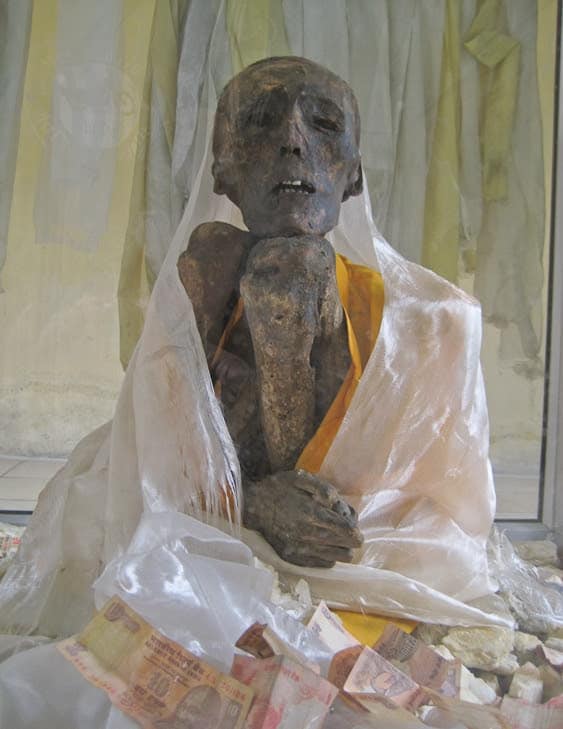
Gue Monastery (also spelled Giu) is a Spiti Valley shrine 8 km off NH05 near Sumdo, Himachal Pradesh, housing the naturally mummified body of 15th-century monk Sangha Tenzin. Unlike Tabo Monastery nearby, Gue is absent from the ASI’s official centrally-protected-monuments list for Lahaul-Spiti; the Himachal Pradesh government and local village society maintain it, charging Rs 30 entry.
Are you planning a trip to Spiti Valley and wondering whether Giu Monastery is worth the detour? I will tell you straight away: it is one of those places that will stay with you long after you have left Spiti. The 550-year-old mummy of monk Sangha Tenzin, sitting in a glass case with intact skin, hair, and teeth, is unlike anything you will see anywhere else in India. And yet, most travelers drive right past the turn-off without even knowing it is there. Keep that in mind when you are planning your Spiti itinerary.
Here is the fact that no one seems to mention in their guides: the hair, nails, and teeth of this mummy are still intact and reportedly show signs of continued growth, even after 550 years. No chemicals were used. No embalming. The mummification was entirely natural, driven by the monk’s own prolonged meditation practice and the extreme cold and dryness of high-altitude Spiti. When you stand before this glass case in a tiny village off NH05, that is what you are actually looking at. The science behind it is extraordinary, and the local folklore around it is equally compelling.
Giu (also spelled Gue or Ghuen) is a tiny village deep in the Spiti Valley of Himachal Pradesh, perched at an elevation of about 10,000 Ft. The village has roughly 50-60 households and sits between Sumdo and Tabo, just off NH05. Most travelers who plan a Spiti Valley trip from the Shimla-Kinnaur route pass through this corridor on their way to Tabo and Kaza. Giu is accessible with a short 8 km detour from NH05, yet it sees a fraction of the visitors that Tabo or Key Monastery get. That is a shame, because the story behind this place is genuinely extraordinary.
Last Updated: June 2026. This guide covers everything you need to know about visiting Giu Monastery: the history of the mummy, how to reach Giu from Nako and Tabo, best time to visit, entry fee, practical tips, and how to fit it into your Spiti Valley itinerary.
Let's quickly dive into the details:
Giu Monastery: Quick Practical Information
Before I get into the history and stories, here are the facts you need for planning your visit.
| Location | Giu Village, Lahaul and Spiti District, Himachal Pradesh |
| Altitude | ~10,000 Ft above sea level |
| Entry Fee | Rs 30 per person (collected by village society, as of 2026) |
| Visiting Hours | 6:00 AM to 6:00 PM (verify locally, as hours can change seasonally) |
| Open Season | April to December (road to Giu closes due to snowfall from January) |
| Best Months | May to October |
| Distance from Kaza | ~80 km via NH05 |
| Distance from Tabo | ~35-40 km (via the Giu detour from Sumdo) |
| Distance from Nako | ~11 km from Sumdo (via the Giu detour) |
| Photography | Allowed outside; NO flash near the mummy; no drones |
| Accommodation | None in Giu; stay in Tabo or Kaza |
| Public Transport | No direct buses; private vehicle or taxi only |
What is Giu Village and Why Should You Visit?
Giu (a.k.a. Gue, Ghuen) is a remote village in the Spiti Valley that has gained its fame almost entirely because of one thing: a naturally preserved mummy of a Buddhist monk that is over 550 years old. Outside of Tibet and Japan, naturally mummified monks are extraordinarily rare. India has only a handful. And among all of them, the Giu mummy is perhaps the best preserved and most accessible to visitors.
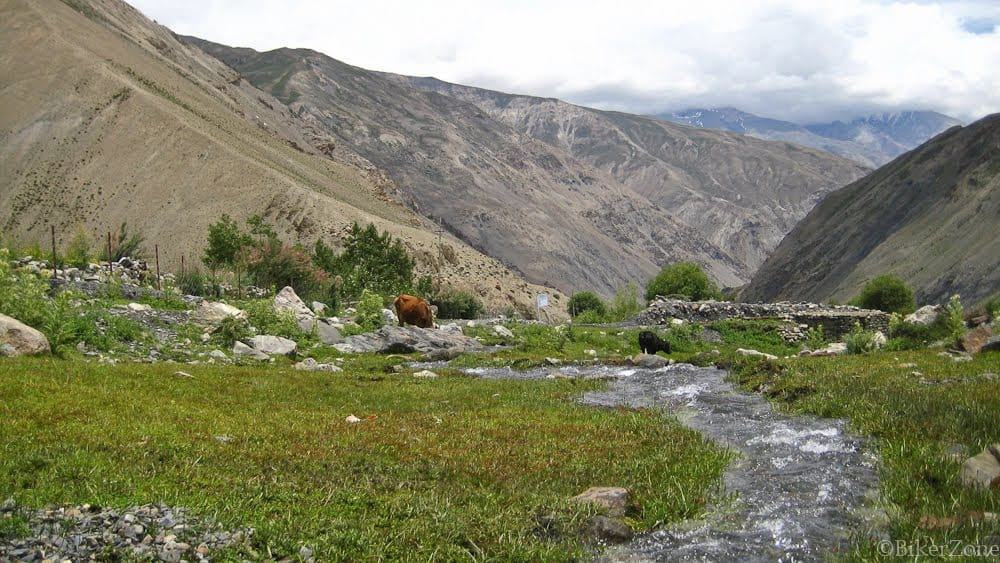
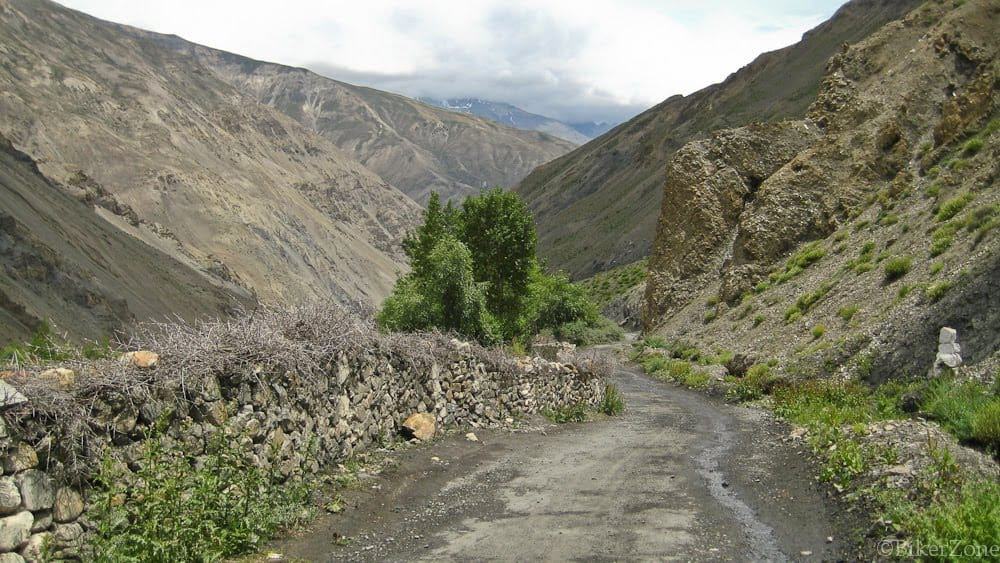
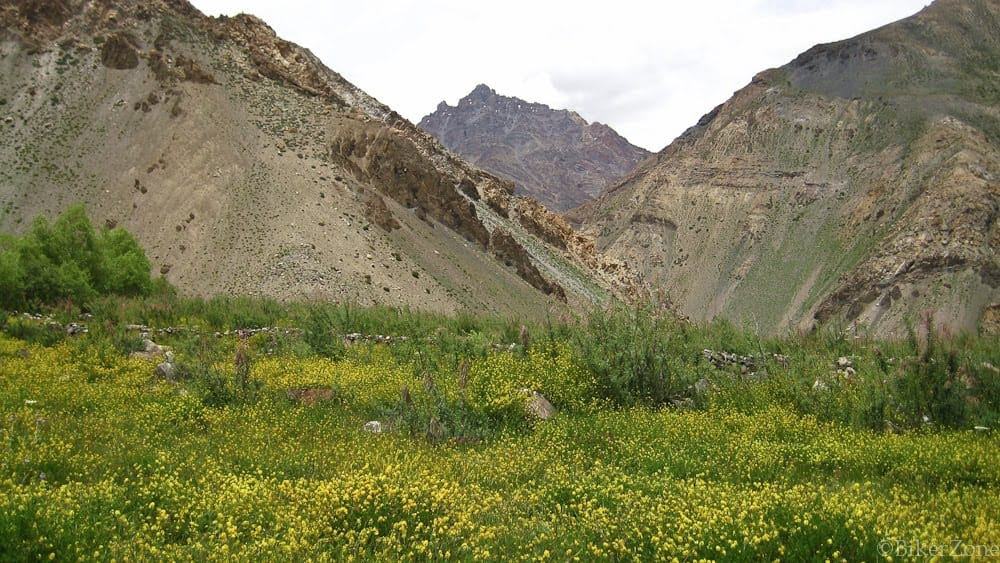
The village itself has stunning views, keeping well in line with what the Spiti Valley is known for. The landscape around Giu is classic high-altitude Spiti: brown mountain slopes, sparse vegetation, a narrow river gorge, and sky that feels impossibly blue. Even without the mummy, Giu would be a scenic stop. With it, the village becomes something truly memorable.
Giu sits on the trade route that once connected Spiti Valley with Tibet. That geographic position shaped the entire history of the village, and it is what eventually led to the monk Sangha Tenzin arriving here centuries ago. I will get to that story in a moment. First, let me tell you how to get there.
How to Reach Giu Monastery: Routes and Road Conditions
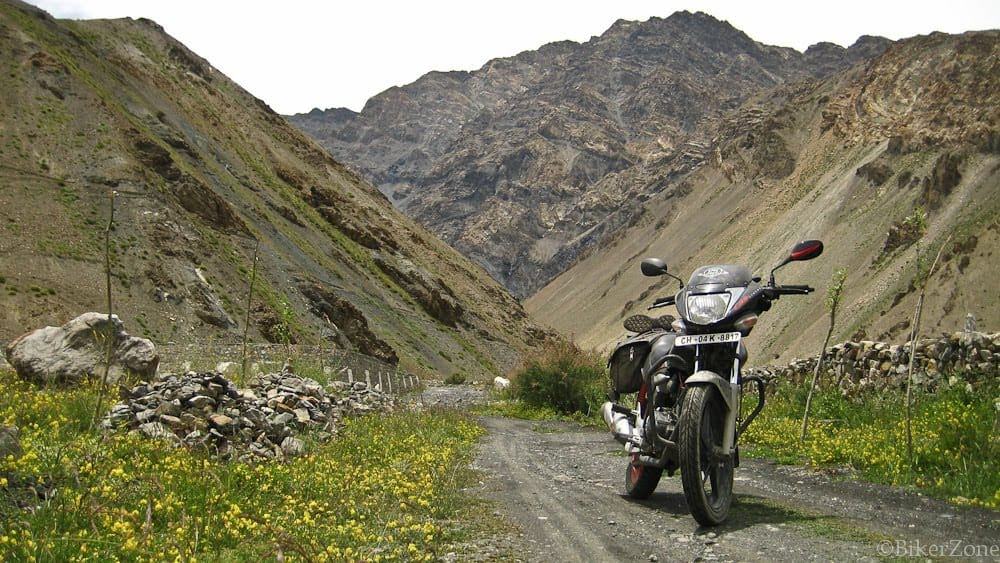
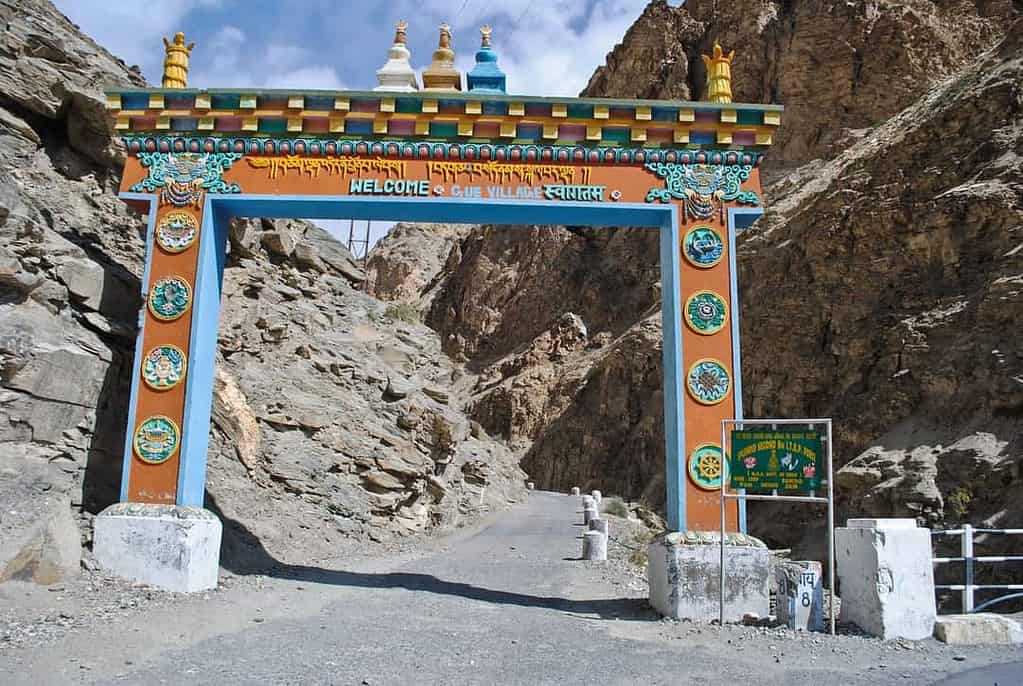
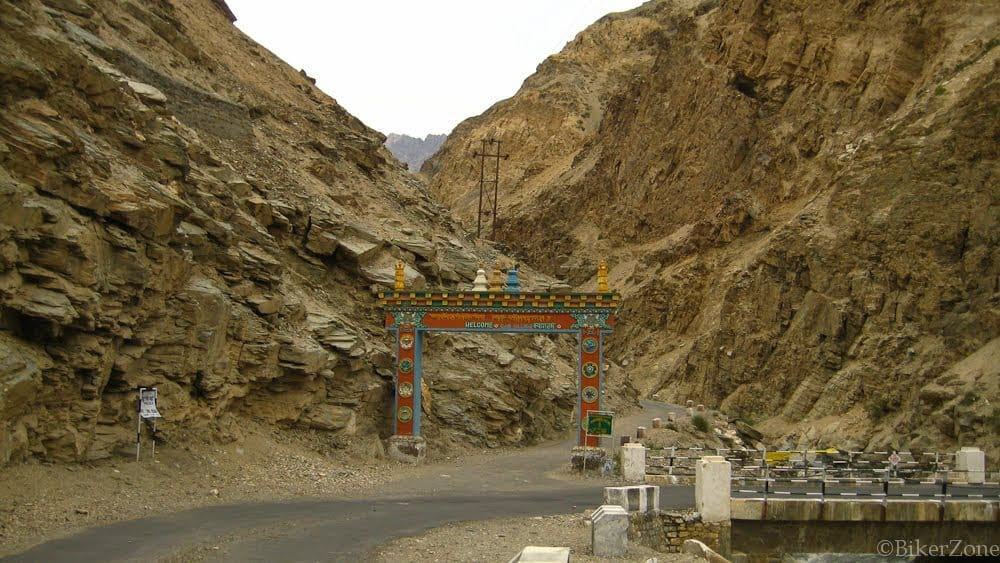
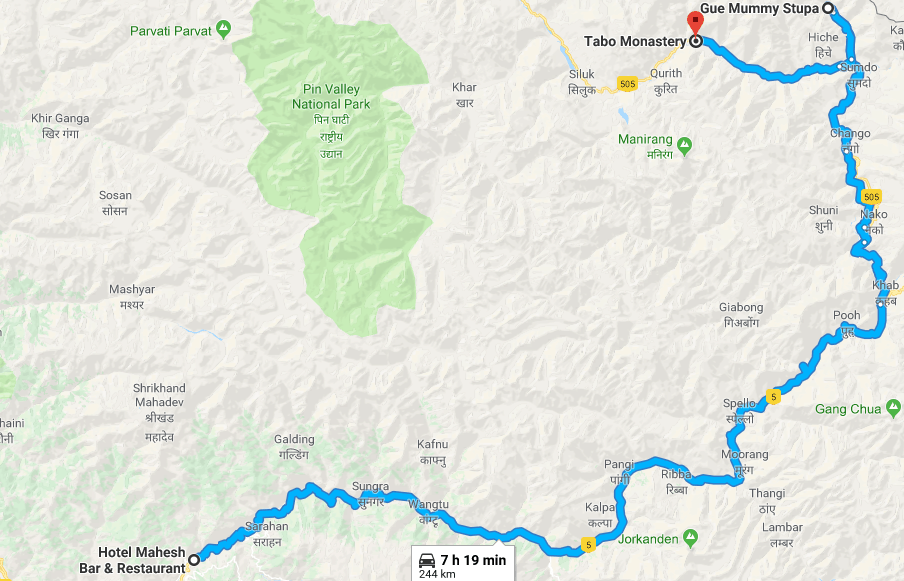
Giu is not difficult to reach, but you need to know exactly where to turn. There are no signboards screaming “MUMMY THIS WAY” on NH05. You have to know the landmark, and this is it: as soon as you enter Spiti Valley at the Sumdo check post (coming from the Shimla-Kinnaur side), drive about 3 km further toward Tabo. You will see a right turn at Giu Nallah, which leads into a gorge. From there, it is approximately 8 km on a narrow mountain road to reach Giu Village. The entire detour from NH05 to the mummy and back takes about 60-90 minutes.
If you are coming from the Kaza side, Giu is about 80 km from Kaza. You will pass through Tabo first (35-40 km from Giu), then continue to Sumdo, and take the left turn before entering Sumdo checkpost. There are no direct buses to Giu from either Kaza or Tabo. You will need a private vehicle or hire a local taxi.
How to Reach Giu from Delhi via the Shimla-Kinnaur Route
If you are starting from Delhi and approaching Spiti via the Shimla-Kinnaur highway, here is a typical 3-day drive to reach Giu. This is the most common route for travelers entering Spiti from the east.
- Day 1: Delhi to Narkanda (about 290 km, 6-7 hours)
- Day 2: Narkanda to Reckong Peo or Kalpa or Sangla (about 170 km, 5-6 hours)
- Day 3: Reckong Peo/Kalpa to Nako Lake to Sumdo to Giu Mummy Monastery to Tabo
On Day 3, do make sure you stop at Nako Lake in Kinnaur on the way. It is a beautiful high-altitude lake sitting just off the highway, and it costs you less than 30 minutes. After Nako, continue to Sumdo, take the right turn to Giu, visit the mummy, then drive on to Tabo for the night. That is a full day, but it fits together beautifully.
How to Reach Giu from Manali via Kaza
If you are approaching Spiti from Manali via the Rohtang-Kunzum route, Giu will be toward the end of your Spiti journey rather than the beginning. From Kaza, drive toward Tabo (about 50 km), then continue to Sumdo and take the detour to Giu. Alternatively, some travelers combine Giu with a one-night stay at Tabo, spending the morning exploring Tabo Monastery and the afternoon visiting Giu, before driving on to Nako and eventually Kinnaur.
When is the Best Time to Visit Giu Monastery?
The diversion road from NH05 to Giu Village is open from April to December. Starting from January, the road closes due to snowfall and does not reopen until April. Hence, if you are planning a winter Spiti trip, keep in mind that Giu itself may not be accessible even though the main highway (NH05) between Shimla and Kaza remains open all year.
For the best experience, I would suggest visiting between May and October. This is the main travel season for Spiti Valley, when the weather is pleasant, the roads are in their best condition, and the views are most vivid. September and October are particularly good months for Giu. The vegetation has turned golden and the crowds in the main Spiti circuit are thinner. May to mid-July works well too, before the rains hit the lower hills of Kinnaur and make some sections of NH05 tricky.
Is the Giu Mummy Real? What You Will Actually See
This is the question that most first-time visitors carry in their heads as they drive down the gorge toward Giu Village. Is it real? The short answer is yes, and there is scientific evidence to confirm it. A research team conducted carbon dating on the body and established that the mummy dates to approximately 1475, making it over 550 years old. The team also confirmed the individual was in his mid-forties when he died. Most importantly, no traces of any artificial embalming chemicals or external preserving agents were found in the body. The mummification was entirely natural.
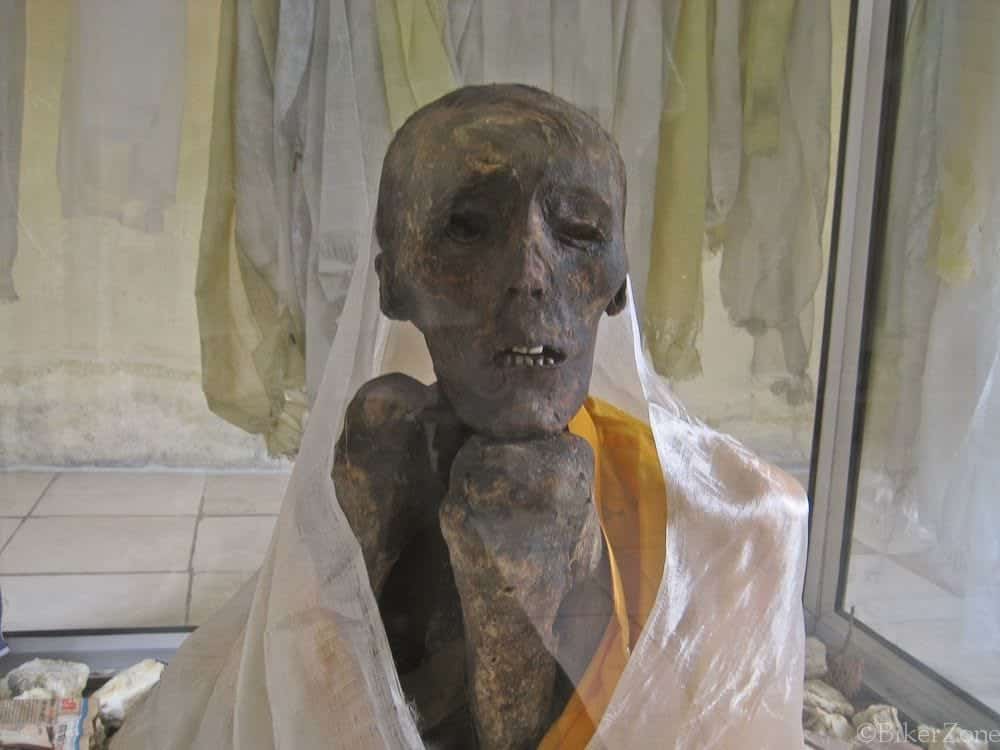
The first thing that strikes you when you see the Giu Mummy is how small it is. The body has shrunk considerably over five centuries, and what you see is a tiny, hunched figure that looks almost deflated. The skin has turned a deep chocolate brown and appears desiccated over many life cycles. Yet the detail that is preserved is remarkable: the skin is largely intact, the teeth are visible through the slightly parted lips, the hair is still present, and the nails reportedly continue to show signs of growth. That last part is what stops most visitors in their tracks.


The mummy sits in a traditional Dhyan Mudra position, with one hand placed in the lap and the other below the chin. This is a meditation posture, consistent with the story of how Sangha Tenzin is believed to have died. A belt called a Gomthak (used by monks during long meditation sessions to support the spine) is still tied around the body from neck to lower back. The mummy is dressed in traditional yellow and white monk robes and housed inside a glass case to protect it from the elements and visitors’ hands.
The glass casing also means you cannot get very close, but the view through the glass is clear enough to take in all the detail. Flash photography is strictly prohibited near the mummy, as the light damages the preserved tissue. Outside the monastery, feel free to take all the photographs you want. Drones are not allowed in this area due to the sensitive border location near Tibet.
Travel Tip: If you are driving yourself to Giu Village or anywhere in Spiti Valley, do not forget to check the 40 must-have things to carry on a self-drive trip to the remote Himalayas.

The Story of Sangha Tenzin: Who Was the Giu Mummy?
If you believe the local folklore (and in this case, there is some science to back it up), around half a millennium ago, a Tibetan Buddhist lama named Sangha Tenzin arrived in Giu Village. A monk from the Gelugpa order, he was believed to be in his mid-forties when he chose to enter deep meditation and voluntarily mummify himself. The villagers fondly call him the Mummy Lama.
The story goes like this: the village of Giu was being plagued by a devastating infestation of scorpions. The scorpions were harming the villagers and their livelihoods. Sangha Tenzin, deeply connected to the community, decided to sacrifice himself through meditation for the well-being of the village. He sat down in the lotus position, asked his disciples to seal him in a tomb, and prayed. As his soul left his body, villagers report that a rainbow appeared across the sky. Since that day, no scorpion has been seen in Giu Village. I cannot explain this, and I will not try. But the villagers believe it with absolute certainty, and their faith is its own story.
The tomb remained undiscovered for centuries. Then, in 1975, an earthquake struck the region and destroyed the structure containing the body. It was during road construction and excavation work by the Indo-Tibetan Border Police (ITBP) that the mummy was discovered by chance. The ITBP team found the body sitting exactly as it had been sealed, in the meditation position, with rosary beads in one hand and the Gomthak belt still tied around the spine.
Since the discovery, the Himachal Pradesh Government has taken responsibility for the maintenance and security of the shrine. The mummy is housed in a specially constructed monastery building, and the glass case helps control the environment around it.
Travel Tip: You should not miss the chance to stop over at Nako Lake on your trip to Spiti Valley or Giu Village. It is only a short detour and one of the prettiest lakes in the Kinnaur-Spiti region.
What Does Science Say? Carbon Dating and the Self-Mummification Process
If you are not someone who takes folk stories at face value, there is scientific data to work with here as well. A team of researchers from Vienna conducted carbon dating on the Giu mummy and established that the body dates back to approximately 1475. This makes the mummy over 550 years old. The team also determined that the individual was in his mid-forties when he died, which is consistent with the local lore about Sangha Tenzin’s age.
Most significantly, the scientific analysis found no traces of chemicals, artificial embalming liquids, or any external preserving agents in the body. The mummification was entirely natural. This is a remarkable finding and it points to a practice called Sokushinbutsu, a form of self-mummification practiced by certain Buddhist monks in Japan and Tibet. The monk would enter a prolonged meditation, surviving on a highly restricted diet of bark, nuts, and seeds, gradually depleting the body of all fats, fluids, and bacteria that would normally cause decay after death. The process could take years before the monk’s soul finally departed.
In the case of Sangha Tenzin, the extremely cold and dry climate of high-altitude Spiti Valley would have further aided the preservation process. The surrounding ice in the sealed tomb would have helped desiccate the body and slow down any remaining biological processes. The combination of the monk’s self-preparation and the natural environment of Spiti created the extraordinary preservation we see today, including the continued presence of intact hair, teeth, and skin.
Another clue to the mummy’s history is the Gomthak belt tied around the spine. This is a meditation support belt used by monks during long, intensive meditation sessions to prevent the spine from collapsing as the body weakens. Its presence confirms that the monk was in a state of deep meditation when he died.
Travel Tip: You should plan to stay and visit Lhalung Village on your trip to Spiti Valley or Giu Mummy monastery. Lhalung is a beautiful and rarely visited village with its own ancient monastery.
What Giu Village Means to Its People
The villagers of Giu believe that the Mummy Lama has looked after their community for centuries. Every hardship the valley has faced, from the scorpion plague to the earthquakes to the loss of the old trade routes, is believed to have been softened by the grace of Sangha Tenzin. This is not just superstition. The faith is woven into the daily life of the village in a way that is genuinely moving to witness.
Older villagers will tell you how Giu was once a prosperous place, strategically located on the ancient Indo-Tibet trading route that connected Spiti with Tibet. Goods, salt, wool, and livestock moved through here. When the political situation between India and China changed after 1962 and the trade route closed, the village lost its economic purpose. Many young people moved away. The Monk, some say, is the reason people still live here. His presence draws visitors and provides a livelihood through tourism.
The mummy is also believed to have protective powers over the village. Any natural disaster, any crop failure, any family crisis, is believed to pass only due to the grace of the Mummy Lama. When you visit Giu and see the quiet devotion of the few remaining villagers, this belief makes complete sense. They are not putting on a show for tourists. This is how they live.
Travel Tip: If you are planning your trip to Spiti Valley or Giu Mummy monastery, you should check out the beautiful high-altitude village of Demul in Spiti. It is one of the highest permanently inhabited villages in Asia and a worthwhile stop if you are exploring beyond the main circuit.
Tibetan Mummification vs Egyptian Mummification: What is the Difference?
Most of us grew up learning about Egyptian mummies: bandaged bodies, elaborate embalming processes, canopic jars. The contrast with what you see in Giu is quite striking. The Giu mummy has no bandages, no artificial preservation, no external intervention of any kind. What you are looking at is a body that has been preserved entirely by the monk’s own spiritual practice and the natural environment around him.
The key difference is intentionality. Egyptian mummification was done to the body after death, by embalmers using natron salts, resins, and other chemicals. Tibetan self-mummification was done by the monk himself, before death, as a spiritual practice. The monk chose this end deliberately. The process is called Sokushinbutsu in Japanese Buddhist tradition and has a parallel in certain Tibetan Buddhist schools. It is considered an act of immense spiritual merit, with the monk sacrificing his physical comfort and ultimately his life for the benefit of his community and future generations.
Tibetan mummification is also much rarer than the Egyptian kind. While Egypt produced thousands of mummies, naturally preserved Buddhist monks are counted in the dozens worldwide. Most of the known Tibetan Buddhist mummies were in Tibet itself, but a significant number were destroyed during the Cultural Revolution of the 1960s when Chinese authorities ordered monasteries to demolish their religious artifacts. The surviving mummies in India, in Ladakh, Spiti, and a few other locations, exist partly because the monasteries here were beyond the reach of that cultural purge.
Travel Tip: Another interesting place that you should check out on your trip to Spiti Valley is the high village of Komic. At 15,000+ Ft, it is one of the highest motorable villages in the world and home to the highest monastery that you can drive to.
Other Buddhist Mummies in India: How Many Are There?
The Giu mummy is the most accessible Buddhist mummy in India, but it is not the only one. A total of 8 mummies are present in various monasteries of Ladakh and Spiti, with one each in Kalimpong and Dehradun. There is also the famous body of Kyabje Yongdzin Ling Rinpoche, tutor of the current Dalai Lama, who passed away over two decades ago and whose body is preserved in McLeodganj.
However, most of these are not publicly accessible. The monks in those monasteries are preserved in ways that make public viewing difficult or inappropriate. Giu is special precisely because the Himachal Pradesh Government has made it accessible, with the protective glass casing, the new monastery building, and a basic infrastructure for visitors. This is one of the few places in India where you can actually stand before a naturally mummified Buddhist monk and reflect on what you are seeing.

Do You Need a Permit to Visit Giu in 2026?
Giu Village is located in the Lahaul and Spiti District of Himachal Pradesh, close to the India-China border. Indian nationals do not require any special inner line permit to visit Giu as of 2026. However, foreign nationals and OCI cardholders need to check current permit requirements, as rules for border belt areas can change. The Protected Area Permit (PAP) rules for the Kinnaur-Spiti belt apply to foreign nationals traveling beyond certain checkpoints. Verify this with the District Commissioner office in Reckong Peo or Kaza before your trip.
For Indian nationals, the standard procedure is to register at the Sumdo check post as you enter Spiti Valley from the Shimla-Kinnaur side. The entry fee at the Giu monastery itself is Rs 30 per person, collected by the local village society for the development of the monastery and the community.
Where to Stay Near Giu: Tabo, Nako, and Kaza Options
There are no hotels or guesthouses in Giu Village itself. The village is tiny and does not have the infrastructure to host overnight travelers. Plan to visit Giu as a day trip or a stop on your way between Nako and Tabo.
The closest town with accommodation is Tabo, about 35-40 km from Giu on NH05. Tabo has a decent range of options for a place this remote. The Tabo Monastery Guesthouse is a well-known budget option, and there are several private guesthouses and homestays in the village. Homestays in Spiti Valley are generally very well run by local families and give you a much richer experience than a standard hotel room.
If you prefer more options, Kaza is the main town in Spiti at about 80 km from Giu, and it has everything from budget guesthouses to mid-range hotels. Sakya Abode in Kaza is a reliable and well-reviewed option. Nako (in Kinnaur, before Sumdo) also has a few guesthouses if you are approaching from the Shimla side and want to break the journey there before heading to Giu the next morning.
How to Include Giu in Your Spiti Valley Itinerary
Giu fits very naturally into the standard Spiti Valley itinerary if you are traveling on the Shimla-Kinnaur route. It is a stop that costs you about 60-90 minutes and rewards you with something completely unique. Here is how I would suggest fitting it in:
Option 1 (Shimla-Kinnaur entry): On the day you drive from Nako or Reckong Peo toward Tabo, stop at Giu on the way. The sequence works perfectly: Nako Lake in the morning, then drive to Sumdo, turn off for Giu, spend an hour at the monastery, then continue to Tabo for the night. This is Day 3 or Day 4 of most standard Spiti itineraries coming from Delhi.
Option 2 (Kaza-Manali exit): If you are finishing your Spiti trip and exiting via Kinnaur toward Shimla, stop at Giu after leaving Tabo. You can visit in the afternoon and then continue to Nako for the night, or push on to Reckong Peo.
Option 3 (Kaza base with day trips): If you are staying in Kaza for multiple days and doing day trips to places like Hikkim Village, Komic, and Kibber, you can also add a full-day trip to Tabo + Giu. It is a long day (about 160 km round trip from Kaza), but very rewarding.
In case you want to explore more of the Spiti Valley sightseeing circuit around Kaza, I have written about the Langza, Komic, and Hikkim local sightseeing route from Kaza in detail. Keep in mind that Spiti roads require patience. Distances that look short on a map can take two or three times longer than you expect.
Practical Tips for Visiting Giu Monastery in 2026
Here are a few things that will make your visit smoother:
- Visiting hours: The monastery is open from 6:00 AM to 6:00 PM. Verify locally before your visit, as hours can shift with the season or during monastery festivals.
- Carry cash: The entry fee is Rs 30 per person. There are no ATMs in Giu. The nearest ATM is in Tabo or Nako, so draw cash before you leave the main highway.
- Fuel: The last petrol pump before entering deep Spiti from the Kinnaur side is typically in Pooh or Nako. If you are driving yourself, fill up before heading to Giu.
- No flash photography near the mummy: This is enforced. The village guide (if present) will remind you, but it is better to know in advance.
- No drones: The border proximity means drone flying is prohibited in this area.
- Carry water and snacks: Giu has no restaurants or shops. The nearest tea shop is in Tabo.
- Mobile connectivity: Network coverage in Giu is poor to non-existent. BSNL has the widest coverage in Spiti, but even BSNL may not work inside the gorge. For mobile connectivity in Spiti Valley, BSNL is your best bet overall.
- Altitude awareness: Giu sits at about 10,000 Ft. If you have just entered Spiti from the plains, take it easy. Most travelers are acclimatizing during their first few days in Spiti, so do not rush around. The drive itself gives you adequate acclimatization if you have spent a night in Nako or Reckong Peo first.
- Vehicle type: The 8 km road from NH05 to Giu is a narrow mountain track, but it is passable by sedans and hatchbacks. An SUV is more comfortable on rough patches, but you do not need a 4×4 specifically for Giu.
- Respectful conduct: This is an active place of worship for a small, tight-knit community. Keep noise levels low, dress modestly, and follow the guide’s instructions inside the monastery.
Is Giu Monastery Worth Visiting?
Yes, without question. In my years of exploring the Spiti Valley and writing about its lesser-known corners, Giu is one of those places that consistently surprises travelers who make the detour. It is not a dramatic, high-altitude adventure. It is a quiet, humbling experience. You drive down a narrow gorge, park in a tiny village, walk into a small monastery, and stand before a 550-year-old monk who is sitting in the same meditation posture he chose for his final moments half a millennium ago, with his hair and teeth still intact after all that time.
Buddhism is a profound religion with layers of tradition that most of us in the Indian mainstream have only a surface-level understanding of. Giu is one of those rare places where you catch a glimpse of something genuinely extraordinary: a practice of sacrifice and devotion that the Western world has no real equivalent for. The hills of Spiti hold many such secrets, and these are the stories that small villages like Giu are waiting to tell.
The existence of the mummy, supplemented by the unwavering faith of the villagers in its powers, is a sight in itself. That a community this small, this remote, this stripped of modern convenience, can live with such a fierce and joyful faith. That, in itself, is worth the detour 🙂 …
If you have questions about including Giu in your Spiti itinerary, or if you want help planning your overall Spiti route, feel free to drop your questions in the comments section below. I will be happy to hear from you. And if you know someone who is planning a Spiti trip and has never heard of Giu, do share this article with them. This is exactly the kind of place that should be on every Spiti traveler’s list.
Have a travel question?? You can subscribe to my YouTube channel and leave a comment to ask your travel questions about traveling to the Himalayas.
Frequently Asked Questions About Giu Monastery
Where is Giu Monastery located?
Giu Monastery is located in Giu Village (also spelled Gue or Ghuen) in the Lahaul and Spiti District of Himachal Pradesh, India. The village is about 3 km from the Sumdo checkpost on NH05, accessible via an 8 km detour road. It sits at an altitude of approximately 10,000 Ft above sea level, between the towns of Nako and Tabo.
What is the entry fee for Giu Monastery?
As of 2026, the village society collects an entry fee of Rs 30 per person to visit the Giu mummy inside the monastery. This amount goes toward the maintenance and development of the monastery and the local community. There is no additional charge for Indian nationals to enter the village itself.
How do you reach Giu from Kaza and Tabo?
From Kaza, Giu is about 80 km on NH05, passing through Tabo (35-40 km from Giu). From Tabo, continue west toward Sumdo. Just before or at the Sumdo checkpost, take the right turn toward Giu Nallah, which leads 8 km into the gorge to Giu Village. There are no direct buses to Giu. You need a private vehicle or a local taxi hired from Tabo or Kaza.
Do Indian nationals need a permit to visit Giu?
As of 2026, Indian nationals do not require a special inner line permit to visit Giu Village. You will need to register at the Sumdo checkpost when entering Spiti Valley from the Kinnaur side, which is standard for all travelers. Foreign nationals and OCI cardholders should verify current Protected Area Permit requirements with the DC office in Reckong Peo or Kaza, as border belt rules can change.
Is Gue Monastery protected by the Archaeological Survey of India (ASI)?
No. Unlike the nearby Tabo Buddhist Monastery, Phoo Gumpha, and the Mirkula Devi Temple in Udaipur (Lahaul), Gue Monastery does not appear on the ASI’s official list of centrally protected monuments for the Lahaul and Spiti district. It is instead maintained by the Himachal Pradesh state government together with the local village society, the same body that collects the Rs 30 entry fee.
Who is the mummy in Giu Monastery?
The mummy is believed to be of Sangha Tenzin, a Buddhist monk from the Gelugpa order of Tibetan Buddhism. Carbon dating by a Viennese research team established that the body dates to approximately 1475, making it over 550 years old. The monk is believed to have voluntarily mummified himself through a prolonged meditation practice (Sokushinbutsu), with no artificial embalming or chemical preservation involved. He was around 45 years of age when he died.
When is the best time to visit Giu Monastery?
The best time to visit Giu is between May and October. The road from NH05 to Giu is open from April to December and closes in winter due to snowfall, typically from January to March. September and October are particularly good months, with cooler weather, lighter crowds, and the mountain colors at their most vivid. May to mid-July is also excellent, before rains affect the lower sections of the Shimla-Kinnaur highway.
Is the Giu mummy real or fake?
The Giu mummy is real and has been scientifically verified. A research team conducted carbon dating on the body and confirmed it dates to approximately 1475, over 550 years ago. The team also found no traces of artificial embalming chemicals. The mummification was entirely natural, driven by the monk’s prolonged meditation practice (Sokushinbutsu) and the cold, dry climate of Spiti. The hair, teeth, and skin remain intact to this day.
Is photography allowed at Giu Monastery?
Photography is allowed outside the monastery building and in the surrounding village. Inside, near the mummy, flash photography is strictly prohibited. The flash damages the preserved tissue over time. Drones are also not permitted in this area due to the sensitive border location near Tibet. Keep in mind that this is an active place of worship for the local community, so maintain respect when visiting.
Where can I stay near Giu Monastery?
There is no accommodation available in Giu Village. The closest options are in Tabo (35-40 km from Giu), which has guesthouses, homestays, and the popular Tabo Monastery Guesthouse. Nako in Kinnaur (about 47 km from Giu via NH05) also has basic guesthouses. For more hotel options, Kaza is the main town in Spiti at about 80 km and has a wider range from budget to mid-range. Plan Giu as a day trip or a stop on your drive between Nako and Tabo.
What are the visiting hours for Giu Monastery?
Giu Monastery is generally open from 6:00 AM to 6:00 PM. However, hours can vary by season and during local festivals, so it is always a good idea to verify with your accommodation in Tabo or Kaza before making the detour. The village caretaker is usually present during daylight hours to collect the Rs 30 entry fee and guide visitors.
