


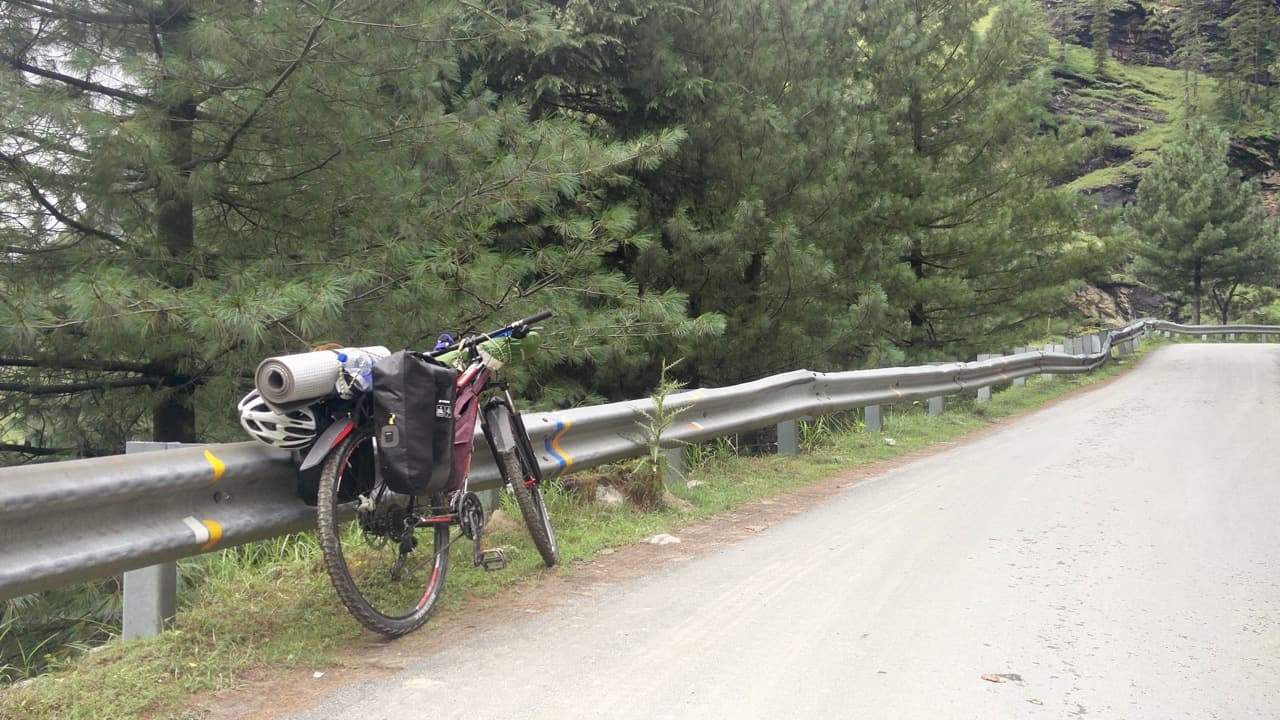
Route: Manali to Leh via 5 high-altitude passes | Distance: 474 km | Duration: 7-14 days | Best time: Mid-June to mid-September | Difficulty: Challenging (altitude 2,050m to 5,328m) | Budget: Rs 15,000-35,000 (self-supported, 10-12 days)
Cycling from Manali to Leh is one of those rides that changes you. I completed this 474 km stretch in 10 days, pedaling through five high mountain passes, two of which sit above 5,000 meters. There were mornings when my legs refused to move, afternoons when headwinds on the Moré Plains nearly broke my spirit, and evenings when a hot cup of chai at a roadside dhaba felt like the greatest reward on earth.
I wanted to do this ride at my own pace, with the freedom to stop wherever the view demanded a longer look or a conversation with a fellow traveler. When I started preparing, I could barely find any practical cycling guide for this route. Hence, I decided to put together everything I learned the hard way, so you can prepare better than I did. In this guide, I will cover physical training, gear, route planning, packing, altitude sickness prevention, and a realistic 2026 budget. For the day-by-day breakdown, check my separate Manali to Leh cycling itinerary.
Let's quickly dive into the details:
How Should You Train for the Manali Leh Cycling Trip?
Start your preparation at least 3-6 months before the trip. If you can ride on inclined roads for 35-40 km in a day without collapsing, you are physically ready. But “physically ready” and “enjoying the ride” are two different things. The more you train, the more you will enjoy the Himalayas instead of cursing them.
12-Week Training Plan for Manali Leh Cycling
Here is a structured training plan that worked for me and other cyclists I have spoken to over the years. Adjust it based on your current fitness level.
| Phase | Weeks | Focus | Weekly Target |
|---|---|---|---|
| Base Building | 1-4 | Build saddle time and endurance | 80-120 km total, 3-4 rides |
| Hill Training | 5-8 | Climbing strength and gear shifting | 100-150 km total, include 2 hill rides |
| Peak & Taper | 9-12 | Long rides, back-to-back days, rest week | 120-180 km (weeks 9-10), then taper down |
What Specific Exercises Help?
Beyond cycling, these exercises will make a real difference on the mountain passes.
- Squats and lunges (3 sets of 15, three times a week). Your quads and glutes do the heavy lifting on climbs.
- Core planks and crunches (daily 10-15 minutes). A weak core means lower back pain by day 3.
- Tempo rides on flat terrain for 2-3 hours at a stretch. This builds your aerobic base.
- Weekend hill climbs. If you live in the plains, find any flyover or overpass and do repeats. It sounds silly, but it works.
- Back-to-back riding days in weeks 9-10. On the highway, you ride every single day. Your body needs to know what consecutive days feel like.
One thing I want to emphasize. No amount of physical training fully prepares you for the altitude. Your body adapts on the road. What training does is make sure your legs and lungs are not the bottleneck, so your mind can focus on acclimatization and enjoying the ride.
What Is the Best Route for Manali to Leh Cycling?
The standard route follows the Manali Leh Highway (NH3), covering 474 km through five major passes. Since the opening of the Atal Tunnel in October 2020, the first pass (Rohtang) is bypassed via the 9.2 km tunnel. No permit is needed for the tunnel, but keep in mind that cycling through it is not always allowed. Check with the BRO or local authorities before your trip.
10-Day Stage-by-Stage Route Plan
This is the route I followed, and it works well for most first-time cyclists. I wanted a comfortable pace with time to enjoy the views, so I kept daily distances between 30-80 km.
| Day | Start | End | Distance (km) | Elevation Gain (m) | Key Notes |
|---|---|---|---|---|---|
| 1 | Manali / Solang | Marhi | 37 | 1,300 | Steep climb, last proper market |
| 2 | Marhi | Sissu | 53 | 900 | Via Atal Tunnel or Rohtang (if open) |
| 3 | Sissu | Darcha | 57 | 900 | Fuel up at Tandi (last petrol pump) |
| 4 | Darcha | Zing Zing Bar | 29 | 900 | Short day, beautiful campsite |
| 5 | Zing Zing Bar | Sarchu | 49 | 1,400 | Baralacha La (4,890m), tough climb |
| 6 | Sarchu | Pang | 79 | 1,200 | 21 Gata Loops, Nakee La, Lachalung La |
| 7 | Pang | Debring | 52 | 641 | More Plains, strong headwinds likely |
| 8 | Debring | Upshi | 76 | 900 | Tanglang La (5,328m), highest point |
| 9 | Upshi | Leh | 49 | 450 | Mostly downhill, victory lap |
| Rest | Manali (Day 0) | Acclimatization | 20-30 | 500 | Ride to Solang Valley and back |
If you have more time, I strongly recommend adding a rest day at Jispa or Keylong after Day 3. Sleeping at a lower altitude before crossing Baralacha La makes a big difference for acclimatization. Avoid sleeping at Sarchu if you are not already comfortable at 14,000 ft.
Where Can You Find Food and Stay on the Route?
Here is a list of places on the Manali Leh Highway where food and basic accommodation (dhabas, tented camps, or guesthouses) are available during the cycling season (June to September).


- Kothi, Marhi, Koksar, Sissu, Gondla, Tandi, Keylong, Jispa, Darcha
- Zing Zing Bar (Lower and Upper), Bharatpur, Sarchu
- Whiskey Nala, Pang, Debring (Lower and Upper)
- Rumtse, Upshi, Karu, Thiksey, Leh
Keep in mind that between Darcha and Sarchu, and between Sarchu and Pang, options are limited to seasonal tented camps. Carry enough food and water for emergencies. For a complete list with phone numbers, check the accommodation options on Manali Leh Highway.
How Do You Carry Your Bicycle and Reach Manali?
The best way to reach Manali from Delhi is to take an overnight HPTDC or HRTC Volvo bus. These buses take 12-14 hours depending on road conditions and traffic. As of 2026, HRTC Volvo fares from Delhi to Manali are around Rs 1,500-2,000, and ordinary buses cost Rs 700-900.
Best Way to Transport Your Bicycle by Bus
The safest way to carry your bicycle on the bus is to pack it in a bicycle or TV box, which fits easily in the luggage compartment of any Volvo bus. This protects the bike and avoids surprises when you unpack in Manali.
- HPTDC buses charge about Rs 300 extra for a bicycle. Private buses can charge Rs 500-1,000, so government buses are a better deal.
- The Bike Shop at Green Park, Delhi is a good place to get your bike packed at a nominal charge. They pack it well to ensure nothing shifts during the journey.
- Stay close to the bus station in New Manali. Moving around with a large bicycle box in Manali’s narrow streets is not fun.
Should You Rent or Buy a Bicycle for the Trip?
I have always preferred touring on my own bicycle. However, renting is a perfectly valid option if you do not own a touring-capable bike.
- Renting in Delhi: A decent MTB is available for Rs 500-800 per day at shops like The Bike Shop (Green Park). For a 12-day trip with helmet, lights, and accessories, expect Rs 10,000-12,000 total.
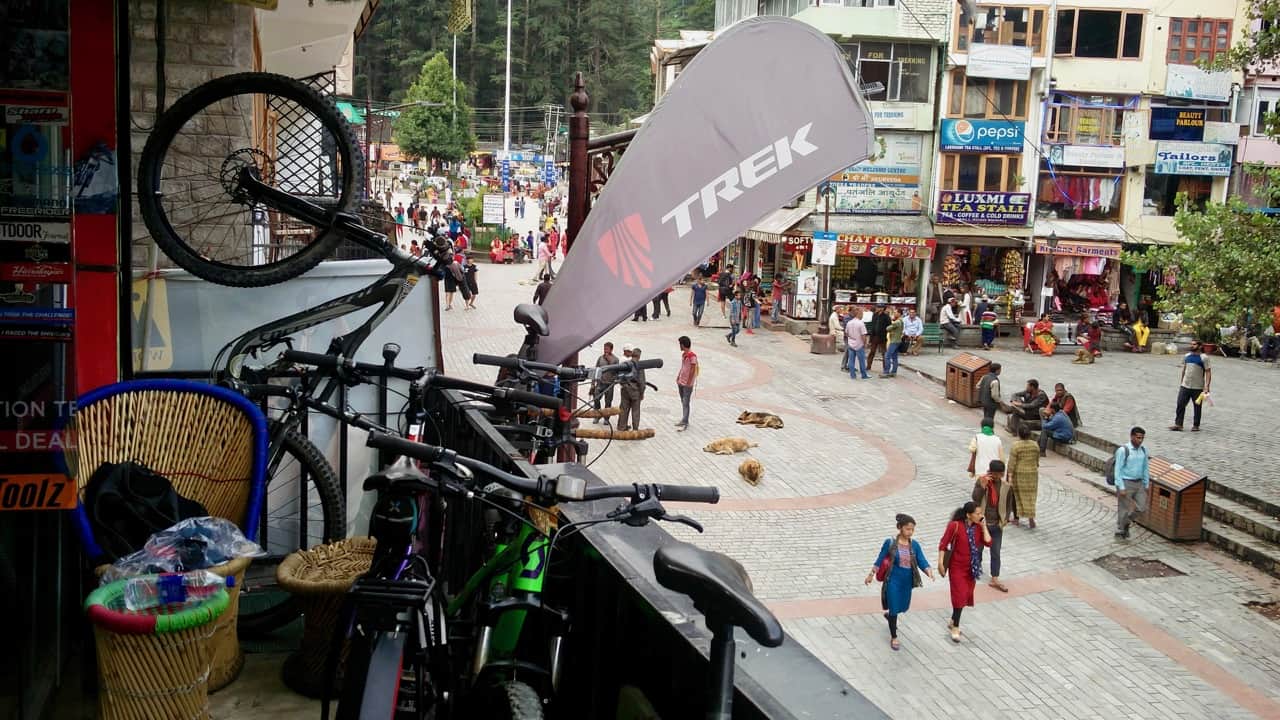
- Renting in Manali: MTB rentals cost Rs 700-1,000 per day. The Himalayan Bike Bar and Fireballs Adventures are recommended vendors. Both cost about the same after the full trip since Delhi rentals mean carrying the bike longer.
- Buying a budget MTB: A decent MTB starts around Rs 20,000 (excluding accessories). If you plan to do more tours, buying makes sense.
- Carrier racks and pannier bags are nearly impossible to find on rent. Buy your own from Decathlon or Happy Earth. Budget Rs 3,000-5,000 for a decent rack and pannier set.
- Once in Manali, Naveen at the local Firefox Store in New Manali has every tool and spare you might need, along with extensive knowledge of the Manali Leh route.
What Bicycle and Gear Should You Use?
The most important thing on the Manali Leh cycling route is knowing your bicycle inside out. Once you leave Manali, you will not find a proper mechanic for the next 400+ km until Upshi or Leh. There are a few bicycle repair shops at Koksar, Keylong, and Zing Zing Bar who can help with flat tires, but nothing beyond that.
What Type of Bicycle Works Best?
Three types of bicycles work well on this route.
- Mountain Bike (MTB): Best all-round choice. Handles rough patches, gravel, and water crossings. Most rental shops offer MTBs.
- Touring Bike: Ideal if you carry heavy panniers. More comfortable on long flat stretches like the Moré Plains.
- Gravel Bike: Growing in popularity. Lighter than MTB, handles mixed terrain. Not ideal for very rough sections near Sarchu.
Whichever bike you choose, make sure it has low gears (a triple chainring or compact crankset) for the steep climbs. A single-speed or fixie is a terrible idea on this route. Trust me on this.
Bicycle Maintenance Skills You Must Learn Before the Trip
Knowing the following things will save your trip. Practice each of these at home before you leave.
- Repairing a flat tire and replacing tubes
- Removing and cleaning chain links. Learn the basics of cleaning and maintaining a bike chain
- Adjusting and changing brake and gear wires
- Changing spokes without using spoke tools (it is a jugaad, and it works :))
- Truing a wobbly wheel using zip ties as a gauge
Complete Spares and Tools Checklist
Here is the list of spares and tools you should definitely carry. I have learned the hard way that skipping any of these can ruin a day.
- 2 sets of spare tubes (matched with your tire size, thicker nozzle preferred), puncture repair kit, and hand pump
- 1 set of spare chain links and chain link removal tool
- Basic bicycle multi-tool kit
- Spare spokes (2 pieces)
- Brake and gear wires (2 pieces each)
- Commonly used extra screws and nuts
- Machine oil or chain lubricant. I personally prefer machine oil over fancy chain lubes.
- Zip ties and duct tape (for emergency fixes of everything)
What Should You Pack for the Manali Leh Cycling Trip?
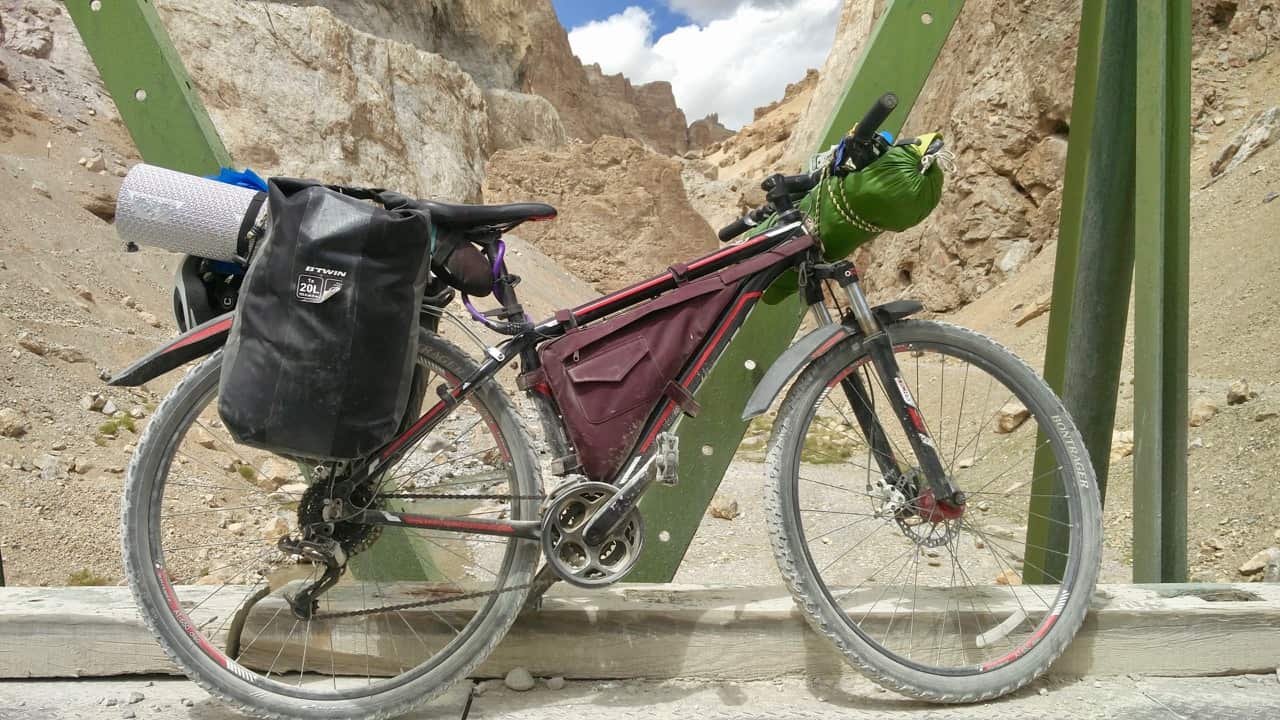
Packing wisely is perhaps the most underrated skill in bicycle touring. I have traveled on my bicycle through Thailand, Vietnam, and several places in India, and I have learned that how you pack matters as much as what you pack. On the Manali Leh route, every extra kilogram makes a difference on the climbs. We kept an average total weight of 15 kg on each bike, distributed across rear pannier bags, a frame bag, and handlebar storage.
Clothing Checklist
- Cycling shorts (2 pairs, padded)
- Jersey or dry-fit T-shirt (2)
- Cotton shorts (1, for camp)
- Cotton T-shirt (2, for evenings)
- Towel (1, microfiber preferred)
- Socks (3 pairs, including 1 woolen)
- Running shoes (1 pair)
- Cap (1) and buff/balaclava (1)
- Woolen gloves (1 pair) and cycling gloves (1 pair)
- Underwear (3)
- Thermal top (1) and thermal bottom (1)
- Fleece jacket (1)
- Windproof and waterproof jacket (1). A raincoat works, but a proper cycling jacket is worth the investment.
Camping Gear
- Lightweight tent (1-2 person)
- Sleeping bag (rated to -5C minimum)
- Sleeping mat or pad
- Thermos (for hot tea on cold mornings)
On-Bicycle Accessories
- Front headlight (USB rechargeable) and rear tail light
- Pannier bags (waterproof if possible)
- Rack (must be compatible with your frame)
- Frame bag and saddle bag
- Bungee cords (3)
- Water bottles (2, at least 750ml each)
- Helmet (non-negotiable)
Cooking Gear and Food
- Portable stove, butane gas canister, and burner adapter
- Lightweight utensil set, bowl, fork, and spoon
- Oats, poha, noodles, Maggi, upma (easy-to-cook meals)
- Dry fruits, energy bars, and trail mix
- Milk powder, sugar, tea, and coffee. Only if you want the comfort of starting early without waiting for dhabas to open.
How to Pack Your Panniers Properly
Here are a few packing principles I follow on every bicycle tour.
- Frame bag: Keep all go-to items here. Money, gloves, camera, mobile, snacks. You should not need to stop and open panniers for everyday things.
- Both pannier bags must weigh the same for proper balance. An uneven load makes the bike unstable on descents.
- Separate by frequency: One pannier for daily-use items, the other for things you use less often (camping gear, spare clothes). This keeps you organized and less messy.
- Front weight matters: If you do not have front panniers, strap something to the handlebar for stability during climbs and descents.
- Solar charger should sit on top of the rear rack where it gets maximum sun while you ride.
How Do You Handle Altitude Sickness on the Cycling Route?
Acute Mountain Sickness (AMS) is the single biggest risk on this route, and we should never joke about it. The good news is that cycling naturally helps with acclimatization because you climb gradually over several days. But “gradually” on a bicycle still means going from 2,050m (Manali) to 5,328m (Tanglang La) in under two weeks.
- Keep yourself hydrated. Drink 4-5 liters of water daily. Stream water on the route is generally safe and clean to drink.
- Carry a thermos with hot black tea. We filled ours every morning. When temperatures drop near the passes, a sip of hot tea is the best way to stay warm and alert.
- Consult your doctor about Diamox if you have not been to high altitude before. Start the course 2 days before reaching 3,500m. It is a preventive measure, not a cure.
- Follow the golden rule: Ride higher, sleep lower. This is why I recommend sleeping in Jispa (3,200m) instead of Sarchu (4,200m) whenever possible.
- Acclimatization ride on Day 0: Spend a full day in Manali before starting. Ride to Solang Valley and back. This 20-30 km warm-up ride at moderate altitude prepares your body for what is ahead.
- Watch for symptoms: Persistent headache, nausea, dizziness, and shortness of breath at rest. If any of these persist after rest and hydration, descend immediately. Do not push through AMS.
What Is the Budget for Manali Leh Cycling in 2026?
One of the biggest advantages of cycling the Manali Leh route is that it can be done on a surprisingly tight budget compared to motorcycle trips or guided tours. Here is a realistic cost breakdown for a self-supported 10-12 day trip in 2026.
| Expense | Budget (Rs) | Mid-Range (Rs) |
|---|---|---|
| Delhi to Manali bus (one way) | 900 (ordinary) | 2,000 (Volvo) |
| Bicycle transport on bus | 300 | 500 |
| Bicycle rental (if renting, 12 days) | 6,000 | 12,000 |
| Accommodation (10 nights, dhabas/tents) | 3,000 (Rs 300/night) | 8,000 (Rs 800/night) |
| Food (12 days) | 4,800 (Rs 400/day) | 7,200 (Rs 600/day) |
| Leh to Delhi return (bus or flight) | 1,500 (bus via Srinagar) | 5,000 (flight) |
| Miscellaneous (repairs, medical, extras) | 1,500 | 3,000 |
| Total (with own bicycle) | 12,000 | 25,700 |
| Total (with rented bicycle) | 18,000 | 37,700 |
If you carry your own camping gear and cook some meals yourself, you can bring the cost down even further. I spent roughly Rs 15,000 for the entire trip in 2018 (with my own bicycle and camping gear). With 2026 prices, expect Rs 15,000-20,000 for a budget trip and Rs 25,000-35,000 for a comfortable mid-range experience. For a detailed cost guide for the broader Ladakh trip, check the Ladakh trip budget calculator.

What About Mobile Connectivity on the Route?
Mobile connectivity has improved significantly since I first did this ride, but long stretches still have no signal at all. Here is what to expect in 2026.
- Manali to Marhi: All networks work. Last point of reliable internet.
- Atal Tunnel to Keylong: BSNL and Jio have intermittent coverage. Airtel works in Sissu and Keylong.
- Keylong to Sarchu: BSNL postpaid has spotty coverage in Darcha and Jispa. No data. Jio 4G works at Sarchu since 2021.
- Sarchu to Pang: Almost no coverage. Army camps at Sarchu and Pang have satellite phones for emergency calls (Rs 2-5/minute for domestic calls).
- Pang to Leh: No network until Upshi. From Upshi onwards, Jio and Airtel work.
- Leh: Jio 5G and Airtel 5G available since 2023-2024. BSNL postpaid is the most reliable overall.
For a detailed breakdown of which network works where, read the mobile connectivity guide for Ladakh. My recommendation for cyclists: carry a BSNL postpaid SIM as your primary, and Jio as a backup.
What About Navigation and Maps?
Since there is no internet for most of the route, Google Maps will not help much. Even its offline mode needs some data to retrieve detailed information. Here are better options.
- OsmAnd or Organic Maps: Both work fully offline and have excellent detail for the Manali Leh route, including elevation profiles, settlements, and water sources. Download the Himachal Pradesh and Ladakh maps before leaving.
- Maps.me: Another solid offline option with good coverage of food stops, trails, and accommodation along the highway.
- Physical map: Carry a printed map or at least a screenshot of this route table as a backup. Electronics fail, especially in cold weather.
I used maps.me on my ride and it worked flawlessly. It even gives you elevation profiles so you know what climbs are coming.
What Mental Preparation Does This Ride Demand?
There is a popular saying among Himalayan cyclists: your body will be the last to give up. It is your mind that quits first. I experienced this firsthand on Day 6, climbing the 21 Gata Loops before Nakee La. My legs could still pedal, but my mind was screaming “stop, take a lift, this is pointless.” I did not stop. And crossing that pass was one of the proudest moments of my life.
- Understand your route before the trip. Read through the Manali Leh Highway travel guide so you know exactly what terrain to expect each day. No surprises means fewer mental breakdowns.
- Carry self-sufficiency gear. Knowing you have a tent, food, stove, and repair tools provides a mental cushion. You are never truly stuck.
- Celebrate every milestone. Be proud of yourself for even starting this ride. Not many people in the world have the courage to pedal to 5,300 meters. Every pass you cross, every day you complete, is a genuine achievement.
- Break the ride into smaller goals. Do not think “I have to reach Leh.” Think “I have to reach the next dhaba.” Then the next. Then the next.
- Travel with a partner if possible. Solo cycling on this route is doable, but having a companion makes the tough days bearable and the good days extraordinary.
What Are the Common Mistakes Cyclists Make on This Route?
After doing this ride and speaking to dozens of cyclists over the years, here are the mistakes I see most often.
- Starting without acclimatization. Skipping the Day 0 warm-up ride in Manali and pushing straight to Rohtang or Atal Tunnel. Your body is not ready.
- Carrying too much weight. If your loaded bike weighs more than 20 kg, you are carrying too much. Every extra kilogram hurts on the 21 Gata Loops.
- Not carrying enough water between Sarchu and Pang. This 79 km stretch has limited water sources. Carry at least 3 liters.
- Ignoring AMS symptoms. Pushing through a persistent headache because “I paid for this trip.” Your trip is not worth your life.
- Not knowing basic bike repair. A flat tire at Lachalung La with no repair kit is a nightmare I have seen play out.
- Sleeping at Sarchu on the first high-altitude night. At 4,200m, Sarchu causes AMS in many first-timers. Sleep at Jispa or Keylong instead and cross Baralacha La fresh the next morning.
- Underestimating headwinds on the Moré Plains. The stretch between Pang and Debring has relentless headwinds in the afternoon. Start early (before 6 AM) to cover maximum distance before the wind picks up.
Frequently Asked Questions
Is Manali to Leh cycling safe for beginners?
Yes, if you prepare properly. You do not need to be a professional cyclist, but you should be comfortable riding 40-50 km on hilly terrain before attempting this route. The biggest risks are altitude sickness (which proper acclimatization prevents) and mechanical breakdowns (which carrying spares and knowing repairs prevents). Start with a 12-week training plan and you will be fine.
What is the best time to cycle from Manali to Leh?
Mid-June to mid-September is the ideal window. July and August have monsoon rain on the Manali side (Rohtang to Keylong), but the Ladakh side remains dry. September offers the clearest skies but shorter days and colder nights. Most cyclists prefer late June or early July for the best balance of weather and road conditions.
Do I need any permits for cycling from Manali to Leh?
No special permits are needed for the Manali to Leh route itself. The Atal Tunnel does not require a permit for transit. However, if you plan to explore Ladakh after reaching Leh (Nubra Valley, Pangong Tso, Tso Moriri), you will need an Inner Line Permit (ILP), which can be obtained online or in Leh. As of 2026, the Ladakh Environment and Development Fee (EDF) is Rs 400 per person plus Rs 20 per person per day plus Rs 10 Red Cross per day.
Can I do this ride solo or should I go with a group?
Both work. Solo cycling gives you complete freedom over pace and stops. Group cycling provides safety, shared costs, and companionship on tough days. If you are a first-timer, I recommend riding with at least one partner. The stretches between Sarchu and Pang, and between Pang and Upshi, can feel very isolated for a solo rider.
How much does a guided Manali Leh cycling tour cost?
Guided cycling tours with a support vehicle, meals, accommodation, and mechanic typically cost Rs 25,000-45,000 per person for a 10-14 day expedition (2026 prices). Companies like Trek The Himalayas, Kahlur Adventures, and Himalaya Destination offer these packages. Self-supported trips cost Rs 15,000-35,000 depending on your accommodation and food choices.
What happens if my bicycle breaks down mid-route?
Basic repair shops exist at Koksar, Keylong, and Zing Zing Bar for flat tires and minor fixes. Beyond that, you are on your own until Upshi (400+ km from Manali). This is why carrying spares and knowing basic repairs is absolutely essential. In an emergency, you can flag down a passing truck or tourist vehicle to transport you and your bike to the nearest town.
Is it possible to cycle from Leh to Manali instead?
Yes, and some cyclists prefer it because you hit the highest passes (Tanglang La, Lachalung La) while descending rather than climbing. However, the Leh-to-Manali direction means facing the steep descent into Manali, which is harder on brakes and requires more technical skill. The Manali-to-Leh direction is more popular because the gradual elevation gain suits acclimatization better.
Final Thoughts
Whether you are planning a ride from Manali to Leh or extending all the way to Khardung La, the preparation tips in this guide apply equally. The Manali Leh cycling route is not just a physical challenge. It is a journey that teaches you patience, resilience, and a deep respect for the mountains. I came back from this ride a different person, and I have seen the same transformation in every cyclist I have met on the highway.
If you have questions about the route, gear, or preparation, feel free to drop a comment below or reach out to me on Instagram. The DwD community has several experienced cyclists who are always happy to help first-timers. In the next article, I cover a detailed day-by-day Manali to Leh cycling itinerary with elevation profiles and camping spots.
If you know friends or family planning a cycling trip to Ladakh, do share this guide with them. It might just save them a flat tire at 16,000 ft with no repair kit 🙂
Last Updated: March 2026

2 Comments
Comments section gets closed in 90 days. To ask your travel questions, you can follow my YouTube Channel for a faster reply or for a much slower reply follow me on Instagram. :)
Hi hitesh. I m also planning the same. 9724804370 my number. Fell free to contact. I m going to mt.abu frm gandhinagar next wewk just to have a feel of hilly cyclling. If u wana join thn contact me
I am planing for Manali to Leh cycling track VIA YHAI in the month on july. and have started cycling one in a weekend for 25-30km cycling.
Can you share, Which location we miss and it should be seen while trip from Manali to Leh.
If you share some idea so that I can plan for that in the same trip coz this memory is a once in a lifetime, and I don’t want to miss this opportunity.