


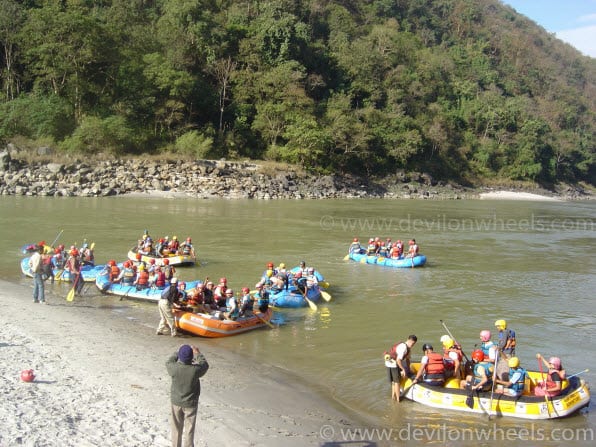
River rafting in Rishikesh is one of those experiences that you keep replaying in your head long after the trip is over. The rush of cold Ganga water hitting your face, the instructor yelling “paddle hard,” your heart doing that weird thing where it wants to stop but also beat faster at the same time. I went through all of this during my Shivpuri trip, and in this second part of the adventure bathing series, I want to share what river rafting and cliff jumping at Rishikesh actually feel like, along with all the practical details you need to plan your own trip in 2026.
One thing has changed since my trip, and it is important enough that I want to flag it right at the top rather than bury it halfway down. Body surfing, which is floating down a rapid holding the raft’s lifeline ropes, is no longer permitted during commercial rafting in Rishikesh. The district administration restricted it after a string of accidents, and registered operators will not offer it to you. I have kept my own account of it below because it is part of what happened on that trip, but please read it as a story from 2012, not as something you can book today.
If you have not read the first part yet, I recommend starting there. It covers river bathing in the Ganga and canyoning at Shivpuri. You can read it here: Adventure Activities in Rishikesh – River Bathing, Canyoning and More.
Quick Info: River Rafting and Cliff Jumping in Rishikesh at a Glance
| Activity | Details |
| Location | Shivpuri to Rishikesh, Uttarakhand |
| Best Time | October to June (closed during monsoon) |
| Rafting Season | 15 September to 30 June (the 2025-26 season opened 27 September 2025) |
| Who Regulates It | Uttarakhand Tourism plus the Ganga Nadi Rafting Rotation Samiti |
| Rafting Cost (Shivpuri 16 km) | Rs 1,000 per person + Rs 20 entry fee |
| Rafting Cost (Marine Drive 24 km) | Rs 1,500 per person + Rs 20 entry fee |
| Cliff Jumping Cost | Usually included with rafting, but not offered on every stretch or every day |
| Body Surfing | NOT permitted as of 2026 |
| Duration (Shivpuri stretch) | 2.5 to 3 hours |
| Duration (Marine Drive stretch) | 4 to 5 hours |
| Swimming Required? | No, life jackets provided |
| Age Limit | 14 to 50 years |
| Weight Limit | 35 kg to 100 kg |
| Nearest City | Dehradun (45 km), Delhi (240 km) |
What Are the Rafting Stretches Available in Rishikesh?
Quick answer: There are five commercial rafting stretches on the Ganga at Rishikesh. Brahmpuri (9 km, Rs 600), Shivpuri (16 km, Rs 1,000), Marine Drive (24 km, Rs 1,500), Byasi (30 km, Rs 2,000) and Kaudiyala (34 km, Rs 2,500). Every stretch adds Rs 20 as an entry fee. Shivpuri is the standard first-timer choice.
Rishikesh offers five different rafting stretches along the Ganga, each varying in distance, difficulty, and the number of rapids you encounter. The starting points range from Brahmpuri (closest to Rishikesh, easiest rapids) all the way to Kaudiyala (longest and most intense). Here is a quick breakdown of each stretch so you can choose based on your comfort level and how much adrenaline you are looking for.
| Starting Point | Distance | Duration | Rapids Grade | Cost Per Person (2026) |
| Brahmpuri | 9 km | 1 to 1.5 hours | Grade I-II | Rs 600 + Rs 20 fee |
| Shivpuri | 16 km | 2.5 to 3 hours | Grade II-III | Rs 1,000 + Rs 20 fee |
| Marine Drive | 24 km | 4 to 5 hours | Grade III-IV | Rs 1,500 + Rs 20 fee |
| Byasi | 30 km | 5 to 6 hours | Grade III-IV | Rs 2,000 + Rs 20 fee |
| Kaudiyala | 34 km | 6 to 7 hours | Grade III-IV | Rs 2,500 + Rs 20 fee |
Keep in mind that the Shivpuri stretch is the most popular choice for first-timers. It has enough rapids to get your heart pumping without being so intense that you spend the whole time being scared. The Marine Drive stretch is what I did, and honestly, it was the best decision I made. 4 to 5 hours on the water, right through the heart of the hills, with rapids like Black Money, Cross Fire, and the famous Golf Course rapid.
The grades you see in that table follow the International Scale of River Difficulty, the same six-point scale used worldwide. Grade I is moving water with small waves, Grade III means irregular waves that can swamp a raft, and Grade IV means powerful, unavoidable rapids that need precise handling. Nothing on the Rishikesh section goes above Grade IV, which is exactly why it works so well as a beginner destination.
How Was My River Rafting Experience at Rishikesh?
It was Day 2 of our Shivpuri trip, and many of us woke up early for nature walks around the camp. After some chai, a couple of rounds of volleyball, and breakfast, it was finally time for the main event: river rafting.
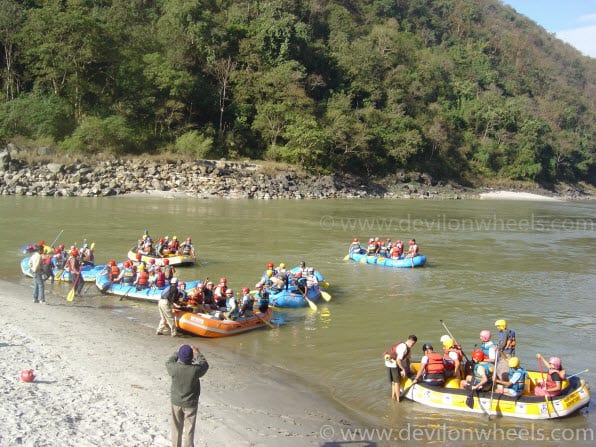
We hiked back to the road where our vehicle was waiting to drop us at Marine Drive, the starting point for this mammoth 4 to 5 hour wet and wild experience. For the first time, our group was split up. The familiar faces were replaced by strangers from other groups. Out of around 100 people present that morning, only 4 from our original group stayed together in one raft, with 4 new members joining us. There were a few objections, but the instructors were firm about mixing the groups.
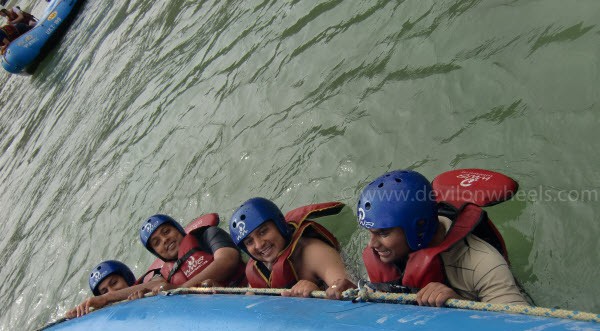
The instructor gave us clear instructions on paddling techniques and safety rules. The raft launched smoothly. It required little force at the beginning, the water was calm. But then the first rapid came. I was sitting in front, and I quickly realized there was no foot support up there. The instructor noticed me scrambling for grip and just smiled. That cheeky smile told me everything I needed to know about what was coming 🙂
What Does It Feel Like When the First Rapid Hits?
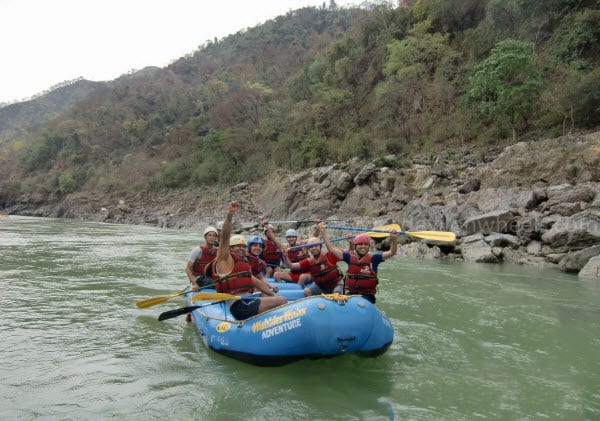
As the first rapid approached, sitting in the front seat and watching the wave form was something else entirely. My heart was in my mouth. One splash, and I was completely drenched. For a moment I thought, why the hell am I here? But then I got my senses back, told myself to stay calm, and braced for the next one, which was bigger. With controlled nerves, the second rapid went smoothly, and from that point on, I started enjoying every bit of it.
The raft sailed over the Ganga right through the hills, as if we were on some new kind of pathway. A pathway with wavy waters, no traffic, and one that made you wet every few minutes. It was a different feeling, something far more intense than the canyoning experience from the previous night. After 3 or 4 rapids, I felt like there could be nothing better than this. A little bit scary, a little bit fun 🙂
What Is Body Surfing During Rafting, and Is It Still Allowed?
Quick answer: Body surfing means getting out of the raft and floating in the current while holding the lifeline ropes. It is no longer permitted during commercial rafting in Rishikesh. The district administration restricted it after repeated accidents, and registered operators will not offer it. The account below is from my 2012 trip, before the restriction.
To take things a step further, I jumped into the water during a calm stretch and held onto the lifeline ropes along the side of the raft. Floating on the Ganga in the middle of the wilderness, looking up at the forested hills, I went into a kind of trance for about 20 minutes. The water was cold, the current was gentle in that stretch, and it felt like the river was carrying me through a different world.
Now, I have to be honest with you here. That was 2012, and the rules have tightened a great deal since. Too many people panicked mid-current, lost their grip on the rope, or got separated from the raft, and the administration eventually stepped in. In case an operator still offers to let you body surf, treat that as a red flag about the operator rather than a bonus in the package. It tells you they are willing to ignore the rules, which is not a quality you want in the person responsible for your safety on a Grade III rapid.
Then the instructor called me back in. A major rapid was approaching. He called it Golf Course, if I remember correctly. There were special instructions for this one because the water level was high that day, and the guide believed there were real chances of the raft flipping. We were all anxious. The milky white waters ahead looked fierce. The person sitting next to me whispered that he did not understand a word the guide said because he did not speak Hindi. That added another layer of nervousness to the whole situation 🙂
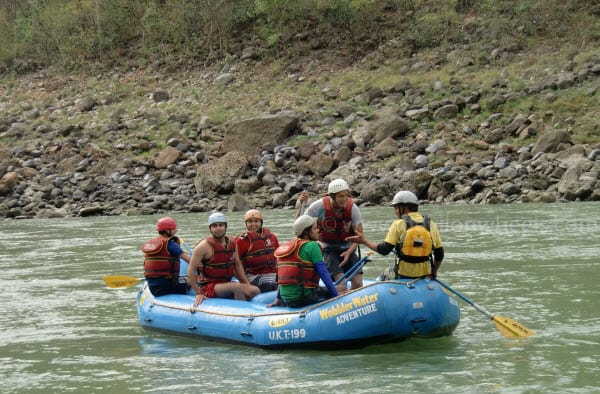
Less than 2 minutes of heart pounding action, and by God’s grace, we made it through, completely drenched. We saw a few rafts ahead of us that had toppled. The operators actually stopped the groups behind us and asked them to cross that section on foot to avoid any casualties. The rest of the journey up to Rishikesh was calm and serene, just simple paddling with the hills watching over us.
What Is Cliff Jumping at Rishikesh and How Does It Work?
Quick answer: Cliff jumping is a 15 to 40 foot jump from a boulder on the river bank into the Ganga, wearing a life jacket, with an instructor waiting in the water below. Most operators include one stop with the rafting package at no extra cost, but it is not guaranteed and gets skipped when the water is high.
Cliff jumping is exactly what it sounds like. You climb up to the top of a large boulder or cliff along the river bank, and you jump straight down into the water below. In Rishikesh, cliff jumping spots are usually 15 to 40 feet high. Most operators include a cliff jumping stop as part of the rafting package, so you do not have to pay extra for it. Keep in mind, though, you do need to be wearing a life jacket, and the instructors will be in the water below to help if needed.
Unlike body surfing, cliff jumping has not been withdrawn outright, but it is no longer the automatic freebie it used to be. Operators drop it when the Ganga is running high, which in practice means the late-season weeks before the monsoon closure and the first few weeks after the season reopens in late September. Hence, if cliff jumping is the main reason you are booking, ask the operator directly whether it is running on the day you plan to raft, and do not pay a premium for a package that only promises it “subject to conditions”.


How Was My Cliff Jumping Experience?
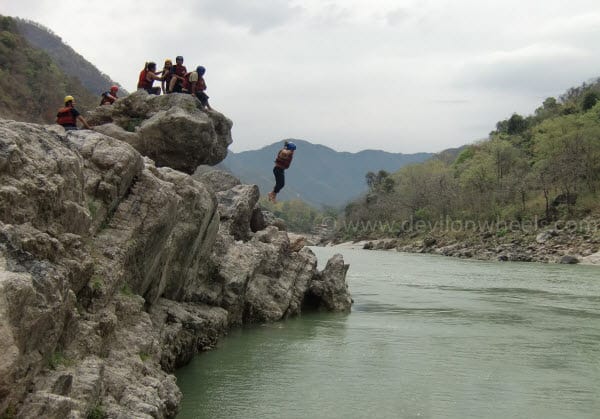
As soon as the rafting ended and the crew started loading the rafts onto pickup trucks, one of the instructors came over and asked a bunch of us to follow him. He led us through a zigzag path to the top of a huge boulder. Then he smiled, took a running start, and jumped right off into the river below.
We looked down. He was waving at us from the water, calling us to jump. And that is when it hit me, this was cliff jumping.
My friends stepped back a little, but I cautiously went to the edge and looked down. It was a good 15 to 18 feet drop straight into the Ganga. And I do not know how to swim. The adrenaline was pumping, and everyone behind me started cheering me on. A round of prayers, a deep breath with a tightly sealed mouth, and I threw myself off the boulder.
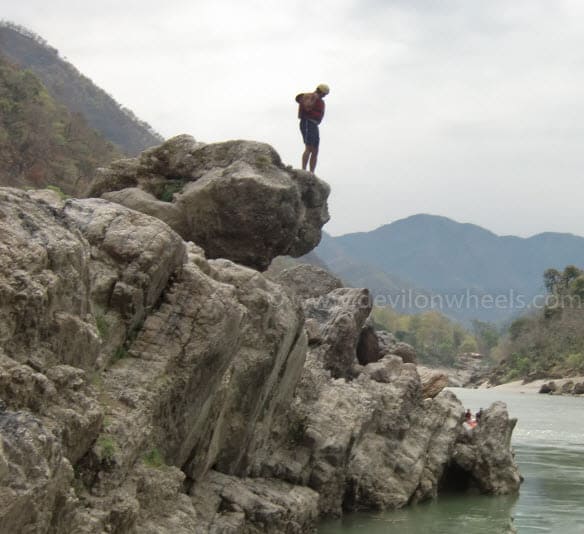
2 to 3 seconds of freefall. My heart stopped, I think. A big splash. I was deep underwater, and for a moment I could not find the surface. It took another 3 to 4 seconds to come back up, and I was so relieved to find myself alive. Water was everywhere, in my eyes, nose, ears, mouth. But I was grinning like crazy 😀
That fall makes your brain work at incredible speed. In those few seconds of freefall, I swear I remembered things from years ago. It was a moment to overcome fear, a moment to feel different, a moment I will carry with me for a very long time. My friends followed after me, and soon others from the group were jumping too. We kept at it until the light faded and we could barely see each other from a distance. The evening ended with a bonfire and a lovely dinner before we crashed for the night.
Something changed in me that day. I no longer feared deep water as much, even though I still do not know how to swim. There is something about facing a fear head-on that rewires your brain a little bit. In case you are wondering whether non-swimmers should try cliff jumping, yes, absolutely. The life jacket keeps you afloat, and the instructors are right there in the water. Just make sure you seal your mouth and nose before the jump.
How Much Does River Rafting Cost in Rishikesh in 2026?
Quick answer: Rafting in Rishikesh costs Rs 600 to Rs 2,500 per person in 2026 depending on the stretch, plus a flat Rs 20 entry fee. The rate includes transport to the put-in point, guide, life jacket, helmet and paddle. Camping at Shivpuri adds Rs 1,200 to Rs 3,000 per person per night.
River rafting prices in Rishikesh are quite affordable, especially when you compare it to adventure sports in other countries. Here is a detailed cost breakdown for 2026 so you can budget your trip properly.
| Item | Cost (2026) |
| Brahmpuri Rafting (9 km) | Rs 600/person |
| Shivpuri Rafting (16 km) | Rs 1,000/person |
| Marine Drive Rafting (24 km) | Rs 1,500/person |
| Byasi Rafting (30 km) | Rs 2,000/person |
| Kaudiyala Rafting (34 km) | Rs 2,500/person |
| Entry Fee | Rs 20/person (all stretches) |
| Cliff Jumping | Usually included with rafting, subject to water level |
| Camping (Shivpuri, per night) | Rs 1,200 to Rs 3,000/person |
| Bungee Jumping (Mohanchatti) | Rs 3,700/person |
| Giant Swing | Rs 3,500/person |
| Neer Garh Waterfall entry | Rs 30/person (Indians), Rs 50 (foreigners) |
The rafting cost includes pickup from the rafting office in Rishikesh, transport to the starting point, the rafting guide, life jackets, helmets, and all required equipment. You do not need to bring anything except a change of dry clothes and waterproof bags for your phone and wallet. Most operators also offer GoPro video recording for an additional Rs 500 to Rs 1,000.
So, doing the math for a standard weekend: two people on the Marine Drive stretch with one night of Shivpuri camping works out to roughly Rs 5,500 to Rs 9,000 for the pair, before you add travel from Delhi. Add another Rs 7,400 if both of you also want to do the bungee jump. Keep in mind that these are 2026 season rates quoted by operators on the Shivpuri and Marine Drive stretches, and weekend pricing in peak March to May can run a little higher, so confirm before you pay any advance.
What Are the Best Rapids to Experience in Rishikesh?
Quick answer: The best known rapids on the Rishikesh section are Golf Course, Roller Coaster, Return to Sender, Black Money, Cross Fire, Three Blind Mice (all Grade III) and The Wall (Grade IV). Golf Course is the one that flips the most rafts. The Marine Drive stretch gives you over 12 rapids in a single run.
The Ganga in the Rishikesh stretch has rapids ranging from Grade I (easy, gentle waves) to Grade IV (intense, requires experienced paddling). Here are some of the most famous rapids you will encounter depending on which stretch you choose.
Shivpuri Stretch (16 km): Roller Coaster (Grade III), Return to Sender (Grade III), Golf Course (Grade III), Double Trouble (Grade II), and Hilton (Grade II). The Golf Course rapid is the one that flipped rafts during my trip, so do not take it lightly.
Marine Drive Stretch (24 km): All the Shivpuri rapids plus Black Money (Grade III), Cross Fire (Grade III), Three Blind Mice (Grade III), and The Wall (Grade IV). This is the stretch I would recommend if you want the full experience. 4 to 5 hours of rafting with over 12 rapids is hard to beat.
Kaudiyala Stretch (34 km): Includes all of the above plus Daniel Dip (Grade IV) and several unnamed Grade III rapids. This stretch is for experienced rafters or those who really want to push their limits. I would not recommend it for first-timers.
What Safety Tips Should You Follow for Rafting and Cliff Jumping?
Quick answer: Wear the life jacket tight at all times, never let go of the paddle’s T-grip, float feet-downstream on your back if you fall out, and seal your mouth and nose before a cliff jump. Book only with an operator registered under the Ganga Nadi Rafting Rotation Samiti and licensed by Uttarakhand Tourism.
Adventure sports carry inherent risks, and river rafting is no exception. Having done it myself and seen rafts flip during the same session, here are some practical safety tips that I strongly recommend.
1. Always wear your life jacket properly. This sounds obvious, but I saw people loosening their jackets during calm stretches. Do not do this. A rapid can come up fast, and a loose jacket will ride up over your head during a fall.
2. Listen to every word the instructor says. During the Golf Course rapid, the person next to me could not understand Hindi and missed critical safety instructions. If you do not speak Hindi, tell the instructor beforehand so they can explain in English.
3. Hold the paddle correctly. Your grip on the paddle determines whether you stay in the raft or fall out. The T-grip at the top should always be in your hand, never let go of it even during rapids.
4. If you fall into the water, float on your back. Feet downstream, toes up. Do not try to stand in moving water because your foot can get trapped between rocks. Let the current carry you and wait for the rescue kayak.
5. For cliff jumping, seal your mouth and nose. I learned this the hard way. Water rushing into your nose from a 15-foot drop is not a pleasant feeling. Cross your arms over your chest, feet together, and jump straight, not at an angle.
6. Check the operator’s credentials. Every commercial rafting operator on this section is supposed to be registered under the Ganga Nadi Rafting Rotation Samiti and licensed by Uttarakhand Tourism. The rotation system exists so that trips are allotted turn by turn rather than by touts undercutting each other on safety. Ask to see the registration before you pay, and walk away from anyone booking you from a roadside desk with no paperwork.
7. Do not accept banned add-ons. As covered above, body surfing is off the table in 2026. An operator who offers it anyway is telling you exactly how seriously they take the rulebook.
How to Plan a Rafting Trip to Rishikesh from Delhi in 2026?
Quick answer: Rishikesh is 240 km from Delhi, roughly 6 to 7 hours by road. Take an overnight bus from ISBT Kashmere Gate on Friday, camp at Shivpuri on Saturday with rafting in the afternoon, explore Rishikesh town on Sunday and drive back. Budget Rs 4,000 to Rs 6,000 per person for the weekend including travel.
Planning a rafting trip from Delhi is straightforward. Rishikesh is about 240 km from Delhi, and most people either drive or take a bus to Haridwar/Rishikesh. Here is a practical step-by-step plan.
Getting There: From Delhi ISBT Kashmere Gate, UPSRTC and Uttarakhand Roadways buses leave frequently for Rishikesh (6 to 7 hours, Rs 400 to Rs 700). You can also take a Volvo or private sleeper bus overnight (Rs 800 to Rs 1,500). If driving, take NH58 via Meerut and Haridwar. The roads are excellent throughout.

Where to Stay: If you want the full adventure experience, stay at one of the riverside camps in Shivpuri. Camping packages start from Rs 1,200 per person per night including meals, bonfire, and basic amenities. Budget hotels in Rishikesh town start from Rs 800 per night, and mid-range options run Rs 1,500 to Rs 3,000 per night.
Booking Rafting: You can book rafting on the spot in Rishikesh, but during peak season (October to November and March to May), I recommend booking in advance through your camp or a certified operator. Weekend slots fill up fast, especially on the Marine Drive and Kaudiyala stretches.
What to Pack: Quick-dry clothes, strap-on sandals, a waterproof pouch and a full change of dry clothes are the non-negotiables. Our general packing checklist for mountain trips covers the rest, and most of it applies here too.
Suggested Itinerary: For a weekend trip, leave Delhi on Friday night by bus, arrive Rishikesh Saturday morning, check into a Shivpuri camp, do rafting on Saturday afternoon, cliff jumping included. Sunday morning, explore Rishikesh (Lakshman Jhula, Ram Jhula, cafes), and head back to Delhi by evening. If you have 3 days, add canyoning and a waterfall trek. You can read about canyoning and river bathing experiences in Part 1 of this series.
In case you have a full week rather than a weekend, Rishikesh works beautifully as the first stop of a longer Garhwal loop rather than a standalone destination. I have laid out one such route in our 8-day Garhwal itinerary. It is also the road head for the pilgrimage circuit, so if you are combining adventure with the temples, our Char Dham Yatra 2026 guide covers the registration and dates side of it.
What Is the Best Time for River Rafting in Rishikesh?
Quick answer: The Rishikesh rafting season runs from 15 September to 30 June and is closed through the monsoon. October to November gives the strongest rapids, March to May is the most comfortable for first-timers, and December to February is the cheapest but the water is freezing. The 2025-26 season opened on 27 September 2025.
The rafting season in Rishikesh runs from 15 September to 30 June. During the monsoon (July to mid-September), all river activities are suspended because the water level rises dangerously and the current becomes too strong for safe rafting. The 30 June closing date and the post-monsoon reopening are both set by Uttarakhand Tourism together with the Ganga Nadi Rafting Rotation Samiti, and the exact reopening date shifts by a week or two each year depending on how the monsoon behaves. The 2025-26 season, for instance, opened on 27 September 2025 rather than 15 September.
October to November: Post-monsoon, the water level is still high, rapids are at their strongest, and the weather is perfect. This is considered the best time for experienced rafters who want intense rapids. The water is a bit murky from the monsoon, but the adrenaline factor is highest. Keep in mind that cliff jumping is the first thing operators drop when the river is running this high.
March to May: The most popular time for rafting. Weather is warm, water is crystal clear, and rapids are moderate. This is ideal for first-timers and families. However, weekends can get extremely crowded during this period.
December to February: Rafting is open, but the water is freezing cold. If you are okay with that, this is the least crowded time, and you can often negotiate better prices with operators.
What Other Adventure Activities Can You Do in Rishikesh?
Quick answer: Beyond rafting, Rishikesh offers bungee jumping (83 m, Rs 3,700), the giant swing (Rs 3,500), flying fox, canyoning, kayaking from Rs 3,000 per day, and short waterfall treks such as Neer Garh. A combo of bungee, giant swing and flying fox runs about Rs 9,400 per person.
Rishikesh is rightly called the Adventure Capital of India, and rafting is just one of many things you can do here. If you are spending 2 to 3 days, I would strongly recommend trying at least a couple of these alongside rafting.
Bungee Jumping at Mohanchatti: India’s highest fixed-platform bungee jumping is at Jumpin Heights in Mohanchatti, about 15 km from Rishikesh. The platform is 83 meters (273 feet) high. Cost is Rs 3,700 per person. Minimum age 12, weight between 40 and 110 kg. I have not done this personally yet, but friends who have say it is absolutely worth it.
Canyoning: I covered this in detail in Part 1 of this series. It involves rappelling down waterfalls, sliding down natural rock chutes, and jumping into pools. One of the most underrated adventure activities in Rishikesh.
Kayaking: Available on the Ganga, starting from Rs 3,000 per day. Requires minimum 3 days of training. This is for people who want a deeper connection with the river beyond just rafting.
Waterfall Treks: Neer Garh Waterfall is the most popular, a short 2 km trek from the main road on the Lakshman Jhula to Neelkanth stretch. It is no longer free. The Forest Department runs a ticket counter roughly 300 metres into the trail and charges Rs 30 per person for Indians and Rs 50 for foreigners. Timings are 8 AM to 6 PM.
Giant Swing and Flying Fox: Both are at the same Mohanchatti jump zone. The giant swing costs Rs 3,500 per person and drops you in an arc across the gorge from the same 83 metre platform. If you want all three, the bungee plus giant swing plus flying fox combo works out to roughly Rs 9,400 per person, which is a better deal than booking them separately.
What Did This Trip Teach Me About Adventure and Fear?
Looking back, this Rishikesh trip changed something fundamental in me. Before the cliff jump, I was genuinely scared of deep water. I could not swim, and the idea of jumping 15 feet into a river would have made me laugh if someone suggested it a day earlier. But I did it. And the moment I surfaced, gasping for air with water in every orifice, I felt a kind of freedom that is hard to describe.
Adventure sports are not about being fearless. They are about being afraid and doing it anyway. The rafting taught me teamwork and trust. You are in a raft with strangers, and your safety depends on everyone paddling together when the instructor says so. The cliff jumping taught me that most fears are bigger in your head than in reality.
Hence, if you are on the fence about trying rafting or cliff jumping in Rishikesh, my sincere advice is to just go for it. You do not need to know swimming. You do not need to be super fit. You just need the willingness to step out of your comfort zone, and Rishikesh makes it easy to do exactly that. Just do it inside the current rules rather than around them, which is the one thing that has genuinely changed since my trip.
If you have done rafting or cliff jumping at Rishikesh recently, feel free to share your experience in the comments below, especially if an operator told you something different about what is and is not allowed this season. That kind of on-ground update is the only way a post like this stays honest. You can also join the conversation with other travelers in the DwD Community. And if you are planning a trip to Uttarakhand beyond Rishikesh, check out some of our other guides for the region. See you on the road, my friend 🙂
Related Reading
- Adventure Activities in Rishikesh – River Bathing, Canyoning and More (Part 1)
- Delhi to Tungnath and Chandrashila – Complete Travel Guide
- Garhwal Itinerary 2026 – An 8-Day Adventure Trip
- Top 10 Offbeat Places in Uttarakhand
- Top 5 Easy Treks in Uttarakhand for Beginners
- Deoria Tal Trek – Complete Travel Guide from Delhi
- Delhi to Auli Road Trip Part 4 – Srinagar, Rishikesh and Haridwar
- Snowfall Near Delhi – 10 Places to Visit in Uttarakhand
Last Updated: September 2026
Frequently Asked Questions
How much does river rafting cost in Rishikesh in 2026?
River rafting in Rishikesh costs between Rs 600 and Rs 2,500 per person depending on the stretch. The most popular Shivpuri stretch (16 km) costs Rs 1,000 per person plus a Rs 20 entry fee. The Marine Drive stretch (24 km) costs Rs 1,500 per person. These prices include transport to the starting point, guide, life jacket, helmet, and all equipment.
Is body surfing still allowed during rafting in Rishikesh?
No. Body surfing, where rafters float in the current holding the raft’s lifeline ropes, is no longer permitted during commercial rafting in Rishikesh. The district administration restricted it on safety grounds after repeated accidents, and operators registered under the Ganga Nadi Rafting Rotation Samiti will not include it. If an operator offers it, treat that as a warning sign about how they handle rules generally.
Do I need to know swimming for rafting or cliff jumping in Rishikesh?
No, you do not need to know swimming. Life jackets are mandatory and provided by all operators. I personally do not know how to swim and have done both rafting and cliff jumping in Rishikesh without any issues. Trained rescue swimmers are always present in the water during cliff jumping.
Is cliff jumping in Rishikesh safe for beginners?
Yes, cliff jumping in Rishikesh is safe for beginners when done with a certified operator. The cliffs range from 15 to 40 feet, and beginners are usually taken to lower cliffs first. Instructors check the water depth before each jump, and rescue swimmers are positioned in the water. Keep in mind that operators skip cliff jumping altogether when the Ganga is running high, so it is never a guaranteed part of a package.
What is the best time for river rafting in Rishikesh?
The rafting season runs from 15 September to 30 June. The best time for intense rapids is October to November (post-monsoon, high water). For first-timers and families, March to May is ideal with clear water and moderate rapids. December to February is open but very cold. Rafting is closed during monsoon (July to mid-September). The 2025-26 season opened on 27 September 2025.
![What is the best bike or best motorcycle for Leh Ladakh bike trip? [4 Things to Consider]](https://discoverwithdheeraj.com/yt_vid_thumbs/ladakh/81.png)
What is the most thrilling rafting stretch in Rishikesh?
The Kaudiyala stretch (34 km, 6-7 hours) is the most thrilling with Grade III-IV rapids including Daniel Dip and The Wall. For a balance of thrill and accessibility, the Marine Drive stretch (24 km, 4-5 hours) is highly recommended. It includes over 12 rapids with famous ones like Golf Course, Black Money, and Three Blind Mice.
What should I wear for river rafting in Rishikesh?
Wear shorts and a quick-drying t-shirt (synthetic, not cotton). Strap-on sandals or water shoes that stay on your feet are essential. Do not wear flip-flops, they will come off in the rapids. Carry a separate dry set of clothes in a waterproof bag. Apply sunscreen as you will be on the water for hours. Leave valuables, phones, and wallets at camp or in waterproof pouches.
Is river rafting in Rishikesh dangerous?
River rafting with a certified operator is generally safe. The rapids on the popular Shivpuri stretch are Grade II-III, which is moderate difficulty. However, there are risks. I personally witnessed rafts flipping during the Golf Course rapid when water levels were high. The key safety measures are: always wear your life jacket properly, follow the guide’s instructions, and book only with operators registered under the Ganga Nadi Rafting Rotation Samiti and licensed by Uttarakhand Tourism.
Can I combine rafting with camping in Shivpuri?
Yes, combining rafting with camping in Shivpuri is the most popular way to experience Rishikesh adventure sports. Most Shivpuri camps offer packages starting from Rs 1,200 per person per night that include accommodation in tents, buffet meals, bonfire, and sometimes rafting. The Ganga river is right next to the camps, making it extremely convenient. Book in advance for weekends as camps fill up quickly during October to May.

4 Comments
Comments section gets closed in 90 days. To ask your travel questions, you can follow my YouTube Channel for a faster reply or for a much slower reply follow me on Instagram. :)
Can we go rafting in FEB – MARCH ..if yes then could you please provide contact details of the organizer for those rafting trips..
Devansh, I am not sure if you can raft in Feb but yea, March and April is when the season begins for them. Sorry, I do not have a reliable contact which I can share with you for the same.
Regards
Dheeraj Sharma
i done this as like you and same place in june 2012 . i have not write this yet but seeing your post i can feel again that adventure
Hey Manu,
That’s the beauty of Traveling and then blogging about it. We tend to relive those moments again and again through one or other’s experiences 🙂 … Thanks for visiting here and liking the articles.
Regards
Dheeraj Sharma