


Are you a history buff planning a trip to Himachal Pradesh and wondering which heritage sites are worth your time? Or maybe you have heard about the UNESCO World Heritage Sites in Himachal Pradesh and want to know which ones have made the list and which are still waiting. Either way, you are in the right place.
Himachal Pradesh is not just about snow-capped mountains, Rohtang Pass permits, and adventure sports. The state has a rich cultural heritage that spans over a thousand years, from ancient Buddhist monasteries in the cold desert of Spiti to Mughal-era forts in the Kangra Valley. As of 2026, Himachal has two confirmed UNESCO World Heritage Sites and five more monuments on the tentative list that have been waiting for over a decade. Let me walk you through all of them.
What Are the UNESCO World Heritage Sites in Himachal Pradesh?
As of 2026, India has 44 UNESCO World Heritage Sites in total. Himachal Pradesh contributes two confirmed entries to this list: the Great Himalayan National Park (inscribed in 2014) and the Kalka-Shimla Railway (inscribed in 2008 as part of the Mountain Railways of India). In addition, five ASI-protected monuments in Himachal remain on India’s UNESCO tentative list since 2011. These are the Hidimba Devi Temple in Manali, Tabo Monastery in Spiti, Kangra Fort, Masroor Rock-Cut Temples, and the Viceregal Lodge (IIAS) in Shimla.
Where Is the Practical Information for Each Site?
| Site | Location | UNESCO Status | Entry Fee | Best Time |
|---|---|---|---|---|
| Great Himalayan National Park | Kullu District | Inscribed (2014) | Rs 200 Indian / Rs 800 Foreigner | Apr – Jun, Sep – Oct |
| Kalka-Shimla Railway | Kalka to Shimla | Inscribed (2008) | Rs 65 – Rs 630 (varies by class) | Year-round (best Mar – Jun) |
| Hidimba Devi Temple | Manali | Tentative List | Free | Apr – Jun, Oct – Nov |
| Tabo Monastery | Spiti Valley | Tentative List | Free | Jun – Sep |
| Kangra Fort | Kangra, near Dharamshala | Tentative List | Rs 25 Indian / Rs 300 Foreigner | Sep – Jun |
| Masroor Rock-Cut Temples | Kangra Valley | Tentative List | Rs 25 (approx.) | Mar – May, Sep – Nov |
| Viceregal Lodge (IIAS) | Shimla | Tentative List | Rs 40 (approx.) | Year-round (best Mar – Jun) |
What Is the Great Himalayan National Park and Why Is It a UNESCO Site?
The Great Himalayan National Park (GHNP) in Kullu district was inscribed as a UNESCO World Heritage Site in 2014 for its outstanding biodiversity. Spread over 1,171 sq km, the park protects the upper mountain glacial and snow meltwater catchment of the western Himalayas. It is home to over 375 fauna species, including the snow leopard, Himalayan brown bear, musk deer, and the Western Tragopan (Himachal’s state bird).
The park has multiple entry points, with Gushaini in Tirthan Valley and Ropa in Sainj Valley being the most common. The nearest airport is Bhuntar (Kullu-Manali Airport), about 50 km away. Permits for the core zone can be obtained at the head office in Shamshi or range offices at the entry points. Keep in mind that trekking inside GHNP requires a registered guide, and overnight camping permits must be arranged in advance.
If you are planning a Himachal trip and want to combine wildlife with heritage, GHNP is a solid 2-3 day addition to a Manali itinerary. The Tirthan Valley base is about 3 hours from Manali.
How Can You Ride the Kalka-Shimla Toy Train in 2026?
The Kalka-Shimla Railway was built between 1898 and 1903 during British rule. It covers 96 km through 102 tunnels and over 800 bridges, climbing from 656 m at Kalka to 2,076 m at Shimla. UNESCO inscribed it in 2008 as part of the “Mountain Railways of India” alongside the Darjeeling Himalayan Railway and the Nilgiri Mountain Railway.
The toy train runs multiple services daily. The Shivalik Deluxe Express is the fastest at about 5 hours, while the Rail Motor Car departs at 5:10 AM from Kalka and reaches Shimla by 9:50 AM. The Himalayan Queen departs at 12:10 PM. One-way fares range from Rs 65 (ordinary class) to Rs 630 (Vistadome coach). I suggest booking tickets at least 15-20 days in advance through IRCTC, especially if you are traveling between April and June when demand peaks.
The Vistadome coach, with its large glass windows and panoramic roof, is worth the premium if you want the best views. The train passes through Barog (the longest tunnel on the route) and Solan, with the scenery getting increasingly dramatic as you approach Shimla.
What Makes the Hidimba Devi Temple in Manali Special?
The Hidimba Devi Temple (also spelled Hadimba) in Manali is one of the most recognizable structures in Himachal Pradesh. Built in 1553 by Maharaja Bahadur Singh, the temple has a distinctive pagoda-style wooden architecture with a rocket-shaped tower, surrounded by thick deodar forest. It is dedicated to Hidimbi Devi, the wife of Bhima from the Mahabharata.
There is no entry fee, and the temple is open from 8 AM to 6 PM. It sits right in the middle of Manali town, making it an easy stop on any Manali trip. The Archaeological Survey of India (ASI) protects this temple, and it has been on India’s UNESCO tentative list since 2011. The temple is particularly beautiful during winter when snowfall covers the surrounding deodar trees.


The Hidimba Devi Festival, usually held in May, draws large crowds and features traditional Kullu folk performances. If your visit coincides with the festival, it is a great opportunity to experience local culture firsthand.
Why Is Tabo Monastery Called the “Ajanta of the Himalayas”?
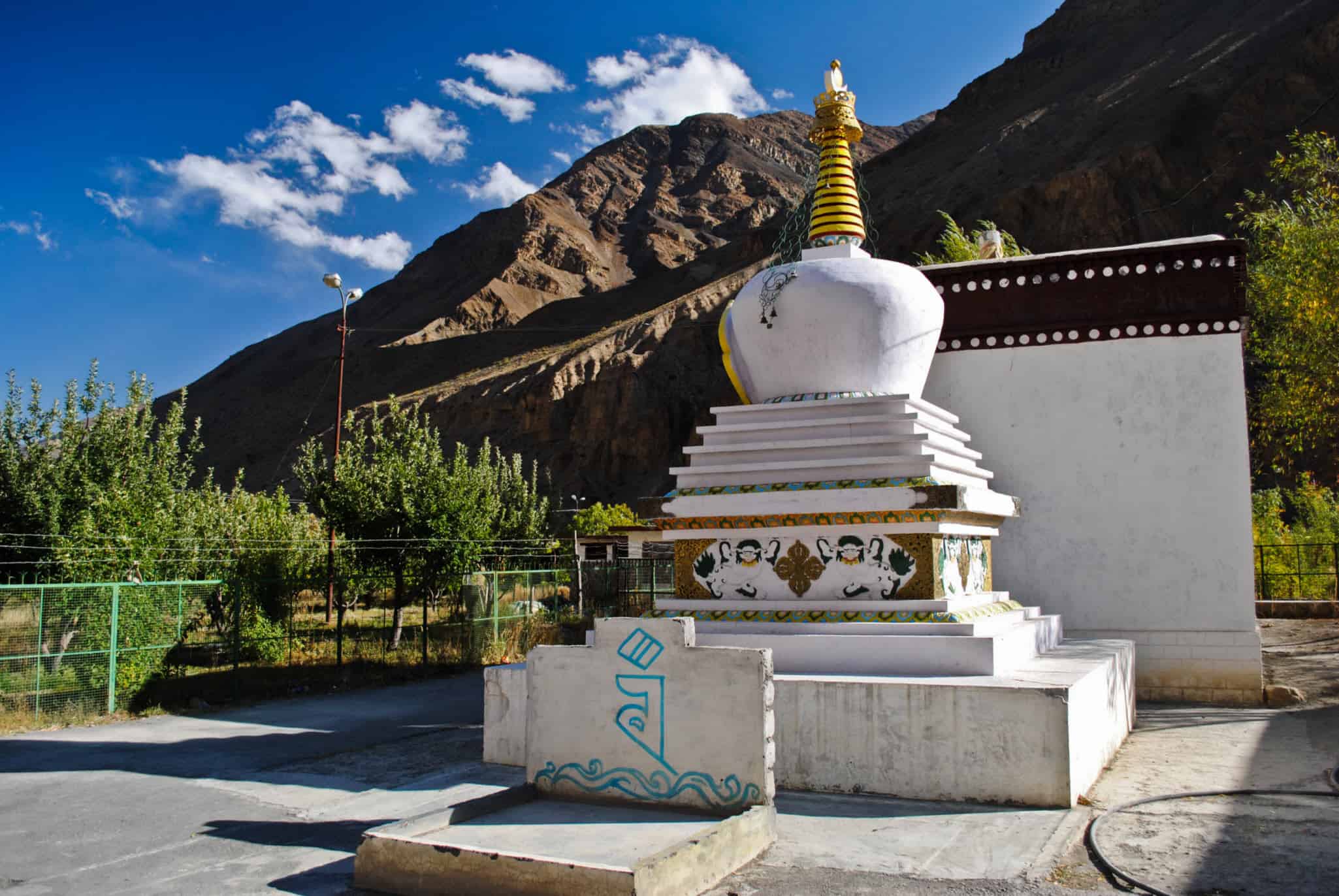
The Tabo Monastery in Spiti Valley was founded in 996 CE by the great Tibetan Buddhist translator Rinchen Zangpo. That makes it over 1,000 years old and the oldest continuously operating Buddhist monastery in India. The complex has 9 temples, 23 chortens, and houses some of the finest Buddhist art in the Trans-Himalayan region, including ancient murals, frescoes, thangka paintings, and stucco sculptures.

Tabo sits at an altitude of about 10,764 Ft (3,280 m) in the cold desert of Spiti. There is no entry fee, and the monastery is open from 6 AM to 5 PM. The mud-brick construction gives the complex a distinctive earthy appearance that blends with the barren landscape around it. The Dalai Lama has expressed his wish to retire at Tabo, which tells you something about the spiritual significance of this place.
If you are doing a Spiti Valley trip via Kinnaur, Tabo is about 47 km before Kaza and makes for a natural stopover. Budget homestays in Tabo village cost Rs 500-800 per night, while mid-range options run Rs 1,500-3,000. I have covered Tabo in more detail in my Tabo, Dhankar, and Pin Valley sightseeing guide. For the best time to plan your visit, check the month-by-month Spiti Valley guide.
What Is the History Behind Kangra Fort?
The Kangra Fort near Dharamshala is believed to be the oldest dated fort in India, with references going back nearly 4,000 years. Spread over a 4 km area, this massive fortification has been ruled by the Katoch dynasty, invaded by Mahmud of Ghazni in 1009 CE, occupied by the Mughals, and later taken by the Sikhs under Maharaja Ranjit Singh. A devastating earthquake in 1905 caused significant damage, and what you see today are the weathered but impressive remains.
Entry fee is Rs 25 for Indian nationals and Rs 300 for foreigners. The fort is open from 9 AM to 6 PM in summer and 9 AM to 5 PM in winter. It is located about 20 km from Dharamshala, and you can easily combine it with a visit to the Masroor Temples (about 35 km further). The fort sits at the confluence of the Banganga and Patal Ganga streams, and the views from the ramparts across the Kangra Valley are worth the visit alone.
Why Should You Visit the Masroor Rock-Cut Temples?
The Masroor Rock-Cut Temples (also called Masrur) near Baijnath in the Kangra Valley are often described as the “Ajanta-Ellora of the Himalayas.” This 8th-century complex of 15 monolithic rock-cut temples was carved out of a single sandstone hill at about 2,500 feet elevation. The temples are in the Nagara style of Indo-Aryan architecture and feature carvings of Lord Shiva, Lord Vishnu, and other Hindu deities.
The entry fee is approximately Rs 25 per person, and the complex is open from 6 AM to 6 PM. The best time to visit is March to May or September to November when the weather is pleasant. The temples suffered damage in the 1905 earthquake (the same one that hit Kangra Fort), and conservation efforts continue under ASI supervision.
Masroor remains one of the most underrated heritage sites in North India. Despite being on the UNESCO tentative list and having ASI protection, it sees far fewer visitors than comparable rock-cut temples elsewhere in India. If you are in the Kangra-Dharamshala circuit, a half-day detour to Masroor is absolutely worth it.
What Can You See at the Viceregal Lodge in Shimla?
The Viceregal Lodge, now the Indian Institute of Advanced Study (IIAS), was the official residence of the British Viceroy of India. Designed by architect Henry Irwin in the Jacobethan style, the 123-year-old building was completed in 1888 during Lord Dufferin’s tenure. The Shimla Conference that led to the Partition of India was held here in 1945.
After Independence, it served as Rashtrapati Niwas until President Dr. S. Radhakrishnan gifted it to house the IIAS. Today, visitors can explore the building and its well-maintained gardens. Entry is approximately Rs 40 per person, and guided tours are available. The lodge sits on the Observatory Hill area of Shimla, about 3 km from the main Mall Road. You can walk or take a taxi.
The building itself, with its teak-paneled interiors, grand fireplaces, and British-era furnishings, feels like stepping back in time. It is one of the finest examples of colonial architecture in the Indian Himalayas.
What Is the Cold Desert Biosphere Reserve?
In a related development, the Cold Desert Biosphere Reserve in Spiti Valley, Himachal Pradesh, was added to the UNESCO World Network of Biosphere Reserves. While this is separate from the World Heritage Sites list, it further highlights the ecological importance of the Spiti region. The Cold Desert covers the Pin Valley and surrounding areas, protecting unique flora and fauna adapted to the harsh Trans-Himalayan conditions, including the snow leopard and the ibex.

This recognition, combined with Tabo’s tentative listing, makes Spiti Valley one of the most culturally and ecologically significant regions in India. If you are planning a Spiti trip, you are not just visiting a beautiful landscape. You are entering a region with serious global heritage value.
Why Have the Tentative List Sites Not Been Inscribed Yet?
This is a question I get asked sometimes. The five Himachal monuments were placed on India’s UNESCO tentative list around 2011, after a preliminary inspection by a UNESCO team. The team asked the Ministry of Cultural Affairs and ASI to address 25 points before formal inscription could happen. As of 2026, the formal inscription has not taken place for any of the five sites.
The process is slow by design. Countries must prepare detailed dossiers, demonstrate conservation measures, and prove “Outstanding Universal Value” (OUV) for each site. India has 70 properties on its tentative list, and the competition for nomination slots is intense. Hence, while the wait continues, the ASI protection and tentative listing still carry significant weight for heritage tourism.
How Can You Plan a Himachal Heritage Circuit?
If you want to cover multiple heritage sites in one trip, here are two practical circuits:
Circuit 1: Shimla – Kangra – Dharamshala (5-7 days)
Start with the Kalka-Shimla toy train ride, visit the Viceregal Lodge in Shimla, then drive to Kangra (about 250 km, 7-8 hours) to see Kangra Fort and Masroor Temples. Combine with a visit to Dharamshala and McLeodganj. My Dharamshala and McLeodganj guide covers the Triund trek and stay options for this leg. This circuit works year-round except during heavy monsoon (July-August).
Circuit 2: Manali – Spiti Valley (10-14 days)
Visit the Hidimba Devi Temple in Manali, then proceed to Spiti Valley via the Manali-Spiti route (open June to October). Visit Tabo Monastery and explore the Cold Desert region. Return via Kinnaur for a complete loop. This is a summer-only circuit due to pass closures.
For those interested in offbeat places in Himachal Pradesh, combining heritage visits with the lesser-known villages and monasteries makes for a deeply rewarding trip that goes beyond the usual tourist circuit.
What Should You Keep in Mind When Visiting Heritage Sites in Himachal?
A few practical tips before you go:
- Photography rules vary. Flash photography is not allowed inside Tabo Monastery (it damages the ancient murals). Kangra Fort and Masroor Temples generally allow photography. Always check before clicking.
- Dress modestly at religious sites. Hidimba Temple and Tabo Monastery are active places of worship. Cover your shoulders and knees.
- Carry cash. Many heritage sites, especially in remote areas like Spiti, do not have card machines. ATMs in Tabo are non-existent (nearest is Kaza or Reckong Peo).
- Hire local guides. At Kangra Fort and Masroor Temples, a local guide makes a big difference in understanding the history. At GHNP, a registered guide is mandatory.
- Respect conservation efforts. These sites are protected for a reason. Do not touch ancient murals, do not carve names on fort walls, and carry your waste back. If you are part of the DwD community, you already know the importance of responsible travel in the Himalayas.
Frequently Asked Questions
How many UNESCO World Heritage Sites are in Himachal Pradesh?
As of 2026, Himachal Pradesh has two confirmed UNESCO World Heritage Sites: the Great Himalayan National Park (inscribed 2014) and the Kalka-Shimla Railway (inscribed 2008 as part of Mountain Railways of India). Five additional monuments remain on India’s tentative list.
Is Tabo Monastery a UNESCO World Heritage Site?
Tabo Monastery is not yet a full UNESCO World Heritage Site. It has been on India’s tentative list since 2011 and is protected by the Archaeological Survey of India. The formal inscription process has not been completed as of 2026, but Tabo remains one of the most significant Buddhist heritage sites in the Himalayas.
What is the entry fee for Kangra Fort in 2026?
The entry fee for Kangra Fort is Rs 25 for Indian nationals and Rs 300 for foreign tourists. The fort is open from 9 AM to 6 PM in summer (April to September) and 9 AM to 5 PM in winter (October to March).
Can you visit the Great Himalayan National Park without a guide?
For day visits to the ecozone areas, you can explore without a guide. However, trekking into the core zone of GHNP requires a registered guide, and permits must be arranged in advance from the Shamshi head office or range offices at Shairopa (Tirthan Valley) or Ropa (Sainj Valley). Entry fee is Rs 200 for Indians and Rs 800 for foreigners.
How do I book tickets for the Kalka-Shimla toy train?
Tickets can be booked through IRCTC website or the IRCTC Rail Connect app. Search for Kalka (KLK) to Shimla (SML). Book at least 15-20 days in advance, especially for the Vistadome coach and during peak season (April to June). One-way fares range from Rs 65 to Rs 630 depending on the class.
Which is the oldest fort in India located in Himachal Pradesh?
Kangra Fort near Dharamshala is considered one of the oldest dated forts in India, with historical references going back nearly 4,000 years. The fort has been ruled by the Katoch dynasty, invaded by Mahmud of Ghazni (1009 CE), and occupied by Mughals and Sikhs. It is spread over a 4 km area and is protected by ASI.
What is the best time to visit heritage sites in Himachal Pradesh?
It depends on which sites you want to visit. The Shimla-Kangra circuit (Viceregal Lodge, Kangra Fort, Masroor Temples) is accessible year-round, best from March to June and September to November. Hidimba Temple in Manali is also year-round. Tabo Monastery in Spiti is only accessible from June to October when the roads are open. GHNP is best visited from April to June and September to October.

Last Updated: March 2026
I hope this guide helps you plan a heritage-focused trip to Himachal Pradesh. These sites represent a side of Himachal that most travelers miss while chasing mountain passes and snowfall. If you have visited any of these heritage sites, I would love to hear about your experience in the comments section. Feel free to share this article with your friends and family who are planning a trip to Himachal Pradesh 🙂 …
In case you want to explore more of Himachal beyond the heritage circuit, check out our guides on offbeat places in Himachal Pradesh and the best time to visit Spiti Valley. For discussions, queries, and finding travel partners, feel free to join the DwD Community.
