


The Chadar Trek is one of the most iconic winter adventures in India, and possibly the world. You walk on a frozen river, the mighty Zanskar, for days in temperatures that can drop to minus 30 degrees Celsius. It is not your typical Himalayan trek. There are no mountain trails here. Instead, you walk on a sheet of ice (called “chadar” in Hindi) that forms over the Zanskar River during the peak of Ladakh’s winter. If this trek has been on your bucket list, this guide covers everything you need to know about the permits, rules, regulations, costs, itinerary, and the latest 2026 status update.
Let's quickly dive into the details:
What Is the Chadar Trek and Why Is It So Famous?
The Chadar Trek follows the frozen Zanskar River from Chilling (or Shingra Koma) to Nerak, a remote village accessible only by this frozen river route in winter. The word “Chadar” literally means “blanket” or “sheet,” referring to the thick ice that blankets the Zanskar River when temperatures plunge in January and February. For centuries, this was the only winter route for the people of Zanskar Valley to reach the outside world. The road from Kargil to Padum in Zanskar gets completely snowed in from November to May, so locals would walk on the frozen river to reach Leh for supplies, medical emergencies, and trade.
Today, the Chadar Trek has become one of India’s most sought-after adventure experiences. Trekkers from across the country and the world come to Ladakh in January and February to walk on this frozen river, camp in caves along the riverbank, and witness the surreal frozen waterfall at Nerak. The total trek distance is approximately 62 to 70 km (one way), and most itineraries span 8 to 10 days including acclimatization days in Leh.
Key Trek Facts at a Glance
| Detail | Information |
|---|---|
| Trek Distance | 62-70 km (one way), ~105 km total round trip |
| Duration | 8-10 days (including Leh acclimatization) |
| Maximum Altitude | 11,100 ft (3,383 m) at Nerak |
| Minimum Altitude | 10,400 ft (3,170 m) at Tsomo Paldar |
| Best Season | January to February |
| Difficulty | Difficult (extreme cold, ice walking) |
| Temperature Range | -10 to -35 degrees Celsius |
| Starting Point | Chilling / Shingra Koma (64 km from Leh) |
| Highlight | Frozen waterfall at Nerak |
Is the Chadar Trek Open in 2026? Latest Status Update
This is the most important update if you are planning your trip. The Chadar Trek 2026 season effectively did not happen. As per The Tribune (January 12, 2026), the administration first delayed the start beyond the usual January 10 window because the river surface had not frozen sufficiently to allow safe movement, and sent an assessment team to inspect the route before taking a final call. The situation never improved. According to a later report by Newsgram (April 2026), the Zanskar River never developed the continuous 30-35 km stretch of solid ice that the route needs, the first time in living memory this has happened, and no partial trekking was permitted for the entire season.
This was not a one-off. The Chadar Trek was also suspended in 2025 for similar reasons, and Ladakh’s own weather data shows winter 2026 was the warmest in the last eight years, with average December-February temperatures around minus 8.6 degrees Celsius, well above historical norms. Local homestay operators and guides in Zanskar felt this directly. Newsgram reported one homestay owner who usually earns close to Rs 3 lakh in a normal Chadar season but received almost no guests in 2026. If you are planning for a future season, keep in mind that the trek’s viability now depends entirely on weather conditions each winter. Always check with the Leh DC office or ALTOA (All Ladakh Tour Operator Association) for the latest status before booking anything, ideally in December once the season’s ice outlook becomes a bit clearer.
What Permits Do You Need for the Chadar Trek?
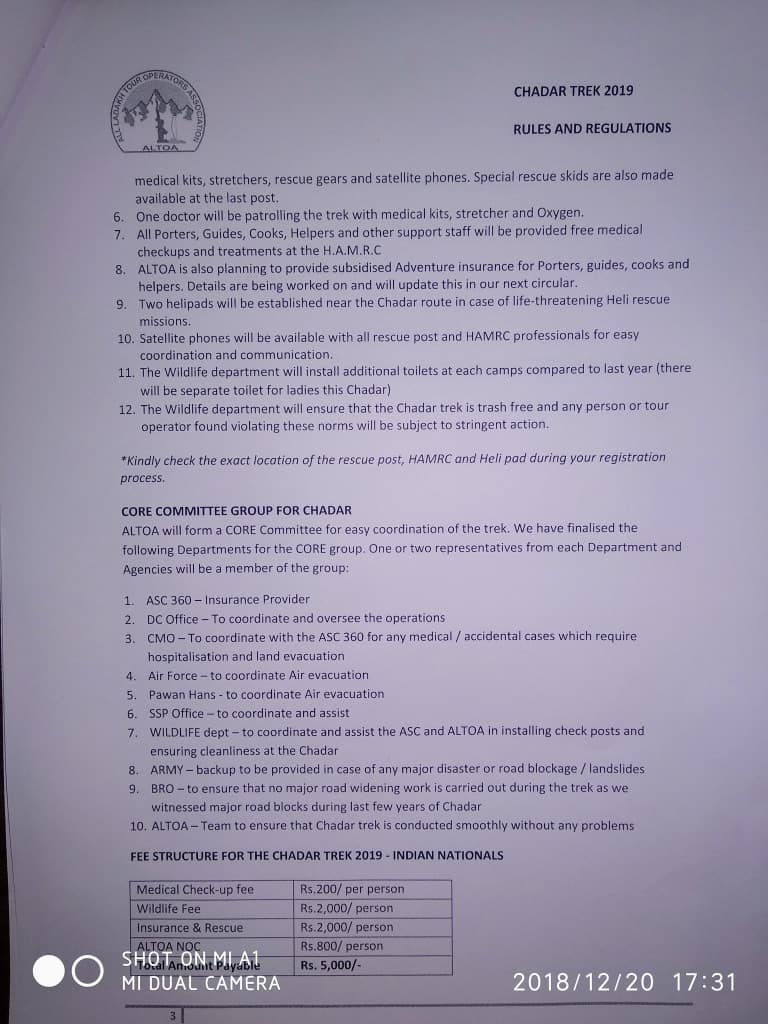
The Chadar Trek requires multiple permits and clearances. Unlike most Ladakh destinations, where Indian tourists only need to pay the online Environment and Development Fee (EDF), the Chadar Trek has a much more rigorous process because it passes through the Hemis National Park area and involves extreme winter conditions. Here is the complete permit breakdown.
1. Wildlife Permit from the Wildlife Department
Since the trek route falls within a protected wildlife zone, you need a permit from the Wildlife Department in Leh. This is the primary trekking permit. Your tour operator typically handles this, but you can also apply at the Tourist Information Center (TIC) in Leh’s main market.
2. ALTOA NOC (No Objection Certificate)
ALTOA, the All Ladakh Tour Operator Association, issues a No Objection Certificate that is mandatory for all Chadar trekkers. This ensures that only registered and authorized operators are conducting treks on the frozen river. If you are going with a registered operator, they will handle this for you.
3. Medical Clearance and Rescue Card
This is a unique requirement specific to the Chadar Trek. On your third day in Leh (after mandatory acclimatization for at least three nights), you must undergo a compulsory medical check-up at the Tourist Information Center. Doctors will check your vitals, oxygen saturation, blood pressure, and overall fitness. If you are found medically unfit, you will not be allowed on the trek. Period. After clearance, you receive a Medical Rescue Card, which entitles you to emergency medical assistance on the trek.
4. Adventure Travel Insurance (ASC360)
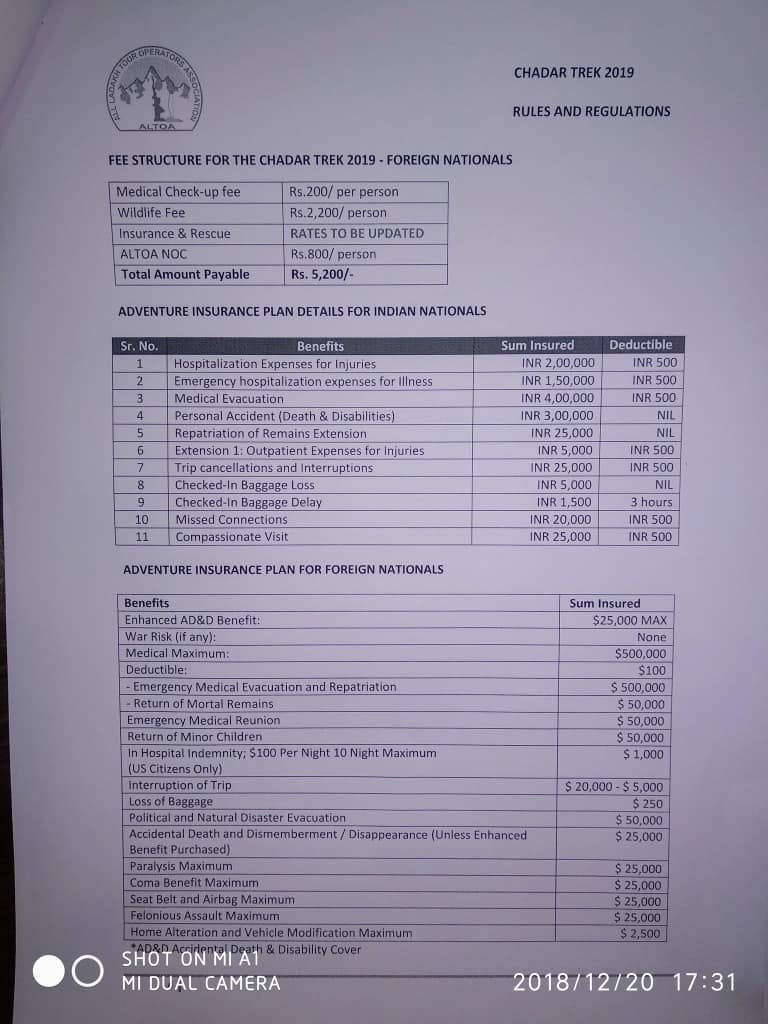
After medical clearance, you must purchase adventure travel insurance from ASC360 (Adventure Sports Company 360), the authorized insurance provider for the Chadar Trek. This insurance covers emergency rescue and medical evacuation. You can purchase it at the TIC in Leh.
Permit Fees for Chadar Trek
The combined cost of all permits, NOC, environmental fees, and wildlife charges comes to approximately Rs 6,000 to Rs 10,000 per person. This amount is paid on the spot at the TIC in Leh. Most tour operators include this in their package cost, but some do not, so clarify before booking. The fee breakdown includes the wildlife permit, ALTOA NOC, LAHDC fee, environmental fee, and the medical check-up and rescue card charges.


What Are the Rules and Regulations for the Chadar Trek?
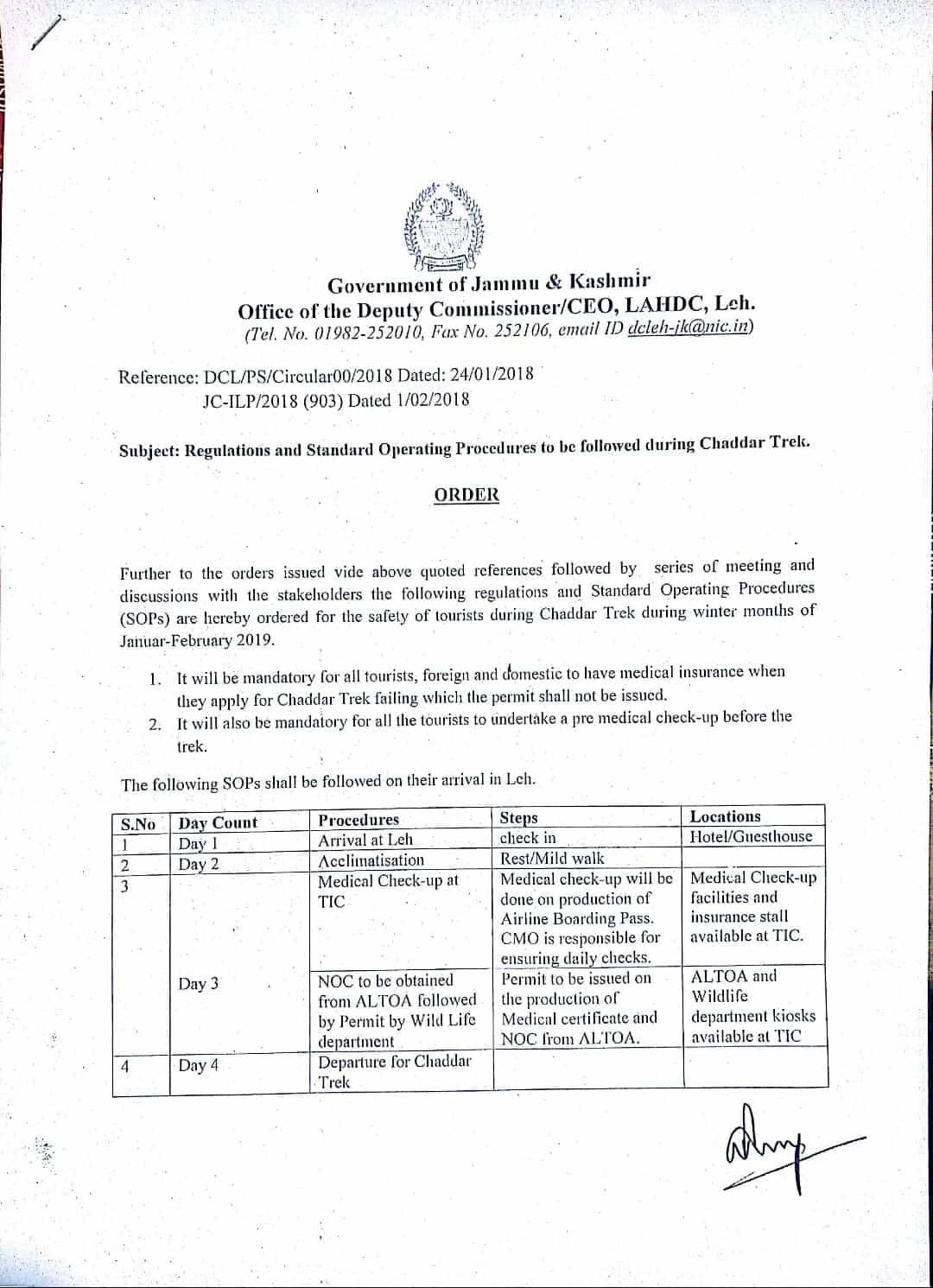
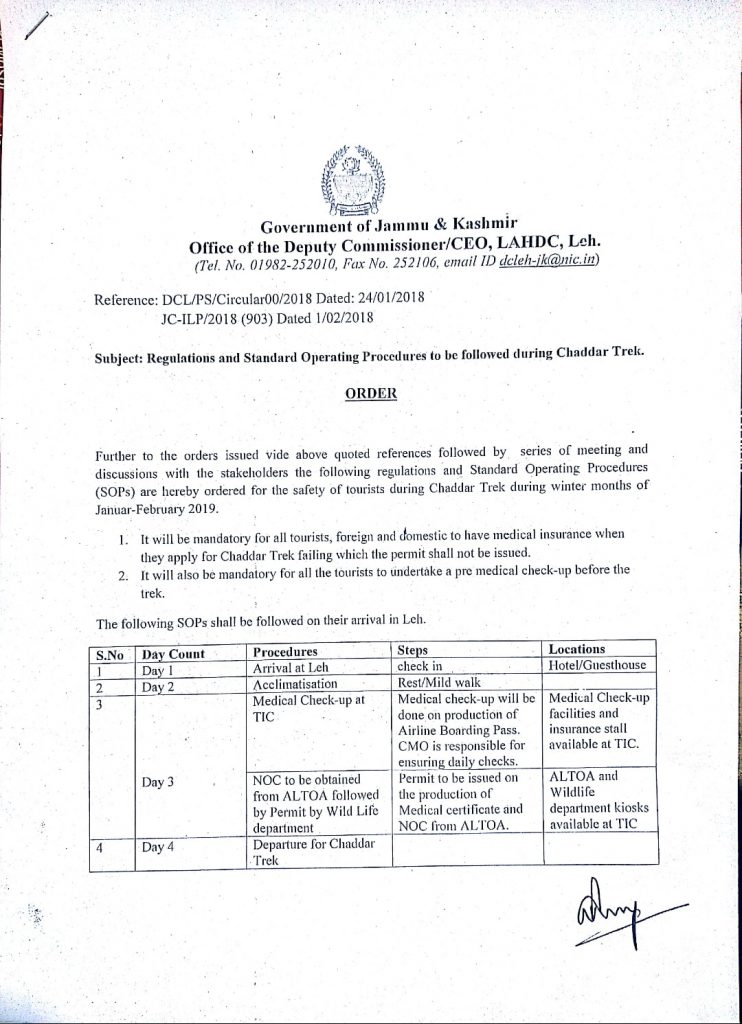
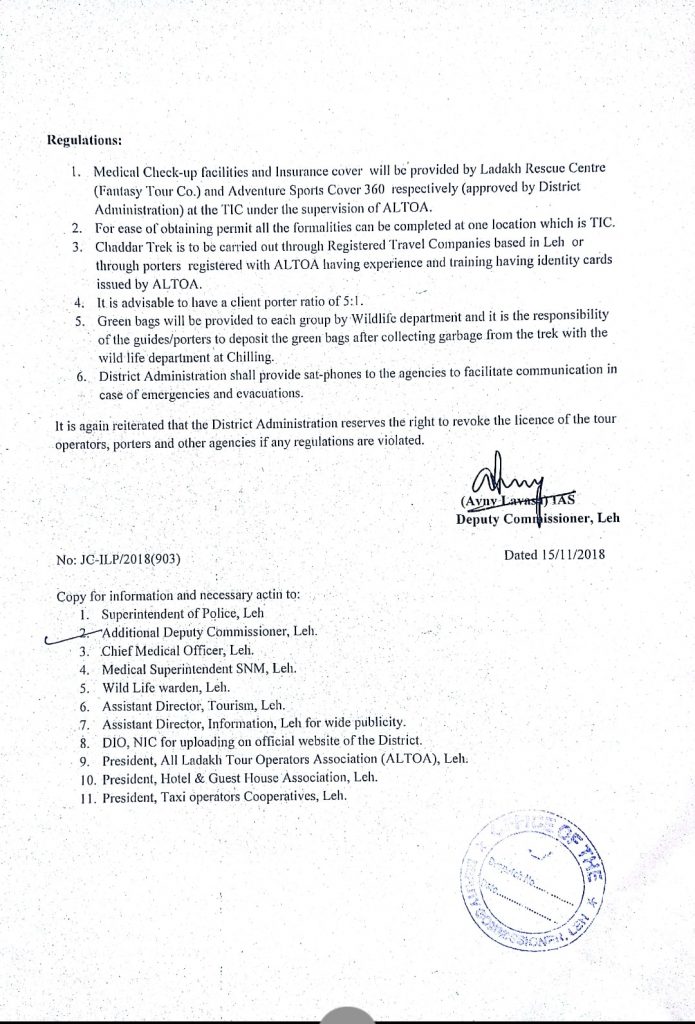
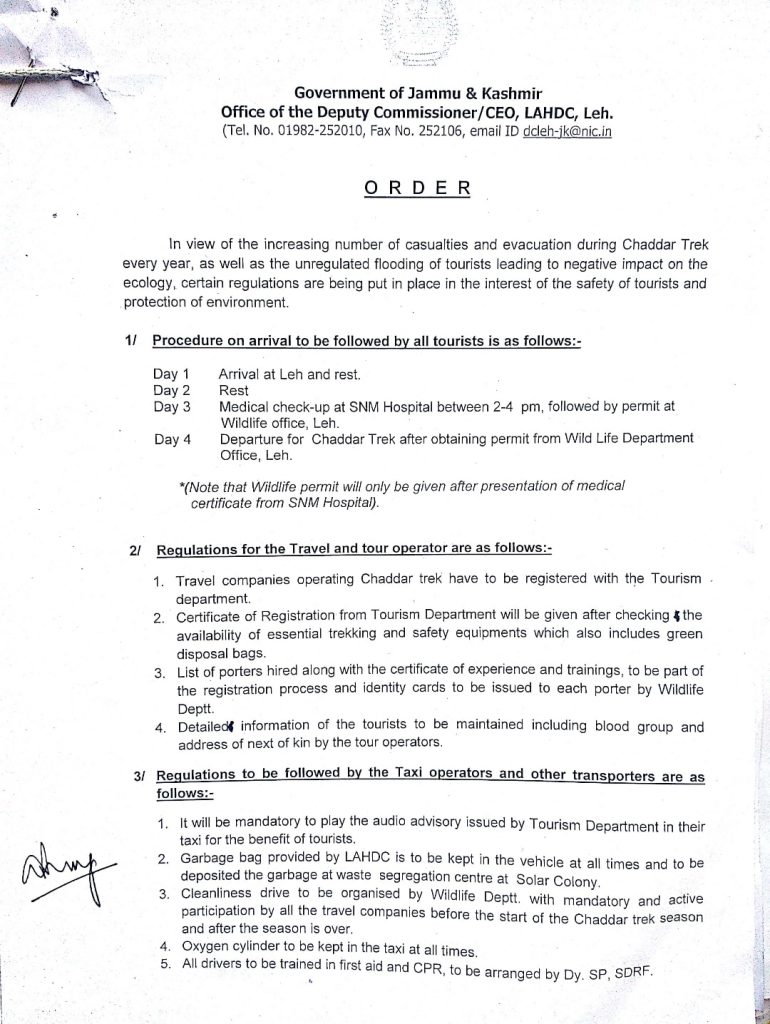
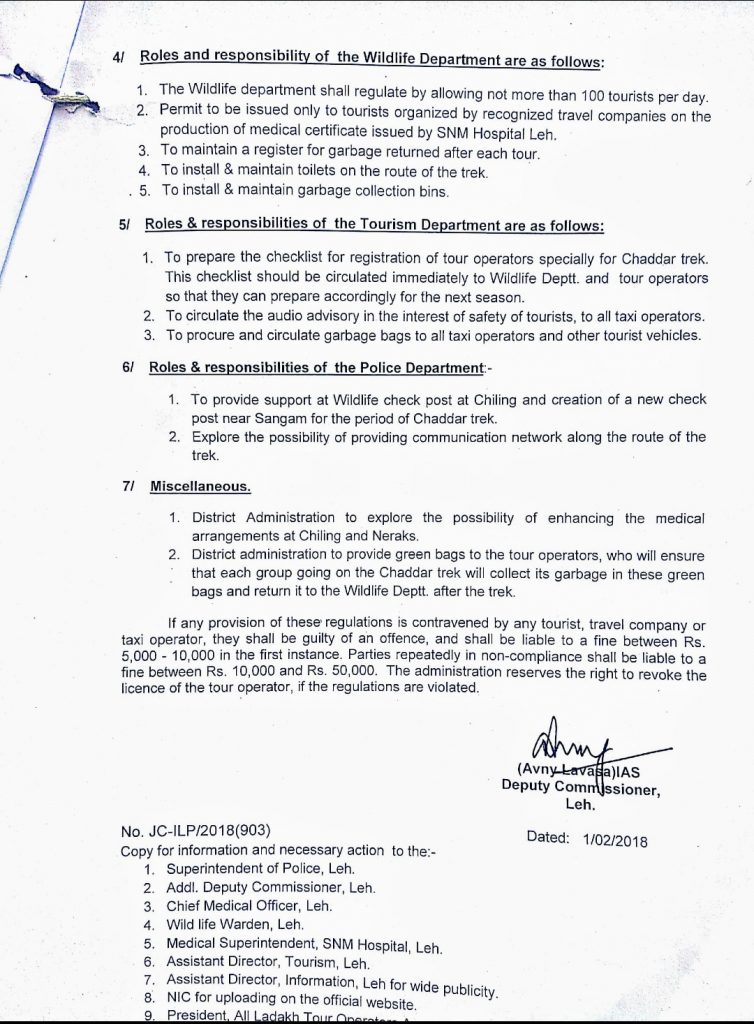
The Leh District Administration has put in place a comprehensive set of rules to protect both trekkers and the fragile ecology of the Zanskar River corridor. These rules were first formalized in 2019 and have been updated since. Here are the key regulations that every trekker must follow.
Mandatory 3-Night Acclimatization in Leh
All trekkers must spend a minimum of three nights in Leh before the trek begins. This is non-negotiable. Since you can only reach Leh by flight in winter (both highways are closed), you arrive at 11,500 ft altitude directly. Your body needs time to adjust. The administration will verify your arrival date using your boarding pass. No boarding pass, no permit. Keep it safe.

Compulsory Medical Check-up on Day 3
On the third day after your arrival, you must undergo the mandatory medical check-up at the TIC. If you fail this test, that is the end of your Chadar Trek. No exceptions. The doctors check for symptoms of Acute Mountain Sickness, heart conditions, blood pressure issues, and overall physical fitness. This rule exists because people have died on the Chadar Trek in the past, and most fatalities were linked to poor acclimatization or pre-existing conditions that went undetected.
Trash Management and Green Bag Policy
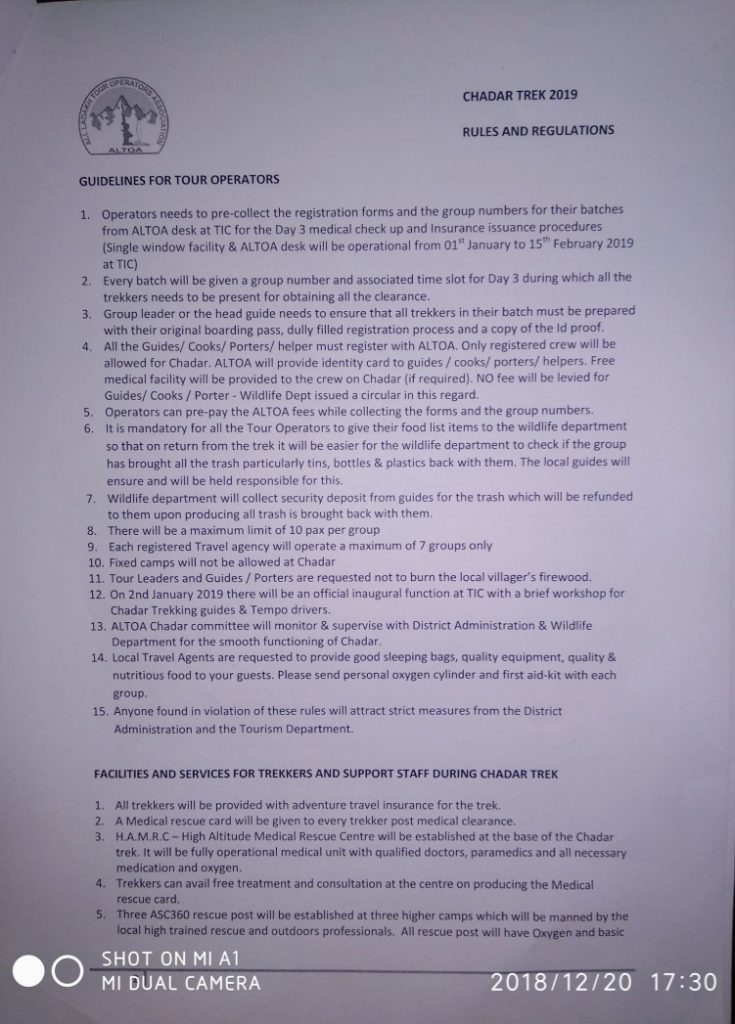
The Zanskar River ecosystem is extremely fragile. After the crackdown on illegal campsites at Pangong Lake, the administration extended environmental protections to the Chadar Trek as well. All authorized tour operators must submit a complete list of rations and food items to the Wildlife Department before the trek. The department issues green bags for trash collection, and a security deposit is collected from the local guide. This deposit is refunded only after verification that all trash, including tins, plastic bottles, and other waste, has been brought back from the trek. The local guide is personally responsible for ensuring compliance.
Only Registered Tour Operators Allowed
You cannot do the Chadar Trek independently without a registered operator. This rule ensures accountability, safety protocols, and environmental compliance. Your operator must be registered with ALTOA and must have the proper permissions from the Wildlife Department.
How to Get Permits for the Chadar Trek? Step-by-Step Process
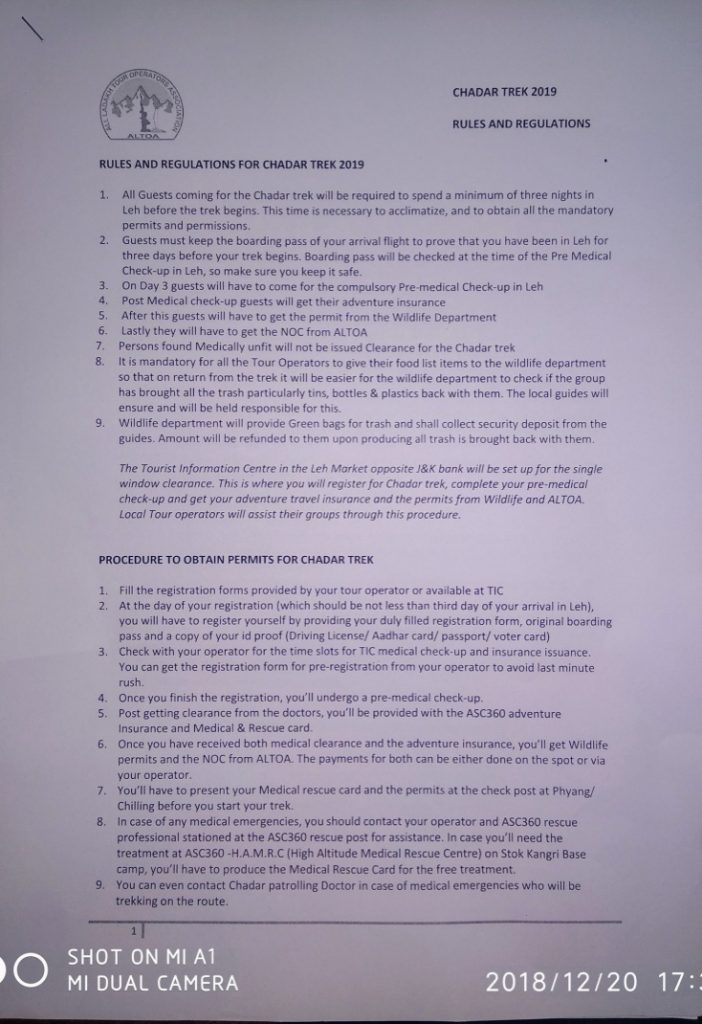
The good news is that the entire permit process happens through a single-window clearance at the Tourist Information Center (TIC) in Leh’s main market, opposite J&K Bank. You do not need to run around to different offices. Here is the step-by-step process.
- Arrive in Leh by flight and keep your boarding pass safe. You will need it as proof of arrival date.
- Spend 3 nights in Leh for acclimatization. Use this time to explore Leh, visit monasteries, and let your body adjust to the altitude. Read our tips for a winter trip to Ladakh for preparation advice.
- On Day 3, visit the TIC with your boarding pass, a filled registration form (your operator provides this, or collect it at TIC), and a copy of your photo ID (Aadhaar, passport, driving license, or voter ID).
- Undergo the medical check-up at the TIC. If cleared, you receive a Medical Rescue Card.
- Purchase adventure travel insurance from ASC360 at the TIC.
- Apply for the Wildlife Permit and ALTOA NOC at the same window.
- Make the payment for all permits and fees (approximately Rs 6,000-10,000). Your operator can handle this payment too.
- Before starting the trek, present your Medical Rescue Card and permits at the check post at Chilling or Phyang.
If you are going through a registered tour operator (which is mandatory), they will assist you through every step of this process. Most operators have a well-oiled system for this, and the entire process typically takes half a day.
What Is the Typical Chadar Trek Itinerary?
The standard Chadar Trek itinerary spans 8 to 10 days, including 3 days of acclimatization in Leh. Here is a typical day-by-day breakdown.
| Day | Plan | Details |
|---|---|---|
| Day 1 | Arrive in Leh | Fly in, rest, begin acclimatization. Stay hydrated, avoid exertion. |
| Day 2-3 | Acclimatization | Explore Leh, visit Shanti Stupa, Leh Palace. Medical check-up and permits on Day 3. |
| Day 4 | Leh to Chilling/Shingra Koma | Drive 64 km on Leh-Srinagar Highway via Nimu. Trek begins on the frozen river. |
| Day 5 | Shingra Koma to Tibb Cave | Walk on the chadar, camp in riverside caves. 14-16 km. |
| Day 6 | Tibb to Nerak | The highlight day. 12 km trek to the famous frozen waterfall at Nerak. |
| Day 7 | Nerak exploration and return | Explore Nerak, then begin return trek to Tibb. |
| Day 8 | Tibb to Shingra Koma | Return walk on the chadar. |
| Day 9 | Shingra Koma to Leh | Drive back to Leh. Celebrate completion. |
| Day 10 | Fly out of Leh | Buffer day in case of flight delays (common in winter). |
Keep in mind that this itinerary can change based on ice conditions. Some days, you might have to take detours on the mountain slope if the chadar has broken in certain sections. Your guide will make the call on such situations. Trust them, they know the river better than anyone.
How Much Does the Chadar Trek Cost?
The Chadar Trek is not a budget trek. The extreme logistics, remote location, winter conditions, and mandatory safety infrastructure make it one of the more expensive treks in India. Here is a cost breakdown for Indian trekkers.
| Expense | Approximate Cost (INR) |
|---|---|
| Tour operator package (7-9 days, all inclusive) | Rs 19,000 – Rs 60,000 per person |
| Return flights to Leh (Delhi-Leh-Delhi) | Rs 8,000 – Rs 20,000 |
| Permits, fees, insurance (if not in package) | Rs 6,000 – Rs 10,000 |
| Gear rental (sleeping bag, gaiters, crampons) | Rs 2,000 – Rs 5,000 |
| Personal expenses (Leh stay, meals, shopping) | Rs 3,000 – Rs 8,000 |
| Total estimated cost | Rs 38,000 – Rs 1,03,000 |
The wide range depends on your choice of operator (budget vs premium), flight booking timing, and whether you need gear rental. If you already own cold-weather trekking gear, you can save a good amount. Book flights early, ideally 2-3 months in advance, as winter Leh flights are limited and prices spike closer to the dates. For a broader understanding of Ladakh trip planning, check our complete Leh Ladakh itinerary guide.
What Happens in Case of a Medical Emergency on the Chadar Trek?
Emergency preparedness is one area where the Chadar Trek administration has done a commendable job. Here is what you should know.
If you face a medical emergency while on the trek, contact your tour operator and the ASC360 rescue professionals stationed at the rescue posts along the route. At Stok Kangri base camp, the administration has established an ASC360 High Altitude Medical Rescue Center (HAMRC). If needed, you can get free treatment at HAMRC by showing your Medical Rescue Card. A patrolling doctor is also usually present on the trek route itself and can be reached through your guide or operator in case of emergency.
The most common medical issues on the Chadar Trek are frostbite, hypothermia, AMS symptoms, and injuries from slipping on ice. Proper gear, adequate acclimatization, and listening to your body are the best prevention. If you feel unwell at any point, tell your guide immediately. The Chadar is no place for heroics.
How Should You Prepare for the Chadar Trek?
The Chadar Trek demands more preparation than most Himalayan treks because of the extreme cold and the unique terrain (walking on ice). Here is what you need to focus on.
Physical Fitness
Start cardiovascular training at least 2-3 months before the trek. Running, swimming, cycling, and stair climbing are all excellent. You will be walking 12-16 km per day on ice while carrying a daypack of about 5-10 kg. Your legs, core, and lungs need to be ready. If possible, do a moderate altitude trek (like Kedarkantha or Brahmatal) a few months before the Chadar as a warm-up.
Essential Gear Checklist
- Sleeping bag: Rated for minus 30 degrees Celsius (most operators provide one, but check quality)
- Down jacket: A heavy-duty down jacket rated for extreme cold
- Thermal layers: Merino wool base layers (top and bottom), mid-layer fleece
- Trekking boots: Waterproof, insulated, with good grip for ice. Gumboots or gaiters for river crossings
- Walking poles: Essential for balance on ice and checking ice thickness
- Crampons or microspikes: For grip on the frozen river surface
- Balaclava and woolen cap: Your face and ears need maximum protection
- Thermal flask: You will drink only hot water during the trek (cold water freezes in your bottle)
- Hand and toe warmers: Chemical warmers that you can slip inside your gloves and shoes
- Sunglasses: Snow blindness is a real risk. UV-protected, wraparound glasses are a must
Walking on Ice: The Penguin Technique
This sounds funny, but it is genuinely important. On the Chadar, you walk like a penguin. Short steps, feet flat, minimal lifting of your feet off the surface. This gives you maximum contact with the ice and reduces the chance of slipping. Your guide will demonstrate this on Day 1. Also, always use your walking poles to test the ice ahead of you, especially near the edges of the chadar where the ice tends to be thinner.
How Do You Reach Leh for the Chadar Trek?
Since the Chadar Trek happens in January-February, both the Manali-Leh Highway and the Srinagar-Leh Highway are closed due to heavy snowfall. The only way to reach Leh in winter is by flying into Kushok Bakula Rimpochee Airport in Leh. Multiple airlines operate flights from Delhi, with some seasonal connections from Mumbai and Bengaluru.
Winter flights to Leh are limited and frequently delayed or cancelled due to weather. Always keep a buffer day in your itinerary (both at the start and end) to account for flight disruptions. Book refundable or flexible tickets if possible. Morning flights generally have a better track record for on-time arrivals.
Is the Chadar Trek Under Threat from Climate Change?
This is a question that needs honest discussion. The answer is yes. The Chadar Trek’s future is uncertain because the Zanskar River’s freezing patterns have become increasingly unreliable. In 2025, the trek was postponed due to non-formation of ice. In 2026, it was suspended again for the same reason, and this time no partial trekking happened at all. This is not a one-off anomaly anymore. Rising winter temperatures in Ladakh, reduced snowfall, and changing weather patterns are all contributing to a shorter and less reliable freezing season. There is also a more unusual factor at play. Newsgram’s April 2026 report on the cancellation noted that debris from the ongoing construction of the Nimmu-Padum-Darcha all-weather road, the very project meant to finally give Zanskar year-round road connectivity, has been entering the Zanskar River and disrupting fragile ice formation. There is a real irony in that: the same infrastructure being built to end Zanskar’s winter isolation may also be one of the reasons the frozen river that once was its only winter lifeline is struggling to form.
For the people of Zanskar, the Chadar was not a tourist attraction. It was their lifeline, their winter highway to the outside world. Its degradation impacts livelihoods, tourism income for guides and porters, and the cultural heritage of the region. If you do get the opportunity to walk the Chadar in a future season, treat it with the respect it deserves. Follow every rule, leave no trace, and support local communities. For more on Ladakh’s environmental challenges, read our article on the environmental crisis at Pangong Lake.
Practical Tips for Planning Your Chadar Trek
- Book early: Popular operators fill up by September-October for the January-February season. Do not wait until December.
- Verify trek status: Always check with ALTOA and the Leh DC office for the latest status. Do not rely solely on operator websites.
- Carry cash: There are no ATMs on the trek. Carry enough cash for personal expenses in Leh and any spot payments for permits.
- Mobile network: There is no mobile network on the Chadar. BSNL and Jio work in Leh city, but once you are on the river, you are disconnected. Inform your family about this beforehand.
- Photography: Camera batteries die fast in extreme cold. Keep spare batteries inside your jacket (body heat) to extend their life.
- Hydration: You must drink hot water throughout the day. Dehydration at altitude in extreme cold is a silent killer. Your operator will provide hot water at camps. Fill your thermal flask every morning.
- Respect the ice: Do not wander off from the group. Do not jump on the ice. Do not go near the edges unless your guide says it is safe. The Zanskar is a living, shifting river underneath that ice.
If you are planning a winter trip to Ladakh beyond the Chadar Trek, we have a detailed winter itinerary guide that covers Leh sightseeing, road conditions in January, and other winter experiences you can combine with your Chadar plan.
Related Reading
- Most Common Itinerary for Leh Ladakh
- How to Plan a Trip to Zanskar Valley
- 6 Special Tips for a Winter Trip to Ladakh
- AMS Prevention and Acclimatization Guide
- Flying to Leh Ladakh: What You Should Know
Frequently Asked Questions
Is the Chadar Trek safe for beginners?
The Chadar Trek is not recommended as a first trek. While the altitude is moderate (10,400-11,100 ft), the extreme cold (minus 20 to minus 35 degrees Celsius), ice walking, and remote location make it physically and mentally demanding. Ideally, you should have completed at least 2-3 Himalayan treks before attempting the Chadar. That said, if you are reasonably fit and prepared, it is doable as a challenging first high-altitude experience.
When is the best time for the Chadar Trek?
The Chadar Trek window is typically mid-January to mid-February, when the Zanskar River freezes solid enough to walk on. Late January to early February tends to offer the most stable ice conditions, though this varies every year. Always confirm with your operator and the Leh DC office before finalizing dates.
Can women do the Chadar Trek?
Absolutely. Many women complete the Chadar Trek every season. Reputable operators ensure separate tent arrangements and maintain appropriate male-to-female ratios in groups. The trek demands fitness, not gender. If you are physically prepared and mentally ready for the cold, go for it.
What if the Chadar breaks during the trek?
If the ice breaks or becomes too thin in certain sections, your guide will take the group on an alternate route along the mountain slopes above the river. This is called “going off the chadar.” It is more strenuous than walking on ice but is a standard part of the experience. Your guide monitors ice conditions constantly and makes safety decisions in real time.
Do I need to carry my own tent and sleeping bag?
Most operators provide tents and sleeping bags as part of their package. However, the quality of sleeping bags varies. If possible, carry your own sleeping bag rated for minus 30 degrees Celsius, or at minimum, carry a sleeping bag liner for extra warmth. Your operator will handle tent setup, cooking, and camp logistics.
Is there any phone network on the Chadar Trek?
No. Once you leave Leh and enter the Zanskar gorge, there is zero mobile network coverage. You will be completely off the grid for the duration of the trek (5-7 days on the river). BSNL and Jio work in Leh city, and Airtel has recently expanded to Leh as well. Inform your family that you will be unreachable during the trek.

Will the Chadar Trek happen in future years given climate change?
The future of the Chadar Trek is uncertain. The trek has been suspended in both 2025 and 2026 due to insufficient ice formation on the Zanskar River, and 2026 was the first season in living memory when the required 30-35 km continuous ice stretch never fully formed. Climate change, plus construction debris from the under-progress Nimmu-Padum-Darcha all-weather road, are both affecting ice formation. While the trek may still operate in years with sufficiently cold winters, it is no longer a guaranteed annual event. If the Chadar is on your bucket list, attempt it when the opportunity arises rather than postponing indefinitely, and always confirm the season’s status with ALTOA or the Leh DC office each December before booking flights.
That is all the information you need to plan your Chadar Trek. If you have any questions about permits, preparation, or anything related to winter travel in Ladakh, feel free to drop a comment below or reach out to us through our Discover with Dheeraj community on Facebook. Our community has several members who have completed the Chadar and can share their firsthand experience 🙂
Last Updated: August 2026

2 Comments
Comments section gets closed in 90 days. To ask your travel questions, you can follow my YouTube Channel for a faster reply or for a much slower reply follow me on Instagram. :)
We, a group of four people are planning chadar trek aroung 12th of January. Is it necessary to go through a tour operator?
We wanted to plan and do the trek on our own to make it more natural and enjoyful and ofcourse bearing more degree of risk. We’ll ofcourse obtain all permits and insurance and try to be as safe as possible. Can this be done?
M in d same boat dude…9999032661
Contact me over whats app